News
Clarence Thomas discloses trips paid for by GOP donor as justices report financials

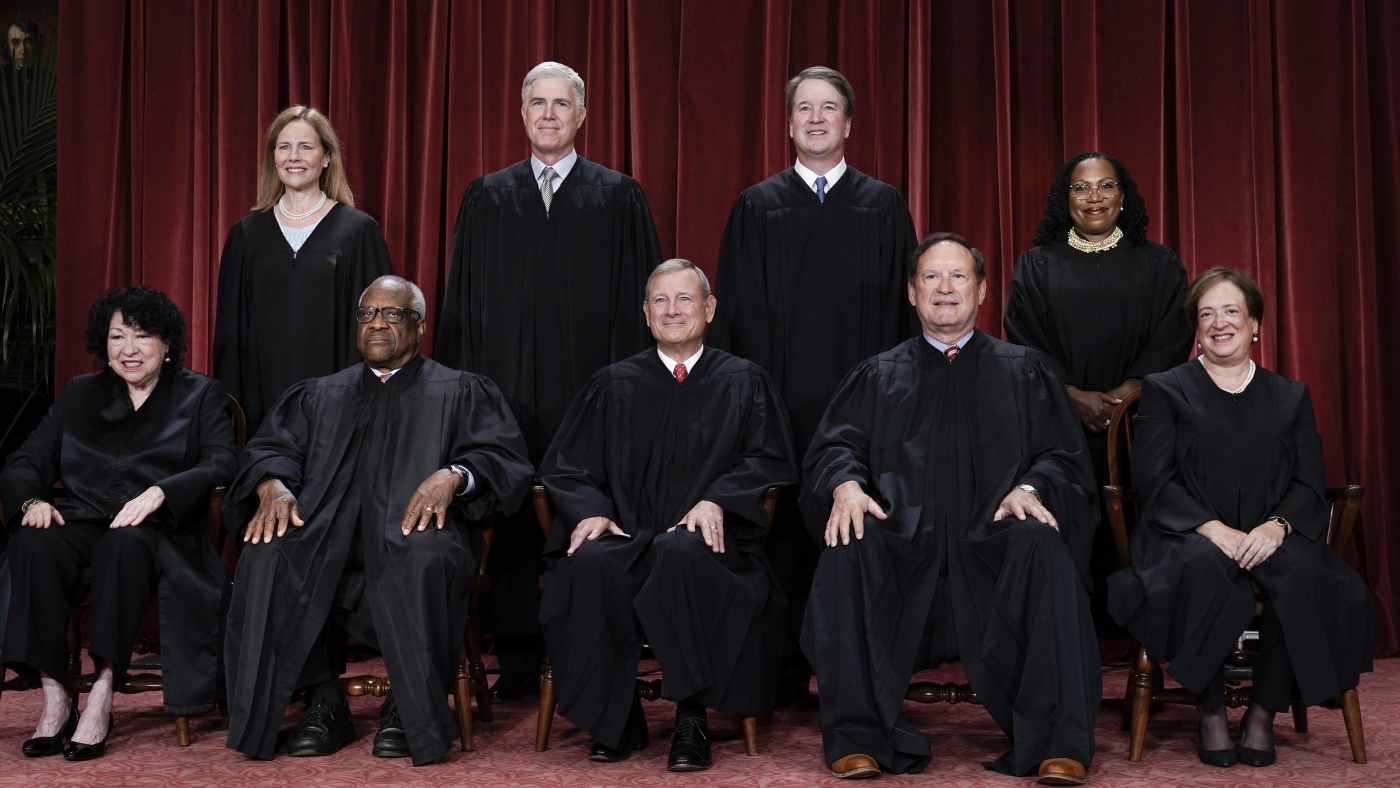
Members of the Supreme Court sit for a new group portrait following the addition of Associate Justice Ketanji Brown Jackson, at the Supreme Court building in Washington, D.C., on Oct. 7, 2022.
J. Scott Applewhite/AP
hide caption
toggle caption
J. Scott Applewhite/AP
WASHINGTON — Justice Clarence Thomas on Friday belatedly acknowledged more travel paid by Republican megadonor Harlan Crow, while several colleagues reported six-figure payments as part of book deals.
Thomas, who has faced criticism for failing to report luxury trips paid for by Crow and others over many years, said in his annual financial disclosure that, in 2019, Crow paid for a hotel room in Bali, Indonesia, for a single night, and food and lodging at a private club in Sonoma County, California. He did not report any travel paid by others last year.
The disclosure on Indonesia is curious for what it omits: the rest of the trip. ProPublica reported last year that Thomas flew to Indonesia on Crow’s private jet and then boarded his superyacht for an islands tour, one of many trips Crow has given to Thomas and his wife, Ginni, over the years.

Another justice, Ketanji Brown Jackson, reported eye-popping numbers, a nearly $900,000 advance for her upcoming memoir, and attention-grabbing gifts, four tickets to a Beyoncé concert valued at $3,700 from the singer herself.
Jackson was one of four Supreme Court justices who reported sizable income from book deals. Justice Brett Kavanaugh reported being paid $340,000 by the conservative Regnery Publishing company. The company was sold and the book is to be published by an imprint at Hachette Book Group, according to Axios, which also reported this week that Kavanaugh’s book will deal with his contentious confirmation hearing that included allegations of sexual misconduct, which he has denied. The court confirmed Friday that the justice is writing a legal memoir.
Justices Neil Gorsuch and Sonia Sotomayor reported royalty income of $250,000 and nearly $90,000, respectively.
In their day jobs, the justices are being paid $298,500 this year, except for Chief Justice John Roberts, who earns $312,200.
The only justice whose report was not available Friday is Samuel Alito, who received an extension for up to 90 days, as he does most years. The justice has separately been under scrutiny over flags that flew outside homes he owned. He has said they were raised by his wife.

Jackson, the first Black woman on the nation’s highest court, signed a book contract soon after taking her seat in 2022. The book, “Lovely One,” is to be published in September.
The total value of her book deal has not been publicly disclosed, but it is expected to rival if not exceed what Sotomayor was paid for her memoir, “My Beloved World,” more than $3 million.
Among the current justices, only Roberts, Alito and Justice Elena Kagan have so far not cut book deals. Thomas received a $1.5 million advance, stunning at the time, for his 2007 book, “My Grandfather’s Son.” Justice Amy Coney Barrett in 2022 reported receiving $425,000 for a yet-to-be-released book, part of a reported $2 million deal she signed soon after joining the court in 2020.
The disclosures paint a partial picture of the justices’ finances, as they are not required to reveal the value of their homes or, for those who are married, their spouses’ salary.
The justices adopted an ethics code in November, though it lacks a means of enforcement. The code treats travel, food and lodging as expenses rather than gifts, for which monetary values must be reported. Justices aren’t required to attach a value to expenses.
In March, the federal judiciary began requiring judges to disclose travel-related gifts and their values — rather than reporting such gifts as reimbursements. The justices say they generally abide by the same rules, but Thomas did not disclose the cost of the Bali hotel.
Some Democratic lawmakers are continuing to press legislation that would require the court to adopt a binding code of conduct and provide for investigations of alleged violations. But the prospect for such legislation is considered remote in a closely divided Congress.
Only two justices reported receiving gifts last year. Thomas said he was given two photo albums worth $2,000 by Terrence Giroux and his wife. Giroux is the executive director emeritus of the Horatio Alger Association.
Jackson received artwork for her Supreme Court office worth $12,500. And then there were the Beyoncé tickets, worth more than $900 a pop. Beyoncé performed two concerts in the Washington area in August 2023, though Jackson’s disclosure does not say when or where the tickets were for.
“Justice Jackson is Crazy in Love with Beyonce’s music,” Supreme Court spokeswoman Patricia McCabe said, invoking a Beyoncé song. “Who isn’t?”

News
As Supreme Court expands Trump’s immigration power, experts warn of steeper U.S. population decline

President Trump holds up a bill funding immigration enforcement after signing it in the Oval Office of the White House, Wednesday, June 10, 2026, in Washington.
Julia Demaree Nikhinson/AP
hide caption
toggle caption
Julia Demaree Nikhinson/AP
Even before the Supreme Court ruled Thursday that President Trump has broad power to deport hundreds of thousands of migrants living legally in the U.S. under temporary protected status, David Bier feared the U.S. was slipping toward a demographic cliff.
“We’re destined to be there, in short order, there’s no question,” Bier said. “We’re already seeing a situation where most counties in the United States had more deaths than births.”
An expert on population and immigration at the libertarian Cato Institute, Bier believes the U.S. is beginning to look more like China, Italy and South Korea — nations that face rapid aging and population decline are seen as a crisis.

U.S. birthrates have been declining for decades. There are far too few children born each year to maintain a stable population.
Until last year, high rates of foreign immigration largely offset that trend. But for the first time since the 1930s, during the Great Depression, the U.S. now faces record low birthrates and low numbers of migrants at the same time.
“Our higher birthrates of a century ago are not coming back. There’s no way to have a sustainable fiscal and economic situation that doesn’t involve immigration,” Bier said.
Trump’s legal fight to end temporary protected status for hundreds of thousands of Haitians, Syrians and others living in the U.S. legally is only one part of a wider administration effort to squeeze immigration.
The Supreme Court also ruled this week that the administration has authority to block most asylum seekers from entering the country. Federal agents have also conducted raids in cities across the U.S., to accelerate deportations.
Last month, Trump issued an executive order that could make it harder for many migrants living in the U.S. without full legal status to use banking and financial services.
Many immigration opponents see these changes as progress. In a statement following this week’s Supreme Court decisions. A spokesman for the Federation for Immigration Reform said Trump should have full authority to direct who enters the U.S.
“Our immigration laws are written to be pro-enforcement, not anti-enforcement,” said FAIR’s Christopher Hajec.
But according to Cato’s Bier, Trump’s policies are already reshaping the demographics of communities, meaning there are fewer workers, consumers, taxpayers, and children in schools.
“If you’re not allowing immigration, you’re going to have [an aging and] a declining population and that creates all kinds of problems,” Bier said.
Economists say that without migrants, the number of young workers paying into Social Security will fall more rapidly; schools in many areas will close; and the number of young families having children will decline.
Census data already shows big changes to U.S. population
The immigration decline under Trump is dramatic. In 2024, roughly 2.7 million foreign migrants entered the U.S., according to the Census Bureau. This year, census experts predict that number could drop as low as 300,000. Some demographers believe the U.S. may be reaching a point where more migrants are leaving than entering.

Impacts of this massive shift on America’s wider population are already emerging. Studies by the Census Bureau, the Congressional Budget Office, and the Federal Reserve all point to a more rapidly aging national population under Trump.
Population growth in the U.S. fell by half in 2025 from the previous year, with five states losing population. Census data shows the total number of young Americans, those under age 25, is already falling nationwide.
William Frey, a demographer at the liberal-leaning Brookings Institution, described last week’s Supreme Court rulings as “alarming.” He believes without robust foreign immigration, more states will quickly see their populations stagnate or decline.
“Not just in big immigration states, but in places that have relatively small numbers of immigrants, you know, Iowa, Kansas, Nebraska — those states require immigrants to get any population growth,” Frey said.
Even before Trump’s policies curbed immigration, the U.S. population was expected to decline later this century. Experts say low immigration rates will cause that downward trend to happen much sooner.
According to Frey, the U.S. has time to reverse course. But he believes the Trump administration is committed to lowering both legal and illegal immigration over the long term, a policy he described as dangerous.
“This is as clear as the nose on your face,” he said. “You’ve got to have this growth in the younger population if you’re going to survive. Immigration is a key part of that going forward.”
“America’s doors are closed”

Stephen Miller, White House deputy chief of staff for policy, speaks with reports at the White House, Thursday, June 25, 2026, in Washington.
Jacquelyn Martin/AP
hide caption
toggle caption
Jacquelyn Martin/AP
The Trump administration sees this very differently, describing foreign migrants not as people who sustain state populations and economies, but as a social burden and a threat.
“America’s doors are closed fully to asylum seekers,” Stephen Miller, one of Trump’s top White House policy advisors, said on Thursday.
Speaking with reporters, Miller described the Supreme Court rulings as a victory and said ending birthright citizenship for the children of migrants born in the U.S. is the next step.
“This country doesn’t have a future if we don’t end birthright citizenship,” Miller said. Justices are expected to rule on birthright citizenship as early as next week.
This kind of opposition to both legal and illegal immigration is now widespread among conservatives, said Cato’s David Bier, who worked as a Republican congressional staffer on immigration policy.
He told NPR that when he talks to conservatives about the economic and demographic risks of closing the country’s doors to migrants, many answer with a cultural argument. “[They] would rather have a declining population of ‘true Americans’ than have an economy kept afloat by people who don’t share [their] values,” Bier said.
But if extremely low or zero-level immigration does become the new normal for the U.S., experts say it would swiftly remake the fabric of the country. The Census Bureau estimates that without robust migration in the coming years, total population loss by the end of this century could exceed 107 million people.

UTAH COUNTY, Utah (ABC4) — Utah County has declared a state of emergency.
According to an announcement from the Utah County Commissioner Skyler Beltran, the county is in a dire position due to the extensive wildfires in the area and high fire risk.
The announcement states that declaring the State of Emergency will allow the county to access additional resources, and notes there is no imminent threat to Utah County residents.
“We have utilized a tremendous amount of our resources (very early in the traditional fire season schedule) responding to the Iron Fire and continue to face ongoing recovery concerns,” the statement read. “This was even before the Maple Peak and Cherry fires, which have now merged and are moving toward the Iron Fire.”
The Iron Fire, which started last week, has burned over 40,000 acres. Around 22,830 of those acres were in Utah County. Reportedly, the county has limited resources available to help those who are evacuating from Juab County, including the 600 residents in the Town of Eureka.
Due to the influx in evacuees, the Utah County Commission says that more resources are necessary to help the evacuation shelters in Elberta, Utah. Additionally, due to the Iron Fire and other wildfires, Utah County is facing immense repair needs to avoid future flooding, loss of homes, and disruption to local economies and ecosystems.
There is “imminent threat” to public safety due to the damage.
The commission also asks the public to be vigilant when handling heavy equipment, using campfires or barbecues, and discharging fireworks, to avoid preventing fires.
Their statement added, “Our firefighters are exhausted, our resources are stretched thin and we are in a very vulnerable position.”
News
A day after Alito’s testy response to Sotomayor’s dissent, court says it was a ‘misunderstanding’

The justices of the U.S. Supreme Court, with Justice Sonia Sotomayor (seated left) and Justice Samuel Alito (seated second from right).
Alex Wong/Getty Images
hide caption
toggle caption
Alex Wong/Getty Images
As the Supreme Court heads into the announcement of its final and hugely important opinions next week, there are reverberations from this week’s announcements, and Justice Samuel Alito’s public rebuke of his colleague Justice Sonia Sotomayor.
On Thursday, Justice Alito summarized from the bench three very big opinions he authored for the court’s six justice conservative majority. Alito, unlike most of his colleagues, doesn’t spend much time on these summaries. And it is rare that a justice has three big opinions to announce, but it is almost the end of the term, and there are a lot of big cases still outstanding.
The first case he announced came and went. Alito then moved on to a second case, this one tests whether migrants may apply for asylum in the U.S. by going to one of several ports of entry along the U.S.-Mexican border, and presenting themselves for admission. This entails presenting documents that persuade an asylum officer that applicants’ fear of persecution in their home country is credible enough to allow them to enter the U.S. while their asylum application is processed. Alito’s opinion ruled in favor of the Trump administration’s policy of refusing all such applicants by blocking them at the border. It was a policy also followed at one time by the Obama administration until it was blocked by the lower courts.
After Alito finished his summary of the opinion, he paused, at which point Justice Sotomayor read a summary of her contrary views in dissent. When she finished, however, Justice Alito did not move on to the announcement of his third opinion. Instead, he did something that nobody in the press corps ever remembers happening before. Looking much as if he had just bitten into a lemon, Alito said, “There is much that I would have added to my bench statement had I known there would be a dissent read.” And he then went on to a short extemporaneous rebuttal.
What caused the hissy fit? Did Sotomayor really fail to tell him she would have an oral dissent? That really would have been a breach of the court’s practices. A justice typically notifies the chief justice and the author of the majority opinion in writing if there is to be an oral dissent.
In response Friday to an inquiry from NPR came this terse statement from the court’s public information office.
“Justice Alito was notified in advance by Justice Sotomayor’s chambers that she would be reading a dissent from the bench. It was a misunderstanding on Justice Alito’s part.”
-

 Utah53 seconds ago
Eight fires sparked by lightning overnight near Utah border, growing Jones Fire billowing smoke
-

 Vermont8 minutes ago
Rockwell was ‘At Home in Vermont’ – VTDigger
-

 Washington11 minutes ago
The Washington Capitals Select Tyus Sparks | Washington Capitals
-

 Virginia11 minutes ago
Southwest, Central Virginia Weather | 6 p.m. – June 27, 2026
-

 Wisconsin23 minutes ago
These natural attractions in Wisconsin are worth a visit this summer
-

 West Virginia26 minutes ago
History Made: WVU Has Two First-Team All-Americans in the Same Season
-

 Wyoming31 minutes ago
Wyoming Cultural Trust Fund awards $529K in grants, including several Fremont County projects
-

 Crypto38 minutes ago
Sharplink Breaks 8-Month ETH Drought With Silent $18M Buy Through FalconX

