Midwest
Wisconsin Gov. Evers signs off on massive child tax credit expansion

- Democratic Wisconsin Gov. Tony Evers signed into law Monday a Republican-authored bill drastically expanding the state’s childcare tax credit.
- The new law expands the Badger State’s childcare tax credit to 100% of a claimant’s federal credit.
- Evers greenlit the doubling of the state’s previous limit because “the cost of child care is too darn high,” according to a post on X, formerly Twitter.
Democratic Gov. Tony Evers signed a Republican-authored bill Monday that dramatically expands the state child care tax credit, days after vetoing three other GOP bills that would have delivered $800 million in tax cuts.
The governor posted on X, the social media platform formerly known as Twitter, that he signed the child care measure because “the cost of child care is too darn high.”
The median child care cost last year in Milwaukee County, the state’s most populous county, was $19,096, equivalent to about 26% of the median family income of $62,314, according to the U.S. Department of Labor. The cost last year in Dane County, the state’s second-most populous county, was $19,586, equivalent to about 17.6% of the $94,813 median family income.
WISCONSIN GOV. EVERS SIGNS DEER HUNT LICENSE PRICE HIKE INTO LAW
The bill expands the state child care tax credit to 100% of the claimants’ federal child care tax credit. Currently filers can claim only 50% of the federal credit on state taxes. The amount of maximum eligible expenses under the state credit would grow from $3,000 to $10,000 for one qualifying dependent and from $6,000 to $20,000 for two or more dependents.
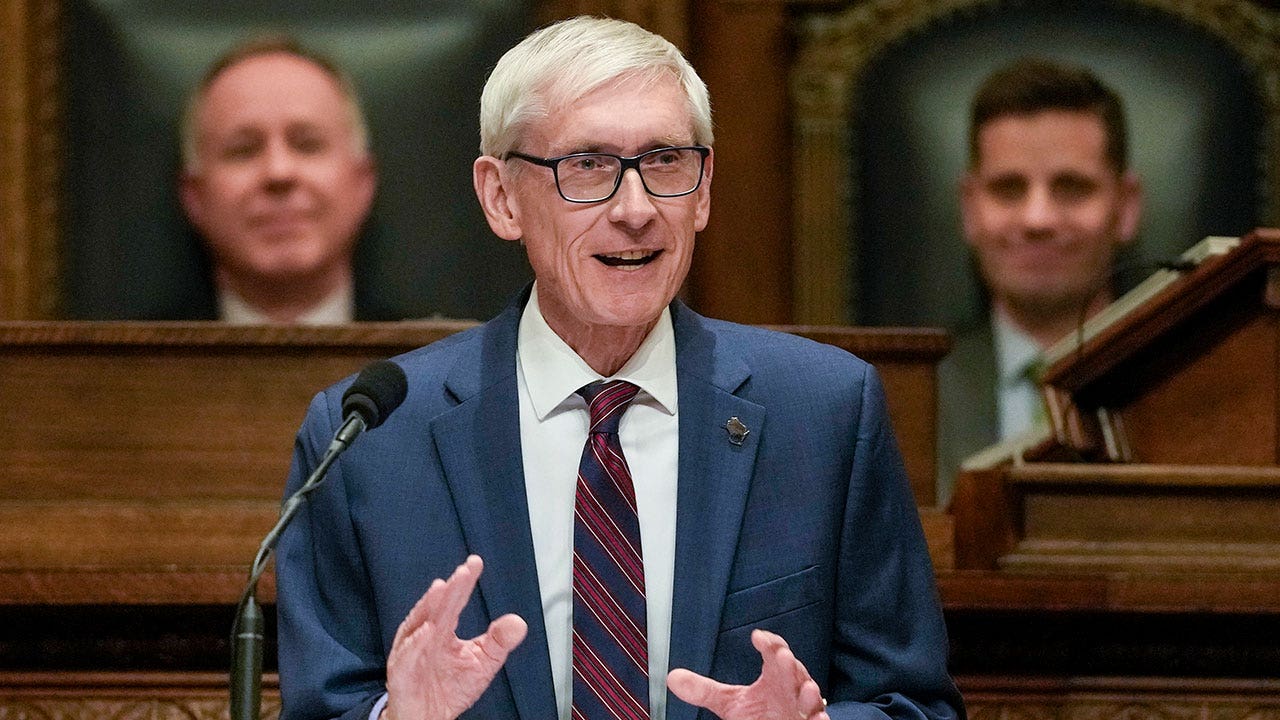
Wisconsin Gov. Tony Evers gives his annual State of the State address on Jan. 23, 2024, in Madison, Wisconsin. (AP Photo/Morry Gash)
The move is expected to cost the state about $73 million in annual revenue, according to the state Department of Revenue.
The measure was part of a package of tax cuts Republicans introduced in January. The legislation included the child care tax credit expansion; a bill that would have expanded the state’s second income tax bracket to cover higher earners, resulting in at least $750 million in income tax savings annually, according to legislative fiscal analysts; a bill that would have increased the marriage tax credit; and a bill that would have increased income exemptions for retirees.
Fiscal analysts projected that taken together the four bills reduced state tax revenue by $2 billion in 2024-25 and about $1.4 billion every year thereafter.
Evers vetoed all the bills except the child care tax credit expansion on Friday, saying the cuts would drain the state’s reserves.
Evers vetoed a similar GOP tax cut plan in November. Republicans lumped all the proposals into a sweeping omnibus bill during that go-around. This time they broke the plans into separate legislation.
The governor also used his partial veto powers in July to reduce a $3.5 billion income tax cut plan the GOP included in the state budget to just $175 million, which equated to a $3- per-month reduction for the average taxpayer.
Read the full article from Here


The Brewers drafted 20 players over the course of 20 rounds in the 2026 MLB Draft, including first-round shortstop Trey Ebel, second-round outfielder Sawyer Strosnider, Wilmot Union HS (Wisconsin) shortstop Chance Ruby, and CC Sabathia’s son, first baseman Carsten Sabathia III. The team now has until 4 p.m. CT on July 27 to sign each draft pick. We’ll keep track of the signees below.
Milwaukee’s total signing bonus pool is $8,042,900, which can be allocated as the team chooses (i.e., slot bonuses are not the guaranteed signing value). Rounds 11-20 automatically have $150,000 allocated to the slot — money given to these picks only counts toward the bonus pool if they exceed $150,000. Teams that exceed their bonus pool face financial penalties, with higher thresholds resulting in the loss of future picks.

A halt on the construction of data centers in Minneapolis took effect in July after the Minneapolis City Council discussed the need for more time to understand the facilities’ potential environmental impacts.
The Council approved the halt through November by an 8-5 vote in May. Members said the halt allows time to study the environmental impacts of data centers and plan their development more conscientiously.
However, Council members not in favor of the halt said it will result in reduced tax revenue and may drive away businesses willing to invest in downtown Minneapolis.
Data centers are not new to the Minneapolis area, but community concerns have grown in recent months, President of Minnesota Building and Construction Trades Council Dan McConnell said.
“Data centers have been around for decades,” McConnell said. “They’re not new. There just seems to all of a sudden be this hysteria around data centers.”
Celeste Robinson, policy aide to Minneapolis Council member Robin Wonsley, said the city should not rush the process because of the potential environmental trade-offs compared with the promised economic benefits. She said the halt could be extended to allow a full 12 months of analysis.
Robinson said the Council’s halt on data centers allows for a more thorough evaluation of their impacts.
“I think that there’s a misconception that the City Council being deliberative and taking the time to do it right. I think that there’s been a portrayal that that’s somehow a bad thing,” Robinson said.
Robinson said, although data centers are often seen as an investment, there is no evidence the developments generate the economic benefits for communities that supporters claim they do. She said the Council wants to determine what resources they would potentially take from the city.
“It is corporations who see land, fresh clean water, and electric grids that they can use for their profit, and that those profits get moved out of state to shareholders,” Robinson said. “They are not reinvested in our community, and so a lot of the rhetoric around data centers has really been about unverified claims around them being a source of investment.”
The American Federation of Labor and Congress of Industrial Organizations’ website claims that data centers are a staple for the modern job market and help to create more jobs, but labor protections for workers and regulations to protect surrounding communities are needed.
Resolution 7, a plan created by the AFL and CIO, outlines labor protections for data center employees and regulations aimed to protect surrounding communities. The plan calls for legislation that would require data centers to conserve water and energy. It seeks transparency from data center operators, union labor agreements and policies requiring data center operators to pay their share of energy and water costs.
In recent years, a lack of development in Minneapolis has seen a decline in commercial property value, leaving a shortfall of about $50 million in expected commercial property tax to fall onto the shoulders of residents, according to the Minneapolis Times. To help offset that shortfall and alleviate the burden that was placed on residents, Minneapolis must find new sources of revenue, Council member Elizabeth Shaffer said.
Some believe data centers, often being large-scale commercial developments, can relieve these financial pressures. Shaffer said the data center located in the Sleep Number headquarters in downtown Minneapolis has had a positive financial impact on the city.
“The Sleep Number building increased its valuation to eight times what it was a year ago because of a data center,” Shaffer said. “That helps relieve the property tax burden that residents and apartment owners have been feeling.”
When property values increase, property tax revenue also increases, helping Minneapolis generate revenue and address its estimated $50 million deficit, Shaffer said.
Robinson said data centers are not the only way for Minneapolis to generate revenue within the city.
“Council member Wonsley has been looking at how do we tax the rich, how do we put fees on real estate transfers for extremely high-value real estate,” Robinson said. “There are so many things that the city council can be doing to bring in new revenue to shift the property tax burden off of working-class people, that is not related to letting big tech corporations build data centers.”
Indianapolis, IN
Quiet and comfortable tonight with the heat gradually returning this week | July 12, 2026

TONIGHT
Mostly clear and pleasantly mild by July standards, with lows falling into the mid to upper 60s. A northeast breeze around 5 to 10 mph gradually diminishes overnight. It is a great evening for taking a walk, sitting outside, or simply opening the windows for a while before the more typical summer warmth returns.
TOMORROW

Sunny and warmer, with highs reaching the upper 80s. A light northeast breeze around 5 to 10 mph keeps the day from feeling too humid, and this looks like another dependable summer day for outdoor plans. After the active and occasionally stormy weather of the past week, central Indiana gets a nice stretch of quiet weather to begin the workweek.
TOMORROW NIGHT
Mostly clear and a little warmer, with lows settling into the upper 60s. Winds become light overnight, and there are no meaningful weather concerns. The warmer nighttime temperatures are the first hint that a hotter pattern is beginning to build.
TUESDAY
Mostly sunny and hot, with highs around 90 degrees. A light east to southeast breeze develops during the afternoon, and humidity becomes a little more noticeable. It is still a very usable summer day, but if you have plans that involve being outside for long periods, make sure to have plenty of water nearby.
TUESDAY NIGHT
Mostly clear and increasingly muggy, with lows holding in the low 70s. There will be noticeably less overnight relief than earlier in the week, and air conditioners will be working a little harder by daybreak Wednesday.
WEDNESDAY
Sunny and hot, with highs climbing into the low 90s. A light southwest breeze develops in the afternoon, and rising humidity may push heat index values into the upper 90s. For those heading downtown for events, concerts, or the Indiana Fever home game Wednesday evening, it will be one of those classic midsummer days where the heat sticks around well into the evening hours.
WEDNESDAY NIGHT
Mostly clear and warm, with lows near 72 and a light southwest breeze. The hot and somewhat muggy pattern remains firmly in place overnight, with very little cooling after sunset.
THURSDAY
Partly sunny, hot, and more humid, with highs again in the low 90s. A light southwest breeze continues, and there may be just enough instability for an isolated afternoon shower or thunderstorm. Most places stay dry, but this begins the transition toward a slightly more unsettled pattern heading into the end of the week.
7 DAY FORECAST
The quiet weather pattern continues through midweek, but temperatures steadily climb from the upper 80s Monday to the low 90s by Wednesday and Thursday. Humidity also returns, making it feel closer to 100 degrees at times during the afternoons. Rain chances remain very low through Wednesday before isolated storm chances begin creeping back into the forecast Thursday and Friday. The biggest story this week is not severe weather, but rather the return of summer heat and humidity across central Indiana.
-

 Denver, CO2 minutes ago
Nuggets sign former Denver West basketball player Alpha Diallo out of EuroLeague
-

 Seattle, WA8 minutes ago
Portland aims to top Seattle’s 405 e-bikes with 2-mile Guinness record ride and party
-

 San Diego, CA14 minutes ago
Top-ranked Jannik Sinner beats Alexander Zverev to win Wimbledon again
-

 Milwaukee, WI20 minutes ago
MLB Draft 2026: Milwaukee Brewers Draft Signing Tracker
-
Atlanta, GA26 minutes ago
Atlanta officials ‘throw out homeless tents and medicine’ near World Cup spot
-

 Minneapolis, MN32 minutes ago
Minneapolis City Council halts new data center developments until November
-

 Indianapolis, IN38 minutes ago
Quiet and comfortable tonight with the heat gradually returning this week | July 12, 2026
-

 Pittsburg, PA44 minutes ago
Pittsburgh Pirates Select Incoming Tennessee Baseball Transfer Outfielder In MLB Draft | Rocky Top Insider


