Midwest
Tim Scott tells MAGA voters Trump ‘is on the ballot’ as GOP fights to grow Senate majority in 2026

NEWYou can now listen to Fox News articles!
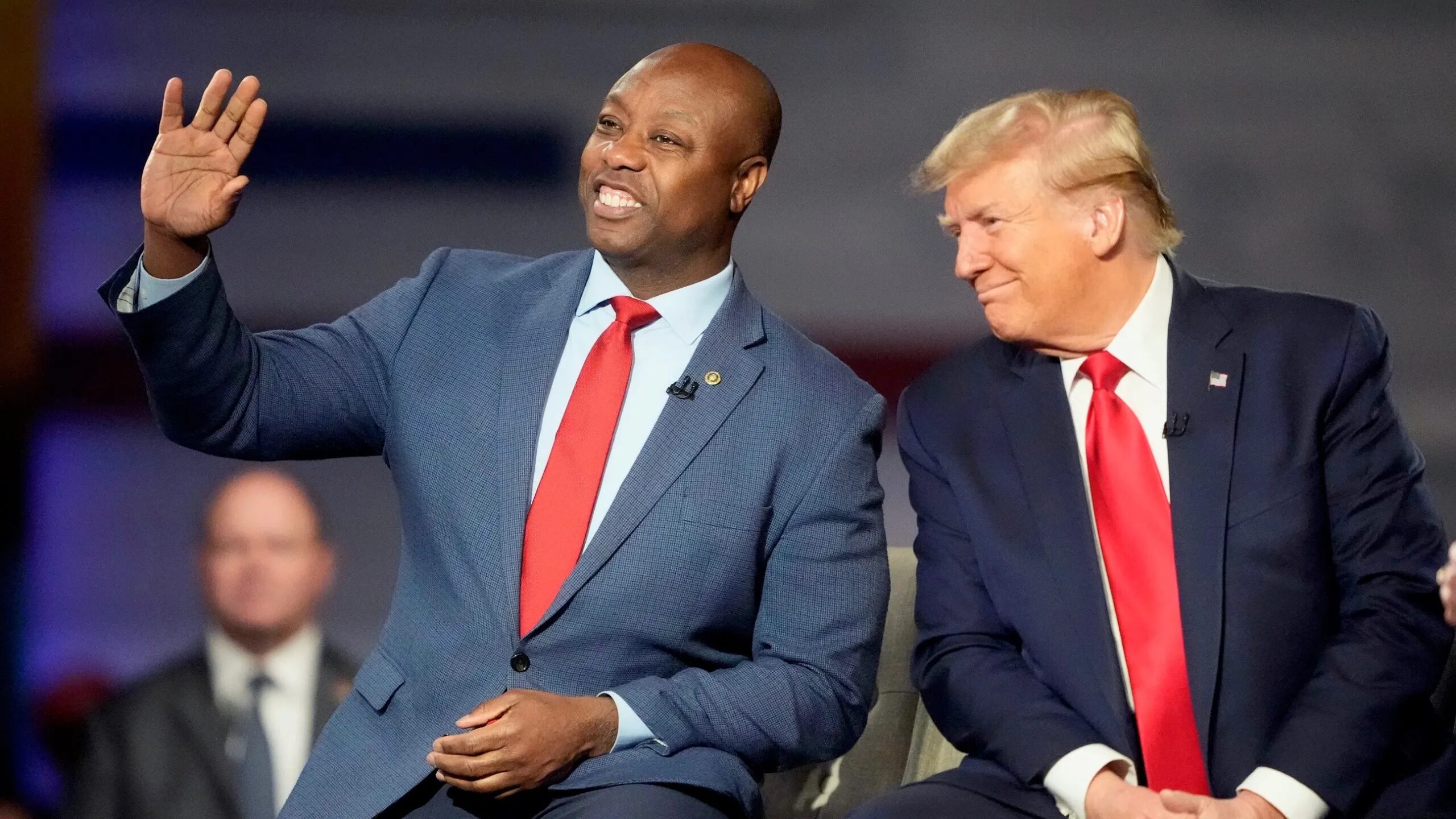
As he aims to not only defend but expand the GOP’s 53-47 Senate majority in next year’s midterm elections, Sen. Tim Scott has a message for MAGA voters who don’t always go to the polls when President Donald Trump’s name isn’t on the ballot.
“Donald Trump is on the ballot, and that’s why he’s been so active around the country,” Scott, the chair of the National Republican Senatorial Committee (NRSC) said this week in a Fox News Digital interview.
Scott, a Republican from South Carolina and Trump ally, said, “I look forward to seeing the president on the campaign trail across this country.”
And the president appears to be delivering.
WHATLEY: ‘THE PRESIDENT AND HIS LEGACY’ ON 2026 BALLOT
Former RNC Chairman Michael Whatley, a 2026 U.S. Senate candidate, is greeted onstage by President Donald Trump, at a campaign event, Friday, Dec.19, 2025, in Rocky Mount, N.C. (Alex Brandon/AP Photo)
Trump on Friday night held the second leg of his affordability tour during a stop in battleground North Carolina, home to what is shaping up to be one of the most crucial, combustible, and expensive Senate battles next year.
“We’re certainly going to need him to be on the ballot,” former Republican National Committee Chair Michael Whatley told Fox News Digital, as he pointed to Trump.
THE GOP’S TAKE ON HIGH-PROFILE SENATE DEMOCRATIC PRIMARIES: ‘THEY’RE IN SHAMBLES’
Whatley, the Trump-backed clear frontrunner for the GOP Senate nomination in the 2026 race to succeed retiring Republican Sen. Thom Tillis of North Carolina, joined Trump at Friday night’s event.
“When you think about what happens if we lose the House, if we lose the Senate, if the Democrats take over, and they go right back to investigations and hoaxes and impeachments, that is really, truly the president and his legacy are going to be on the ballot,” Whatley emphasized.
Trump and Republicans spotlighted rising prices as they swept to major victories in 2024, retaking the White House and Senate and holding their majority in the House.
But with inflation remaining persistent, Democrats have been laser focused this year on the issue of affordability, which fueled their decisive victories in last month’s 2025 elections and their overperformances this year in a slew of special elections.
But Scott predicts the tide will turn.
“I’ve said 2026 is a year of affordability, and the great news is President Trump has been producing time and time again,” he touted.
Pointing to the tax cut provisions in the GOP’s sweeping domestic policy measure signed into law this past summer by Trump, Scott said “2026 is shaping up to be the year where Donald Trump’s activities, his actions, the legislation we’ve passed, shows up for the American voter. And consumers all across the country will see a more affordable economy because of President Trump and the Senate majority and the House majority in the hands of the Republican Party.”
GOP SENATE CAMPAIGN CHIEF AIMS TO EXPAND 2026 MAP IN THIS BLUE-LEANING STATE
Lauren French, communications director at Senate Majority PAC, the top Senate Democrat-aligned outside group, told Fox News Digital that “even Tim Scott is occasionally right — 2026 will be the year of affordability.”
But taking aim at the GOP narrative, French argued that affordability will continue to grab top billing with voters “because Americans can’t afford Donald Trump and Republican policies that continue to drive up the cost of groceries, basic goods, and, right now, Christmas presents.”
“The out-of-touch insistence from the GOP that the economy is thriving proves they don’t understand what working families are facing, which is probably why Democrats won or dramatically overperformed in every contested election this year,” she emphasized. “2026 will be no different as Democrats continue to put forward real plans to address the cost-of-living crisis.”
There are 35 Senate seats up for grabs next year, including special elections for GOP-held seats in Florida and Ohio. Overall, Republicans are defending 22 of the seats.
But the map of competitive races is much smaller.
Scott reiterated that open Democrat-held seats in battleground Michigan and swing state New Hampshire are two of the NRSC’s top targets, along with Sen. Jon Ossoff in battleground Georgia, whom Republicans consider the most vulnerable Democrat seeking re-election next year.
4 KEY SENATE SEATS REPUBLICANS AIM TO FLIP IN 2026 MIDTERMS TO EXPAND THEIR MAJORITY
The NRSC chair is also eyeing blue-leaning Minnesota, where the Senate GOP campaign arm is working to recruit former professional football sideline reporter turned political activist and commentator Michele Tafoya, who is inching closer to jumping into the race.
“We’re excited about expanding our map, and Minnesota is one of the target states that we’re looking at,” Scott said. “We see real reasons to be optimistic. President Trump was very close in Minnesota. It’s a four-point race. We know with the right candidate, we will be successful.”
Apparently pointing to Tafoya, Scott suggested Republicans are likely to land “a strong candidate in the race,” and teased “wait and see” for “better news.”
Scott will likely be playing defense in Texas, where there’s currently a nasty three-way GOP Senate primary, as well as in North Carolina, Maine and Ohio.
Asked his prediction for next year, Scott said “54 is clearly within our grasp right now, but with a little bit of luck, 55 is on our side.”
CLICK HERE TO DOWNLOAD THE FOX NEWS APP
But the rival Democratic Senatorial Campaign Committee (DSCC) sees it differently.
“While Democrats have expanded the map and created a path to flip the majority in 2026, Senate Republicans are facing a string of embarrassing recruitment failures and messy primaries — and their toxic agenda of health care cuts and price spikes for hardworking Americans will cost them at the ballot box,” DSCC spokesperson Joe Bush told Fox News Digital.
Read the full article from Here



Publicly funded stadium deals can involve questionable incentives for politicians. The megaprojects bill in Illinois would drive up neighbors’ property taxes.
Any deal between Illinois and the Chicago Bears for a new stadium must avoid giveaways to lawmakers and property tax increases for others.
The Bears own the former Arlington Park Racecourse in Arlington Heights and have said they’re also considering Northwest Indiana for a stadium development. A bill in the Illinois General Assembly would offer property tax breaks to such “megaprojects.”
Agreements for publicly funded stadiums in other cities often have included luxury suites and free tickets for lawmakers. Local officials in Kansas City have been criticized for getting access to tickets and suites during ongoing stadium negotiations. Officials in Arizona have repeatedly used free access to publicly funded stadiums to host guests.
A bill in Ohio would prohibit state lawmakers from knowingly accepting free or discounted tickets to pro sports events. The proposal comes amid negotiations with the Cleveland Browns over public funding for a new stadium.
Offering free admission and luxury suites to lawmakers who make decisions about publicly funding stadiums creates a clear conflict of interest.
From a taxpayer perspective, such perks can divert public resources if lawmakers have an incentive to offer a team or other megaproject a tax break when that revenue could go toward broadly shared public benefits. From a free-market standpoint, these arrangements distort competition by subsidizing select teams and projects rather than encouraging municipalities to make themselves attractive for private investment.
Illinois legislators should ensure that any stadium agreement with the Bears does not include free tickets or luxury accommodations for lawmakers.
Perks for politicians are only half the story. The proposed incentive package in Springfield, HB 910 House Amendment 1, would be devastating for taxpayers.
Much of the current discussion revolves around the massive property tax reductions the bill would provide for so-called megaprojects as an attempt to spur economic development.
While negotiating targeted tax incentives is bad policy to begin with, the legislation would make Illinois’ property tax crisis even worse for other taxpayers. Although approved megaprojects would pay steeply discounted property taxes, a clause in the bill allows a taxing body to count the cash value of the megaproject in its total assessed value.
In other words, taxing bodies can still increase taxes as if the project were paying normal tax rates, generating increased revenue, but the project would not pay those higher taxes. Neighboring businesses, homeowners and renters would pay more to make up for the team’s discount.
Here is some of what’s in the bill, which has passed out of committee and could be called for a full House vote any time:
- To qualify, a project must have at least $500 million in eligible costs, which can include the property purchase and can be retroactive up to five years before the megaproject certificate is issued. The project must be completed within seven to 10 years, but that can be extended by five years. The site must be operated for at least 20 years; the tax incentive would last at least 23 years and up to 40 years.
- The megaproject’s assessment would be frozen so that its property tax bill is calculated on the “base year” of the project, meaning the value of the property before any improvements, such as a stadium.
- However, for purposes of issuing bonds and property tax extension limitation calculations, the taxing body could use the current fair cash value of the property. In other words, new development, which is generally exempt from Property Tax Extension Limitation Laws, would allow for the levy to grow beyond the limited rate, which other taxpayers will have to cover.
The bill’s “incentive agreement” allows for separate payments from the megaproject entity, such as the Bears, or an alternative source, to affected taxing bodies in addition to property taxes bill. The payment amount would be negotiated with taxing bodies.
Illinoisans already pay the highest property taxes in the nation. Homeowners in Arlington Heights pay average annual property taxes of more than $8,000. HB910 would make it even worse. One simple solution is to strike this language from the bill:
“Projects to be valued at fair cash value for purposes of bonded indebtedness and limitations on property tax extensions. Projects to which an assessment freeze applies pursuant to this Division shall be valued at their fair cash value for purposes of calculating a municipality’s general obligation bond limits and a taxing district’s limitation on tax extensions.”
Removing that language would ensure that businesses, homeowners and renters in the megaproject area would not face higher property taxes because of an incentive agreement.

Just three days before Selection Sunday in March of 2020, the NCAA announced that March Madness, like so many other events that spring, would be cancelled due to the new virus upending life. The decision marked the first time in tournament history that the final weeks of the college basketball season would not be played, squashing Atlanta’s plans to host the Final Four.
When the following year rolled around, the NCAA decided that March Madness would not succumb to the virus once more.
With a vaccine only on the horizon and hundreds of Americans still dying each day, the organization announced in November of 2020 that while the tournament would go on, it would certainly not be business as usual. All 67 games, NCAA officials said, would be held in one location. Central Indiana was the first choice as Indianapolis had been on tap to host the Final Four April 3-5.
The plan, said NCAA senior vice president of basketball Dan Gavitt in a November 2020 IndyStar article was to present “a safe, responsible and fantastic March Madness tournament unlike any other we’ve experienced.”
In January the NCAA made it official: All games would be played in and around Indianapolis in a modified version of a bubble.
Holding the tournament in one place just made sense, NCAA officials told IndyStar. Unlike in a typical year when a winning team would travel multiple times before the championship, this system would minimize travel, which could inadvertently expose players and coaches to the virus.
Two months later when the tournament kicked off on March 18, 55 of the 67 games were scheduled to be played in Indianapolis venues, such as Gainbridge (then Bankers Life) Fieldhouse, Lucas Oil Stadium, Indiana Farmers Coliseum and Butler’s Hinkle Fieldhouse. Purdue’s Mackey Arena and IU’s Assembly Hall also hosted games.
While the first Covid vaccine had arrived a few months earlier, few people outside of first responders and the most vulnerable had been immunized, so in an effort to avoid large crowds, the Indianapolis sites all capped tickets at 25% capacity. That meant only 17,500 people could attend games at the largest venue, Lucas Oil Stadium. The college arenas allowed far smaller audiences, with IU limiting attendance to 500 people.
A week before the tournament began Marion County Public Health Department officials and Mayor Joe Hogsett asked attendees to make smart public health choices, such as social distancing and obeying the face masks mandate. Referees donned masks as much as possible as did coaches and players on the bench.
The NCAA regularly tested athletes, administering 28,311 tests Covid tests during the tournament, 15 of which came back positive.
Post-mortems after the tournament asked whether the NCAA had made the right call. Two high profile deaths occurred in the aftermath of the tournament — one a University of Alabama superfan who had traveled to Indy for the games and the other a St. Elmo bartender. But proving a direct link between their deaths and the tournament would prove impossible, and some public health experts said the NCAA had done everything it could to protect athletes and fans short of canceling the event.
A study conducted by IU, Regenstrief researchers and others that appeared in August 2021 in the Journal of the American Medical Association found that while mask wearing had theoretically been compulsory, about a quarter of attendees at the games were either not wearing masks or doing so inappropriately. Still, in an IndyStar article about the study Indiana Sports Corps president Ryan Vaughn termed the event “a resounding success.”
The following year, with a vaccine widely available and far fewer daily deaths from the virus, the tournament returned to a typical schedule, concluding in New Orleans’ Ceasars Superdome. More than 69,00 fans attended the final games, according to the NCAA. Local authorities had lifted the mask requirement by this point.
“Last year was about survival. Just having championships in any way, single site, keep everybody safe and be successful,” Gavitt said in an NCAA news release in late April 2022. “I think this year was about advancing.”


Child abuse: What signs to watch for if you suspect it
Child abuse includes physical, sexual, emotional and medical abuse, as well as neglect. Learn about signs, risk factors, how to get help.
Wochit, Wochit
Two Iowans will spend decades in federal prison after pleading guilty to separate child exploitation offenses.
Martin Menjivar, 59, of Iowa City, was sentenced Thursday, March 26, to 42 years in prison after pleading guilty to sexual exploitation of a child and child pornography possession. It comes days after Pry’Shayn Mosley, 21, of Fort Dodge was sentenced to 25 years for exploitation and receipt of child pornography.
Iowa City man picked up children from school, abused them
Menjivar, a citizen of Honduras, was charged in May 2025. In court filings, prosecutors say Menjivar was entrusted to pick up children, some as young as 5, from their elementary school and bring them to his wife’s home for after-school babysitting. In at least two cases, Mejivar used that access to get children alone and touch them inappropriately, recording the interaction on video.
Investigators reportedly found dozens of illicit images and videos on Menjivar’s electronic devices. Menjivar also previously worked as a school photographer in Honduras, and investigators found he had hundreds of photos from his former employment that focused on children’s clothed genitals.
“Defendant’s horrific actions of creating and collecting child pornography show violence against young, vulnerable children and a severe danger to the community,” prosecutors wrote in presentence filings.
Menjivar also has been charged in Johnson County with second-degree sexual abuse against two different children, apparently in relation to the same conduct. That case remains pending, with a plea hearing scheduled in May.
Fort Dodge man gets 25 years for enticing children
Mosley, who was sentenced March 23, was charged in January 2025. Prosecutors alleged that in 2022, he enticed two minors to engage in sexually explicit conduct, photographed or recorded it, and distributed the resulting pornography to others, including additional children.
In addition, during a warrant search that located drugs, guns and electronic devices containing child pornography, Mosley tried to get a juvenile at the scene to conceal drugs from the investigators.
Mosley pleaded guilty to sexual exploitation and receiving child pornography. Additional drug, pornography and exploitation charges were dismissed as part of a plea deal.
Menjivar was prosecuted by the U.S. Attorney’s Office for the Southern District of Iowa, while Mosley’s case was handled by the U.S. Attorney’s Office for the Northern District of Iowa. Attorneys for Menjivar and Mosley did not immediately return messages Thursday seeking comment.
William Morris covers courts for the Des Moines Register. He can be contacted at wrmorris2@registermedia.com or 715-573-8166.

Bears stadium deal should not include lawmaker perks or raise property taxes

Retro Indy: Five years ago Covid confined March Madness to Indiana

Two Iowans sentenced to prison for creating child pornography

Will Flory Bidunga Return to Kansas, Enter the NBA Draft, or Transfer?

Kentucky among Southeastern states receiving FEMA disaster recovery funding

Florida High School Football Rankings: Top 25 teams – Oct. 21

How old is Bo Nix? What to know about Oregon quarterback ahead of 2024 NFL Draft

Cleary's 21 help Le Moyne down Central Connecticut State 69-64 in OT

99th annual Pony Swim held in Virginia

Indiana Members Credit Union announced as new anchor tenant at Bottleworks District

Video: Will ICE Change Under Its New Leader?

DHS shutdown breakthrough comes at cost for Republicans as funding fights nears end

Rubio joins crucial G7 talks as Iran war set to dominate second day

A surprise resignation could open the door for an independent to win a Montana Senate seat

Video: Savannah Guthrie Says She Believes Her Mother Was Taken for Ransom
-

 Detroit, MI1 week ago
Drummer Brian Pastoria, longtime Detroit music advocate, dies at 68
-

 Science1 week ago
How a Melting Glacier in Antarctica Could Affect Tens of Millions Around the Globe
-

 Movie Reviews1 week ago
‘Youth’ Twitter review: Ken Karunaas impresses audiences; Suraj Venjaramoodu adds charm; music wins praise | – The Times of India
-
 Science1 week ago
I had to man up and get a mammogram
-

 Sports6 days ago
IOC addresses execution of 19-year-old Iranian wrestler Saleh Mohammadi
-

 New Mexico5 days ago
Clovis shooting leaves one dead, four injured
-
 Business1 week ago
Disney’s new CEO says his focus is on storytelling and creativity
-

 Texas1 week ago
How to buy Houston vs. Texas A&M 2026 March Madness tickets