Midwest
'Squad' member under DOJ investigation is still paying her husband with campaign funds, filings show

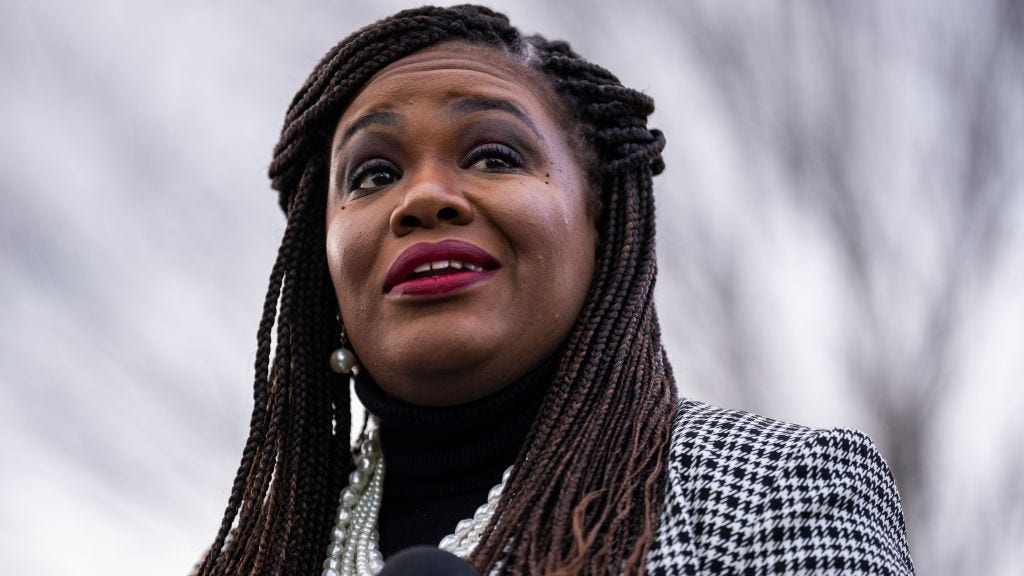
Rep. Cori Bush, D-Mo., paid her husband another $15,000 from her candidate committee this year even as she faces a Justice Department probe into her campaign spending, new filings show.
The progressive “Squad” member’s campaign made two $2,500 wage payments to her spouse, Cortney Merritts, each month between January 1 and March 29, according to documents submitted to the Federal Election Commission and released on Monday.
In total, the Bush campaign has now paid Merritts $135,000 for security services since January 2022, which have been listed as “wage expenses” since April 2023.
The Bush campaign did not immediately respond to a request for comment.
CORI BUSH’S CAMPAIGN PAYS $17,500 MORE TO HER HUSBAND, BRINGING HIS TOTAL TO $120k, NEW FILINGS SHOW
Rep. Cori Bush (D-Mo.), center, joins Maximus Federal Call Center workers at a protest calling on the Biden administration for higher wages and good federal jobs outside the Department of Health and Human Services on Dec. 12, 2023 in Washington, D.C. (Paul Morigi/Getty Images for Communications Workers of America (CWA))
In January, Bush released a statement that confirmed Department of Justice investigators were reviewing her campaign committee’s spending on security services. “As a rank-and-file member of Congress I am not entitled to personal protection by the House, and instead have used campaign funds as permissible to retain security services,” Bush said.
“In accordance with all applicable laws and House rules, I retained my husband as part of my security team to provide security services because he has extensive experience in this area, and is able to provide the necessary services at or below a fair market rate.”
Politicians can pay family members from their committees as long as they provide “bona fide” services at fair market value. However, Merrits pocketed the money as Bush’s campaign simultaneously spent significantly more on St. Louis-based companies, such as PEACE Security, for private detail. She has spent over $770,000 on such services.
Merritts, whose online accounts and posts have indicated he worked at a railroad company for years before starting a moving company, did not have a private security license as of late February 2023. He also did not appear in a Washington, D.C., database of licensed security specialists, Fox News Digital previously reported.
CORI BUSH’S CAMPAIGN CONTINUES TO SHELL OUT THOUSANDS OF DOLLARS TO HER HUSBAND FOR PRIVATE SECURITY
Watchdog groups have filed at least two complaints against Bush over the security payments. The first complaint, filed by the Foundation for Accountability and Civic Trust last year, is still pending. The House Ethics Committee has since cleared Bush in a second complaint from the Committee to Defeat the President.
Bush’s campaign has declined to respond to multiple Fox News Digital inquiries about the payments.
In October, Fox News Digital confronted Merritts as the couple left a Washington, D.C., fundraiser for California Democrat candidate Derek Marshall. During the exchange, Merritts appeared to backtrack about his role in the campaign after telling the videographer he does not have one.
“I don’t have a role in the campaign, man,” Merritts told a videographer when asked what his role in the campaign is.
CORI BUSH’S CAMPAIGN PAID HER HUSBAND FOR SECURITY SERVICES – BUT HE DOESN’T HAVE A PRIVATE SECURITY LICENSE
Rep. Cori Bush, D-Mo., is the subject of a Justice Department probe over her campaign spending on security services, including payments to her husband, Cortney Merritts. (Tom Williams/CQ-Roll Call, Inc via Getty Images)
However, when pressed, he said he was employed with the campaign.
“I’m still in the campaign; I still do security with the campaign. Have a good night, man. Be safe,” Merritts said before getting into a car with Bush.
FEC filings also show Bush is still at a significant cash disadvantage in the Democratic primary for Missouri’s 1st Congressional District.
Ahead of the Aug. 6 primary, Bush reported $528,622 cash on hand as of March 31. Her opponent, Wesley Bell, a progressive prosecuting attorney for St. Louis County who differs from Bush in his Israel stance, has more than double at his disposal, with $1.14 million in his war chest.
Bell is backed by wealthy Democratic donors, including LinkedIn co-founder Reid Hoffman, who contributed the maximum of $6,600 to his campaign for the primary and general elections, filings show.
A recent poll found that Bush may also be in trouble come August. Bell is currently up by 22 points over the “Squad” member, the New York Post reported.
Fox News Digital’s Joe Schoffstall contributed to this report.
Read the full article from Here


New coach Collin Klein knows what it takes to beat in-state rival KU as a player, finishing 2-0 in his career as the starting quarterback. In those two games, he scored nine total touchdowns, with six of them coming on the ground. The Week 6 matchup in Manhattan this season is the first opportunity for Klein to win this rivalry as the head coach, and K-State fans will be looking for that streak to be extended to 18 consecutive wins against KU.
KU has taken steps in the right direction under coach Lance Leipold, but the Jayhawks have been unable to get the job done against the Wildcats. Last year, the Wildcats limped into that matchup with just a 3-4 record. However, K-State took control early in Lawrence en route to the 42-17 victory.
Beating KU is always on top of the priority list for the Wildcats, and for Klein, keeping the streak going is something the fans are expecting.
K-State Early Opponent Preview Series: Nicholls| Washington State| Tulane| Cincinnati| Houston
Offense
One of the biggest question marks going into the 2026 season for KU is who will be the starting quarterback. Jalon Daniels might not always have been beloved by Jayhawks fans, but to lose that type of college production is tough to overcome.
Isaiah Marshall and Cole Ballard are in a tight battle for the job, and they both play the position differently. Both guys played sparingly last season, as Marshall showcased his rushing ability, carrying the ball 15 times for 160 yards. This is obviously the most important battle for the Jayhawks, and it could be a situation where this battle goes into Week 1 and potentially even the Missouri game.
One of the more shocking transfer portal decisions was Dylan Edwards leaving K-State, and going to KU. Edwards has battled injuries his entire career, but he gives the Jayhawks a legitimate home run threat out of the backfield. His ability to catch the ball out of the backfield will be big for either quarterback, as he fits the Jayhawks offensive scheme very well.
Dylan Edwards officially announces his commitment to Kansas. https://t.co/WVPC77x2Qp pic.twitter.com/ZWNT4yk5xu
— Jason Kinander (@WIBWJason) January 18, 2026
The receiver position has some legitimate talent, as transfer Nik McMillan and Cam Pickett should form one of the better duos in the Big 12. He had 62 catches for 981 yards and three touchdowns at Buffalo, while Pickett was second on the Jayhawks last year with 45 catches for 476 yards and three scores. Depth at the position is solid, as guys like Nahzae Cox and Tate Nagy also figure to be important pieces of the offense.
Defense
This is an area where the Jayhawks have to be better, but some interesting pieces are coming back on that side of the ball. Linebacker Trey Lathan made an immediate impact after transferring from West Virginia, as he led the team last year with 86 tackles. With another year in Lawrence, look for him to take anoher big step, and be one of the best defensive players in the Big 12.
There is some talent back on the defensive line, as Leroy Harris III and Blake Herold are two guys who contributed last year. Harris led the Jayhawks with 4.5 sacks, while Herold had 43 tackles after only 20 in his first season. The secondary has some new pieces, but there is talent there, led by Louisville transfer Corey Gordon Jr. He had 53 tackles last season, and is the type of guy who figures to be on the field immediately for the Jayhawks
Schedule
The schedule makers didn’t do the Jayhawks any justice, as they have a very challenging schedule this year. A week 2 rivalry game against Missouri is definitely circled on the calendar, but the Jayhawks will be in London the following Saturday for a Big 12 matchup against Arizona State. There are many K-State fans still mad about traveling overseas last season, and that was in the opener. To have to do that in Week 3 is a big challenge.
Even the week before the big rivalry game against K-State, the Jayhawks travel to one of the most hostile places in the country to take on the Utah Utes. The conference schedule is going to be a tough challenge, as the Jayhawks have only three conference games in Lawrence.
Outlook
This is a pivotal season in the Leipold era in Lawrence. On the one hand, there is no denying that he has built KU into a respectable program after it was at rock bottom when he got there. However, Jayhawks fans want more as the team has struggled to win in the final minutes of games over the last couple of seasons.
For the Jayhawks, this is always a big game, but the stakes in this game have never been higher. The Jayhawks have shown the ability to make it to a bowl game under Leipold, but winning the Sunflower Showdown is the next step they want to see Leipold and his staff accomplish.
Game Info
Date: Saturday, October, 17
Time: TBD
TV: TBD
Location: Bill Snyder Family Stadium
Series history: KU leads 64-54-5. While the Jayhawks lead the all-time series, it is the Wildcats that have won 17 straight games. The last time KU won was on Nov. 8, 2008 when the Jayhawks won, 52-21, in Lawrence.
Sign up for our free newsletter and follow us on Twitter/X, Facebook, YouTube and Instagram for the latest news.
Follow

DETROIT – A major banking merger is reshaping the financial landscape in Michigan — and customers need to take action before the changes take effect.
Fifth Third Bank completed its acquisition of Comerica, and beginning Sept. 8, Comerica customers will transition onto Fifth Third’s systems. The switch affects everything from mobile banking to direct deposits.
What Comerica customers need to do
Steve Davis, regional market president for Michigan, said the transition is designed to be straightforward for most customers.
“For the most part, what our customers are going to need to do is on September 8th, they’re going to log in to the Fifth Third app or their website, create a new user ID, a new password, and they’re good to go,” Davis said. “Their debit card, their ATM, their direct deposit information, all their ACHs — that’s all going to transfer over for them.”
To help customers prepare, welcome packets will be mailed in August walking through every step of the process. The bank says it is also staffing up to handle an expected surge in questions.
“It’s an all hands on deck to make sure that we can exceed customer expectations,” Davis said.
Customers looking for additional information can visit Fifth Third’s Better Together page.
Branch closures, but more options overall
The $10.9 billion all-stock deal — finalized in October — comes with significant changes to the branch network. More than 70 locations are slated to close as part of the merger.
The bank says it is working to relocate affected employees or help them find other opportunities. And while the closures mark a loss for some communities, Davis says the combined network ultimately gives customers more options.
“If you’re in the tri-county of Southeast Michigan — like Livingston, Macomb, Wayne, etc., we’re going to be number one in terms of branches there,” Davis said. “In the City of Detroit, we’re going to be number one in terms of branches there, so for our customers on average it’s a much better thing than a worse thing.”
Will Comerica Park be renamed?
Perhaps no question has captured more public attention than the fate of Comerica Park — the downtown Detroit ballpark that is home to the Detroit Tigers.
Could it become Fifth Third Park? That answer isn’t ready yet.
“We’re evaluating everything — we’ll decide something in the offseason,” Davis said. “It’s really cool that people care so much about Comerica Park and what it’s meant to them.”
Copyright 2026 by WDIV ClickOnDetroit – All rights reserved.

Sunday will feature more sunshine in Minnesota, but it stays hot and humid with highs staying in the mid 80s.
Sunday through Tuesday will be dry. The start of the next workweek will feature slightly humid conditions, and high temperatures will be closer to 90.
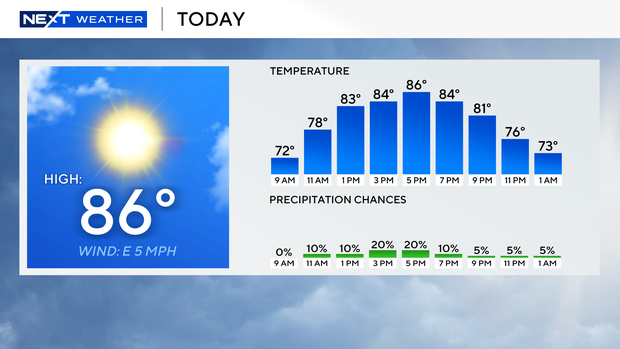
There’s also a chance of storms between the middle and end of the coming week.
-

 Kansas2 minutes ago
2026 K-State Football Early Opponent Preview, Game 6: Kansas
-

 Kentucky2 minutes ago
Recovery operations underway to find possible drowning victim on Kentucky Lake | NewsRadio 1230 AM/99.3 FM | Hopkinsville’s News Leader
-

 Louisiana10 minutes ago
Man killed, officer injured in shooting in alleyway near Sand Bar in downtown Shreveport
-
Maine17 minutes ago
People We’ve Lost
-
 Maryland20 minutes ago
BGE working to restore power to over 40,000 customers after July 4th storms move through central Maryland
-

 Michigan25 minutes ago
Fifth Third, Comerica merger: What Michigan customers need to know
-

 Massachusetts32 minutes ago
EV sales have slowed down. That puts pressure on Massachusetts’ climate goals. – The Boston Globe
-

 Minnesota35 minutes ago
Summer heat and humidity continue in Minnesota with low storm chances midweek


