Ohio
Storms tear through Northeast Ohio, leaving hundreds of thousands without power


Tuesday afternoon, heavy rain and high winds traveled across Northeast Ohio, leaving a wake of destruction and around 400,000 people without power.
As of 8 p.m., the following counties were dealing with power outages.
- Cuyahoga: 221,851
- Ashtabula: 14,565
- Geauga: 26,885
- Lake: 61,183
- Lorain: 43,551
- Portage: 9,146
- Stark: 1,008
- Summit: 9,514
- Trumbull: 12,477
The entirety of the News 5 viewing area was under a Severe Thunderstorm Warning at one point, and half a dozen counties were under a Tornado Warning. Jerry Gassan
By the time the storms passed out of our area, trees were felled, power lines had been ripped down, and even boats at the marina in Lorain had capsized.
Other boats on land over at the Edgewater Marina overturned.

News 5 Cleveland
In Mentor, fire crews had to lift up a car after a motorist drove around a barricade and into some downed wires.
Car caught in wires in Mentor
In Bay Village, fallen trees were everywhere.
News 5 Cleveland

One home in Bay Village had its entire driveway blocked by a collapsed tree.
News 5 Cleveland

Over on East 127th Street near Bratenahl and East Cleveland, residents were out clearing damage after the storms passed. One person had a tree fall onto their front porch.
Cleveland storm damage
In Parma Heights, the entire roof of an apartment complex on Kingsdale Boulevard was shorn off.
Parma Heights storm damage
In Willoughby Hills, fallen trees over major roadways caused delays to motorists in the area.
Storm damage in Willough Hills
In Euclid, one resident’s 1969 Mini Cooper was damaged when a tree fell onto its roof.
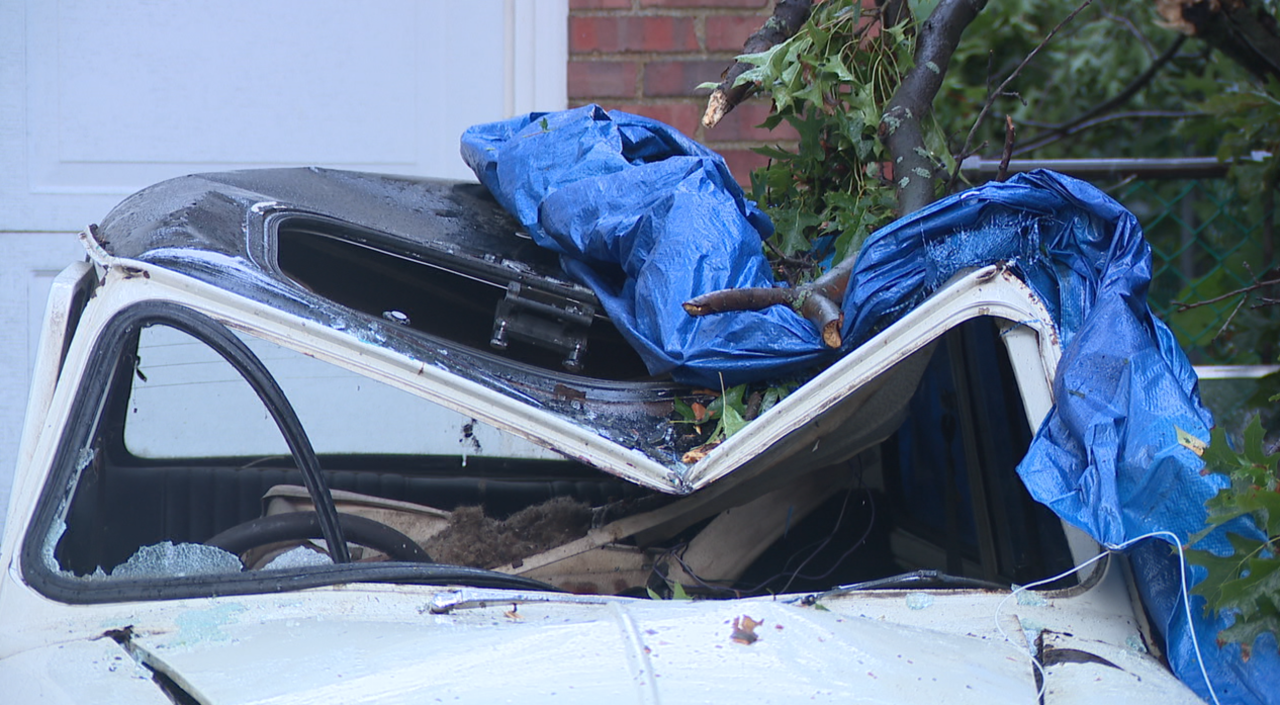
Euclid residents cleaning up after strong storms wreak havoc
CLICK HERE to check power outages in your area.
If you’d like to send us a photo of damage in your area, email us by CLICKING HERE.
Want the latest Power of 5 weather team updates wherever you go? Download the News 5 App free now: Apple|Android
Download the StormShield app for weather alerts on your iOS and Android device: Apple|Android
Click here to view our interactive radar.
Read and watch the latest Power of 5 forecast here.
Follow the News 5 Weather Team:
Mark Johnson: Facebook & Twitter
Trent Magill: Facebook & Twitter
Katie McGraw: Facebook & Twitter
Phil Sakal: Facebook & Twitter



Pato O’Ward finally broke through for his first victory of the season at the Honda Indy 200, anchoring a historic day for Arrow McLaren at the Mid-Ohio Sports Car Course.
Behind the wheel of the #5 Arrow McLaren Chevrolet, the 27-year-old secured his first podium of the year by winning. This victory was the team’s first-ever 1-2 finish in the IndyCar Series.
O’Ward entered the weekend with a remarkably consistent season, boasting six top-five finishes, but he had yet to crack the top three. That changed on Mid-Ohio’s 2.258-mile, 13-turn natural road course, where he put together a calm drive and controlled the field by leading 45 of the race’s 90 laps.
The decisive pass
The defining moment of the race occurred on Lap 42. O’Ward had been shadowing his teammate, Christian Lundgaard, all weekend as the duo virtually matched each other pace-for-pace. When Lundgaard made a costly slip in Turn 2, O’Ward didn’t hesitate.
“I was positioning myself to pounce on an opportunity whenever he would make a mistake,” O’Ward said. “So I was banking on that he was going to make one, and he did. That’s what ultimately gave me the opportunity, and I took full advantage of it. It’s always more fun to do it on track over a pit stop sequence or something.”
Pit work makes the difference
Pato O’Ward, Arrow McLaren
Photo by: Penske Entertainment
While O’Ward took care of business on the tarmac, he was quick to credit his crew for protecting the advantage after delivering flawless execution on Sunday.
“It’s great that the first podium of the year for me is a win,” O’Ward said. “We’ve had performances, and I think today was a textbook showing of execution. I want to give it to my guys in the pits; they were phenomenal. I know they’ve been working so hard because this year that has been a bit of a challenge, and I know they’re working so hard to give me the pit stops that they gave me today. I know they’ve been working hard for that.
“I really want to recognize that because they make or break my race. They truly allowed me to fight my way and keep my position today as we were fighting on track.
“Obviously the cars have been strong all weekend. It’s been a very strong weekend for all three cars. It was a matter of being perfect.”
O’Ward eyes late-season push
Pato O’Ward, Arrow McLaren
Photo by: Penske Entertainment
The victory injects a massive dose of momentum into O’Ward’s championship campaign as the series heads into the final stretch. Through 11 of 18 rounds, he now sits fifth in the championship standings, 94 points behind leader Alex Palou (404–310).
With strong historical tracks on the horizon, O’Ward believes a late-season title charge is entirely realistic if the team maintains this elite level of form.
“If we keep having weekends like today, certainly so,” O’Ward said. “That would be fantastic. Obviously Nashville has been a great place for me and the team. Portland we’ve been very strong, as well. Markham, we’ve had the best street course results that we’ve had in quite some time this year. I’m excited for Markham. I’m excited for Washington. That one is going to be crazy. Milwaukee, we’ve won there before.
“There’s plenty of opportunities left. I’m not changing my approach. It’s going to be the same as it’s been all year. I didn’t really change it this weekend, either.”

Ohio State will travel to the Los Angeles Memorial Coliseum on Oct. 31 to face USC in a much-anticipated matchup between the two blue bloods and first as Big Ten opponents.
The Buckeyes present the toughest offensive triplets — consisting of a starting quarterback, lead running back and a top pass catcher, the Trojans are set to face in 2026.
Ohio State Offensive Triplets
It’s a close debate between them and Oregon. The Ducks have the advantage at quarterback with Dante Moore, but the Buckeyes have the edge at running back and wide receiver.
Ohio State quarterback Julian Sayin is the only returning Heisman finalist in college football. The Southern California native was excellent in his first season as the starter in Columbus.
Sayin threw for 3,610 yards and 32 touchdowns last season. His biggest superpower is his accuracy. When he gets in a rhythm, the Buckeyes redshirt sophomore signal-caller is surgical. Sayin’s 77.0 completion percentage set a new is a Big Ten Record. He enters this season high on NFL Draft boards but with something to prove as well after a disappointing two-game stretch to end last season.
Bo Jackson proved very early last season that he was the best running back on the Ohio State roster. He took over as the starter in September and was one of three true freshmen to top 1,000 rushing yards in 2025. The sophomore tailback is underrated pass-catcher out of the backfield and is just scratching the surface of the player he can be.
Jeremiah Smith would have been a top 10 pick two years after a sensational freshman season. For a school that has produced the likes of Jaxon Smith-Njigba, the reigning Offensive Player of the Year, Marvin Harrison Jr., and Garrett Wilson, just to name a few in recent memory, Smith tops all of them in an Ohio State uniform.
The 6-foot-3, 223-pound Smith is a two-time first team All-American. He’s an alien at the position. The junior receiver has his eyes on winning the Biletnikoff Award, after USC’s Makai Lemon brought home the hardware last year, and helping the Buckeyes get back to the national championship.
Ohio State hired former NFL head coach Matt Patricia to be their defensive coordinator and the results was No. 1 defense in the country. They dove back into the NFL ranks again this offseason and hired former head coach Arthur Smith to be their offensive coordinator.
New-Look Defense at USC
USC made a big splash this offseason with the hiring of defensive coordinator Gary Patterson. The former longtime TCU head coach built great defenses for two decades in Fort Worth and a big reason why he’s headed to the College Football Hall of Fame.
He is looking to build similar success in Los Angeles. Except now, Patterson has more talent and resources than he’s ever had in front of him. The question is he can maximize it in year one and build a unit that creates problems for its opponents.
Rutgers receiver KJ Duff will challenge the Trojans secondary in week 3 with his 6-foot-6 and 225-pound frame. And then USC will see the entire offensive package when Oregon rolls into town the following week. Matchups against Washington and Penn State in early October will also test the Trojans new-look defense before they host Ohio State in late October.
Sign up to our free newsletter and follow us on Facebook, and X for the latest news.
 Add us as a preferred source on Google
Follow

YOUNGSTOWN, Ohio (WKBN) — Part of Glenwood Avenue is closed due to a water main break in Youngstown.
Saturday afternoon, water could be seen flowing down Glenwood Avenue near Ravenwood Avenue.
The road is closed between Ravenwood Avenue and Clearmount Drive while crews repair the break.
Dominic O’Brien contributed to this report.
-

 Atlanta, GA5 minutes ago
Big Tigger leaving radio show after Sandy Springs arrest
-

 Minneapolis, MN12 minutes ago
Teen In Critical Condition After Water Rescue At Minnehaha Falls
-

 Indianapolis, IN15 minutes ago
Rolling Deep With Some Of Indy’s Local Motorcycle Clubs
-

 Pittsburg, PA20 minutes ago
Sinkhole closes portion of road near UPMC Passavant hospital
-

 Augusta, GA27 minutes ago
Coroner investigating inmate death from Charles B. Webster Detention Center
-

 Washington, D.C30 minutes ago
Celebration to suffocation: Washington’s air turns world’s worst after July 4 fireworks extravaganza
-

 Cleveland, OH35 minutes ago
White Sox vs. Guardians game delayed due to rain Sunday 7/05/26
-

 Austin, TX42 minutes ago
Two found dead as deputies investigate double homicide at Travis County gentlemen’s club

