Ohio
No matter who wins between Notre Dame, Ohio State, this bettor’s positioned to profit


LAS VEGAS — Notre Dame and Ohio State winning their semifinal playoff games meant the wisdom of Tom Petty, once again, rang true.
“Even the losers / Get lucky sometimes.”
Sometimes, fortune smiles upon minnow bettors whose stacks of losing tickets provide so many bookmarks, coasters and, yes, even novel wrapping paper.
On Dec. 12, I studied the new 12-team College Football Playoff with a keen eye to newly released title-game exacta odds.
My college-pigskin rudder is points-per-play, ratios available at TeamRankings.com. The tale of teams is contained in those fractions.
On offense and defense, and overall margins, Notre Dame had sparkled since early October. “Past three games” reveals how teams are currently running.
I applied those figures to project each playoff game, best squad moving on. I played out the tournament, producing the finale exacta. I aimed to go into the championship game with a sweet ticket on both teams, guaranteeing profit.
That exercise compelled me to obtain South Point tickets on Notre Dame over Ohio State, 30-to-1 odds, and Ohio State over Notre Dame, at 25-1. Alas, the Buckeyes and Irish play for the national title Monday night.
“That’s awesome!!!” Long Island handicapper Tom Barton wrote in a text message.
“Looks like you played it 100% correct,” Southern California professional bettor Tommy Lorenzo told me. “Bull’s-eye, well done. TeamRankings is a great tool. I use a lot of its info for my power rankings.
“You’re sitting pretty, my friend.”
The two best teams
Barton entered the week 3-0 in this new playoff, and he sounded as if he’d be fine taking a pass on the championship game.
Unless the point spread ekes up to 10 somewhere. It mostly opened around 9 to 9.5 points in favor of Ohio State. Last Sunday night, it got shaved to 8. Monday afternoon, it hit 7.5 before pumping back to 8.5 by Wednesday.
“I haven’t finished my homework on the championship game,” Barton said. “I tend to lean with the points. The over looks interesting, too, but I’m not sure if I’ll play anything.”
Monday, DraftKings posted a 45.5 total. Wednesday, it hit 46.5, -108 over (or risk $108 to win $100), -112 under. Odds subject to change.
Lorenzo said he felt fortunate to be holding a title ticket on Notre Dame, at 11-1, plus Ohio State at +340.
They represented the two top teams in his power ratings, “so I pulled the trigger.” He added, “I do kick myself, however, for not attacking the championship exacta on those two, given my conviction on those two being the best teams overall.”
More maneuvering
I have more work to do, since I’ve been on Notre Dame since the summer. I’m bullish on Irish coach Marcus Freeman, so I bought a 22-1 Irish title ticket Aug. 31.
It lost early to Northern Illinois but has won 13 in a row, and I nabbed a 30-1 ducat on the Irish on Nov. 21 at the Westgate -SuperBook. So I reap more profit with a Notre Dame victory.
To even that out, I’ll stake positions with Ohio State, likely via in-game maneuvering.
Should the Irish tally an early touchdown, say, the Bucks’ moneyline will shrink closer to even (from around -380), providing an optimal situation to bet on Ohio State and ensure my dividends will be nearly equal, no matter who wins.
I did scramble for a +560 Penn State ticket on New Year’s Eve, just in case, among other moves. I had already bought into the Nittany Lions, at 24-1, on Aug. 31 at William Hill.
There are other debits, and credits. For the semifinals, I played a moneyline parlay of Ohio State to Notre Dame, turning two units into five. In sum, I’ll likely net around 55 units of playoff profit.
Howard’s Will
A lifelong Notre Dame supporter, Lorenzo said he ultimately believes Ohio State will get the victory; the figures back up that outcome.
Ohio State boasts a 0.617 points-per-play ratio over its last three games; Notre Dame’s offense, at 0.374, has been faltering.
Turnovers might be an equalizer, though, as the Irish’s ball-hawking defenders snatched an NCAA-best 32 combined fumbles and interceptions this season. Senior free safety Xavier Watts yanked down six of those picks.
All of which funnels into this column’s final words from Paul Stone, arguably the country’s finest purveyor of college-pigskin prognostications.
He noted the game opening Ohio State -10.5 at Circa Sports, which drew early action on underdog Notre Dame. Wednesday, Vegas had the Buckeyes as consensus 8-point favorites.
From East Texas, Stone said he respected those early waves of cash on the Irish, but he views Ohio State as the “more-complete team” and will back the Buckeyes on the point spread.
“They have found another gear in the playoffs and have too much firepower for Notre Dame, in my opinion,” he said. “Ohio State defeated a talented trifecta of teams — Tennessee, Oregon and Texas — all by 14 points or more.
“The Buckeyes have averaged 7.5 yards per play in those victories, while allowing only 4.2 yards per play.”
The key is Ohio State quarterback Will Howard, the 6-4, 237-pound senior who left Kansas State for Columbus.
“If [he] takes care of the ball and the Irish don’t post a defensive or special-teams touchdown,” Stone said, “I think the Buckeyes win by double digits.”



Amanda-Clearcreek honors Ohio Air National Guard member Capt. Seth Koval
Amanda-Clearcreek honors Ohio Air National Guard member Capt. Seth Koval
The remains of three Ohio airmen who were killed in the crash of their KC-135 refueling plane in Iraq earlier this month will be returned this weekend, according to a family member of one of the deceased.
The airmen, identified as Master Sgt. Tyler Simmons, 28, of Columbus; Capt. Curtis Angst, 30, of Wilmington, and Capt. Seth Koval, 38, of Stoutsville, will be brought back March 29 to Rickenbacker Air National Guard Base near Columbus, said Charles Simmons, Tyler’s father.
“Tyler will have a hero’s welcome, because he is a hero,” said Charles.
The Columbus Division of Police will be involved in the funeral procession when the airmen’s remains are transferred from the airport to funeral homes, said Columbus police Sgt. James Fuqua. That will take place between 1 p.m. and 2 p.m. March 29, said Fuqua.
The airmen’s remains first arrived back in the U.S. on March 18 with a dignified transfer taking place at Dover Air Force Base in Delaware.
Curtis, Angst, and Simmons were members of the 166th Air Refueling Squadron connected to the 121st Air Refueling Wing based at Rickenbacker Air National Guard Base in Columbus.
The airmen, as well as three other servicemembers, died on March 12 when their KC-135 tanker crashed in western Iraq during a mission in support of Operation Epic Fury in Iran. The cause of the crash, which occurred in friendly airspace, has not been publicly identified. U.S. Central Command has said the incident did not involve hostile or friendly fire, and military experts have theorized the crash may have been the result of a collision with a second KC-135 that sustained heavy damage to its tail fin but landed safely at an airport in Tel Aviv, Israel.
Reporter Bethany Bruner can be reached at bbruner@dispatch.com.
Reporter Shahid Meighan can be reached at smeighan@dispatch.com, at ShahidMeighan on X, and at shahidthereporter.dispatch.com on Bluesky.

COLUMBUS, Ohio (WSYX) — Thousands of people are expected to head to downtown Columbus for the 23rd annual Home Improvement Show this weekend.
Organizers say visitors can find ideas for everything from small interior design projects to major renovations.
The event is being held at the Ohio Expo Center and includes seminars, exhibits and demonstrations from local and national companies.
The show begins at noon Friday and runs until 6 p.m.
It continues Saturday from 10 a.m. to 6 p.m. and Sunday from 11 a.m. to 5 p.m.
Adult tickets cost $5 at the door.

Matt Patricia’s contract extension earlier this offseason included a pay raise that figures to make him the highest-paid assistant coach in college football this year.
But Patricia, who will make $3.75 million in guaranteed compensation as Ohio State’s defensive coordinator in 2026, also held an appreciation for his situation.
“Ohio State is such a special place, not only just the history, the tradition, the football program, the school, but the people here,” Patricia said. “Having a chance to have a little stability with my family, it’s hard when you have to move your family around, your kids and the new school and all that.”
Before he joined Ryan Day’s staff last year, the 51-year-old Patricia had bounced around as an assistant in the NFL for much of the decade.
He spent 2021 and 2022 in a variety of roles with the New England Patriots, then a year as a defensive assistant with the Philadelphia Eagles. He took off from coaching in 2024. The frequent relocation gave him perspective.
“We had an unbelievable experience settling into Columbus,” Patricia said. “Everybody’s been so nice and welcoming. It feels like home. It’s a big deal for us to be in a place where everybody’s happy. That’s really important.”
Patricia had a significant impact on the Buckeyes in his first year replacing Jim Knowles. Despite heavy roster attrition following their national championship season, he kept the defense atop the Football Bowl Subdivision. For the second straight season, no one allowed fewer points than Ohio State.
The 9.3 points per game allowed by the Buckeyes were the fewest by any defense since Alabama in 2011.
The success made Patricia a hot commodity on the coaching market, rebuilding his reputation as a sharp and creative football mind only a decade removed from his tenure as a Super Bowl-winning defensive coordinator for the Patriots. He was a finalist for the Broyles Award as the nation’s top assistant.
Patricia said he heard about opportunities in the NFL and elsewhere across the college football landscape, though none of them would pry him away from Ohio State.
“It wasn’t necessarily something where you’re looking to leave,” Patricia said, “but you do have to listen when those things come up. I’m just glad everything worked out.”
His challenge in his second season mirrors his previous one, as the Buckeyes are again managing the loss of eight starters on defense.
But unlike 2025, they have fewer returning pieces, relying on a larger class of transfers to help fill the holes on the depth chart.
“With as much coming into the program for the first time, not only are you trying to catch them up on the football scheme, but you’re also trying to catch them up on everything else,” Patricia said. “This is how we work, this is how we do things, this is the standard we’re looking for, this is how we practice, this is how we prepare, this is how we go to school. That has to be also taught. It becomes a lot, but that’s why you bring in the right guys that have the mental makeup to do all that.”
Joey Kaufman covers Ohio State football for The Columbus Dispatch. Email him at jkaufman@dispatch.com and follow him on @joeyrkaufman on X.
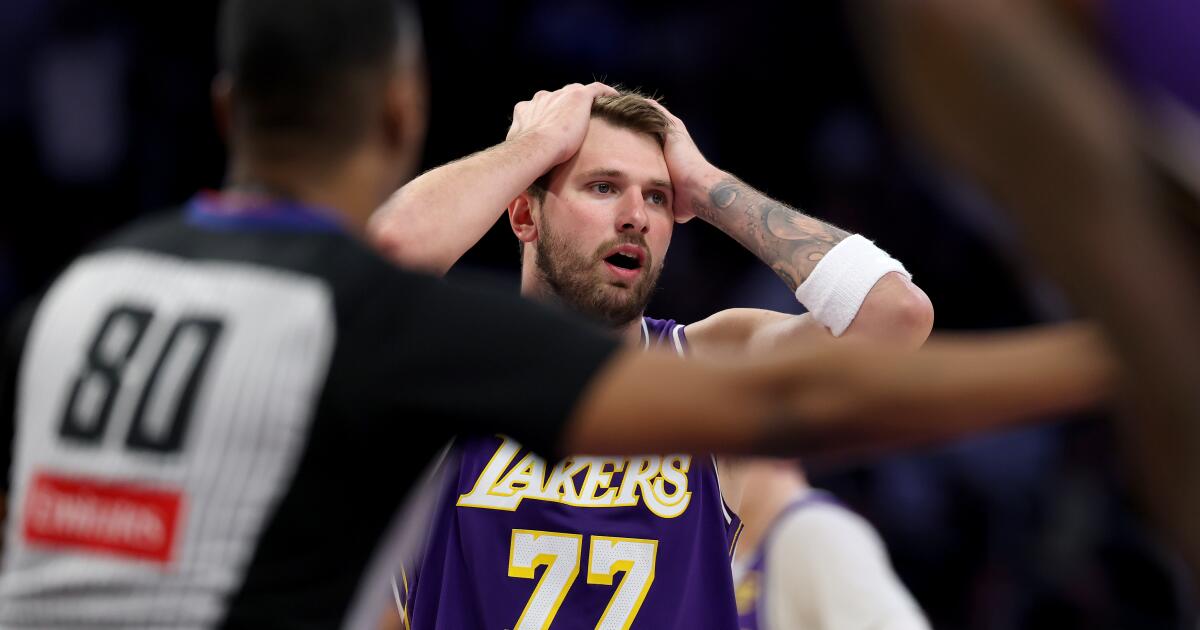
Lakers beat Nets, but Luka Doncic is facing suspension again after 16th technical

EU Parliament unblocks key political hurdle in digital euro talks

Man arrested in plot to firebomb Palestinian activist’s home after undercover op

Video: We Analyzed the Deadly Crash at LaGuardia

PWHL players bond with women’s hockey pioneers at Detroit clinic | NHL.com

Florida High School Football Rankings: Top 25 teams – Oct. 21

How old is Bo Nix? What to know about Oregon quarterback ahead of 2024 NFL Draft

Cleary's 21 help Le Moyne down Central Connecticut State 69-64 in OT

99th annual Pony Swim held in Virginia

Indiana Members Credit Union announced as new anchor tenant at Bottleworks District
EU Parliament unblocks key political hurdle in digital euro talks
Man arrested in plot to firebomb Palestinian activist’s home after undercover op

WATCH: Senate hearing goes silent after Angel Father confronts top Dem over daughter’s death

US diplomat Marco Rubio denounces settler violence, tolls in Hormuz strait

Iran-linked hackers have breached FBI Director Kash Patel’s personal emails | CNN Politics
-

 Detroit, MI1 week ago
Drummer Brian Pastoria, longtime Detroit music advocate, dies at 68
-

 Movie Reviews1 week ago
‘Youth’ Twitter review: Ken Karunaas impresses audiences; Suraj Venjaramoodu adds charm; music wins praise | – The Times of India
-

 Sports7 days ago
IOC addresses execution of 19-year-old Iranian wrestler Saleh Mohammadi
-

 New Mexico5 days ago
Clovis shooting leaves one dead, four injured
-
 Business1 week ago
Disney’s new CEO says his focus is on storytelling and creativity
-

 Technology6 days ago
YouTube job scam text: How to spot it fast
-

 Tennessee4 days ago
Tennessee Police Investigating Alleged Assault Involving ‘Reacher’ Star Alan Ritchson
-

 Texas1 week ago
How to buy Houston vs. Texas A&M 2026 March Madness tickets