Ohio
2024 NFL Draft: Multiple Ohio State Buckeyes Sign UDFA Contracts


The 2024 NFL Draft ended as a productive weekend for the Ohio State Buckeyes.
Four Buckeyes players heard their names called during the three-day event. Star receiver Marvin Harrison Jr. kicked things off as the fourth-overall choice and was followed by defensive tackle Michael Hall Jr. (Cleveland Browns), tight end Cade Stover (Houston Texans), and linebacker Tommy Eichenberg (Las Vegas Raiders).
In the hours since the draft closed late Saturday evening, three other members of the Scarlet and Gray have signed NFL contracts as “undrafted free agents.” Here are the latest Ohio State players to ink professional deals.
Apr 25, 2024; Detroit, MI, USA; Ohio State Buckeyes wide receiver Marvin Harrison Jr. poses after
Kirby Lee-USA TODAY Sports
Josh Proctor (SAF) – Jacksonville Jaguars
Josh Proctor’s time at Ohio State was plagued by injuries, which limited his on-field contributions. However, the safety has more than proven his ability in the reps which he has received.
During the NFL Combine, the Owasso, Oklahoma native said his time off of the field has helped him prepare himself for life in the NFL.
“It helped me mature,” Proctor said. “Helped me learn, helped me grow in different aspects in life. So honestly, it’s just a great opportunity to be a better person, a better player at the end of the day.”
Xavier Johnson (WR) – Buffalo Bills
Xavier Johnson was Ohio State’s primary option out of the slot last season, a position at which he was able to mix his terrific hands with lightning speed. Receiver is not the only spot at which Johnson has experience, as the career of “weapon X” began playing defensive back.
By adding Johnson to their roster, the Bills are one step closer to filling the massive shoes of receiver Stefon Diggs. Diggs was traded to the Texans earlier this month, in exchange for a handful of current and future draft picks.
Matthew Jones (OL) – Miami Dolphins
The Dolphins offensive line was one of the best in the NFL last season. Miami finished with the most earned yards last season with 6,822, which averages out to over 400 per game.
Matthew Jones will have to work hard to earn a place on such a strong O-line, something of which the senior is not afraid. Following Ohio State’s Pro Day on March 20, Jones said his focus would be on becoming as multifaceted as possible.
“I’m just trying to be as versitalle as possible,” Jones said. “From that center position, just be comfortable and be confident.”



Richland County is great for fishing
Some of Ohio’s best fishing opportunities are in Richland County.
Anglers can find strong opportunities for bass, crappie and catfish across central Ohio lakes this summer, according to a community announcement from the Ohio Department of Natural Resources Division of Wildlife.
The agency highlighted several reservoirs and lakes where fish populations remain robust and accessible, while also noting the relatively low cost of fishing in the state and the availability of free fishing promotions.
Ohio residents can purchase a one-year fishing license for $25, while youth younger than 16 do not need a license. The state also offers designated Free Fishing Days during which residents can fish without purchasing a license, though size and daily limits still apply.
Lakes across region offer diverse fishing opportunities
Central Ohio’s waterways, including reservoirs, inland lakes and streams, support a range of species such as hybrid-striped bass, crappie, black bass and catfish, according to the announcement.
Griggs Reservoir in Franklin County stands out for hybrid-striped bass, which are known for aggressive strikes and strong fights. Anglers often find success watching for birds diving on baitfish near the surface, which can signal feeding schools below. Fish exceeding 20 inches are regularly caught at the reservoir. Effective techniques include using swimbaits, rattle traps and topwater lures. The daily catch limit for hybrid-striped bass is 30 fish, with no more than four exceeding 15 inches.
Crappie fishing remains strong at Deer Creek Lake, spanning Fayette and Pickaway counties. Fisheries surveys conducted in fall 2025 identified numerous large fish. Anglers are encouraged to target submerged brush or trees, or to troll small crankbaits to cover more water.
Buckeye Lake, which touches Fairfield, Licking and Perry counties, also offers consistent crappie fishing. The lake contains both white and black crappie, with strong habitat areas such as submerged woody cover around Cranberry Bog. Public access is available through multiple boat ramps and shoreline sites.
The daily limit at both Deer Creek and Buckeye Lake is 30 crappie with a minimum length requirement of 9 inches.
Bass and catfish destinations draw anglers
Alum Creek Lake in Delaware County continues to produce largemouth and smallmouth bass in high numbers and sizes, according to the announcement. Tournament catches with five-fish totals nearing 20 pounds have been recorded.
Largemouth bass are commonly found near weed beds in shallow water, typically between 3 and 10 feet deep. Smallmouth bass are more often located near rocky areas and offshore points. The reservoir has a daily limit of five bass with a minimum length of 12 inches.
Hoover Reservoir, located in Delaware and Franklin counties, remains a key location for catfish anglers, according to the community announcement. Blue catfish stocked in 2011 have grown significantly, with some approaching 50 pounds. Anglers targeting these fish often use cut bait, especially in the northern portion of the reservoir during warmer months. The daily limit allows one blue catfish measuring at least 35 inches, with no limit on smaller fish.
The reservoir also features multiple boat launches and restrictions on motor horsepower, capped at 10 horsepower for outboard motors.
Resources and recognition programs available
The Division of Wildlife offers tools such as lake maps, fishing tips and forecasts to assist anglers, according to the announcement. These resources can be accessed through the HuntFish OH mobile app or on the agency’s website at wildohio.gov.
The agency also promotes its Fish Ohio program, which recognizes anglers who catch trophy-sized fish across 26 species. Qualifying participants receive a commemorative pin for their first entry and can earn a Master Angler pin by catching four different qualifying species within a year.
This year’s commemorative pin features a channel catfish.
This story was created with the assistance of Artificial Intelligence (AI). Journalists were involved in every step of the information gathering, review, editing and publishing process. Learn more at cm.usatoday.com/ethical-conduct.
Ohio
Operation 'Woah Nellie' in Masury, Brookfield Township, Ohio forces shelter to stop animal intake
The Healthy Hearts and Paws Project announced on Facebook that they are no longer taking in animals until others get fostered or adopted. The post says the shelter currently has no room for more animals after taking in one dog and over a dozen cats from a Masury home.
Source link

Photo:
Casey Laughter / Eclipse Sportswire
This year’s Preakness Stakes was advertised as the weak sister of the 2026 Triple Crown series. While Golden Tempo, Renegade, Commandment, and Chief Wallabee all took a hard pass on the middle jewel, they still ran the race at Laurel Park. The brunt of jokes before and after Napoleon Solo’s victory, the Preakness may yet enjoy the last laugh.
While Napoleon Solo and Iron Honor, the top two finishers from Maryland’s classic, will wait for the $1 million Haskell (G1) next month at Monmouth Park, Saturday’s $500,000 Ohio Derby (G3) attracted a solid field of 3-year-old males to Thistledown. Included in the group was a quartet coming straight out of the Preakness, led by Chip Honcho and Ocelli.
Bull by the Horns and Robusta were longshots off their results at Laurel and they ran like it in Ohio. Chip Honcho and Ocelli, on the other hand, were well supported on Saturday after running third and fourth in the Preakness.
After the pair put away the favored Desert Gate at the top of the stretch, they battled it out down the lane. In the end, it was Chip Honcho getting the better of his rival late to pull clear to a one-length score in the Ohio Derby. The Lexington Stakes (G3) winner Trendsetter was able to rally and get by the favorite for third, but this really was a two-horse race down the Thistledown stretch.
Trained by Steve Asmussen and ridden again by Jose Ortiz, Chip Honcho earned his second stakes win of his career, and his first of his sophomore season with the performance.
Before his solid third-place effort in the Preakness behind Napoleon Solo and Iron Honor, the son of Connect had run several good efforts in New Orleans, including a win in the Gun Runner and a strong second-place performance behind Paladin and ahead of the Kentucky Derby and Belmont Stakes hero Golden Tempo in the Risen Star (G2).
Despite his solid racing at Fair Grounds the decision was made to skip the Kentucky Derby with Chip Honcho and point for the Preakness instead. That decision already seems to be paying dividends.
On Saturday, he was steadied just a bit heading into the first turn but had already been asked to keep off the early lead set by Robusta. His ability to stalk from just off the pace in his last two races has seemingly made him a better and more dangerous horse.
When Ocelli rolled by him on the turn, he had to come up with a strong stretch drive to win and he did just that. Other than the Louisiana Derby, where he was hung out to dry a little bit early and faded to fifth, Chip Honcho has run nothing but good races in his career and looks to continue to be a player in the division as we move into the second half of the season.
As for Ocelli, I must admit that he was the one I was pulling for in the Ohio Derby. Also a son of the Curlin stallion Connect, he is a horse that I find it impossible not to root for.
After Saturday’s strong run for second, Ocelli has now run nine times in his career and remains winless. Sent off as the third choice in the Ohio Derby behind Desert Gate and Chip Honcho, the maiden once again ran a big race in defeat.
After displaying some rallying talent in his first three career starts, it has been a steady diet of stakes races and tough competition for the Whit Beckman-trained runner.
Even in the Sam F. Davis, won by Renegade, and the Virginia Derby, won by Incredibolt, Ocelli made his move from behind, but in both races, he was too immature to handle any adversity, and he backed out down the lane.
Undeterred, his connections were willing to keep trying. A solid rally to be third in the Wood Memorial (G2) was enough to get him into the Run for the Roses and his connections took full advantage. He actually briefly led in the stretch run of the Kentucky Derby, before finishing third as the longest shot on the board.
No horse was able to make up much ground in the Preakness, but Ocelli was the best of the late-runners, checking in 4th of 14. In the first two legs of the Triple Crown, the maiden finished ahead of all but 5 of the 30 horses he faced.
In the Ohio Derby, he had a wide trip and came with his patented rally under rider Tyler Gaffalione but could not hold off Chip Honcho in an exciting battle.
Despite still being winless in nine career starts, Ocelli has amassed $829,800. Not bad for a maiden, and not bad for a horse that was originally purchased for $12,000 as a yearling.
I cannot recall a maiden ever reaching the $1 million mark in earnings. I believe Ocelli has a chance to be the first. With a demanding schedule and a consistent far turn rally, it has been fun to watch the ride.
Chip Honcho and Ocelli, coming out of good efforts at Laurel Park, absolutely dominated Saturday’s Ohio Derby. Maybe we should start taking a more positive view of the 2026 Preakness Stakes.
-
 Sports7 minutes ago
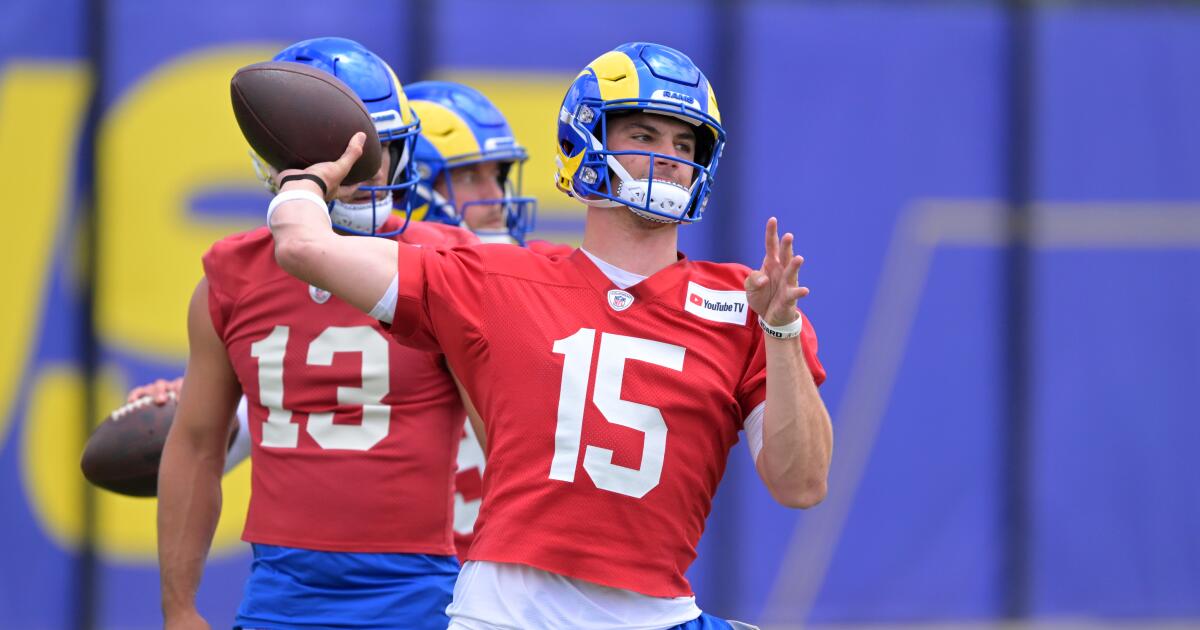
Rams QB Ty Simpson embracing an unusual bedtime routine to spur his development
-

 World17 minutes ago
Lebanon Latest: Israeli attacks surge despite ceasefire efforts
-
 News44 minutes ago
Supreme Court allows a ruling that ends a tool to protect minority voters in 7 states
-

 New York2 hours ago
How a Security Guard Lives on $46,000 a Year in the East Bronx
-

 Los Angeles, Ca2 hours ago
L.A. Tenants Union trying to save business owner given eviction notice ‘without reason or discussion’
-

 Detroit, MI2 hours ago
Grace Hanke crowned Miss Michigan 2026
-

 San Francisco, CA2 hours ago
The U.S. Government Secretly Tested Biological Weapons. The Citizens of San Francisco Paid the Price.
-

 Dallas, TX3 hours ago
3 Cowboys Entering Training Camp With Plummeting Stock

