Nebraska
The Northern Catalpa Tree | Nebraskaland Magazine


By Gerry Steinauer, Botanist
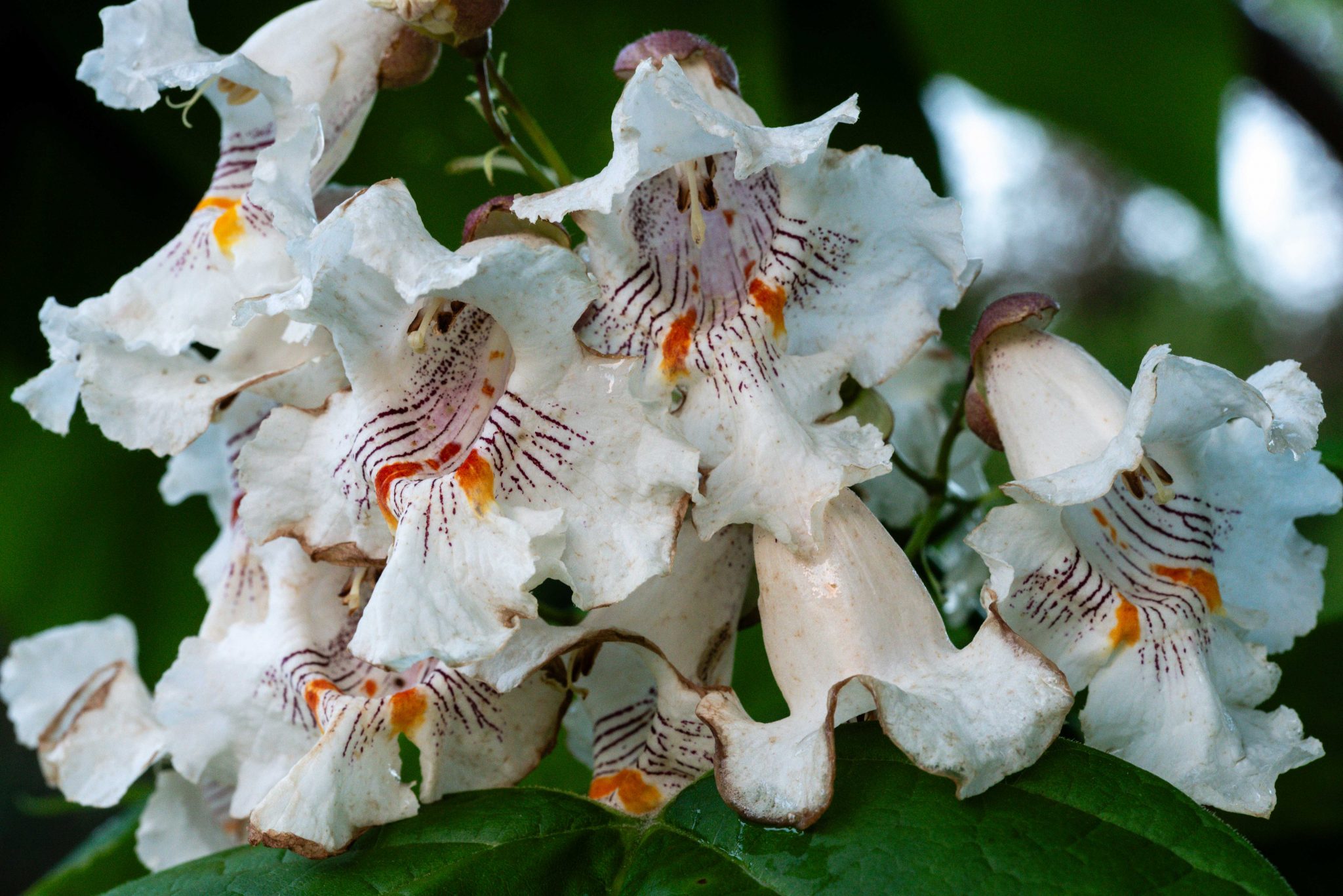
The northern catalpa is a tree you likely recognize but may not know by name. Perhaps you’ve seen it adorned with striking clusters of large, white flowers, standing out like a snow cone amid otherwise green woodlands. Or maybe, as a child, you were grudgingly sent outside to rake up its huge fallen leaves cluttering the yard. Most memorably, you and your friends may have ventured into the woods, plucked a few of the catalpa’s cigar-shaped seed pods and pretended to smoke them.
The tree is native to the central Mississippi River valley where it is called the Catawba tree (cuh-tah-buh). For reasons unknown, early settlers or botanists in this region named the tree after the Catawba people, a local Native American tribe. The northern catalpa has been widely planted in the eastern half of Nebraska, mainly as an ornamental and as a source of fence posts, where it has escaped cultivation and now grows in the wild in moist bottomlands with well-drained soils.
Several years ago, I gathered seed pods from a catalpa tree growing near an abandoned house up the road from our farm. I planted seeds in pots and transplanted several seedlings into our yard. I’ve been impressed by the trees’ rapid growth, shapely form and diversity of pollinators attracted to the flowers. Recently, I read that catalpa worms, a prized catfish bait, live on the trees. This summer I plan to pay even closer attention to this interesting tree … as I love to catfish.

Natural History
The northern catalpa is a stout-trunked tree that, in Nebraska’s drier climate, can reach about 40 feet in height and live up to 150 years in age. Its pale-colored wood is weak yet durable when in contact with the soil, making it historically popular for fence posts. To form the best post, saplings were cut back to the ground after the first or second year of growth and then only one or two of the best sprouts were left un-thinned to grow to post-size.
The tree’s telltale heart-shaped leaves can reach an impressive 4 to 10 inches long and 3 to 8 inches wide. The bell-shaped, 2-inch-long flowers bloom from late May to mid-June. The seed pods, which can reach an amazing 20 inches in length, ripen from green to purplish-brown in late summer and hang from the tree through winter. These distinctive pods give the tree two of its other common names: the Indian bean tree and cigar tree.
The nectar-rich flowers attract a variety of pollinators including hummingbirds, native bees and bumble bees, and night-flying moths. The lower flower petal has purple lines and yellow blotches that act as guides for incoming pollinators, which are drawn to the blooms by their sweet, citrus- or jasmine-like fragrance. Honeybees also swarm to catalpas, making the trees a beekeeper’s delight.
In Nebraska, the northern catalpa can only be confused with its cousin, the southern catalpa. The latter is native to the Gulf Coastal states, is less suited to the rigors of the Plains and has been planted sparingly in our southeastern towns and cities. A few distinguishing characteristics: the northern catalpa has larger and more pointed leaves, larger but fewer flowers, and longer, thicker seed pods than the southern catalpa. Interestingly, their leaf scents also differ — when crushed, northern catalpa leaves emit a sweet fragrance, while their southern cousin’s leaves produce a foul odor.
While the southern catalpa has never escaped cultivation in Nebraska, the northern catalpa escape into the wild has raised concerns among conservationists. For instance, along the central Platte River valley, the tree is taking hold along wet riverbanks and sandbars, displacing native vegetation.
In addition, this stretch of the Platte River is critical spring roosting habitat for migrating sandhill and whooping cranes. There, the open, sandy channel provides the birds with a clear view of approaching predators and encroaching trees obstruct this visibility, reducing the cranes feeling of safety and potentially limiting their use of the area. Local conservation groups are cutting and grinding larger catalpas and other invasive trees on the riverbank and disking sandbars to uproot saplings in an effort to maintain an open channel.
Catalpa Worms
The catalpa sphinx moth is named for its caterpillars, called catalpa worms, which feed exclusively on catalpa leaves, sometimes defoliating entire trees. The moth has migrated northward and westward from its native range, following planted catalpas. Over the past two decades, my friend Mark Brogie, who attracts moths with night lights, has photographed several catalpa moths in his backyard in Creighton in Knox County. “A catalpa tree just down the street is the likely source of these moths,” Brogie said. If the catalpa sphinx moth has reached as far northward and westward as Knox County, it could be present wherever catalpas grow in Nebraska.

In spring, the female moths lay masses of eggs on the underside of catalpa leaves. Typically, two broods of caterpillars hatch each summer. Mature caterpillars can reach 2 inches in length and are usually black on the back with a broad yellow stripe along the side. They have a single thorn-like, black horn at the tail end. When fully developed, the caterpillars drop from the leaves and burrow into the soil where they overwinter, metamorphosize and emerge as adult moths the following spring.
In the South, these caterpillars are called Catawba worms, and anglers prize them as bait for bass, bluegill, catfish and other fish. Fishermen pick the worms individually from the underside of leaves where they hang out or shake a branch or tree to collect entire coffee cans full of the fallen worms. Some anglers turn the worms inside out on the hook, claiming that their soft, juicy insides better entice fish. Lastly, it’s rumored that smart fishermen never reveal the location of their favorite Catawba worm tree.
It’s likely that northern catalpa trees will continue to spread in Nebraska. How much of a nuisance they become remains unknown. On the positive side, in the coming decades, Nebraska anglers may have a new go-to fish bait.





Troy coach Scott Cross met with the media following his team’s 76-47 loss in the first round of the NCAA Tournament. The victory was the first NCAA Tournament win in Nebraska basketball history.
The Huskers were led by Pryce Sandfort, who scored 23 points in the victory. The former Iowa Hawkeye shot 7-of-13 from the floor and 7-of-12 from the 3-point line. Rienk Mast contributed 13 points and 6 rebounds in the win.
Advertisement
As a team, the Huskers shot 25-of-65 from the field, 14-of-39 from the 3-point line and 6-of-6 from the free throw line. Troy shot 13-of-46 from the floor, 8-of-28 from beyond the arc and 13-of-14 from the charity stripe.
Cross told the press that while the defeat was difficult to take, he knows his team won’t let this season be defined by this one loss.
“Thank you for being here. I would like to thank the good Lord for the opportunity to just have your guts absolutely ripped out. It stinks, but I told our guys in the locker room, they’re not defined by this basketball game.”
Troy entered the NCAA Tournament on a four-game winning streak after earning the regular-season and tournament titles in the Sun Belt Conference. Cross acknowledged that this Nebraska team is one of the best teams he’s seen in his over 25 years of coaching.
“They played an amazing team. Nebraska is one of the best teams. I’ve been doing this since 1998. They’re really, really freaking good. The way they shoot the basketball and the way they defend, watching it on video, you’re, like, man, there’s no openings as you watch it on video.”
Nebraska and Vanderbilt will play on Saturday at 7:45 p.m. CT, and the game will be broadcast on TNT.
Advertisement
Contact/Follow us @CornhuskersWire on X (formerly Twitter) and like our page on Facebook to follow ongoing coverage of Nebraska news, notes and opinions.
This article originally appeared on Cornhuskers Wire: What Troy coach Scott Cross said after first-round loss to Nebraska

No. 5 Vanderbilt Commodores defeated the No. 12 McNeese State Cowboys in the first round of the men’s 2026 NCAA Tournament.
Vanderbilt eliminated McNeese by a score of 78-68 on Thursday afternoon in Oklahoma City. McNeese took the lead early in the first half, but Vanderbilt came back in the second half in a close, back-and-forth game.
Now, Vanderbilt will face off against the No. 4 Nebraska Cornhuskers in the second round at Paycom Arena in Oklahoma City on Saturday, March 21.
Here is everything you need to know in order to buy Vanderbilt vs. Nebraska March Madness basketball second round tickets.
Shop Vanderbilt vs. Nebraska March Madness tickets
When is March Madness 2026?
The First Four tipped off the 2026 March Madness tournament on Tuesday, March 17. The two rounds run between Thursday, March 19 and Sunday, March 22. The tournament concludes with the Final Four on Saturday, April 4 and the National Championship game on Monday, April 6.
Vanderbilt March Madness next opponent
Vanderbilt earned a No. 5 seed in the South regional. They defeated McNeese in its opening game and have advanced to the Round of 32, where they will play the No. 4 Nebraska Cornhuskers. Tickets to Vanderbilt’s Round of 32 game start at $193.
Vanderbilt March Madness basketball tickets
Limited Vanderbilt NCAA Tournament tickets are still available for the Round of 32. Get your Vanderbilt March Madness tickets now.
Shop Vanderbilt basketball tickets
Vanderbilt March Madness schedule
After defeating McNeese on Thursday, No. 5 Vanderbilt Commodores will take on No. 4 Nebraska Cornhuskers on Saturday, March 21. The tipoff time for that game is still to be determined. Shop Vanderbilt Round of 32 tickets now.
More March Madness: Everything fans need to know about the 2026 NCAA Tournament
Vanderbilt March Madness game locations
Vanderbilt will play their Round of 32 game at Paycom Arena in Oklahoma City on Saturday, March 21.
Limited tickets for the Round of 32 March Madness in Oklahoma City are available. Shop your Vanderbilt NCAA Tournament tickets now.
Vanderbilt Sweet 16 tickets
If the Commodores were to advance to the Sweet 16, they’d travel to they’d travel to Houston, Texas. Sweet 16 tickets in Houston are already available starting at $207.
Shop Vanderbilt basketball tickets
March Madness 2026 full schedule for the men’s tournament
- April 6: National Championship
- March 19-20: First round
- March 21-22: Second round
- March 26-27: Sweet 16
- March 28-29: Elite 8
- April 4-5: Final Four
Shop ALL March Madness tickets


SGA’s cousin, Troy guard Javier Gilgeous-Glasgow, braces for March Madness
Troy guard Javier Gilgeous-Glasgow, the cousin of Thunder star Shai Gilgeous-Alexander, goes through practice drills ahead of Troy’s first round matchup with Nebraska on Thursday in Paycom Center.
Nebraska men’s basketball is amid an historic season in 2025-26, earning a program-best No. 4 seed in the NCAA Tournament. It’s unprecedented territory for the Cornhuskers, who have never experienced success in March Madness.
Literally.
Seventh-year coach Fred Hoiberg didn’t make the NCAA tournament with Nebraska until his fifth season with the program in 2023-24. The Cornhuskers missed the big dance again last season, although they won the inaugural College Basketball Crown championship before winning 20 consecutive games to start the 2025-26 season.
No. 13 seed Troy, who’s making its second consecutive NCAA Tournament appearance, won’t be an easy out. Nebraska will also certainly be looking to lift some historical blunders off its shoulders with a win.
Here’s what to know of Nebraska’s NCAA Tournament history:
Has Nebraska ever won an NCAA Tournament game?
Nebraska is the only Power conference program to have never won a Men’s NCAA Tournament game, and has its best chance in program history to win its first when it faces Troy in the first round on Thursday, March 19.
It’s the Cornhuskers’ ninth-ever NCAA Tournament appearance, having last made the field in 2024. Nebraska lost to Texas A&M 98-83, despite being a No. 8 seed against the No. 9 Aggies in the first round.
Hoiberg said March 18 that he hasn’t addressed the program’s NCAA Tournament history leading up to the game, and that he doesn’t plan to. He did note, however, that there’s pressure involved with the game.
“I know the first question is going to be Nebraska has never won a tournament game,” Hoiberg said. “We realize that. Have I talked to our players about it? No, I haven’t. They know. They see it. Is there a pressure that goes along with that? Of course there is.”
Hoiberg’s son, Sam Hoiberg, is one of Nebraska’s top players. He also addressed what it would mean for the school to win a March Madness game.
“That’s what I’ve been dreaming of since I became a player in this program,” Sam Hoiberg said. “That’s the only thing left to do is get that tournament win. It’s the unsaid thing in every single room, is we don’t have a tournament win. So being able to do it as a senior would be pretty cool.”
Nebraska NCAA Tournament history
- 2024: No. 9 Texas A&M 98, No. 8 Nebraska 83
- 2014: No. 6 Baylor 74, No. 11 Nebraska 60
- 1998: No. 6 Arkansas 74, No. 11 Nebraska 65
- 1994: No. 11 Penn 90, No. 6 Nebraska 80
- 1993: No. 7 New Mexico State 93, No. 10 Nebraska 79
- 1992: No. 9 UConn 86, No. 8 Nebraska 65
- 1991: No. 14 Xavier 89, No. 3 Nebraska 84
- 1986: No. 8 Western Kentucky 67, No. 9 Nebraska 59

Cal, Randy team up in Seattle Mariners’ 6-run inning – Seattle Sports

Where to watch TCU vs. UC San Diego in March Madness First Round: Time, TV Channel

Utah Jazz vs Milwaukee Bucks: Recap and final score

Atlanta lawyer’s bond eased ahead of murder retrial

Minneapolis man charged with killing his ex-partner, child

Florida High School Football Rankings: Top 25 teams – Oct. 21

How old is Bo Nix? What to know about Oregon quarterback ahead of 2024 NFL Draft

Cleary's 21 help Le Moyne down Central Connecticut State 69-64 in OT

99th annual Pony Swim held in Virginia

Indiana Members Credit Union announced as new anchor tenant at Bottleworks District

Meet the longtime biz partner of Ilhan Omar’s husband as questions swirl over her skyrocketing net worth

‘Nobody can blackmail us’: Leaders excoriate Orbán’s veto

Trump is dismantling democracy at ‘unprecedented’ speed, global report finds

4 House Dems vote against Women’s History Museum bill over biological women-only amendment, Republican claims

Iran attacks cut 17% of Qatar’s LNG capacity for up to 5 years: QatarEnergy
-

 Oklahoma6 days ago
Family rallies around Oklahoma father after head-on crash
-

 Detroit, MI1 day ago
Drummer Brian Pastoria, longtime Detroit music advocate, dies at 68
-

 Nebraska1 week ago
Wildfire forces immediate evacuation order for Farnam residents
-

 Georgia4 days ago
How ICE plans for a detention warehouse pushed a Georgia town to fight back | CNN Politics
-

 Massachusetts1 week ago
Massachusetts community colleges to launch apprenticeship degree programs – The Boston Globe
-

 Alaska5 days ago
Police looking for man considered ‘armed and dangerous’
-

 Colorado1 week ago
‘It’s Not a Penalty’: Bednar Rips Officials For MacKinnon Ejection | Colorado Hockey Now
-

 Southwest1 week ago
Talarico reportedly knew Colbert interview wouldn’t air on TV before he left to film it