Connect with us

Missouri

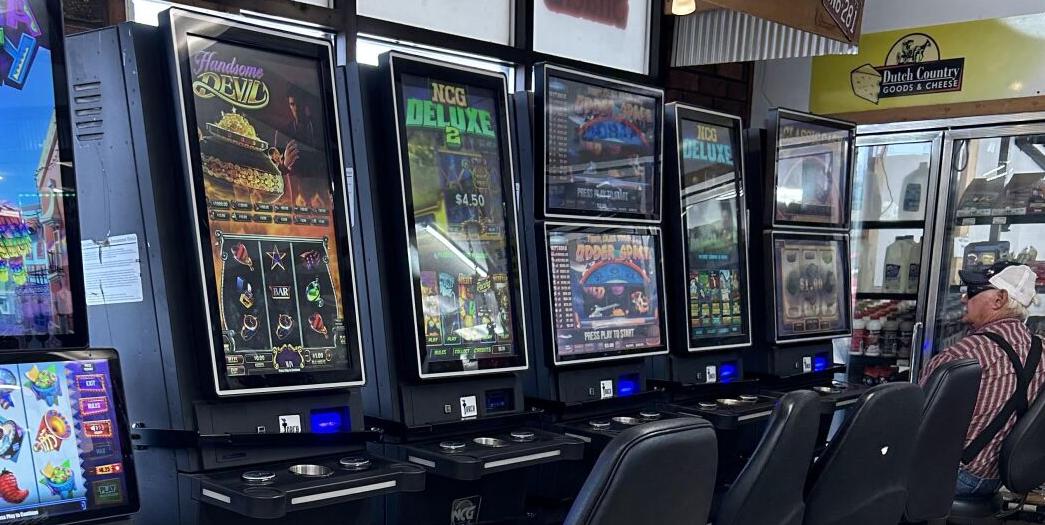
Move by Missouri House to legalize gas station slot machines faces stiff odds in Senate

Published

on

Move by Missouri House to legalize gas station slot machines faces stiff odds in Senate


JEFFERSON CITY — The Missouri House gave narrow preliminary approval Monday to a plan to tax and regulate the video gambling machines that have spread across the state for the past decade.

But, even if it wins final approval in the House, the measure could be dead on arrival in the state Senate, where top leaders have signaled there is little appetite among the 34 members for an expansion of gambling this year.

Under legislation sponsored by Rep. Bill Hardwick, R-Dixon, the state would establish a fee and tax structure for the Missouri Lottery to administer the program. There also would be safeguards in place to limit play of the games by minors.

A fiscal analysis shows the program could generate nearly $350 million in tax revenue for the state at a time when revenue growth is slowing.

Advertisement

People are also reading…


Advertisement


Rep. Bill Hardwick, R-Dixon. 

Advertisement


Hardwick said businesses that have the machines need regulatory certainty about the future of the games.

“There’s definitely some ambiguity when it comes to the legality,” Hardwick said. “We owe it to them to give them regulatory certainty.”

Rep. John Martin, R-Columbia, said the proposal could represent the biggest expansion of gambling in state history, but Hardwick said it could result in fewer machines than there are now if cities and counties opt out of the program.

An amendment introduced by Rep. Brenda Shields, R-St. Joseph, to send the matter to voters failed to be adopted.

Advertisement

The overall measure was endorsed on a 74-70 vote and needs one more roll call in the House before it moves to the Senate for further debate. The bar will be higher on the House’s second vote, where 82 votes will be needed to advance.

In opening the legislative session in January, Senate President Cindy O’Laughlin, R-Shelbina, signaled she is not in favor of more gambling in Missouri, which is in the midst of rolling out a sports betting program approved by voters in November.

“Our greatness is not found in enabling destructive behaviors, whether it’s gambling away a paycheck or the normalization of drug use,” O’Laughlin said.

O’Laughlin told the Post-Dispatch that legalization and taxation of the unregulated machines could be positive for the state, but the Senate has a heavy load of other legislation it is wrestling with between now and the scheduled end of session in May.

“I’m not sure there is a big push for that here,” O’Laughlin said.

Advertisement

Her assessment is shared by others in the upper chamber.

Sen. Lincoln Hough, R-Springfield, said there is little chance the measure will find support in the Senate Appropriations Committee, which he chairs.

“There is no appetite for that,” Hough said in March.

The looming standoff comes as video gambling companies spent the election season contributing more than $1 million to state officials in an attempt to sway their votes for and against the changes.

The Missouri Gaming Commission has deemed the machines illegal, and the Missouri State Highway Patrol has referred numerous cases to local prosecutors for charges. But county prosecutors have taken limited legal action against Wildwood-based Torch Electronic, which has placed thousands of machines in businesses across the state.

Advertisement

Torch has argued its machines are legal amusement devices even though players can win money from them.

The state’s 13 casinos are opposed to the legalization, primarily because it could result in a decrease in customers going to their facilities.

The tax rate on the games would be set at 34%, which is similar to the tax on state-regulated casinos, but more than the tax rate approved by voters in November for sports wagering.

The proposal would limit the number of machines per location to eight and allow local governments to vote on whether to permit them. 

The legislation is House Bill 970.

Advertisement

Missouri House committee votes to legalize video slot machines

Some Missouri lawmakers want to rein in unregulated gaming machines. They face long odds.

Missouri gas station slot machine company gives big to PAC for Lt. Gov. Mike Kehoe

Are those gas station slot machines legal? Missouri court won’t say

Advertisement

March 2025 saw severe weather, fish fries, opening day and the beginning of spring. Here’s what the Post-Dispatch photographers captured in those 31 days. Video by Jenna Jones.


Advertisement


Source link

Missouri

Kansas City, Missouri, police investigating Wednesday afternoon homicide at 43rd, Paseo

Published

on

Kansas City, Missouri, police investigating Wednesday afternoon homicide at 43rd, Paseo


KANSAS CITY, Mo. — The Kansas City, Missouri, Police Department is investigating a homicide that occurred Wednesday afternoon.

At around 4:18 p.m., KCPD responded to the area of 43rd Street and The Paseo on a reported shooting.

No word on what led to the violence.

Advertisement

This is a developing story. Check back for updates.

If you have any information about a crime, you may contact your local police department directly. But if you want or need to remain anonymous, you should contact the Greater Kansas City Crime Stoppers Tips Hotline by calling 816-474-TIPS (8477), submitting the tip online or through the free mobile app at P3Tips.com. Depending on your tip, Crime Stoppers could offer you a cash reward.

Annual homicide details and data for the Kansas City area are available through the KSHB 41 News Homicide Tracker, which was launched in 2015. Read the KSHB 41 News Mug Shot Policy.


Source link

Advertisement
Continue Reading

Missouri

New West Boulevard Elementary School principal announced

Published

on

New West Boulevard Elementary School principal announced


Columbia Public Schools announced Tuesday that M. Fernanda Blackburn will be the principal at West Boulevard Elementary School for the 2026-2027 school year.

Currently, Blackburn is the assistant principal at Shepard Boulevard Elementary School. She will replace Morgan Neale who announced she would be moving to Rock Bridge Elementary School as assistant principal earlier this year, according to a news release.

Blackburn has 26 years of experience in education, including 20 years as a classroom teacher, two years in curriculum and instruction and four years as an assistant principal, according to the news release.

Advertisement

“Dr. Blackburn is focused on fostering student success, supporting educators, and building strong partnerships with families and the community and we are excited to have her join the West Boulevard community,” Superintendent Jeff Klein said in the news release.

Blackburn has a bachelor’s degree in bilingual education, a master’s degree in education and a doctoral degree in child development and education.


Source link

Advertisement
Continue Reading

Missouri

Mid-Missouri family speaks out amid eminent domain battle

Published

on

Mid-Missouri family speaks out amid eminent domain battle


After living on their farm in Mexico for decades, a mid-Missouri family said they have been forced to fight in a years-long battle, after an electrical cooperative invoked eminent domain.

Andy Ekern said his family moved to Mexico, Missouri in the 1960s. His mother was a teacher and his dad was a doctor. Ekern said they both had a dream to own land of their own.

“They came to Mexico, Missouri with nothing,” Ekern said.

Over the years the Ekern’s worked hard to turn their vision into a reality, curating hundreds of acres of farmland and building a quiet place for their family to call home.

Advertisement

“This is good rolling farm ground right here.This is all pasture,” Ekern said.

However, a portion of this paradise will soon be used for something else.

About two years ago, the Ekern’s said their lives changed overnight when they received a letter from Central Electric Power Cooperative. The letter asked for a 14-acre easement to build a transmission power line across their property, connecting two nearby sub-stations.

“It was a complete shock,” Ekern said.

If the Ekern’s didn’t agree, Central Electric threatened to use eminent domain.

Advertisement

“They could come and take the easement and do what they wanted to anyways,” Ekern said.

That’s exactly what happened. Ekern said his mother was devastated.

“For the longest time, she cried every time you talked about it,” Ekern said.

Ekern said landowners’ hands are essentially tied when it comes to fighting eminent domain.

“When you’re the black dot in the middle of the powerline, you’ve got no recourse,” Ekern said.

Advertisement

Despite this, he vowed to fight in whatever way he could. Ekern enlisted help from The Law Firm of Haden and Colbert to guide him through the legal process.

His lawyer, Brent Haden, said three court-appointed commissioners determined how much the Ekern’s would be paid. However, Haden said there could be a catch.

According to Haden, cooperatives, such as Central Electric, pay 100% of the fair market value as determined by the courts. Meanwhile, investor-owned electrical utilities and merchant transmission lines pay 150% when they go over agricultural ground.

“Central Electric only has to pay 100%, whereas Grain Belt, had they built the line themselves, would have had to pay 150%,” Haden said. “It’s a real source of frustration to think the system could be gamed.”

In a statement, Central Electric said, “Grain Belt is required to pay for any upgrades to the transmission system necessary to maintain reliability of the grid, due to their interconnection. If those upgrades weren’t funded by Grain Belt, then our member owners would have to foot the bill.”

Advertisement

Central Electric also said the transmission line going across Ekern’s property will be used to support the Cooperative bulk electric transmission system in the region.

A spokesperson with the group said, “It will help to ensure reliable electric service to our member owners. In the Mexico area, that member is Consolidated Electric Cooperative.”

Following the commissioner’s decision, Central Electric requested a jury trial. In a statement, Central Electric said it hopes it can come to a reasonable settlement before going to trial.

Amid the ongoing legal battle, Ekern said work on the property has already begun. He said crews were there clearing the land with bulldozers and chainsaws.

He said it has impacted some of the family’s crops.

Advertisement

“Where the line is coming through it’s mostly crop, so it’s got corn and soybeans in it,” Ekern said. “You have to farm around it. You have to plant around it. And, you have to look at it, which is probably the biggest part.”

Additionally, Haden said companies are not required to help fix land once construction is complete. He said the law is pretty much silent when it comes to land management and how land is treated in eminent domain cases.

“A lot of people get upset with the way the utilities tear the ground up underneath the lines and there’s no obligation under the law to go back and repair that,” Haden said. “Some of them do a pretty good job on that front. Some of them do a terrible job and they tear up the ground and won’t fix it when they leave.”

While some may think the Ekern’s story does not apply to them, Haden warned the expansion of data centers could change that.

“Data centers are going to use a tremendous amount of power,” Haden said.

Advertisement

Haden claimed more power lines will be needed to fuel data centers and rural landowners could pay the price, with many possibly fighting eminent domain cases of their own.

“The projections we have here for many rural landowners, it’s almost unavoidable that you’re going to have this problem because of the raw number of lines they’re going to have to build,” Haden said. “They’re going to run out of room.”

Ekern said while it may be too late for his family, he’s determined to share their experience in the hopes that landowners have more protections in future eminent domain cases.

“Right now the landowner is completely powerless,” Ekern said. “We were told if you don’t like it, you have to change it.”

Ekern said he has shared his story with legislators at the State Capitol. Haden encouraged residents to speak with their local and state representatives.

Advertisement

He said legislation that provides more protections for landowners must be passed.

“The good news is, in a democracy we control our government,” Haden said. “And so, ultimately it’s up to us to get involved.”


Source link

Continue Reading
Advertisement

Trending