Missouri
More transfers to follow, but Missouri football has inked some key returners


JACKSONVILLE, Fla. — Eli Drinkwitz just had to make sure.
He knew Nicholas Rodriguez, one of Missouri football’s few real standouts with 15 total tackles in the Tigers’ disappointing 13-7 loss to Virginia in the Gator Bowl on Saturday, Dec. 27, had put pen to paper to return next season. But, in college football in 2025, it doesn’t hurt to double-check.
“We’ve got a really strong foundation. Nick’s going to be back,” Drinkwitz said, then paused and turned to his sophomore linebacker over his right shoulder. “You’re going to be back, right?”
“Yeah,” Rodriguez said, smiling.
Rodriguez was among a list of four players the Mizzou coach, of his own accord, confirmed are signed to return in 2026. The others are star running back Ahmad Hardy, freshman quarterback Matt Zollers and defensive tackle Jalen Marshall.
Now, that’s a short list to work with while trying to get a feel for what the Tigers might look like in 2026.
And, as we’ve seemingly seen from some of Mizzou’s recent expected portal entrants and a lawsuit (and countersuit) involving Georgia and current MU defensive end Damon Wilson II, signing paperwork isn’t nearly as guaranteed as most coaches and teams would like it to be.
But it’s a start. And an important start.
Drinkwitz indicated that there are more players who were on the roster for the Gator Bowl who will not be suiting up in Columbia next season.
“Starting tomorrow (Dec. 28) we’ll finish up re-signing the current roster,” Drinkwitz said. “There’s going to be guys (transferring), there’s guys that already told us that they were going to transfer but they wanted to play tonight. We really appreciate those guys finishing.”
This is shaping up to be a crucial transfer portal for the Tigers.
Zollers, a true freshman, looked raw and more of a project than a clear-cut QB1 for the 2026 season. Quarterback is going to be an area of need for Missouri when the transfer portal opens up, as starter Beau Pribula is among the nine MU players who have already been confirmed as soon-to-be former Tigers.
There is still no public word on whether a trio of draft-eligible third-year players — Wilson, linebacker Josiah Trotter and left tackle Cayden Green — will stay in college or enter the NFL Draft process this offseason.
And, without getting into the weeds, here’s a quick glance at where Mizzou is losing starters or key rotation members just to eligibility: Right tackle; center; slot receiver; field defensive end; two defensive tackles; two more linebackers; both starting corners; free safety.
Like Drinkwitz said, the day after the Gator Bowl is going to be spent figuring out who they can get back. That means announcements are likely to be rolling in soon.
Then, if all of that wasn’t enough, the madness really starts.
“Then once we have kind of a final feel of where that is, then we’ll go attack the portal and build a new team. That’s college football now. I mean, every team’s looking to rebuild their roster post bowl games, post coaching changes, whatever. That’s what we’ll do.”
That’s not new. Missouri has mostly navigated the choppy transfer portal waters quite successfully over the past few seasons.
Drinkwitz, even back on early signing day Dec. 3, took “whatever it’ll be, it’ll be” stance to the numbers the Tigers will take when the frantic fortnight — the portal is officially open for entries Jan. 2-16 — gets underway.
Where Missouri fails to re-sign potential returners, it will add players. Where there is glaring needs, be it because of draft-bound players or otherwise, the Tigers will replenish. It’s not a complex formula but could become quite busy.
Tack on that the SEC is moving back to 105 scholarships in 2026, up from 85, and you might see an even larger influx this season.
Pure mathematics suggests the number of newcomers between now and spring ball will comfortably top 20 players. That does not account for potential early NFL Draft declarations or potential portal-bound players. The Tribune counted 75 scholarship players who can return to Mizzou next season, sheerly based on eligibility.
If that sounds expensive in the NIL and revenue-sharing age, you’re right. Teams have $20.5 million in the revenue pot to share directly with student-athletes, and that’s for all sports, not just football. You can bet the likes of Hardy and Rodriguez aren’t getting shortchanged.
Before sourcing third-party deals — and you can now see why Drinkwitz was so vocal about finding that form of funding this season as he weighed a contract extension — that’s a limited pool for massive offseason need.
Exactly how that will impact Missouri’s portal strategy will be among the more fascinating offseason storylines. How many bona-fide stars do the Tigers chase, and at what positions? Who and where are the priorities?
“I think we’ve got a really good foundation in the trenches. We got a really good foundation in the skill positions. So, it’s about filling in the holes, sustaining the culture,” Drinkwitz said. “Guys like Nick and Ahmad and Matt and Jalen Marshall, all these guys that have committed to coming back and re-signing, they’ve got to carry the culture that’s been established, that (graduating center Connor Tollison) fought for.
“That will be what we do. Back to work. I mean, nothing good comes easy. It will be a fight to the finish here, or a fight to finish off re-signing our team, and then we’ll go to work. That’s what we’ll do.”



Former Missouri Gov. Jeremiah “Jay” Nixon followed in his ancestor’s footsteps, 250 years to the day.
On July 8, 1776, Colonel John Nixon was the first person to publicly read the Declaration of Independence from the steps of the Pennsylvania State House, now Independence Hall.
Jay Nixon, along with other Missouri officials from local, state and national offices, participated in a semiquincentennial celebration at the Historical Greene County Courthouse on July 8, 2026.
“As we commemorate 250 years of American independence, may we remember not only the courage of those who signed the declaration, but also our responsibility to preserve the freedoms they declare,” said Connie Yen, director of the Greene County Archives and Records Center.
While the reading of the Declaration of Independence was the main event, patriotic music from the Salvation Army Band, Springfield Sound, the Patriotic Chorale — as well as the national anthem sung by former U.S. Attorney John Ashcroft and former judge and representative Max Bacon — rang throughout the courthouse’s rotunda, which was packed with people. The music itself, Ashcroft said, was a metaphor for the nation.
“There is something charming about America that doesn’t require that we be uniform. There’s a difference between unity and uniformity. As a matter of fact, you can’t have harmony if you only have one note. You have to sing different notes for things to be harmonic and it’s much more beautiful,” he said. “Maybe America is America not because of uniformity or everybody being in unison, but America may be America because we have disparity, but we’re in harmony. We believe in unity, not uniformity.”
Before reading the Declaration of Independence, Nixon shared part of a speech he gave at Fulton’s Westminster College in August 2025, where he encouraged people to “resist apathy with action” through involvement with civic and faith organizations, and by voting. Like others, he emphasized diversity as the strength of America.
“(We’re) a nation of immigrants. Many of our ancestors fled poverty, injustice and tyranny to build something better. We are the great-great-great-grandchildren of slaves, and those who enslaved them; the first families who inhabited these lands, and those who drove them from it,” Nixon said. “A nation of scrappy strivers stitched together by our ideals, marked by original sins, but redeemed by the courage and sacrifice that saved us from fascism and unleashed freedom and prosperity — the envy of the world. That is the true story we all need to tell, the promise we made to each other that we work every day to keep.”
The reading was followed by an ice cream social, co-hosted by the Greene County Democratic and Republican women’s clubs.
Missouri
UPDATE: Suspect wanted in Kansas captured near Columbia; Missouri State Highway Patrol aircraft plays key role | 93.9 The Eagle

The Missouri State Highway Patrol says one of its planes played a key role in Tuesday morning’s capture on I-70 near Columbia of a Kansas suspect wanted for child endangerment.
Missouri state troopers say they were on patrol near a rest area on eastbound I-70 in Cooper County, when they located a Dodge Durango wanted for an alleged incident in Topeka. Troopers say the suspect drove off after seeing troopers and that the Patrol plane was used to avoid a pursuit.
Troopers say they were able to get in position after the plane’s pilot located the vehicle and that the Patrol deployed stop sticks and safely deflated the suspect’s tires.

The Highway Patrol says the suspect was captured without incident and that the two-year-old child, who was unharmed, has been reunited with their mother.
The Missouri Lottery offers several draw games for those aiming to win big.
Here’s a look at July 7, 2026, results for each game:
Winning Mega Millions numbers from July 7 drawing
02-31-35-36-63, Mega Ball: 12
Check Mega Millions payouts and previous drawings here.
Winning Pick 3 numbers from July 7 drawing
Midday: 1-3-9
Midday Wild: 5
Evening: 8-5-4
Evening Wild: 0
Check Pick 3 payouts and previous drawings here.
Winning Pick 4 numbers from July 7 drawing
Midday: 8-1-4-4
Midday Wild: 0
Evening: 2-6-7-0
Evening Wild: 1
Check Pick 4 payouts and previous drawings here.
Winning Cash Pop numbers from July 7 drawing
Early Bird: 09
Morning: 08
Matinee: 15
Prime Time: 01
Night Owl: 10
Check Cash Pop payouts and previous drawings here.
Winning Show Me Cash numbers from July 7 drawing
12-16-17-28-31
Check Show Me Cash payouts and previous drawings here.
Feeling lucky? Explore the latest lottery news & results
Are you a winner? Here’s how to claim your lottery prize
All Missouri Lottery retailers can redeem prizes up to $600. For prizes over $600, winners have the option to submit their claim by mail or in person at one of Missouri Lottery’s regional offices, by appointment only.
To claim by mail, complete a Missouri Lottery winner claim form, sign your winning ticket, and include a copy of your government-issued photo ID along with a completed IRS Form W-9. Ensure your name, address, telephone number and signature are on the back of your ticket. Claims should be mailed to:
Ticket Redemption
Missouri Lottery
P.O. Box 7777
Jefferson City, MO 65102-7777
For in-person claims, visit the Missouri Lottery Headquarters in Jefferson City or one of the regional offices in Kansas City, Springfield or St. Louis. Be sure to call ahead to verify hours and check if an appointment is required.
For additional instructions or to download the claim form, visit the Missouri Lottery prize claim page.
When are the Missouri Lottery drawings held?
- Powerball: 9:59 p.m. Monday, Wednesday and Saturday.
- Mega Millions: 10 p.m. Tuesday and Friday.
- Pick 3: 12:45 p.m. (Midday) and 8:59 p.m. (Evening) daily.
- Pick 4: 12:45 p.m. (Midday) and 8:59 p.m. (Evening) daily.
- Cash4Life: 8 p.m. daily.
- Cash Pop: 8 a.m. (Early Bird), 11 a.m. (Late Morning), 3 p.m. (Matinee), 7 p.m. (Prime Time) and 11 p.m. (Night Owl) daily.
- Show Me Cash: 8:59 p.m. daily.
- Lotto: 8:59 p.m. Wednesday and Saturday.
- Powerball Double Play: 9:59 p.m. Monday, Wednesday and Saturday.
This results page was generated automatically using information from TinBu and a template written and reviewed by a Missouri editor. You can send feedback using this form.
-
Business6 minutes ago
Commentary: Trump wants to let companies make fewer disclosures, thus keeping investors in the dark
-
 Entertainment13 minutes ago
Justin Baldoni and wife break silence after ‘It Ends With Us’ legal battle with Blake Lively
-
 Lifestyle16 minutes ago
A meal with an animated Mona Lisa? Immersive dining goes high tech — but will L.A. eat it up?
-
 Politics21 minutes ago
Nexstar launches its first digital subscription service with The Hill Insider, aimed at political junkies
-
 Science28 minutes ago
Not everyone is leaving California. A new commercial battery maker just landed in Sacramento
-
 Sports31 minutes ago
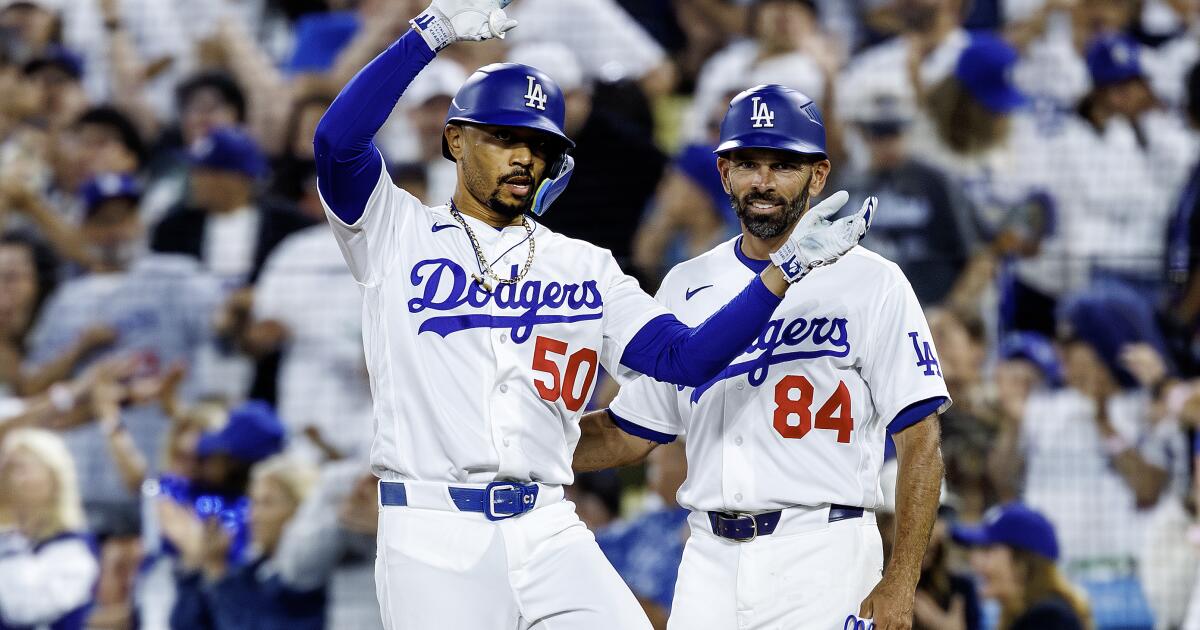
Mookie Betts’ eighth-inning single gives Dodgers the win over the Rockies
-
World43 minutes ago
From sewers to swimming sites: how Europe's cities reclaim their rivers
-

 News1 hour ago
Three more people charged with damaging Reflecting Pool after Trump’s multimillion-dollar restoration | CNN Politics


