Missouri
Failed GOP attempt to keep abortion off Missouri ballot could foreshadow fight to come • Missouri Independent


Four lawsuits. Several failed attempts to raise the threshold to pass constitutional amendments. One unprecedented attempt to decertify a ballot measure.
Despite this succession of failed GOP efforts to torpedo Amendment 3 over the past 18 months, abortion will remain on Missouri’s Nov. 5 ballot.
“What a long strange trip it’s been,” said Michael Wolff, a former Missouri Supreme Court chief justice and dean emeritus at St. Louis University School of Law, quoting Grateful Dead guitarist Jerry Garcia.
In the 18 months since the amendment, which would legalize abortion up until the point of fetal viability, was proposed as an initiative petition, it has faced a “minefield of ballot litigation” that ended earlier this month when the state’s highest court ruled the measure must stay on the ballot, Wolff said.
On June 24, 2022, Missouri became the first state in the country to ban abortions in response to the U.S. Supreme Court striking down Roe v. Wade and the constitutional right to an abortion. The ruling triggered a state law banning all abortions with limited exceptions in cases of medical emergencies. There are no exceptions for victims or rape or incest.
Since then, citizens in six states have voted to protect or increase abortion access, including in Kansas, Ohio and Michigan. Missouri is among 10 states where abortion will be on the ballot this year.
Amendment 3 would legalize abortion until the point of fetal viability and protect other reproductive rights, including birth control.
For anti-abortion lawmakers, “this is like the mega Super Bowl,” said James Harris, a longtime Republican political consultant.
He said litigation to drive up costs for proponents is advantageous, so lawsuits are par for the course. But the secretary of state’s effort to decertify the measure before the court cases concluded was unique.
While all the attempts were ultimately rebuffed by Missouri’s higher courts, they could foreshadow fights to come if Amendment 3 passes.
Sean Nicholson, a long-time progressive activist who has worked on multiple initiative petition campaigns, but is not involved with Amendment 3, called a circuit court ruling earlier this month that threatened to throw the measure off the ballot “some creative lawyering.”
“Nothing shocks me anymore in terms of what politicians are willing to do,” Nicholson said. “I think fundamentally they are terrified of a straight up or down vote on Amendment 3 and they’re going to pull out everything they can to avoid the consequences of voters having their say.”
State Sen. Mary Elizabeth Coleman, a Republican from Arnold, is among the anti-abortion activists who sued to keep Amendment 3 off the ballot. She said regardless of what happens in November, there’s a long road ahead.
“This is not the end all be all,” Coleman said. “And I think you will see efforts, win or lose, for Missourians to get another say in this.”
In the courts
In March 2023, 11 iterations of what’s now Amendment 3 were filed by Dr. Anna Fitz-James on behalf of the coalition behind the campaign. The political maneuvering by the state’s Republican elected officials aimed at keeping the abortion-rights amendment off the ballot began almost immediately.
Missouri Attorney General Andrew Bailey refused to accept State Auditor Scott Fitzpatrick’s fiscal note summary estimating the potential public cost of the amendment. Bailey, who thought the estimate should be about $6.9 trillion, attempted to force Fitzpatrick to alter his estimate of $51,000.
By the time Cole County Circuit Judge Jon Beetem ordered Bailey to certify the measure with Fitzpatrick’s estimate, the initial certification process, which is supposed to take no more than 54 days, had already taken nearly double that. The Supreme Court ultimately ruled in favor of Fitzpatrick.
Shortly after, Amendment 3 backers sued Secretary of State Jay Ashcroft over the ballot summary language he drafted, which would have asked Missourians, in part, if they wanted to “allow for dangerous, unregulated, and unrestricted abortions, from conception to live birth.”
Beetem ruled in September 2023 that Ashcroft’s language was “problematic” and inaccurate.
Missourians for Constitutional Freedom, the campaign behind the amendment, officially kicked-off signature gathering efforts in January, blaming the previous months of litigation for the delay.
Despite a May deadline to gather more than 171,000 signatures from Missourians across six of the eight congressional districts, the campaign ultimately filed more than 380,000 signatures with the secretary of state’s office.
This was despite a “decline to sign” campaign, the distribution of fliers urging Missourians to withdraw their signatures and unsubstantiated warnings that signing the initiative could result in identity theft.

At the same time, GOP lawmakers failed to pass one of their top priorities — legislation raising the threshold to pass initiative petitions — due in part to a record-breaking filibuster by Senate Democrats.
Chris Melody Fields Figueredo, executive director at the Ballot Initiative Strategy Center, said Missouri has been a battleground for attacks on the initiative process.
“We’ve seen an escalation of attacks to the ballot measure process and politicians trying to change the rules of the game to prevent citizens from putting these issues on the ballot,” she said. “Like reproductive freedom.”
Shortly after Ashcroft certified the measure for the ballot in mid-August, he posted “fair ballot language” to his official website that mirrored the ballot language rejected by the courts in 2023. Cole County Circuit Judge Cotton Walker ruled the description was “unfair, inaccurate, insufficient and misleading.”
Ashcroft was ordered to replace his language with the court’s language.
The final effort to keep Amendment 3 off the ballot began in late August, when a lawsuit filed by anti-abortion lawmakers and activists claimed the initiative petition failed to follow a number of laws.
Cole County Circuit Judge Christopher Limbaugh sided with the plaintiffs, ruling the proposal failed “to include any statute or provision that will be repealed, especially when many of these statutes are apparent.”
“I do think the circuit court decision is an important inflection point for the legislature to have a policy discussion in [2025] about when all of these measures are putting umpteen things into the constitution which then directly or indirectly invalidate a statute,” James said. “Should the voter clearly know that, and has it been kind of loosy-goosy?”
The Supreme Court took an expedited appeal of Limbaugh’s ruling. But Ashcroft announced he was decertifying the measure, an unprecedented attempt to rescind his previous decision that the measure had met the requirements to be on the ballot.
The next day, the Supreme Court judges said Ashcroft missed his statutory deadline to change his mind and they allowed the measure to stay on the ballot in a narrow 4-3 vote.

“The litigation, although highly charged, tends to wring out the politics of it and get down to what is legally required and how to apply that,” Wolff said, later adding: “It’s still not going to be easy to pass a constitutional amendment in the future, but I think we have some greater clarity about the process going forward.”
Alice Clapman, senior counsel for voting rights at the Brennan Center for Justice — a nonpartisan nonprofit that focuses on democracy issues — said Ashcroft “acted outside the law” when he decertified the ballot initiative.
It was an example of a series of “particularly brazen” attempts to stop abortion ballot initiatives that reflect a much broader pattern seen across the United States, she said.
“In a way these tactics to block abortion rights ballot initiatives are really doubling down on the repressive nature of abortion restrictions,” Clapman said.
Ashcroft called Clapman’s characterization of him “patently false,” saying his decision was within reason until the Supreme Court decided otherwise.
“The court did not follow state statute to stop it from going to the ballot,” he said. “I stepped in and did what the court illegally failed to do.”
Ashcroft added that he was “disheartened” by the rulings, but he expects if Amendment 3 passes, “some people will celebrate, and some people will act in the very same way they did in 1973 when Roe v Wade passed. They will work and act to make sure that women and children are protected.”
Missouri isn’t the only state to have a fight over an abortion amendment play out in new ways.
In Florida, state police have knocked on voters’ doors to question them about signing a petition to restore abortion rights in their state. A state health care agency also created a website denouncing the amendment, and Florida Gov. Ron DeSantis has been particularly vocal in his opposition to it.
In Arkansas, the state Supreme Court upheld the secretary of state’s decision to keep an abortion amendment off the ballot, ruling that the campaign behind the initiative did not submit the correct paperwork on time.
If voters approve Amendment 3, Missouri could be the first state to overturn a statewide ban by the vote of the people.
2 years after Missouri banned abortion, navigating access still involves fear, confusion
GOP lawmakers over the last decade passed laws targeting abortion providers in order to make obtaining an abortion more difficult. Those laws included mandatory pelvic exams for medication abortions and 72-hour waiting period between the initial appointment and an abortion.
A decade ago, more than 5,000 abortions were performed in the state, according to data from the Missouri Department of Health and Senior Services. But by 2020, that number dropped to 167 as providers closed. Between the Supreme Court decision in June 2022 through March 2024, there were 64 abortions under the state’s emergency exemption, according to data from the Missouri Department of Health and Senior Services.
Meanwhile, a recent study by the Guttmacher Institute, a reproductive rights research group, found that in 2023, 8,710 Missourians traveled to Illinois and 2,860 Missourians went to Kansas for the procedure, which remains legal in both states.
What’s next
Polling has remained favorable for Amendment 3.
An Emerson College poll found 58% of those surveyed support Amendment 3, with 30% opposed. The most recent SLU/YouGov Poll found that 52% supported the amendment and 34% opposed.
State Sen. Tracy McCreery, a Democrat from Olivette and a long-time advocate for abortion rights, said it’s important to keep in mind Missouri’s recent past.
“The legislature has a history of overturning the vote of the people,” she said.
As far back as 1940, when Missourians approved an initiative for a nonpartisan court plan to select appellate judges, the legislature put a proposition on the ballot two years later hoping to repeal it. Voters rejected the attempt.
In 2010, voters approved a new statute banning puppy mills by regulating dog breeders. The next year, legislation changed key provisions, such as removing the cap on the number of dogs allowed per breeder, undoing the citizen-led statutory change.
In 2018, Missourians passed a citizen-led amendment that would have required legislative districts be drawn to ensure partisan fairness. This amendment, known as “Clean Missouri,” was repealed two years later through a legislature-proposed amendment.
In 2020, Missouri voters approved Medicaid expansion. Lawmakers refused to fund it until the Missouri Supreme Court ruled they had no choice.
If Amendment 3 passes, McCreery predicted, Republican lawmakers will try something similar to what happened with Medicaid expansion, “but on steroids.”
“I expect shenanigans moving forward,” she said.
Wolff said lawmakers may also attempt to legislate around the issue. Even though parental consent is not directly mentioned in the amendment, lawmakers could try to rewrite laws requiring it.
Wolff added that he’s never seen such a unified effort by elected officials to stop a ballot measure. Even the heavily-opposed embryonic stem cell research amendment of 2006 didn’t face such pushback.
But lawmakers limited the kinds of research that could be conducted under the stem cell amendment. Ultimately, those restrictions made it impossible for researchers to move forward.
“(Amendment 3) is going to be harder to chip around about,” Wolff said. “But they’ll be creative. They’ve already been quite creative, so they will continue. That’s what a democratic republic will give you.”
Coleman said if the amendment passes, it will not be the last time Missourians vote on abortion, adding that an effort similar to the one that undid Clean Missouri is likely.
“The reason why you’ve seen such passion in the pro-life movement or from elected officials who are pro-life is because that reflects the passion of Missouri citizens who are pro-life,” Coleman said. “Which is to do anything and everything to protect the most vulnerable.”
Wolff agreed that this won’t be the end.
“There’s nothing permanent,” Wolff said, “in the people’s constitution.”
GET THE MORNING HEADLINES DELIVERED TO YOUR INBOX



Missouri
Thousands show up to protest current administration at ‘No Kings’ rally in Kansas City, Missouri

KSHB 41 reporter Lily O’Shea Becker covers Franklin and Douglas counties in Kansas. Share your story idea with Lily.
—
Thousands showed up to Mill Creek Park on Saturday in Kansas City, Missouri, in a wave of protests across the country criticizing U.S. President Donald Trump and his administration.
Thousands show up to protest current administration at KCMO ‘No Kings’ rally
Multiple protesters told KSHB 41 News they participated in the protest because they feel like it is the only way their voices can be heard.
Chris Morrison/KSHB
“Congress is not working for us,” said Sharon, a protester at Mill Creek Park. “I have called my Congress people numerous times.”
It was the third wave of ‘No Kings’ protests across the country since June 2025.
“I’ve been here for each of the ‘No Kings,’ and I’ll admit that I’m frustrated that I have to be back here again,” protester Carter Taylor said.
Taylor is a teacher for Kansas City Public Schools with AFT Local 691, and she said she showed up to represent her students.
“I hope that everyone here doesn’t just stay here today — that they donate to food banks, that they check in on their public schools,” Taylor said.
Will Shaw/KSHB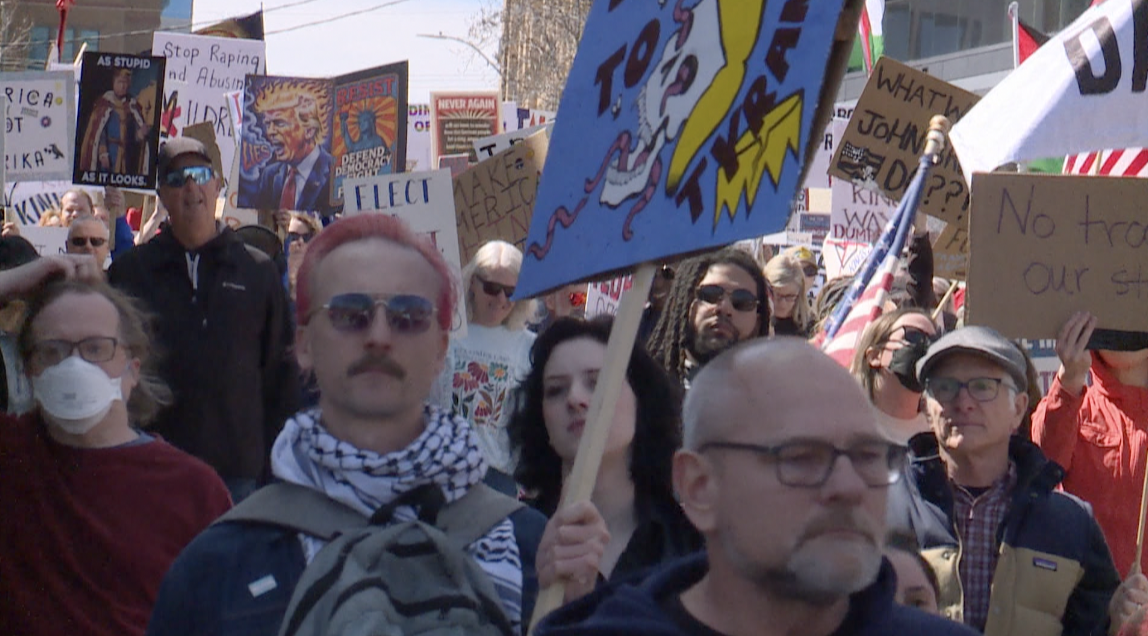
Protesters held signs critiquing the current administration’s stances on tariffs, ongoing wars and immigration enforcement, among other things.
Chris Morrison/KSHB
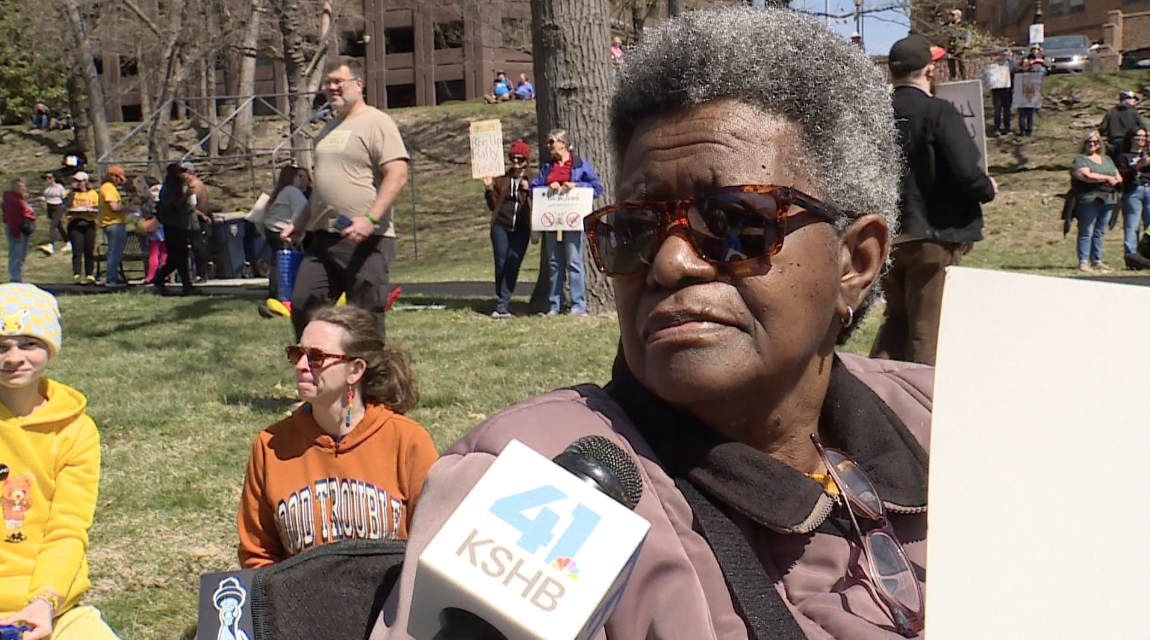
“It means that people care,” protester Lonnie Beattle said. “People care about what’s going on in this country, and people are not happy with what’s going on in the country.”
—

The Missouri Lottery offers several draw games for those aiming to win big.
Here’s a look at March 27, 2026, results for each game:
Winning Mega Millions numbers from March 27 drawing
13-27-28-41-62, Mega Ball: 16
Check Mega Millions payouts and previous drawings here.
Winning Pick 3 numbers from March 27 drawing
Midday: 1-2-5
Midday Wild: 5
Evening: 1-5-9
Evening Wild: 6
Check Pick 3 payouts and previous drawings here.
Winning Pick 4 numbers from March 27 drawing
Midday: 4-9-8-1
Midday Wild: 7
Evening: 6-7-3-3
Evening Wild: 6
Check Pick 4 payouts and previous drawings here.
Winning Cash Pop numbers from March 27 drawing
Early Bird: 10
Morning: 10
Matinee: 03
Prime Time: 15
Night Owl: 09
Check Cash Pop payouts and previous drawings here.
Winning Show Me Cash numbers from March 27 drawing
08-15-18-25-29
Check Show Me Cash payouts and previous drawings here.
Feeling lucky? Explore the latest lottery news & results
Are you a winner? Here’s how to claim your lottery prize
All Missouri Lottery retailers can redeem prizes up to $600. For prizes over $600, winners have the option to submit their claim by mail or in person at one of Missouri Lottery’s regional offices, by appointment only.
To claim by mail, complete a Missouri Lottery winner claim form, sign your winning ticket, and include a copy of your government-issued photo ID along with a completed IRS Form W-9. Ensure your name, address, telephone number and signature are on the back of your ticket. Claims should be mailed to:
Ticket Redemption
Missouri Lottery
P.O. Box 7777
Jefferson City, MO 65102-7777
For in-person claims, visit the Missouri Lottery Headquarters in Jefferson City or one of the regional offices in Kansas City, Springfield or St. Louis. Be sure to call ahead to verify hours and check if an appointment is required.
For additional instructions or to download the claim form, visit the Missouri Lottery prize claim page.
When are the Missouri Lottery drawings held?
- Powerball: 9:59 p.m. Monday, Wednesday and Saturday.
- Mega Millions: 10 p.m. Tuesday and Friday.
- Pick 3: 12:45 p.m. (Midday) and 8:59 p.m. (Evening) daily.
- Pick 4: 12:45 p.m. (Midday) and 8:59 p.m. (Evening) daily.
- Cash4Life: 8 p.m. daily.
- Cash Pop: 8 a.m. (Early Bird), 11 a.m. (Late Morning), 3 p.m. (Matinee), 7 p.m. (Prime Time) and 11 p.m. (Night Owl) daily.
- Show Me Cash: 8:59 p.m. daily.
- Lotto: 8:59 p.m. Wednesday and Saturday.
- Powerball Double Play: 9:59 p.m. Monday, Wednesday and Saturday.
This results page was generated automatically using information from TinBu and a template written and reviewed by a Missouri editor. You can send feedback using this form.
Missouri
Boone Health files lawsuit against Missouri Heart Center, alleging contract breaches, data misuse

COLUMBIA, Mo. (KMIZ)
Boone Health is suing a Columbia-based cardiology group, alleging breaches of contract, misuse of confidential information and plans to engage in unlawful competition.
The lawsuit, filed in Boone County Circuit Court, targets Missouri Cardiovascular Specialists LLP, also known as the Missouri Heart Center or MO Heart, which has provided cardiology services to Boone Health for more than a decade. According to court documents, a renewed agreement was signed in 2021 covering professional services and management of Boone Health’s cardiology operations.
Boone Health alleges it paid the cardiology group millions of dollars under those agreements for staffing, administrative oversight and revenue cycle management, which included access to sensitive financial and patient-related data. In return, MO Heart and its physicians agreed to noncompete and confidentiality provisions designed to protect Boone Health’s business interests.
The health system claims MO Heart violated those agreements by preparing to launch a competing cardiology practice in the Columbia area, potentially as soon as the contracts expire on May 6, 2026. The lawsuit alleges the new venture would fall within a restricted geographic area and time frame outlined in the noncompete clause, which Boone Health argues is enforceable under Missouri law.
Boone Health also accuses MO Heart of disclosing or misusing confidential information, including billing rates, reimbursement data and strategic business details during its transition to new partnerships with outside organizations. Boone Health alleges in the lawsuit those actions could cause “severe and irreparable injury.”
In addition, Boone Health claims MO Heart obstructed access to critical systems and data. The lawsuit alleges the cardiology group cut off Boone Health’s access to a key billing and patient information platform and stopped sharing necessary data, raising concerns about continuity of patient care.
Boone Health alleged that MO Heart indicated that it intends to operate independently and has taken the position that the noncompete provisions are unenforceable, according to the filing.
Boone Health is asking a judge to rule the noncompete agreements that MO Heart signed are valid, as well as having MO Heart return or destroy confidential information, and delay starting a competing practice until May 2027.
A jury trial has been requested.
A spokesperson for Boone Health told ABC 17 News that it would provide additional details early next week.
Dr. James T. Elliott of MO Heart disagreed with allegations in the lawsuit through a written statement.
“For months, we have tried to meet with leadership team at Boone Health to work constructively towards a new, collaborative arrangement that would preserve access to and expand high‑quality care for our patients and for the entire community. Unfortunately, Boone refused to engage with us in any meaningful way. Instead, we have been met with a series of escalating legal threats, culminating in today’s filing,” the statement reads.
“Earlier today Boone Health filed a lawsuit against Missouri Heart Center. We disagree with the lawsuit’s allegations and believe those claims are both legally and factually incorrect. This litigation does not change our commitment to caring for patients.”

Written off in Pittsburgh: 5 former Steelers looking for redemption in UFL

One dead following a shooting in Richmond County

Thousands turn out – again – as third 'No Kings' rallies take over Maryland streets

Third wave of No Kings Day protests take over northeast Ohio

Goodwill Central Texas launches “Swap Your Shop” Challenge

Florida High School Football Rankings: Top 25 teams – Oct. 21

How old is Bo Nix? What to know about Oregon quarterback ahead of 2024 NFL Draft

Cleary's 21 help Le Moyne down Central Connecticut State 69-64 in OT

99th annual Pony Swim held in Virginia

Indiana Members Credit Union announced as new anchor tenant at Bottleworks District

Jeffries declines to break with indicted Democrat after ethics panel’s guilty verdict

Hundreds of thousands march through London in stand against the far right

2 students killed, 7 other people injured in Tennessee bus crash during school field trip

Dem senators dodge crucial question on illegal alien accused of killing Chicago college student

EU Parliament unblocks key political hurdle in digital euro talks
-

 Movie Reviews1 week ago
‘Youth’ Twitter review: Ken Karunaas impresses audiences; Suraj Venjaramoodu adds charm; music wins praise | – The Times of India
-

 Sports1 week ago
IOC addresses execution of 19-year-old Iranian wrestler Saleh Mohammadi
-

 New Mexico6 days ago
Clovis shooting leaves one dead, four injured
-
 Business1 week ago
Disney’s new CEO says his focus is on storytelling and creativity
-

 Tennessee5 days ago
Tennessee Police Investigating Alleged Assault Involving ‘Reacher’ Star Alan Ritchson
-

 Technology6 days ago
YouTube job scam text: How to spot it fast
-

 Minneapolis, MN3 days ago
Boy who shielded classmate during school shooting receives Medal of Honor
-

 Texas1 week ago
How to buy Houston vs. Texas A&M 2026 March Madness tickets