Missouri
Cannabis trade group pushes back on Missouri rules to combat ‘predatory’ practices • Missouri Independent


Missouri cannabis regulators and the state’s largest marijuana trade group agree that people should be banned from flooding the license lottery with applicants they recruit who are never intended to have any actual control or profits.
It’s a practice the Missouri Division of Cannabis Regulation has called predatory, and efforts to root it out of the state’s microbusiness program have resulted in 41 licenses being revoked or facing possible revocation.
“We understand and agree with the intent of eliminating straw applicants and groups who are only interested in taking control of the licenses from such applicants, instead of a true partnership,” Andrew Mullins, president of the Missouri Cannabis Trade association, said in a letter to cannabis regulators last week.
But the details on how to do it are where differences emerge.
The Missouri Division of Cannabis Regulation announced last month a series of proposed rules aimed at combating predatory financial agreements and other practices during the application process. The division will now incorporate public feedback before submitting the final rules to the Secretary of State’s office.
The microbusiness program, which was written into the Missouri 2022 constitutional amendment that legalized marijuana, was designed for the licenses to end up in the hands of disadvantaged business owners — including disabled veterans, those with lower incomes and people with non-violent marijuana offenses.
The new rules attempt to clarify that contracts that take away majority ownership and control from the eligible applicants do not meet the constitutional requirements for the microbusiness program.
In its letter, MoCann pushed back on the division’s “list of arrangements that indicate a license is not owned and operated by the eligible applicants.”
On that list are “unexecuted” contracts that would take away control in the future. MoCann criticized the division for revoking licenses for having such agreements.
“If a contract is unexecuted, it is not an agreement at all,” Mullins wrote.
The letter reflects a key defense used in some of the appeals of licenses the division revoked last year.
Mullins wrote that the proposed rules were too vague about what an “exploitive exit fee” is if applicants want to get out of an agreement, along with what “majority owned and operated” looks like in practice. Mullins also urged the state to consider a new rule — allowing licensees to sell majority ownership right after the license is issued, instead of after the business is up and running which is required currently.
“Seeking to protect microbusiness owners from their own decisions will only succeed in crushing that dynamism,” Mullins said of the proposed rules. “It might protect microbusiness licensees from exploitation, but it will also protect their businesses straight into insolvency.”
Sami Jo Freeman, spokeswoman for the division, said regulators are “in the process of reviewing this letter, as well as all comments received, prior to moving forward.”
Revocations and MoCann’s members
State regulators have used a lottery system over the last two years to award 96 microbusiness licenses — a program sold to voters as a way to help victims of the War on Drugs get a toehold in the burgeoning cannabis industry.
But of the 96 licenses issued so far, 41 have been either revoked or are currently at risk of being revoked. Another three are under investigation.
A majority of those 44 licenses are connected to groups or individuals who flooded the lottery by recruiting people to submit applications and then offering them contracts that limited their profit and control of the business.
Some of MoCann Trade’s key members are associated with the licenses under state scrutiny.
The association’s general counsel is Eric Walter, an attorney who also represents cannabis investor Michael Halow.
Halow is connected to more than 1,000 of the 3,600 applications submitted for Missouri’s lottery since the program began and 22 awarded licenses. But every one of those licences has been either revoked or was denied certification earlier in October by the division.
An investigation by The Independent into one of these revoked licenses revealed that Halow signed a contract with a Black disabled veteran who told regulators she didn’t realize the agreement would give Halow full ownership of the business.
Missouri cannabis consultant John Payne led the campaign to legalize recreational cannabis in 2022 and sits on MoCann’s board of directors. He is connected to nearly 500 applications and 12 awarded licenses since the program’s inception.
Payne received six notices of pending revocation in October for licenses where he serves as the designated contact, stating the agreements reflected that the licenses would not be “majority owned and operated” by eligible applicants. Three more current licenses are under investigation for the same reason.
Seven of these licenses are connected to David Brodsky, who is MoCann’s microbusiness representative to the advisory board.
Brodsky told The Independent in an email Monday that he didn’t provide any input into MoCann’s response to the letter.
“I do agree with everything MoCann said in their response though,” he said.
Payne and Walter did not respond to The Independent’s request for comment.
When asked if Payne or Walter had a hand in writing the comments to the state, MoCann’s spokesman Jack Cardetti said, “Rule and regulatory matters generally emanate from our 10-person government affairs committee, which is comprised of licensees, many of whom are attorneys.”
Payne sits on the association’s government affairs committee. Cardetti further said, “As MoCann’s outside general counsel, Eric Walter is one of several who review these.”
The rules and contracts
The proposed rules would impact a number of contracts The Independent has analyzed.
The Independent’s June investigation found that for some of the applications, Payne recruited eligible Missourians and had them sign a 47-page contract that would ultimately give him and his partners 90.1% of profits and majority control of the business. Despite only owning a fraction of the business, under state law the applicants would bear the lion’s share of the regulatory scrutiny. If they ever want to walk away from the deal, they would be required to pay a nearly $1 million fee.
Four legal experts who reviewed the contract for The Independent concluded it was unfair and potentially predatory.
According to the proposed new rules, a license would not be considered owned and operated by the eligible applicants if the financial arrangement includes an “exploitive exit fee by a consultant or manager.”
The proposed rules also address provisions found in Destiny Brown’s contract with Michael Halow. Brown, who qualifies as an eligible applicant because she’s a disabled veteran, signed a memo of understanding and promissory note giving Halow the right to convert the loan he promised to provide into 100% of the “membership interest” — or all of the profits and voting rights of the business.
The state revoked the license on seven grounds, including that the application included “false or misleading information” and the licensee withheld information.
The proposed rule prohibits “agreements that the original majority eligible owner(s) in the application will not have majority ownership in the future.” That also includes any other documents, whether executed or in draft form, that may remove operational control from the eligible individuals listed in the application.
Halow told The Independent in an email last week that the proposed changes are “problematic.”
“Specifically, by stipulating that eligible applicants who are not the original lottery winners cannot operate a recently issued license,” Halow wrote, “the state would effectively strip those individuals of their constitutionally granted right or privilege to operate these businesses, regardless of their ownership or lottery status.”
MoCann suggests allowing agreements to sell majority equity of the business to occur after the state has issued the license. Currently, the licensees can only do that after the business has been approved to commence.
“The ability to sell the license – including by contracting to sell prior to commencement – is a valuable backup plan for every licensee,” Mullins wrote in his letter.
‘Operated by’

One contract associated with Brodsky established a board of three managers that would vote on all company decisions. The lender and the “consultant” each get to select a member.
That left the qualified applicant with only one-third of the voting power.
Brodsky said his contract is valid because all board members meet the program’s eligibility requirements.
“The constitution only says that it must be majority owned and operated by eligible applicants,” Brodsky stated in an email to The Independent. “I am an eligible applicant as is everyone involved with Green Zebra LLC.”
The validity of this type of board structure could potentially change by alternative language that MoCann proposed in its letter.
In the state’s definition of majority owned and operated, eligible individuals must also have the power to direct the management and policies of the license and enter into agreements.
The association proposes to add the word “collectively” after individuals. It also proposes stating that, “Non-eligible owners may hold a minority of voting rights, and the owners may hire management, managers, staff and enter into contracts that implement the decisions of the ownership collectively.”
The division’s definition also includes the phrase “must have a level of operational control that would be expected of an owner.”
MoCann suggests an alternative definition that eligible majority owners don’t need to have “exclusive operational control” of the business, but they must have majority voting rights. This takes out any “vagueness,” the letter states, on what operational control means.
“If they must indeed exercise exclusive and total control over the business, there is effectively no way for them to hire any managers, staff or vendors to assist with the business,” Mullins wrote.
However, the division’s website states that, “the ‘owned and operated’ requirement does not prohibit microbusiness licensees from entering into management agreements for facility operations.”
Michael Wolff, a former chief justice of the Missouri Supreme Court and dean emeritus of the St. Louis University Law School, said he wouldn’t construe the state’s definition to prohibit somebody from hiring a manager — because that’s what would normally be expected of an owner.
“I don’t think you can make a parade of horribles out of that language,” Wolff said. “I think that language was put in there with a good effect and good intent.”
The division stated in a press release last month that a “purported owner with little to no knowledge, control, agency or decision-making authority in an application or license does not meet the intent or meaning of the requirement in Article XIV.”
Adolphus Pruitt, president of the St. Louis City NAACP and who helped write the microbusiness provision, sided with the division’s definition.
It’s similar, he said, to a federal standard, known as the “commercially useful function” rule, used to weed out pass-through companies in contracts set aside for underrepresented business enterprises.
“It ensures that underrepresented business enterprises are genuinely responsible for executing distinct elements of work by actively performing, managing,” Pruitt said, “and supervising their operations, thereby preventing token participation.”
Canna Zoned
James Harnden says he didn’t realize that when he agreed to apply for a microbusiness license that the contract he signed gave him 100% ownership interest but no revenue or profits from the business.
The contract was with Michigan-based cannabis group Canna Zoned.
After the business passed through all the state and municipal approvals, the contract stated that Harnden would be required to sell his share of the business for $1 to the group or be held in breach of contract.
Harden did not get a license, but the state revoked two other applicants connected to Canna Zoned.
Under the new rules, any entity who was the designated contact for a license that was previously revoked for failure to comply with the ownership and operation requirements will no longer be allowed to be involved in any capacity in a future microbusiness application.
All microbusiness applications in which such former designated contact has any involvement would be denied.
Jeffrey Yatooma, president of Canna Zoned and the designated contact for the two licenses revoked last year, told The Independent in an email last week that the proposed rule changes “reflect a fundamental misunderstanding” of the support that many applicants need to navigate the “labyrinthine system.”
“These applicants often lack the experience or resources to manage the hurdles involved in obtaining full licensure,” Yatooma stated. “That’s exactly why they turn to us—to provide guidance, expertise, and a clear path forward. The assertion that these partnerships are somehow ‘predatory’ mischaracterizes the reality of the situation.”



Missouri
Boone Health files lawsuit against Missouri Heart Center, alleging contract breaches, data misuse

COLUMBIA, Mo. (KMIZ)
Boone Health is suing a Columbia-based cardiology group, alleging breaches of contract, misuse of confidential information and plans to engage in unlawful competition.
The lawsuit, filed in Boone County Circuit Court, targets Missouri Cardiovascular Specialists LLP, also known as the Missouri Heart Center or MO Heart, which has provided cardiology services to Boone Health for more than a decade. According to court documents, a renewed agreement was signed in 2021 covering professional services and management of Boone Health’s cardiology operations.
Boone Health alleges it paid the cardiology group millions of dollars under those agreements for staffing, administrative oversight and revenue cycle management, which included access to sensitive financial and patient-related data. In return, MO Heart and its physicians agreed to noncompete and confidentiality provisions designed to protect Boone Health’s business interests.
The health system claims MO Heart violated those agreements by preparing to launch a competing cardiology practice in the Columbia area, potentially as soon as the contracts expire on May 6, 2026. The lawsuit alleges the new venture would fall within a restricted geographic area and time frame outlined in the noncompete clause, which Boone Health argues is enforceable under Missouri law.
Boone Health also accuses MO Heart of disclosing or misusing confidential information, including billing rates, reimbursement data and strategic business details during its transition to new partnerships with outside organizations. Boone Health alleges in the lawsuit those actions could cause “severe and irreparable injury.”
In addition, Boone Health claims MO Heart obstructed access to critical systems and data. The lawsuit alleges the cardiology group cut off Boone Health’s access to a key billing and patient information platform and stopped sharing necessary data, raising concerns about continuity of patient care.
Boone Health alleged that MO Heart indicated that it intends to operate independently and has taken the position that the noncompete provisions are unenforceable, according to the filing.
Boone Health is asking a judge to rule the noncompete agreements that MO Heart signed are valid, as well as having MO Heart return or destroy confidential information, and delay starting a competing practice until May 2027.
A jury trial has been requested.
A spokesperson for Boone Health told ABC 17 News that it would provide additional details early next week.
Dr. James T. Elliott of MO Heart disagreed with allegations in the lawsuit through a written statement.
“For months, we have tried to meet with leadership team at Boone Health to work constructively towards a new, collaborative arrangement that would preserve access to and expand high‑quality care for our patients and for the entire community. Unfortunately, Boone refused to engage with us in any meaningful way. Instead, we have been met with a series of escalating legal threats, culminating in today’s filing,” the statement reads.
“Earlier today Boone Health filed a lawsuit against Missouri Heart Center. We disagree with the lawsuit’s allegations and believe those claims are both legally and factually incorrect. This litigation does not change our commitment to caring for patients.”
Missouri
Missouri bill that would split Jackson County and Kansas City gets little support from lawmakers

A Missouri House committee had its first hearing this week on a proposed constitutional amendment that would split Kansas City and Jackson County upon approval by voters.
The legislation is nicknamed “Jackxit,” a nod to Brexit, the withdrawal of the United Kingdom from the European Union in 2020.
Republican state Rep. Mike Steinmeyer is sponsoring the bill. He said eastern Jackson County voters feel underrepresented in the county government, and this legislation would give them the power to change that.
At the hearing, committee members listened to Steinmeyer’s presentation of the bill before asking questions and sharing their thoughts.
Democratic state Rep. Bridget Walsh Moore compared what the bill proposes to “The Great Divorce” that saw the legal separation of the city of St. Louis from St. Louis County in 1876.
Several committee members criticized a part of the bill that says if it’s signed into law, the question of whether to split the county in two would appear on the Missouri ballot every 10 years.
Moore called it a “never-ending clause.”
“There’s a provision that says every 10 years this has to go back on the ballot, whether you like it or not,” Moore said. “And we’re going to keep voting on it, until you vote the way we think you should.”
Democratic state Rep. Jeff Hales said the bill’s language suggests the question would reappear on the ballot every 10 years until it’s approved by voters.
“Why does it end when it’s approved if the importance and the value here is giving the voters of Jackson County a right to weigh in on their charter and their government?” Hales said.
Steinmeyer said that clause exists to give Jackson County voters the opportunity to weigh in on their form of government.
“It gives them the right to speak and say we want change, or we want to abolish and start over,” Steinmeyer said. “That’s all we’re asking for.”
Democratic state Rep. Ashley Aune questioned how the ballot question would protect the right of voters. Steinmeyer said it protects their right to vote and be heard, specifically on their governance.
Lobbyist Shannon Cooper testified on behalf of the city of Kansas City, the Greater Kansas City Chamber of Commerce and the Civic Council of Greater Kansas City. He said during a public comment period that the bill was “the most befuddling piece of legislation” that he’s had to testify for or against.
Cooper brought up the historic recall election of County Executive Frank White Jr. and said the recall showed the system Steinmeyer is trying to fix with this bill can work.
“If the voters are not happy, they can deal with their problems,” Cooper said. “They’ve proven that in the last year.”
No action was taken on the bill, and it is not yet scheduled for a future hearing.
Missouri
Kansas City, Missouri, City Council voted Thursday to approve the city’s $2.6 billion budget for 2026-27
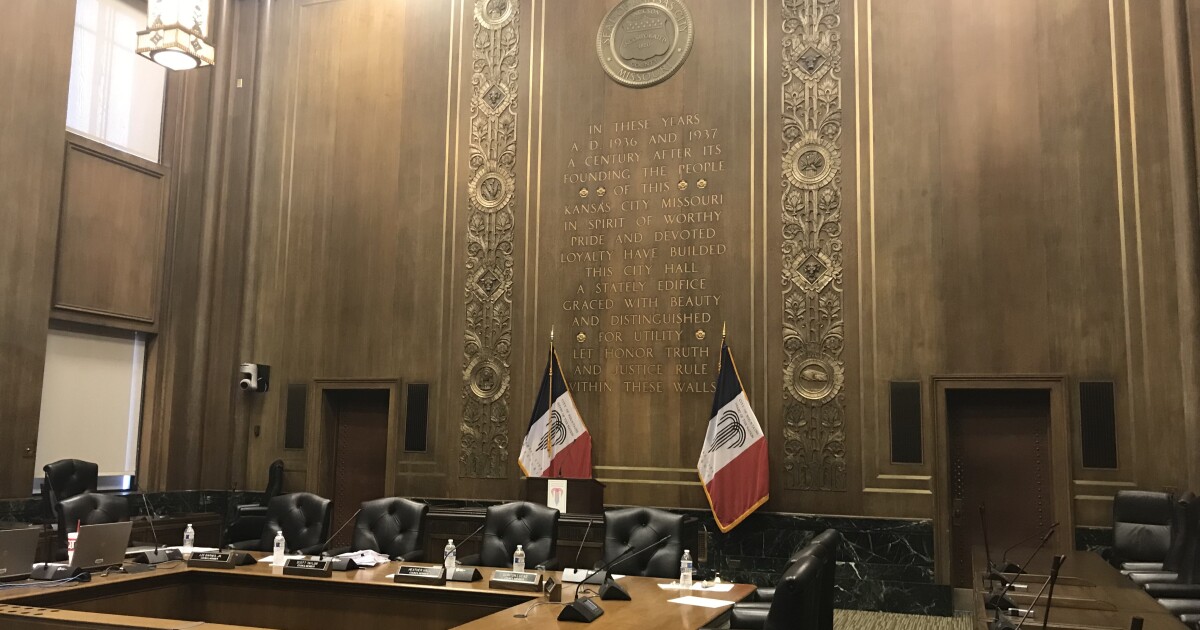
KANSAS CITY, Mo. — The Kansas City, Missouri, City Council voted Thursday to approve a $2.6 billion budget for the city’s fiscal year of 2026-27.
The budget includes $744 million in spending for public safety, including $26.3 million for a new Department of Community Safety and $4.2 million to hire 50 new KCMO Police Department officers, along with 10 call takers and 10 dispatchers.
“Our budget respects the strong fiscal foundation the taxpayers have helped Kansas City build, maintaining a rainy-day fund of over $200 million, increasing road resurfacing, hiring more public safety and city workers, and investing in all Kansas City neighborhoods,” Mayor Quinton Lucas said in a news release from the city. “In a city that can walk and chew gum, we are proud to welcome the world while delivering strong basic services for Kansas City’s families.”
The council voted to spend $83.8 million for the Kansas City Area Transportation Authority to provide bus services, but the KCATA may have to make cuts in bus services even with a $6 million boost in funding from the city.
In addition, the council approved spending $39.4 million for citywide street resurfacing and $1.5 million for tearing down dangerous buildings.
“This budget reflects a collaborative effort across the city, and provides a clear path for Kansas City to keep moving forward with discipline, accountability and a focus on service,” City Manager Mario Vasquez said in the news release. “Thank you to the council for its thoughtful deliberation and input in crafting this budget.”
More information on the fiscal year 2026-27 budget can be found on the city’s website.
—

Illinois vs Iowa prediction, analysis, Elite Eight expert picks for men’s March Madness

Police arrest suspect in Westfield homicide

Tennessee basketball vs Iowa State Sweet 16 tipoff time changed for later start

Kansas State Baseball 2026 at Utah

Kentucky Newsmakers 3/29: Senate Candidate Charles Booker; Kentucky League of Cities Pres. Mayor Paul Sandefur

Florida High School Football Rankings: Top 25 teams – Oct. 21

How old is Bo Nix? What to know about Oregon quarterback ahead of 2024 NFL Draft

Cleary's 21 help Le Moyne down Central Connecticut State 69-64 in OT

99th annual Pony Swim held in Virginia

Indiana Members Credit Union announced as new anchor tenant at Bottleworks District

WATCH: Senate hearing goes silent after Angel Father confronts top Dem over daughter’s death

US diplomat Marco Rubio denounces settler violence, tolls in Hormuz strait

Iran-linked hackers have breached FBI Director Kash Patel’s personal emails | CNN Politics

Live: CPAC 2026 Day 2

Video: Will ICE Change Under Its New Leader?
-

 Detroit, MI1 week ago
Drummer Brian Pastoria, longtime Detroit music advocate, dies at 68
-

 Movie Reviews1 week ago
‘Youth’ Twitter review: Ken Karunaas impresses audiences; Suraj Venjaramoodu adds charm; music wins praise | – The Times of India
-

 Sports6 days ago
IOC addresses execution of 19-year-old Iranian wrestler Saleh Mohammadi
-

 New Mexico5 days ago
Clovis shooting leaves one dead, four injured
-
 Business1 week ago
Disney’s new CEO says his focus is on storytelling and creativity
-

 Technology5 days ago
YouTube job scam text: How to spot it fast
-

 Tennessee4 days ago
Tennessee Police Investigating Alleged Assault Involving ‘Reacher’ Star Alan Ritchson
-

 Texas1 week ago
How to buy Houston vs. Texas A&M 2026 March Madness tickets