Minnesota
Things to know about Minnesota's new, non-racist state flag and seal


MINNEAPOLIS (AP) — Love it, hate it or yawn at it, Minnesota is set to get a new state flag this spring that echoes its motto of being the North Star State, replacing an old flag that brought up painful memories of conquest and displacement for Native Americans.
During the monthslong selection process, some publicly submitted designs gained cult followings on social media but didn’t make the final cut. They included: a loon – the state bird – with lasers for eyes; a photo of someone’s dog; famous paintings of George Washington and Abraham Lincoln; and an image of a rather large mosquito.
Instead, the flag design adopted in December includes a dark blue shape resembling Minnesota on the left, with a white, eight-pointed North Star on it. On the right is a light blue field that to those involved in the selection process symbolizes the abundant waters that help define the Land of 10,000 Lakes.
The new state seal features a loon amid wild rice, to replace the image of a Native American riding off into the sunset while a white settler plows his field with a rifle at the ready. The seal was a key feature of the old flag, hence the pressure for changing both.
Unless the Legislature votes to reject the new emblems, which seems unlikely, they will become official May 11. Other states are also considering or have already made flag changes. Here are things to know about Minnesota’s new flag and seal, and how the debate unfolded.
WHY THIS DESIGN?
The flag was designed by committee — a commission that included design experts and members of tribal and other communities of color. More than 2,600 proposals were submitted by the public. The commission picked one by Andrew Prekker, 24, of Luverne, as the base design.
The main changes the commission made were rotating the star by 22.5 degrees so it pointed straight north, and replacing the original light blue, white and green stripes with a solid, light blue field. The significance of the light blue area is up to the beholder. The original Dakota name for Minnesota, Mni Sóta Makoce, which will go on the new seal, can be translated as “where the water meets the sky.” The commission’s chairman, Luis Fitch, said that to him, the light blue represents the Mississippi River, which originates in Minnesota, pointing to the North Star.
THE CRITICISM
It’s fair to say that much of the public reaction to the new flag fell into the category of “meh” or worse when the design adoption was announced. But supporters of the new flag hope it will grow on people. It’s not like many people were particularly attached to the old flag.
Some criticism circulated by conservatives has been inaccurate. The flag does not resemble that of Somalia nor of its Puntland region.
While it’s true that both the original design and the Puntland flag had light blue, white and green stripes in the same order, the commission dropped the stripes in favor of simplicity and symmetry. And it’s a stretch to say the final version bears much resemblance to the Somali national flag, which is a solid light blue with a white, five-pointed star right in the center. The state Democratic Party chairman issued a news release taking one GOP lawmaker to task for fueling the spread of the misinformation on social media.
Two Republican lawmakers who were nonvoting members of the commission objected to putting the Dakota name for Minnesota on the seal. They said they will propose letting voters decide up or down this November. That proposal is unlikely to get traction in the Democratic-controlled Legislature. And Democratic Secretary of State Steve Simon, a commissioner who backed both designs, said a referendum would probably be unconstitutional.
Additionally, Aaron Wittnebel — a voting member of the commission for the Ojibwe community — said in a minority report last week that adopting the Dakota phrase on the seal “favors the Dakota people over other groups of peoples in Minnesota.”
THE PRAISE
While the new flag might strike some critics as uninspired — and a waste of time and the $35,000 budgeted for the commission — the change is important to many Native Americans in a state where there are 11 federally recognized Ojibwe and Dakota tribes.
“Dare I say anything that’s not a Native person being forced off their land is a flag upgrade?!” tweeted Democratic Lt. Gov. Peggy Flanagan, a member of the White Earth Band of Ojibwe. “Excited to have a new state flag that represents every Minnesotan.”
Democratic state Sen. Mary Kunesh, a descendant of the Standing Rock Lakota, was a chief author of the bill that launched the redesign and a nonvoting member of the commission. She said in a statement that the more than 2,600 submissions and the lively public debate showed that Minnesotans care deeply about their state.
“It was an incredible experience to see our community’s energy and passion captured in the beautiful designs they submitted,” Kunesh said. “From loons and wild rice to water and the North Star, we have captured the essence of our state in the new flag and seal. These designs honor our history and celebrate the future of Minnesota.”
One Indigenous graphic designer is already selling T-shirts online that bear the new design and say, “At least the flag isn’t racist anymore.”
Ted Kaye, secretary of the North American Vexillological Association, who studies flags and was involved in the redesign, has said the new Minnesota flag gets an “A+” from him for its simplicity, uniqueness and inclusion of meaningful symbols.
THE REST OF THE COUNTRY
Several other states also have been redesigning flags.
The Utah Legislature last winter approved a design featuring a beehive, a symbol of the prosperity and the industriousness of its Mormon pioneers. Mississippi chose a new flag with a magnolia to replace a Confederate-themed flag. Other states considering simplifying their flags include Michigan, Illinois and Maine.
___
Associated Press writer Trisha Ahmed in Minneapolis contributed to this report.



Minneapolis police are investigating a shooting that seriously injured a man on the city’s north side Wednesday afternoon.
The shooting happened just before 2 p.m. on the 1200 block of 36th Avenue North, according to the Minneapolis Police Department.
Upon arrival, officers found a man inside the living room of a residence suffering from a life-threatening gunshot wound. Police provided medical aid to the victim before he was transported by ambulance to an area hospital.
Officers are working to determine what led up the shooting, including if it was accidental, according to officials.
No arrest have been made so far.

The National Weather Service (NWS) has confirmed that the tornado that struck the Detroit Lakes area of northwestern Minnesota on July 6 was rated EF2, with estimated peak winds of 185 km/h (115 mph).
The tornado touched down at 19:47 local time (LT), approximately 3 km (2 miles) south-southwest of Westbury, according to the NWS.
It remained on the ground for about 10 minutes. The tornado had a path length of 10.93 km (6.79 miles) and reached a maximum width of more than 730 m (2 400 feet). It dissipated approximately 6 km (4 miles) northeast of Detroit Lakes at 19:57 LT.
The Becker County Sheriff’s Office (BCSO) said deputies and other emergency responders began monitoring the severe weather around 19:30 LT after receiving reports of a possible funnel cloud north of Lake Park.
At approximately 20:14 LT, the Sheriff’s Office received a report of a tornado near the Oakland Beach area, where it caused extensive damage to homes, buildings, and trees.
The NWS confirmed two injuries associated with the event, one of which was directly caused by the tornado.
“1 injury can be directly attributed to the tornado, as a homeowner was injured in their home when their roof was removed by the tornado. The second injury was after the tornado during the cleanup stage and could be due to shock or trauma, according to the county emergency manager,” the NWS reported.
“Responders went from home to home looking for residents and checking for the injured. Two individuals were transported to Essentia St. Mary’s Hospital with non-life-threatening injuries. One other patient went to the hospital by private vehicle,” the BCSO said.
-

Tornado damage in Detroit Lakes, Minnesota on July 6, 2026. Credit: Becker County Sheriff’s Office
-
Tornado damage in Detroit Lakes, Minnesota on July 6, 2026. Credit: Becker County Sheriff’s Office
-
Tornado damage in Detroit Lakes, Minnesota on July 6, 2026. Credit: Becker County Sheriff’s Office
-
Tornado damage in Detroit Lakes, Minnesota on July 6, 2026. Credit: Becker County Sheriff’s Office
-
Tornado damage in Detroit Lakes, Minnesota on July 6, 2026. Credit: Becker County Sheriff’s Office
-
Tornado damage in Detroit Lakes, Minnesota on July 6, 2026. Credit: Becker County Sheriff’s Office
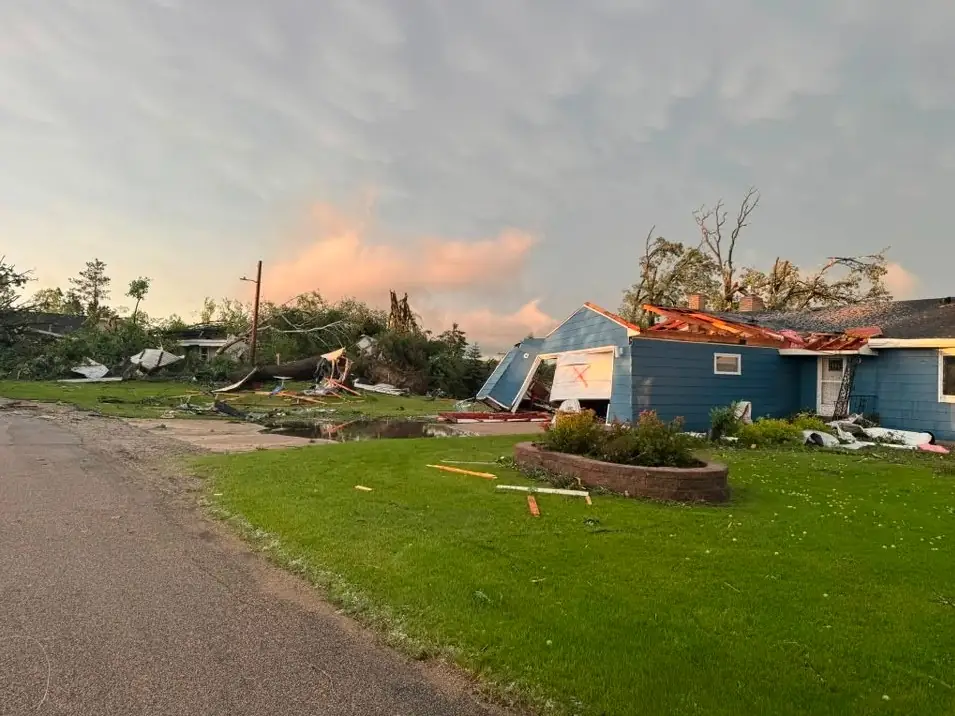
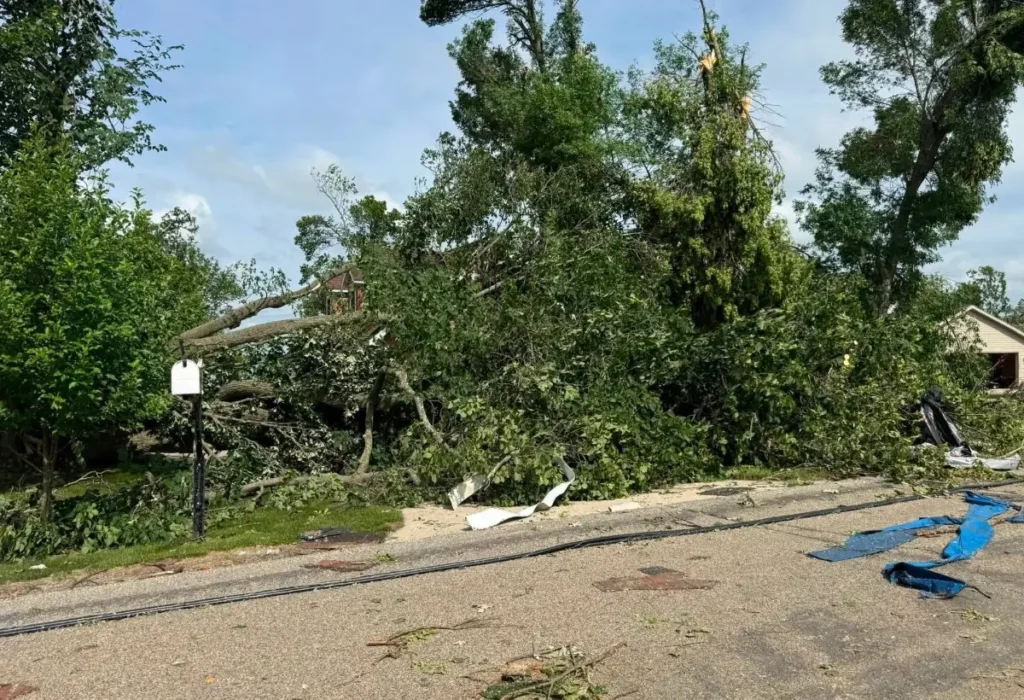
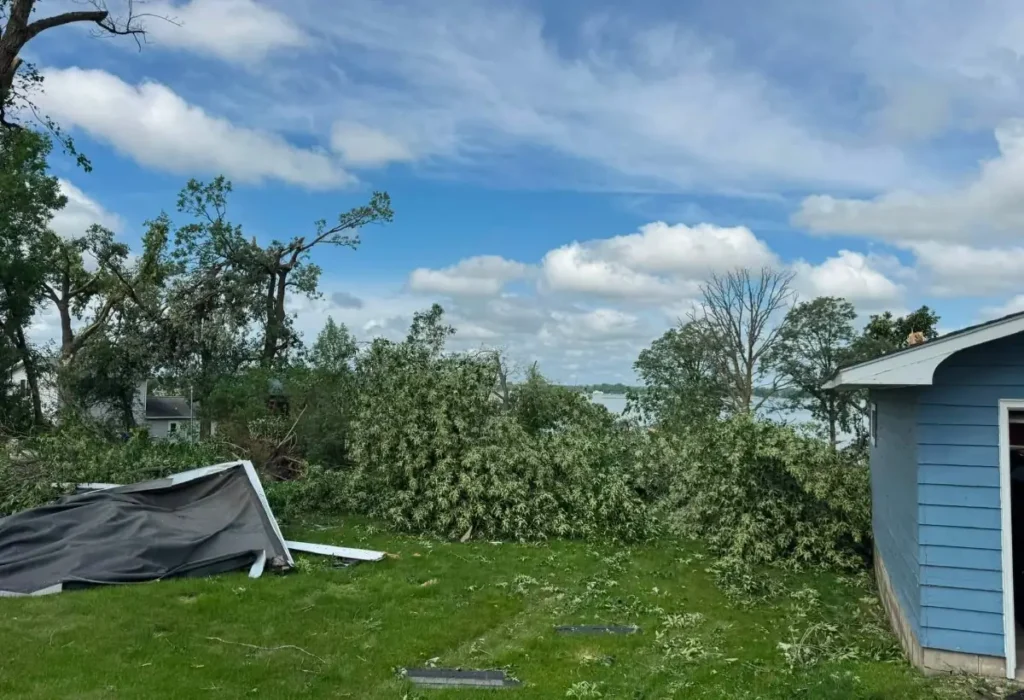
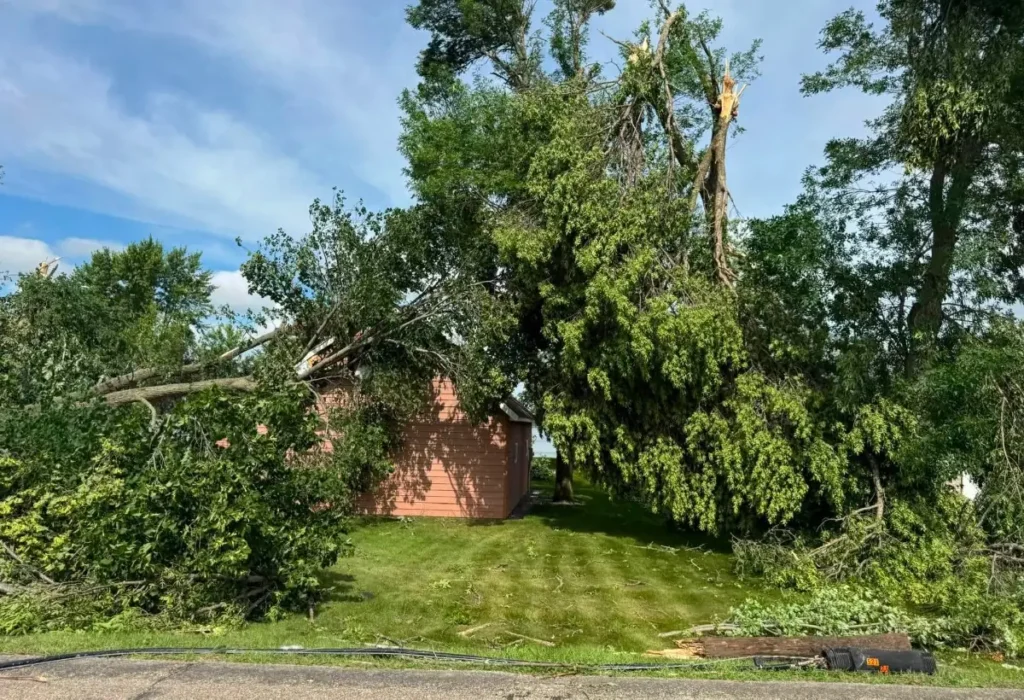
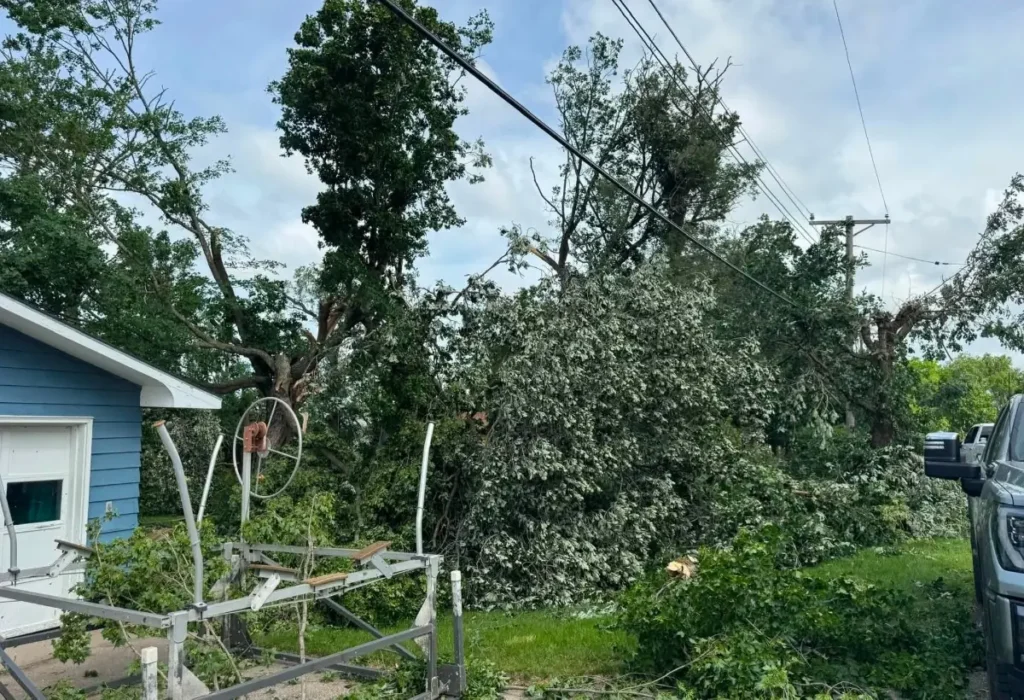
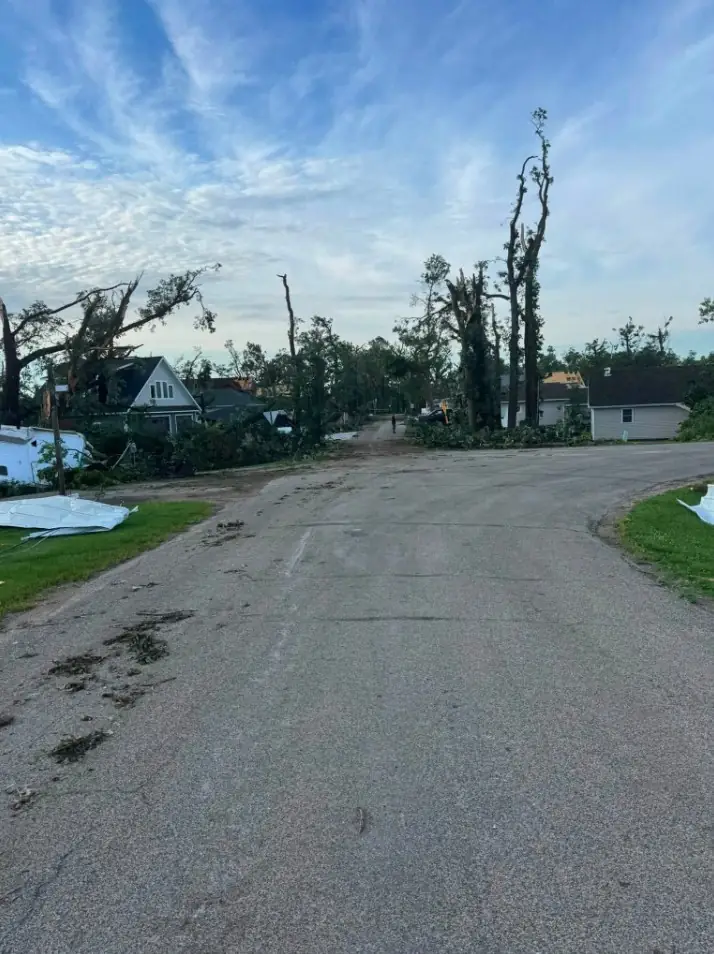
The tornado began about 2 km (1 mile) northwest of Wheeler Lake before crossing the lake, where it damaged the roofs of several homes and snapped the trunks of large oak and poplar trees.
It reached its maximum width near the western shore of Big Floyd Lake, with the Oakland Beach neighborhood sustaining the most severe damage.
Multiple garages and lighter outbuildings were swept away, while widespread roof and tree damage was reported. A 2 x 4 m (6 x 12-foot) horse trailer was lofted and carried about 200 m (656 feet) before the tornado crossed Big Floyd Lake and continued east. The last visible damage was identified near the intersection of County Highway 25 and Anchor Road.
More than 500 customers lost power as a result of the storms, according to Detroit Lakes Public Utility.
As the storm tracked east-southeast, strong winds, hail, and heavy rain affected areas north of Audubon before a tornado warning was issued for the Callaway and Rochert areas. Reports of downed trees, power lines, and debris soon followed from Detroit Township between U.S. Highway 59 and County Highway 21.
References:
1 Public Information Statement – NWS – July 7, 2026

Giordano’s, the famous pizzeria known for their deep-dish style Chicago pizza, is opening a second location in Minnesota at the Mall of America.
The pizza chain also has a location in Richfield, and previously had a location some years ago in Minneapolis in Uptown.
The grand opening of the Mall of America location will be on Thursday, July 16. The restaurant there will be unique, with the restaurant’s first self-service kiosk ordering. It will also have a grab-and-go area and a normal seated restaurant experience.
The Chicago deep-dish chain has been around since 1974, with the vast majority of locations in the Chicagoland area. They have 60 restaurants in nine states and are currently expanding nationwide.
-

 North Dakota2 minutes ago
Today in History, 1975: Earthquake rattles portions of Minnesota and the Dakotas, including Fargo-Moorhead
-

 Ohio9 minutes ago
Is another team ready to take over the top of the Big Ten from Indiana and Ohio State?
-

 Oklahoma12 minutes ago
Kip Lewis reveals why he returned to Oklahoma for senior season
-

 Oregon17 minutes ago
Pierce County Sheriff: Homicide ‘suspect was shot and killed by police in Seaside, Oregon’
-

 Pennsylvania24 minutes ago
‘Natural splendor at its best’: Penn’s Cave may become Pa.’s next state park
-

 Rhode Island27 minutes ago
Throwback: USS Rhode Island commissioned in Newport
-

 South-Carolina32 minutes ago
Watch out for SC’s 5 most common ticks and take steps to avoid bites
-
South Dakota39 minutes ago
SD Lottery Powerball, Lotto America winning numbers for July 8, 2026

