Minnesota
Grading the 2024 Minnesota Twins: Hitters


Well, that was a baseball season. I’d say it was one to forget but sadly this epic disaster of a second half will not likely be leaving our memories any time soon. Now that all 162 games are in the books, it’s time to reflect and evaluate the individual contributors. We’ll start today with the hitters. Seventeen different players made at least 50 plate appearances for the Twins. Here I assign them all letter grades, in alphabetical order.
Byron Buxton: B
It got lost in the in the fact that he once again was sidelined by multiple injuries, but this was a big bounce-back year for Buxton. He reached 100 games played for just the second time in his career, and posted All-Star caliber production while on the field. Still, he did miss about two months of action, and showed some signs of diminishing athleticism at age 30.
Willi Castro: B
Castro made his first All-Star team and led Minnesota in games played, setting a new MLB standard for positional flexibility (and a franchise record for HBP!). His durability and versatility made him an indispensable asset for the manager. Those positives solidly outweighed his power outage in the second half, although that did hurt.
Carlos Correa: B
On a rate basis, Correa would be graded an A or even an A+. He was hugely impactful while on the field, hitting as well as he ever has while playing stellar defense. Unfortunately, another bout with plantar fasciitis cost him nearly the entire second half, and his absence played a big part in the team’s downfall.
Kyle Farmer: D
For most of the season, Farmer was about as bad as a player could possibly be. But he surged enough toward the end to bring his numbers back into the range of respectability, and to his credit, he did it at a time where the rest of the offense was in hell. Still, on balance, a poor campaign.
Ryan Jeffers: C
Jeffers failed to back up his stellar 2023 season, experiencing a major offensive backslide after starting strong in April. He completely disappeared in September. Jeffers was still an average MLB hitter and launched 21 home runs; that does have quite a bit of value for a catcher. But his defense behind the plate was generally pretty rough.
Edouard Julien: F
It’s tough to shine any kind of positive light on Julien’s year. He struggled in the majors, went to Triple-A, failed to dominate minor-league pitching, and then got called back up only out of roster necessity. Julien was so uninspiring in his second stint that, by season’s end, he was mostly sitting even against right-handed pitchers.
Max Kepler: D
A sad end to Kepler’s lengthy Twins career. Battling a sore knee for much of the season, Kepler produced a career-worst 91 OPS+ while also showing decline defensively in right field, and he missed all of September.
Alex Kirilloff: F
He had a solid first couple of weeks, then went into a prolonged tailspin, and revealed only after being optioned to the minors that he’d been playing through injury – to the team’s detriment. He didn’t appear in a game after June 11th, batting .201 on the season.
Trevor Larnach: B+
Larnach was one of the few unclouded bright spots of the 2024 Twins. Putting several years of underwhelming, injury-impacted performance behind him, Larnach played in 112 games and was usually in one of the lineup’s money spots against righties while producing at a well above-average rate (115 OPS+).
Brooks Lee: D
Ranked as one of the best prospects in baseball, fresh off torching Triple-A, Lee arrived on the big-league scene with a splash, batting .458 in his first six games. From that point forward he batted .182 with a .500 OPS in 44 games, showing minimal ability to drive the ball despite a contact-heavy approach. Better days are ahead for the 23-year-old.
Royce Lewis: C
Through his first 40 games, Lewis slashed .279/.356/.664 with 15 home runs, looking the part of an elite slugger. In his last 42, he slashed .191/.236/.256 with one home run as the team nosedived. On balance, his production was still certainly better than average, but he again missed tons of time with injury and his defense regressed noticeably.
Austin Martin: D+
Martin played more than expected, and probably more than he earned, but his ability to handle center field somewhat competently kept him on the roster for much of the season, and his speed was an asset on a team that had almost none. But Martin was a punchless hitter, and not particularly sharp at any of the defensive positions he played.
Manuel Margot: F
His modestly good numbers against left-handed starters were not enough to offset his general lack of production, his shoddy defense, and his almost inconceivable ineptitude as a pinch-hitter. One of the more annoying Twins players to watch in memory.
Jose Miranda: D+
What a weird season for Miranda, whose hot hitting in June and July – including an MLB record-tying string of 12 straight at-bats with a hit – gave way to a .543 OPS with no homers in the second half, during which he may have never been healthy. He again looked poor defensively at third and first.
Carlos Santana: B
The veteran first baseman proved to be an excellent addition in the context of his modest price tag, delivering a number of clutch hits while leading the team in home runs and providing defense worthy of a Gold Glove. A .748 OPS from a first baseman is ultimately nothing to write home about, but Santana was a quality contributor all-around.
Christian Vázquez: D
To his credit, Vázquez rated well defensively again, but rather than rebounding from a horrendous season at the plate in 2023, he was somehow even worse offensively, ranking among the worst hitters in the league. Even for a role with low offensive standards, Vázquez came up well short of expectations for a second straight season.
Matt Wallner: B+
He stumbled badly out of the gates and spent most of the first half in Triple-A as a result, but after returning from the minors, Wallner was the team’s most productive player for the remainder of the season, blasting 13 homers with a nearly .900 OPS in 75 games.



.jpeg.ca95269fce1db9861b700d87a34be4c6.jpeg?w=400&resize=400,240&ssl=1 "Four Minnesota Twins Stats to be Thankful For")
.jpeg.ca95269fce1db9861b700d87a34be4c6.jpeg?w=80&resize=80,80&ssl=1 "Four Minnesota Twins Stats to be Thankful For")


Minnesota
Where to watch Cleveland Guardians vs Minnesota Twins: TV channel, start time, streaming for July 9


What to know about MLB’s ABS robot umpire strike zone system
MLB launches ABS challenge system as players test robot umpire calls in a groundbreaking season.
The 2026 MLB season has surpassed the quarter mark, and after each team’s first 40 games, there’s plenty of reasons to tune in all summer long.
Chicago White Sox slugger Munetaka Murakami has already proven doubters wrong by launching 17 home runs, Pittsburgh’s Paul Skenes consistently looks like the best version of himself on the mound and Milwaukee ace Jacob Misiorowski is throwing harder than any starter in the majors.
The MLB action continues on Thursday as the Cleveland Guardians visit the Minnesota Twins.
Here’s everything you need to know to tune in for the first pitch.
See USA TODAY’s sortable MLB schedule to filter by team or division.
What time is Cleveland Guardians vs Minnesota Twins?
First pitch between the Minnesota Twins and Cleveland Guardians is scheduled for 1:40 p.m. (ET) on Thursday, July 9.
How to watch Cleveland Guardians vs Minnesota Twins on Thursday
All times Eastern and accurate as of Thursday, July 9, 2026, at 6:33 a.m.
- Matchup: CLE at MIN
- Date: Thursday, July 9
- Time: 1:40 p.m. (ET)
- Venue: Target Field
- Location: Minneapolis, Minnesota
- TV: Guardians.TV and Twins.TV
- Streaming: MLB.TV on Fubo
Watch MLB all season long with Fubo
MLB regional blackout restrictions apply
MLB scores, results
MLB scores for July 9 games are available on usatoday.com . Here’s how to access today’s results:
See scores, results for all of today’s games.

Minneapolis police are investigating a shooting that seriously injured a man on the city’s north side Wednesday afternoon.
The shooting happened just before 2 p.m. on the 1200 block of 36th Avenue North, according to the Minneapolis Police Department.
Upon arrival, officers found a man inside the living room of a residence suffering from a life-threatening gunshot wound. Police provided medical aid to the victim before he was transported by ambulance to an area hospital.
Officers are working to determine what led up the shooting, including if it was accidental, according to officials.
No arrest have been made so far.

The National Weather Service (NWS) has confirmed that the tornado that struck the Detroit Lakes area of northwestern Minnesota on July 6 was rated EF2, with estimated peak winds of 185 km/h (115 mph).
The tornado touched down at 19:47 local time (LT), approximately 3 km (2 miles) south-southwest of Westbury, according to the NWS.
It remained on the ground for about 10 minutes. The tornado had a path length of 10.93 km (6.79 miles) and reached a maximum width of more than 730 m (2 400 feet). It dissipated approximately 6 km (4 miles) northeast of Detroit Lakes at 19:57 LT.
The Becker County Sheriff’s Office (BCSO) said deputies and other emergency responders began monitoring the severe weather around 19:30 LT after receiving reports of a possible funnel cloud north of Lake Park.
At approximately 20:14 LT, the Sheriff’s Office received a report of a tornado near the Oakland Beach area, where it caused extensive damage to homes, buildings, and trees.
The NWS confirmed two injuries associated with the event, one of which was directly caused by the tornado.
“1 injury can be directly attributed to the tornado, as a homeowner was injured in their home when their roof was removed by the tornado. The second injury was after the tornado during the cleanup stage and could be due to shock or trauma, according to the county emergency manager,” the NWS reported.
“Responders went from home to home looking for residents and checking for the injured. Two individuals were transported to Essentia St. Mary’s Hospital with non-life-threatening injuries. One other patient went to the hospital by private vehicle,” the BCSO said.
-

Tornado damage in Detroit Lakes, Minnesota on July 6, 2026. Credit: Becker County Sheriff’s Office
-
Tornado damage in Detroit Lakes, Minnesota on July 6, 2026. Credit: Becker County Sheriff’s Office
-
Tornado damage in Detroit Lakes, Minnesota on July 6, 2026. Credit: Becker County Sheriff’s Office
-
Tornado damage in Detroit Lakes, Minnesota on July 6, 2026. Credit: Becker County Sheriff’s Office
-
Tornado damage in Detroit Lakes, Minnesota on July 6, 2026. Credit: Becker County Sheriff’s Office
-
Tornado damage in Detroit Lakes, Minnesota on July 6, 2026. Credit: Becker County Sheriff’s Office
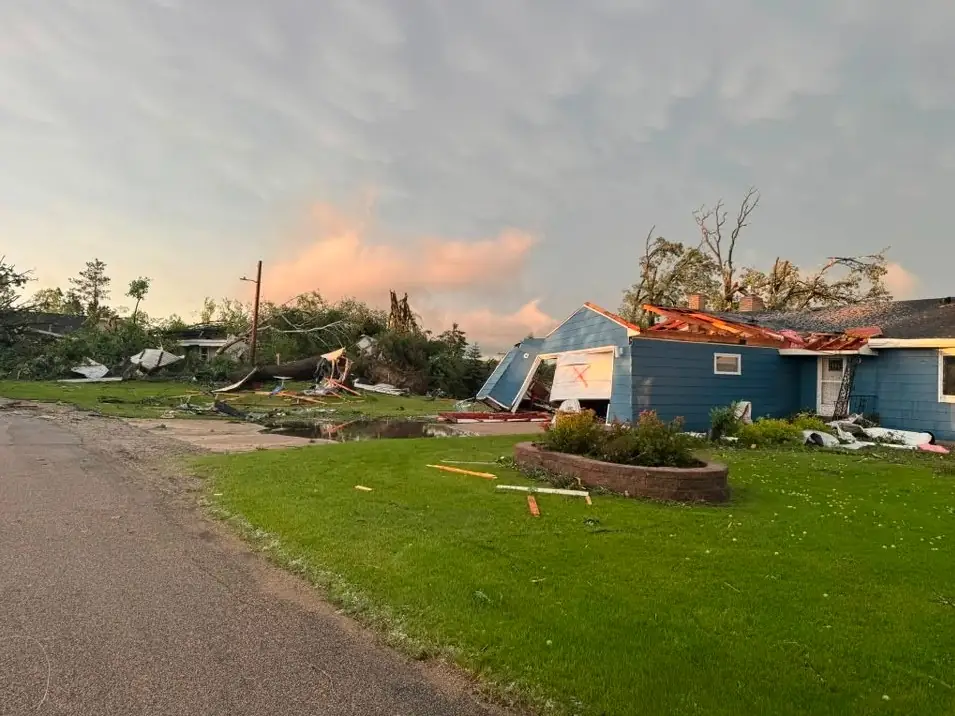
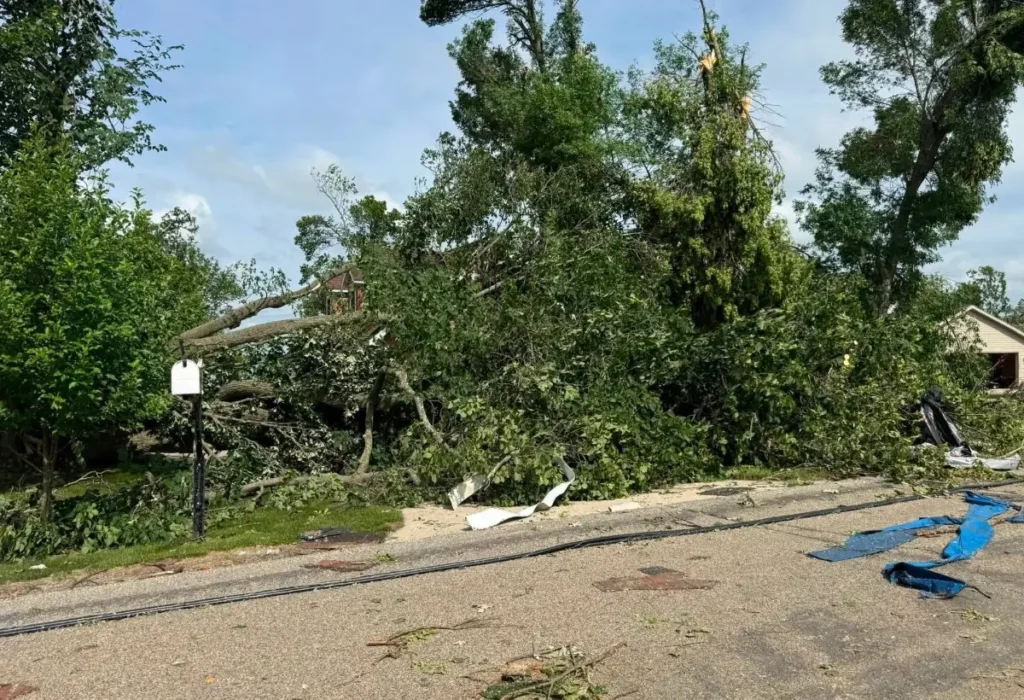
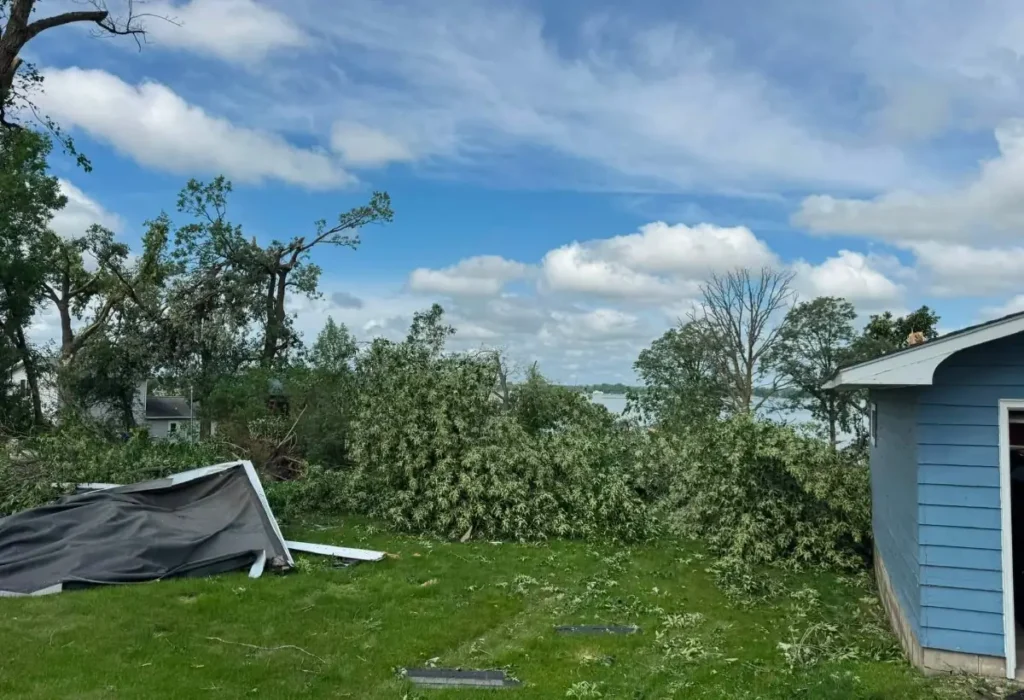
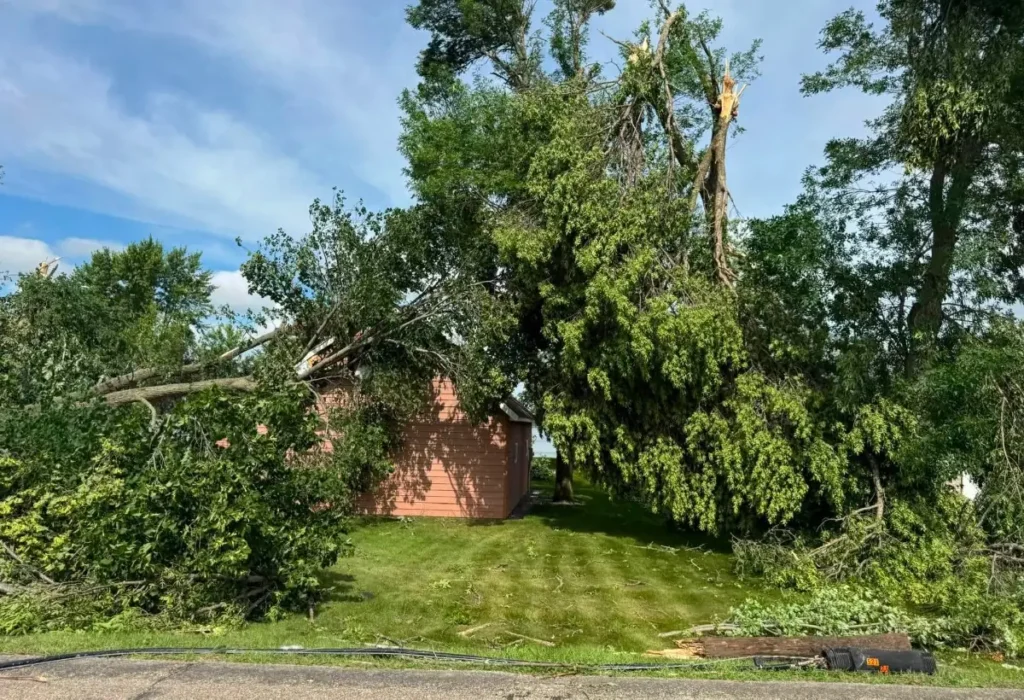
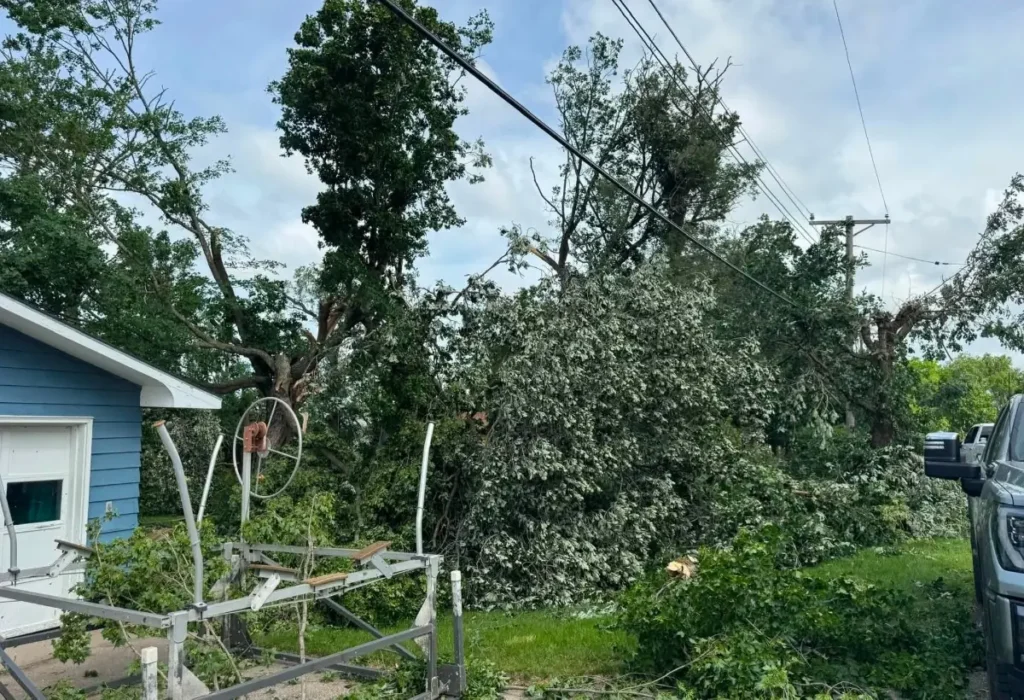
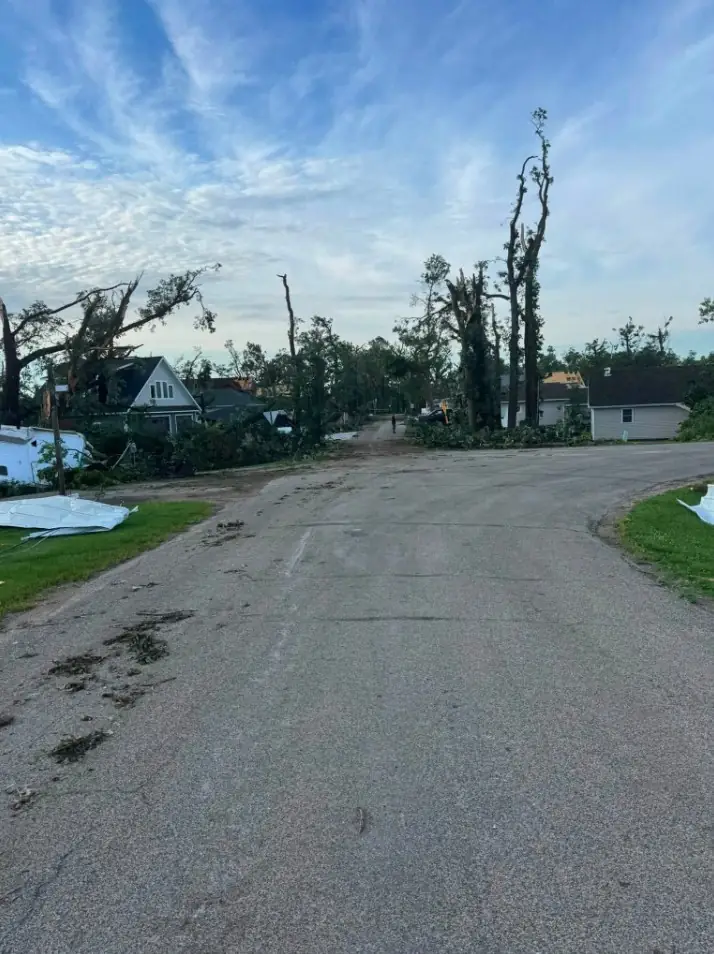
The tornado began about 2 km (1 mile) northwest of Wheeler Lake before crossing the lake, where it damaged the roofs of several homes and snapped the trunks of large oak and poplar trees.
It reached its maximum width near the western shore of Big Floyd Lake, with the Oakland Beach neighborhood sustaining the most severe damage.
Multiple garages and lighter outbuildings were swept away, while widespread roof and tree damage was reported. A 2 x 4 m (6 x 12-foot) horse trailer was lofted and carried about 200 m (656 feet) before the tornado crossed Big Floyd Lake and continued east. The last visible damage was identified near the intersection of County Highway 25 and Anchor Road.
More than 500 customers lost power as a result of the storms, according to Detroit Lakes Public Utility.
As the storm tracked east-southeast, strong winds, hail, and heavy rain affected areas north of Audubon before a tornado warning was issued for the Callaway and Rochert areas. Reports of downed trees, power lines, and debris soon followed from Detroit Township between U.S. Highway 59 and County Highway 21.
References:
1 Public Information Statement – NWS – July 7, 2026
-

 Idaho3 minutes ago
Idaho Power crews respond to outage affecting 2,163 customers in Canyon County
-
 Illinois15 minutes ago
As Illinois enters 10th year under Evidence-Based Funding model, equity remains an elusive goal
-

 Indiana18 minutes ago
FAIRFIELD NATIVE AND HIS WIFE FOUND DEAD IN THEIR NEWBURGH, INDIANA HOME
-

 Iowa23 minutes ago
From caviar nuggets to bison, 10 new Iowa State Fair food trends
-

 Kentucky33 minutes ago
Kentucky lawmakers hold town hall on AI data centers in Louisville
-

 Louisiana38 minutes ago
Norman C. Francis library naming honors Lafayette education legacy
-

 Maine45 minutes ago
Live updates: U.S. and Iran escalate attacks; jockeying starts in Maine after Graham Platner drops Senate bid
-

 Maryland48 minutes ago
How the Baltimore-style hot dog tells a uniquely Maryland story

