Minnesota
Gopher OL commit Kaveon Lee discusses Minnesota commitment


On Saturday, the Minnesota Golden Gophers picked up a commitment from Illinois offensive lineman Kaveon Lee. The 6-foot-6, 280-pound offensive tackle out of Plainfield Central picked the Gophers over Kansas State, Marshall, Memphis, Northern Illinois, and West Virginia among others.
His decision also came just a week following an official visit to Minneapolis. Following his commitment, Gophers Nation caught up with Lee to discuss his why he chose to be a Gopher.
Not a Gophers Nation subscriber and want access to more interviews like this? Take advantage of our BLACK FRIDAY 75% OFF DEAL! Get 75% off your first year of Gophers Nation!



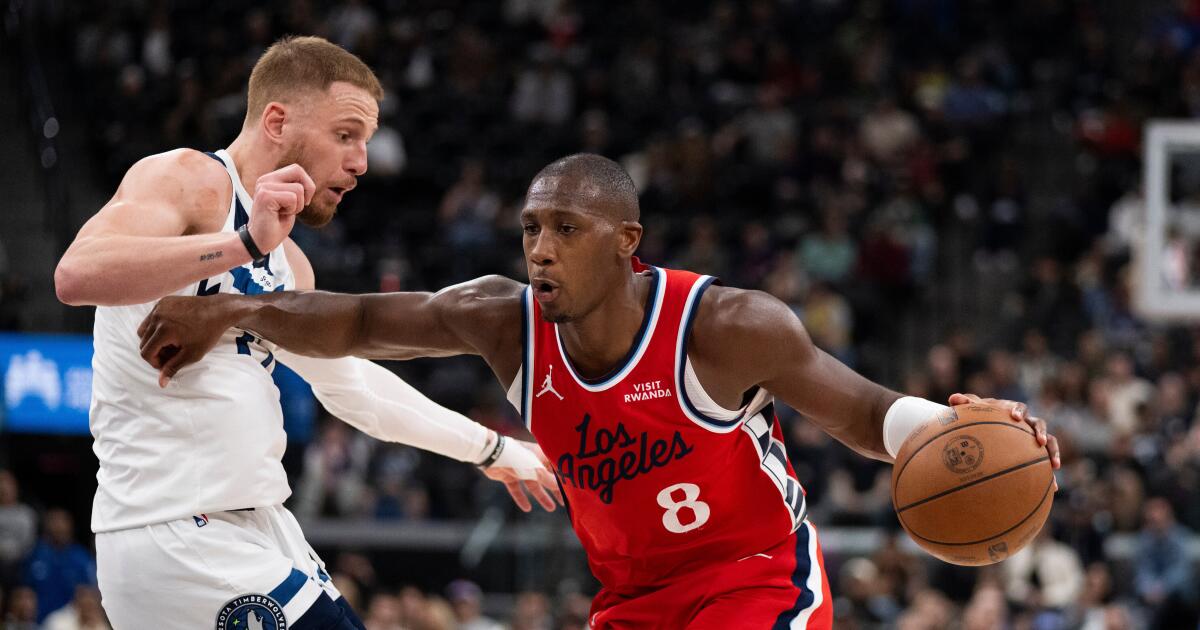
Anthony Edwards scored 31 points, Donte DiVincenzo added 18 and the surging Minnesota Timberwolves beat the Clippers 94-88 on Thursday night.
Jaden McDaniels and Ayo Dosunmu each scored 12 points and Rudy Gobert had 13 rebounds to help the Timberwolves improve to 5-1 since Feb. 9 and 3-1 since the All-Star break.
Edwards, returning to the site of the All-Star Game, where he was the MVP, was 12 for 24 from the floor and sealed the victory with a step-back three-pointer over two defenders for a 92-88 lead with 42.9 seconds left.
Minnesota improved to 2-0 on a three-game trip.
Derrick Jones Jr. scored 18 points and Bennedict Mathurin added 14 for the Clippers, who struggled from the outset with a season-low 38 points in the first half. Kris Dunn had 11 points for the Clippers (27-31), who have lost three consecutive games for the first time since December.
The Clippers struggled on offense without star Kawhi Leonard, out because of ankle soreness. The Clippers shot 40.5% from the floor, including 18.2% (four for 22) in the second quarter. Minnesota shot 43.4% in the game.
The Timberwolves (37-23) scored just 15 points in the second quarter and still topped the Clippers, who had 11. Minnesota led 44-38 at halftime behind 12 points from DiVincenzo and 11 from Edwards.
The Clippers led by six in the third quarter and were up 68-63 heading into the fourth. Edwards’ drive and reverse layup put the Timberwolves up for good at 76-74 with 7:40 remaining.
The Clippers pulled within one three times in the last 2½ minutes, but Edwards answered each time. He scored the Timberwolves’ last nine points.
Up next for Clippers: vs. New Orleans on Sunday night.

A St. Paul church member has filed a federal lawsuit alleging that a group of individuals, including journalist Don Lemon and activist Nekima Levy Armstrong, unlawfully disrupted service last month as part of a coordinated political demonstration.
The complaint, filed by Ann Doucette in the U.S. District Court of Minnesota, alleges that a Jan. 18 demonstration at Cities Church interfered with her ability to worship and caused her to suffer damages, including emotional distress and trauma.
In addition to the former CNN anchor and Armstrong, the complaint names journalist Georgia Fort and activists Will Kelly, Jerome Richardson, Trahern Crews and Jamael Lundy. It also names St. Paul school board member Chauntyll Allen.
Doucette and seven of the defendants did not immediately respond to requests for comment. Doucette filed the complaint without the representation of an attorney. In an emailed statement to NBC News, Crews denied the lawsuit’s allegations “with empathy and compassion.”
The lawsuit accuses the group of civil conspiracy, aiding and abetting, intentional infliction of emotional distress, interference with religious exercise and trespassing.
“As a result of Defendants’ actions, the worship service was disrupted, congregants experienced fear and distress, and Plaintiff’s ability to freely exercise her religion in a private place of worship was unlawfully interfered with,” the lawsuit states.
All eight defendants are also facing federal charges for conspiracy against the rights of religious freedom at a place of worship and for interfering with the exercise of the right of religious freedom. Lemon has pleaded not guilty to all charges, saying outside the court, “I wanted to say this isn’t just about me, this is about all journalists, especially in the United States.”
Fort, Crews and Lundy were released on bond and entered not guilty pleas, according to The Associated Press.
This is the latest legal action tied to protests in the Twin Cities, where tensions remain over the Trump administration’s immigration crackdown and the fatal shootings of Renee Good and Alex Pretti.
According to the lawsuit, the demonstrators engaged in “coordinated conduct” by organizing meetings ahead of the “Operation Pullup” protest and promoting it on social media.
The lawsuit alleges that on the morning of Jan. 18, a coordinated group of individuals entered Cities Church, halting the worship service, and chanting “‘ICE Out!’ and ‘Hands Up, Don’t Shoot!’” while obstructing aisles. Protesters could allegedly be seen “confronting the pastor and congregants in a menacing manner,” the lawsuit says, noting that their chanting and “aggressive gestures” caused “severe emotional distress, fear, anxiety, and trauma” and caused children “terror.”
Demonstrators gathered at the church because they said its pastor, David Easterwood, was the acting director of an ICE field office in the city, the lawsuit says.
Lemon was arrested in January in California and accused of violating federal civil rights law after covering the protest on Jan. 18. He was released on a personal recognizance bond before a federal grand jury in Minnesota returned the indictment against Lemon and eight co-defendants, all of whom are also named in Doucette’s lawsuit.

In the lawsuit, Doucette alleges that Lemon specifically livestreamed the protest, “noting congregants’ fear and distress, and appeared to take satisfaction in the disruption.”
Levy Armstrong, a Minneapolis-based civil rights attorney and activist, was also arrested for her participation in the St. Paul protest. Her arrest drew national attention after the White House shared on social media doctored photos where she appeared to be crying.

A Hubbard County man was arrested and charged after threatening to kill a Minnesota state senator on Facebook.
Court documents filed on Wednesday state the Minnesota State Patrol were investigating a threat posted by John Tobias saying that he would “kill every one of you treasonous [expletive] immediately” if he did not get money back that he claims he lost during the 2020 COVID shutdown.
Court documents go on to say that Tobias then called the Minnesota Attorney General’s Office asking for something to be done about “Minnesota Governor Tim Walz ‘unconstitutionally’ shutting down the state due to COVID-19.
The Minnesota State Patrol contacted Hubbard County deputies regarding Tobias. Court documents state Hubbard County investigators were already familiar with Tobais after speaking with him regarding similar threats he made in Jan.
The charging documents state that investigators searched Tobias’ residence on Tuesday and found an arsenal of guns and 45 boxes of ammunition.
Tobias was taken into custody. During an interview with law enforcement, Tobias admitted to making the threat on Facebook. He also told investigators that “he did not have any intention of killing anyone, but admitted he was trying to get people’s attention,” according to court records.
In late 2025, Lt. Col. Jeremy Geiger of the Minnesota State Patrol, who oversees Capitol security, told a panel of lawmakers that threats to lawmakers had doubled between 2024 and 2025.
Tobias made his first court appearance Wednesday morning and is expected back in court early next month.

Here’s your first look at Kratos in Amazon’s God of War show

State Dept authorizes non-essential US Embassy personnel in Jerusalem to depart ahead of possible Iran strikes

Where Iran’s ballistic missiles can reach — and how close they are to the US

Heart disease threat projected to climb sharply for key demographic

Anthony Richardson free to seek trade after injury setbacks amid Colts’ shift to Daniel Jones

Florida High School Football Rankings: Top 25 teams – Oct. 21

Cleary's 21 help Le Moyne down Central Connecticut State 69-64 in OT

How old is Bo Nix? What to know about Oregon quarterback ahead of 2024 NFL Draft

99th annual Pony Swim held in Virginia

Indiana Members Credit Union announced as new anchor tenant at Bottleworks District
Where Iran’s ballistic missiles can reach — and how close they are to the US

Has India’s influence in Afghanistan grown under the Taliban?

Bill Clinton to testify before House committee investigating Epstein links

Read Judge Schiltz’s Order

Vulnerable House Dem lashes out at Trump’s ‘racist’ SOTU challenge: ‘That was uncomfortable’
-

 World1 day ago
Exclusive: DeepSeek withholds latest AI model from US chipmakers including Nvidia, sources say
-

 Massachusetts2 days ago
Mother and daughter injured in Taunton house explosion
-

 Montana1 week ago
2026 MHSA Montana Wrestling State Championship Brackets And Results – FloWrestling
-

 Oklahoma1 week ago
Wildfires rage in Oklahoma as thousands urged to evacuate a small city
-

 Louisiana4 days ago
Wildfire near Gum Swamp Road in Livingston Parish now under control; more than 200 acres burned
-

 Technology6 days ago
YouTube TV billing scam emails are hitting inboxes
-

 Denver, CO2 days ago
10 acres charred, 5 injured in Thornton grass fire, evacuation orders lifted
-

 Technology6 days ago
Stellantis is in a crisis of its own making