Minneapolis, MN
Sen. John Curtis says DHS secretary ‘lost’ trust following Minneapolis shooting


SALT LAKE CITY — Homeland Security Secretary Kristi Noem’s response to a fatal shooting by federal agents in Minneapolis will “forever undermine trust” with Americans, Utah Sen. John Curtis said Thursday.
Speaking to reporters at the state Capitol, Curtis expanded on his criticism of Noem after previously calling her response to the Jan. 24 shooting of 37-year-old Alex Pretti “premature.” Noem initially said Pretti, a U.S. citizen, committed an “act of domestic terrorism” and planned to kill officers, even though videos showed him holding a cellphone, not a weapon.
Curtis quickly joined others in calling for an independent investigation into the shooting.
“I think it will forever undermine trust that she has with the American people,” Curtis said of Noem’s response. “Now, at this point, I think it’s up to the president to see if that’s salvageable, but I do think a lot of trust was lost, and as you know, trust is very hard to rebuild.”
The senator’s comments came amid a partial government shutdown impacting the Department of Homeland Security, which Noem oversees. Democrats are pushing for reforms to immigration enforcement procedures after Pretti and Renée Good, also a U.S. citizen, were fatally shot by agents in Minneapolis last month.
Curtis said he’s still “hopeful” a resolution to end the shutdown can be reached, although he acknowledged negotiations between President Donald Trump and Senate Minority Leader Chuck Schumer appear to have stalled.
The shutdown impacts agencies like the Transportation Security Administration, Federal Emergency Management Agency, U.S. Customs and Border Protection and U.S. Immigration and Customs Enforcement. However, ICE and CBP operations are still funded thanks to the “One Big Beautiful Bill” that passed last year, the Associated Press reported.
“(I’m) really frustrated myself,” Curtis said. “I just do not like shutdowns. There’s nothing good that comes out of a shutdown.”
Curtis said he supports “reasonable reforms” at the Department of Homeland Security, such as better training for agents and scrutinizing how quickly they are being hired. As for Democrats’ demands that ICE agents stop wearing masks in the field, Curtis was less enthusiastic. He said there are known instances of immigration agents being doxxed, with personal information about them and their families publicly posted online.
“It’s easy for me to say this is not just as clean-cut as ‘don’t wear a mask,’” he said.
There have been rumblings that an immigrant detention facility may be coming to Salt Lake City, prompting protests by some Utahns. Curtis said state lawmakers raised that issue with him on Thursday during private meetings, but he has not had any discussions with the Trump administration about it.
“But I’m happy to advocate on behalf of the state and do what’s best for the state,” Curtis added. “Beyond that, I’ve not had conversations.”
Opposition to Trump nominee
Curtis recently announced his opposition to one of Trump’s nominees for a high-ranking State Department position, likely tanking the nomination.
Jeremy Carl was tapped to serve as an assistant secretary of state for International Organizations, but Curtis grilled him during a recent hearing over previous statements Carl had made suggesting that Jewish people focus too much on the Holocaust.
“I’m not convinced that Jeremy Carl is the right person to represent our nation’s best interests in international forums, and I find his anti-Israel views and insensitive remarks about Jews unbecoming of the position for which he has been nominated,” the senator stated last week.
This is the first time Curtis has outright opposed one of Trump’s nominees. But it’s not the first time the freshman senator has raised questions about them. Curtis was reportedly one of several GOP senators who helped sink former Rep. Matt Gaetz’s nomination as attorney general.
Daniel Woodruff, KSL
Curtis also expressed concerns about confirming Pete Hegseth as secretary of defense. Hegseth was accused of sexual assault, heavy drinking, financial mismanagement and other things. Curtis initially said those allegations were “serious,” but he ultimately voted to confirm Hegseth.
Asked on Thursday why he decided to come out so strongly against Carl’s nomination, the senator said: “There’s a difference between concerns and an outright no.”
“I was willing to give a lot of deference to the president in his selection,” Curtis said of Trump’s cabinet nominees. “I think at that point I’m looking for fatal flaws, right? That’s a line I can’t cross. Jeremy Carl, to me, has fatal flaws.”
Curtis added he chose to “speak out early” against Carl.
“I didn’t want this thing to mature and have people question where I was at,” he said. “The longer it goes, the better I actually feel about my decision.”
Curtis talks priorities and AI regulation
Curtis spoke to reporters after meeting with state lawmakers from both parties about his priorities in Congress that include tax relief, cutting regulation around housing and transportation, streamlining the development of clean energy and protecting children online.
As the Utah Legislature weighs several bills this session dealing with artificial intelligence, the Trump administration is pressuring one state representative to drop his bill requiring AI developers to implement plans to keep children safe while using the emerging technology. Actor Joseph Gordon-Levitt even came to the Capitol to speak in favor of the bill.
“We are categorically opposed to Utah HB286 and view it as an unfixable bill that goes against the administration’s AI agenda,” a letter from the White House Office of Intergovernmental Affairs reads.
Curtis said Congress is “wrestling” with potential AI regulations.
“I personally think there’s probably a lane for states, and there’s probably a lane for the federal government,” he said. “We need to define that and make sure that everybody is in their lanes.”
Curtis said he’s worried about ceding the technology race to global adversaries but added he thinks there is broad support for regulations aimed at protecting kids.
The Key Takeaways for this article were generated with the assistance of large language models and reviewed by our editorial team. The article, itself, is solely human-written.



MINNEAPOLIS (FOX 9) – Firefighters are investigating the Minneapolis’s second fire fatality of the year after a man died in a house fire Saturday afternoon.
Fatal fire on 28th Avenue South
What we know:
According to the Minneapolis Fire Department (MFD), fire crews arrived shortly after 1:00 p.m. and found smoke coming from the second floor of a single-family home on 28th Avenue South. Bystanders alerted firefighters that someone might be trapped inside.
Crews had to work through heavy debris to reach the upstairs area. It took about 40 minutes to fully put out the fire.
During the primary search, firefighters found a man in his 60s dead on the second floor. No one else was found after searching all the floors.
Minneapolis Animal Care and Control took in a dog found outside the home.
Assistant Chief Wes Van Vickle said, “The department is grateful to the neighbors who alerted fire crews that someone may still have been inside, allowing them to act quickly.”
Fire safety reminders and community response
What they’re saying:
“This afternoon’s tragic loss of life weighs heavily on all of us, and we extend our deepest condolences to the family and friends of the deceased,” said Van Vickle.
He also encourages the public to regularly check and maintain smoke detectors and fire extinguishers at home.
There were no other injuries reported. The Hennepin County Medical Examiner is working to confirm the man’s identity.
What we don’t know:
The cause of the fire has not yet been determined, and the man’s name has not been released.

ST. PAUL, Minn. — Organizers of Saturday’s “No Kings” rallies across the country are predicting that the protests against the actions of President Donald Trump and his administration could add up to one of the largest demonstrations in U.S. history, with Minnesota taking center stage.
Organizers say more than 3,100 events have been registered in all 50 states, with more than 9 million people expected to participate.
And they’ve designated the rally at the Minnesota Capitol in St. Paul as the national flagship event, in recognition of how the state where federal agents fatally shot two people who were monitoring Trump’s immigration crackdown became an epicenter of resistance.
Headlining that observance will be Bruce Springsteen, performing “Streets of Minneapolis,” which he wrote in response to the deaths of Renee Good and Alex Pretti, and in tribute to the thousands of Minnesotans who took to the streets over the winter. Springsteen’s Land of Hope & Dreams American Tour, which has a “No Kings” theme, kicks off Tuesday in Minneapolis.
Minnesota organizers have told state officials they expect 100,000 people could converge on the Capitol grounds, where last June’s event drew an estimated 80,000 people.
The St. Paul rally will also feature singer Joan Baez, actor Jane Fonda,Sen. Bernie Sanders and a long list of other activists, labor leaders and elected officials.
The White House dismissed the nationwide protests as the product of “leftist funding networks” with little real public support.
“The only people who care about these Trump Derangement Therapy Sessions are the reporters who are paid to cover them,” White House spokesperson Abigail Jackson said in a statement.
Rallies are also planned in more than a dozen other countries, from Europe to Latin America to Australia, Ezra Levin, a co-executive director of Indivisible, a group spearheading the events, said in an interview. Countries with constitutional monarchies call the protests “No Tyrants,” he said.
For those unable to attend in person, another activist group, Stand Up For Science, is hosting a “virtual and accessible” event online.
National organizers told reporters in an online news conference Thursday that they expect Saturday’s protests to be larger than the first two rounds of No Kings rallies, which they estimate drew more than 5 million people in June and more than 7 million in October.
“This administration’s actions are angering not just Democratic voters or folks in big blue city centers – they are crossing a line for people in red and rural areas, in the suburbs, all over the country,” said Leah Greenberg, the other co-executive director of Indivisible. “The defining story of this Saturday’s mobilization is not just how many people are protesting, but where they are protesting,”
Two-thirds of the RSVPs have come from outside of major urban centers, Greenberg said, listing registration surges in conservative-leaning states like Idaho, Wyoming, Montana, Utah, South Dakota and Louisiana, as well in competitive suburban areas of Pennsylvania, Georgia and Arizona.
“Millions of us are rising up from all walks of life, from rural communities to big cities at No Kings,” said Katie Bethell, executive director of MoveOn, another major organizer. “And as we do so, we will send the loudest, clearest message yet that this country does not belong to kings, dictators, tyrants. It belongs to us.”
Copyright © 2026 by The Associated Press. All Rights Reserved.

On a freezing February evening last year, around a dozen people gathered on an interstate overpass in Minneapolis and hoisted a sign in view of oncoming traffic.
The sign — letters screwed to long, thin pieces of lumber — read: “STOP THE COUP.”
A week later, the group gathered again, though they had doubled in number. The week after that, they doubled again.
Over a year later, around 40 neighbors and up to 100 on busy nights now squeeze onto the overpass Thursday evenings with a new message for the rush-hour traffic.
They call themselves Democracy Bridge Minneapolis, and have protested almost every week since President Donald Trump’s second inauguration.
And in the lead-up to the third nationwide No Kings protests tomorrow, Democracy Bridge catalyzed a wave of demonstrations like their own spanning the 1,568-mile length of Interstate 35.
From Duluth, Minn., to San Antonio, 47 different bridge protests cut through the midline of the country Thursday with the same message: “YES DEMOCRACY NO KINGS.”
Grassroots organizations 50501 Kansas City, Indivisible Twin Cities and The Visibility Brigade also took the lead on mobilizing this week.
Organizers said they hope their efforts inspired onlookers to participate in what’s projected to be the largest turnout for a single-day protest in United States history.
“We have to help us and we have to start by letting our neighbors know what the hell is going on and why they should care,” Sarah Linnes-Robinson, a founding member of the group, said.
While millions of Americans will take to the streets in cities across the country, as many as 100,000 people could attend the No Kings Day flagship rally in Minnesota’s capital, St. Paul.
The flagship rally will feature progressive leaders Gov. Tim Walz and U.S. Sen Bernie Sanders, as well as legend Bruce Springsteen, who will headline with his “Streets of Minneapolis.”
“ICE OUT OF MN:” The Twin Cities fight back
Past the stardom, the rallies across the Twin Cities may provide catharsis for residents whose lives over the past several months have been upended by Trump’s winter immigration enforcement operation.
Dubbed “Operation Metro Surge,” Trump’s massive deployment of immigration officials in Minnesota resulted in mass unlawful detentions, repeated violent assaults against peaceful protesters, and ultimately, the killings of two U.S. citizens, who were both shot by federal officers.
Democracy Bridge protesters channeled their outrage over Renee Good’s and Alex Pretti’s killings through their weekly messages.
“DEFUND ICE” and “ICE OUT OF MN” lit up the bridge on Jan. 29, 2026.
Similarly, “HANDS OFF ELECTIONS” appeared following Trump’s threat to “take over voting” this February, as well as signs protesting the escalation of the Iran war.
Other messages, all of which can be viewed on the organization’s website archive, urged for the release of the Epstein files, opposed a war with Venezuela and admonished Trump’s proposed 2027 budget for its potential impact on Minnesotans’ healthcare.
Most messages are succinct and sometimes abbreviated so while organizers said they would like it, words like “authoritarianism” don’t make the cut.
Some have backgrounds in community organizing, while other bridge-goers are architects and retired researchers. Some come straight from pickleball practice and others from church.
“All are welcome so you can have a Ukrainian flag, you can have a Palestinian flag, a right side up flag, an upside down flag I mean come as you are,” Rosemary Dolata, a Minneapolis resident and bridge protest organizer, said.
Mary Jane Levine has lived in Minneapolis since 2000 and works in a garden store. But before that, she was a federal law enforcement officer. It’s what brought her to the bridge.
“I’m horrified by what was done to the civil service and even more horrified to see what my former federal law enforcement officers are doing to our citizens,” Levine said.
Do protests work? What the data and the locals say
With thousands of other local protests planned across the U.S, this follows a trend of increasing decentralization within civic action.
That’s according to data from American University researcher Dana Fisher, who has been conducting surveys of widespread protests since the Women’s March in 2017.
Fisher’s data shows that nationwide protests in recent years have been largely composed of white, highly educated, and primarily older women. While multiple factors are at play, Fisher noted that a lack of diversity is not always reflective of a lack of interest.
As pointed out by organizers as well, many people of color don’t feel safe showing up to a large crowd and making their presence known amid Trump’s deployment of federal agents. And for young people, some are just burned out.
“They’ve had a really hard go of being adults,” Fisher said. “And the country has been in precarious moments of democracy basically consistently.”
In addition to her vast demographic research, Fisher said she’s worried about the national focus on high turnout without a solid plan for what’s next after No Kings Day.
While excited about the potential record turnout this weekend, bridge regulars underscored how their smaller efforts have engendered meaningful local impact in Minneapolis.
Everyone who protests has their first one, and Linnes-Robinson said the project has been a way to meet the moment in a time when many in Minneapolis “are just ready to say yes.”
Fisher added that despite her doubts or larger organizational aims, these local actions remain important for “collective mourning” and fostering “collective identity formation.”
Demonstrators came together overwhelmingly on the top two issues of “Trump” and “Immigration” at the last No Kings Day, according to Fisher’s data.
“While I’m critical of the way the organizers keep banging on the number, I also just want to recognize that they are very much doing other work to get people to build power and capacity in their communities,” Fisher said.
Sarah Strzok, another founding member of the group, described the organizing process as a true grassroots effort. Each Monday, members text in their Signal group to brainstorm and settle on a message for the signs. Neighbors then build the signs from their “letter library” with wooden sticks and sign holders.
Because they are not permitted to fasten the signs to the bridge itself, participants get creative with pieces of bamboo and pool noodles to hold up the signs.
Apart from sign logistics, unforgiving Minnesota weather has been another consideration for bridge regulars. While some still made it outside in freezing temperatures, the group organized an indoor project in the coldest months where others could write letters and assemble whistle kits.
Once daylight savings hit, the group moved their demonstration an hour earlier and community members donated reflective tape to ensure signage visibility and safety.
Dolata lives in South Minneapolis and said protesting at the bridge has been a way to not just advocate for change but connect with the community she’s lived in for more than 25 years.
“It’s just been neighbors reaching out to neighbors,” Dolata said.
This “reaching out” has transcended the bridge demonstrations. This winter, Rebecca Shield told Democracy Docket that some in the group found out that families at local schools were facing food insecurity.
It wasn’t long before the crew decided to chip in. What began as boxes of food for 20 families in need has surged to about 120, Shield said. And bridge friends are pitching in to cover rent for some of the families, too.
The solidarity and community-building that Fisher said No Kings protests have the potential to engender have manifested at the bridge – from mutual aid to merely flashing a smile to a fellow protester in the grocery store.
“It [the bridge] was just another thread that knit us all together,” Strzok said.

They transformed a historic bar into a fantasy forest for all of L.A.’s witches
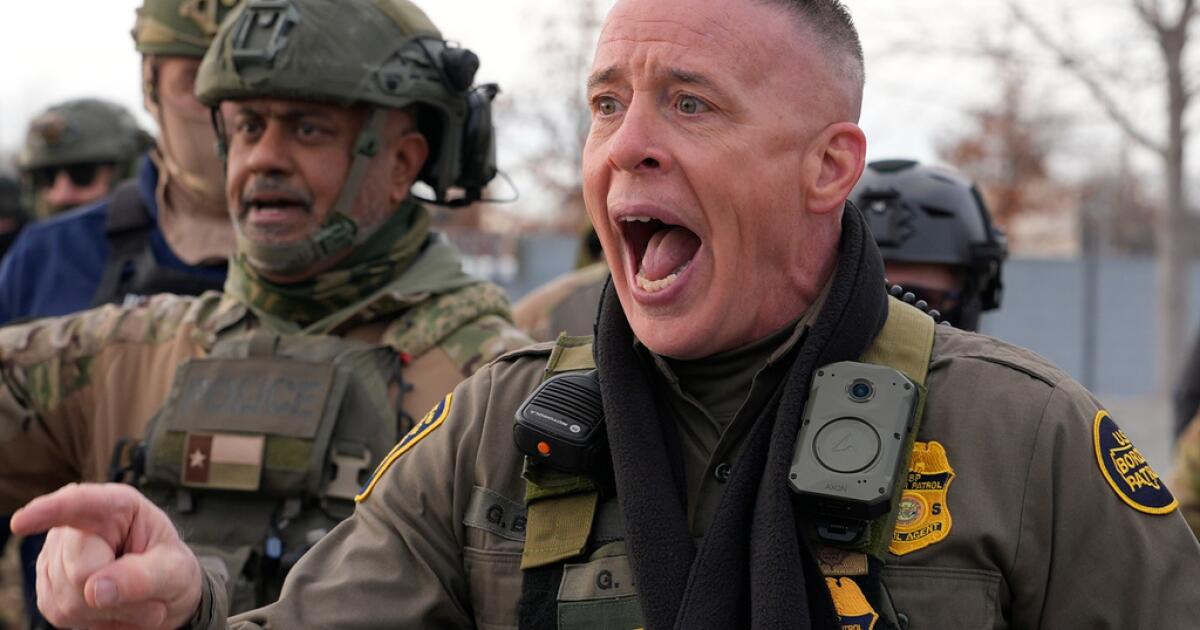
Commentary: Goodbye, Border Patrol bogeyman Gregory Bovino, and good riddance

High school baseball and softball: Saturday’s scores
The EU's recipe for trade deals : easy on beef, tough on wine

Photos: ‘No Kings’ protests across the country

Florida High School Football Rankings: Top 25 teams – Oct. 21

How old is Bo Nix? What to know about Oregon quarterback ahead of 2024 NFL Draft

Cleary's 21 help Le Moyne down Central Connecticut State 69-64 in OT

99th annual Pony Swim held in Virginia

Indiana Members Credit Union announced as new anchor tenant at Bottleworks District
The EU's recipe for trade deals : easy on beef, tough on wine
Photos: ‘No Kings’ protests across the country

Jeffries declines to break with indicted Democrat after ethics panel’s guilty verdict

Hundreds of thousands march through London in stand against the far right

2 students killed, 7 other people injured in Tennessee bus crash during school field trip
-

 Movie Reviews1 week ago
‘Youth’ Twitter review: Ken Karunaas impresses audiences; Suraj Venjaramoodu adds charm; music wins praise | – The Times of India
-

 Sports1 week ago
IOC addresses execution of 19-year-old Iranian wrestler Saleh Mohammadi
-

 New Mexico6 days ago
Clovis shooting leaves one dead, four injured
-

 Tennessee5 days ago
Tennessee Police Investigating Alleged Assault Involving ‘Reacher’ Star Alan Ritchson
-

 Technology7 days ago
YouTube job scam text: How to spot it fast
-

 Minneapolis, MN3 days ago
Boy who shielded classmate during school shooting receives Medal of Honor
-

 Texas1 week ago
How to buy Houston vs. Texas A&M 2026 March Madness tickets
-

 Science1 week ago
Record Heat Meets a Major Snow Drought Across the West