Michigan
Michigan lawmakers weigh new rules for artificial intelligence


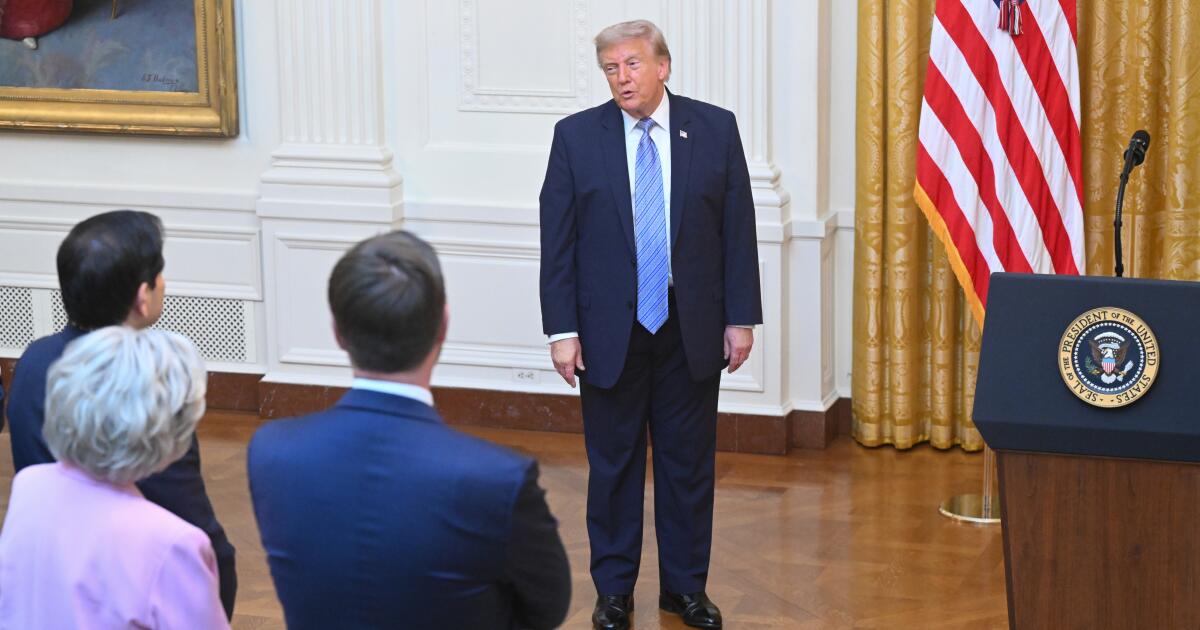
Trump says US will loosen rules in push to win AI race
The Trump administration released a new artificial intelligence blueprint that aims to loosen environmental rules and vastly expand AI exports to allies, in a bid to maintain the American edge over China in the critical technology.
Policymakers eager to address how artificial intelligence should be regulated in Michigan — from governing how AI companies can operate in the state to determining what types of programs companies can use to monitor employee productivity — have plenty of ideas but haven’t been able to see all of their proposals into law, yet.
Measures to regulate AI were introduced in all 50 states last year, according to the National Conference of State Legislatures. While experts point out that innovation in AI generally occurs at a faster rate than state governments can propose and enact new policies, there’s a wide selection of proposals on regulating AI currently floating through the Michigan Legislature.
Michigan has made some headway in enacting AI regulation laws, including prohibiting the use of AI to create sexualized “deep fake” images. In 2025, the state created penalties, including fines and potential jail time, for using AI platforms to make fake or false images portraying a sexual act or intimate part of someone’s body. Lawmakers broadly supported the proposals, creating the law which passed the state Legislature by wide partisan margins.
Supporters of the pornographic deepfake ban said it would protect Michiganders from sexual exploitation.
And in 2023, Michigan became just the fifth state to require disclosing when AI is used in certain political campaign materials. If a campaign used AI in an ad or social media post within 90 days of an election, it would be subject to fines for each violation. The measure aims to prevent AI-driven misinformation during election season.
Here’s a look at other AI policies that have been proposed but not yet voted on:
Guardrails for AI companies
One policy measure would set rules for the companies that operate major AI programs.
House Bill 4668, introduced by Rep. Sarah Lightner, R-Springport, would require operators to create security features intended to mitigate risks. These measures include creating and implementing a publicly accessible safety and risk protocol. Developers would be tasked with using the protocol to manage “critical risks” associated with the AI model.
Critical risks would be considered a scenario where an AI model was used to carry out any incident that could lead to the death or injury of 100 people or $1 million in property damage.
Any company that spends $100 million on its AI model annually, or spends $5 million to start operations, would be subject to the requirements.
Advocates for Lightner’s bill say it’s important to place guardrails around AI, given its rapid evolution.
“Every technologic innovation has the potential for both good and harm,” said Felix De Simone, director of advocacy group Pause AI during a Sept. 11 House Judiciary Committee hearing on the bill. “It’s the responsibility of lawmakers to keep people safe from these harms while ensuring innovation moves in the public interest.”
Opponents of the bill, which include officials from different chambers of commerce around the state, warn it could stifle innovation from AI developers and dissuade them from operating in Michigan. Randy Gross, senior director of legislative affairs for the Michigan Chamber, said during the Sept. 11 hearing the group acknowledges a need for AI guardrails but believes the federal government should take the lead.
“Handling these issues at the state level is going to create a patchwork approach that will inevitably lead to some inconsistencies in application that will likely lead to some contradictions in how you regulate this issue,” Gross said.
While the House Judiciary Committee reported the bill during the Sept. 11 hearing, it has not received a vote from the full chamber, yet. A companion bill, HB 4667, would make it illegal to develop an AI system to commit a crime.
Use of AI to monitor workers
Labor advocates have warned of the possibility of AI being used for surveillance in the workplace. Since remote work boomed for many in traditional office jobs during the COVID-19 pandemic, the availability of AI surveillance programs for workers has escalated. These can include programs to monitor keystroke logging, facial recognition and even when a remote worker steps away for a bathroom break, according to the Aspen Policy Academy, a Bay Area organization that trains prospective lawmakers.
Some labor advocates argue this is an invasion of privacy.
“Invasive, unnecessary and unethical surveillance techniques (are) increasingly used to track the body movements and even facial expressions of employees continuously,” Rep. Penelope Tsernoglou, D-East Lansing, said at a Feb. 23 news conference.
In February, House Democrats proposed legislation that would define how AI could be used in the workplace when it comes to how employers can deploy AI to monitor workers’ productivity.
House Bill 5579, introduced by Tsernoglou, would ban employers from using AI programs to make decisions related to setting wages, hiring and firing workers, and tracking facial patterns of workers. Workplaces would still be allowed to use AI to screen large pools of candidates. Employers would also need to get written consent from workers when using an AI tool to monitor productivity.
The bill has backing from major labor groups, including the Michigan AFL-CIO.
There is opposition from some business groups, however. The Michigan Chamber said in a Feb. 25 news release, the bill would place strict parameters on employers and limit their abilities to maintain productive staff levels.
HB 5579 has been referred to the House Committee on Economic Competitiveness, where it awaits a hearing.
Banning AI chatbot ‘therapy’ for minors
Generative AI generally can be used to mimic some human behavior. Some AI platforms offer companion apps where a language model talks to a user like a real person.
This has raised concern over how minors use generative AI: A Stanford University study found it was easy for researchers to elicit inappropriate responses from a chatbot when posing as minors. The Federal Trade Commission also launched an inquiry into companion chatbots in September, seeking information on how platforms interact with minors.
OpenAI, which runs the popular ChatGPT program that’s become synonymous with generative AI, has faced wrongful death lawsuits after allegations that its chatbot affirmed suicidal ideations from users. OpenAI has denied claims that ChatGPT is responsible for the deaths.
Senate Bill 760, introduced by Sen. Dayna Polehanki, D-Livonia, would ban AI platforms from making chatbots available to minors that can mimic emotional support — specifically, the bill bans any platform retaining conversation history with a minor, sustaining dialogue about the user’s personal matters and offering unprompted emotional advice.
It’s part of a four-bill package aimed at improving social media safety for minors in Michigan.
“These systems are being deployed at scale, marketed as friendly, supportive and conversational. Yet they’re being released without any meaningful safeguards for minors. And when something goes wrong, the consequences can be very grave,” Polehanki said during a March 4 hearing in front of the Senate Committee on Finance, Insurance and Consumer Protection.
Some of the concerns with the proposal center around how AI platforms would verify the age of the user. Age verification laws have popped up in other states and been proposed in Michigan before. Generally, those opposing age verification laws worry about the security of personal information once it’s handed over to a website or another digital platform.
“That kind of data collection creates a honeypot for cyber criminals and bad actors to exploit,” Turner Loesel, a policy analyst at the James Madison Institute, said during the March 4 hearing.
SB 760 currently remains in committee.
Banning AI in public health care, rent-setting
Last year, Rep. Carrie Rheingans, D-Ann Arbor, introduced legislation that would ban the use of AI programs to determine claims for Medicaid and other health insurance programs on the health care marketplace. House Bills 4536 and 4537 were introduced in May and have both been referred to House Committee on Insurance.
House Bill 4538 would ban landlords from using an AI-driven algorithm to determine average rental prices in an area and then instituting rent at their properties derived from the AI’s calculations. The bill’s been referred to the Committee on Regulatory Reform.
The bills haven’t received hearings in their respective committees yet.
Six states — Arizona, California, Illinois, Maryland, Nebraska and Texas — have laws that in some way ban the usage of AI as the basis to deny health insurance claims, according to KFF (formerly Kaiser Family Foundation).
And while some major cities, like San Francisco and Philadelphia have banned using algorithms to set rental prices, adoption in states has been slower to occur, according to government relations firm MultiState.
Trump calls for federal AI standard
In December, President Donald Trump issued an executive order aimed at establishing a federal framework for AI regulation. Having state-level regulations could hamper innovation in AI, the president argued.
“My Administration must act with the Congress to ensure that there is a minimally burdensome national standard — not 50 discordant State ones,” the executive order states. “The resulting framework must forbid State laws that conflict with the policy set forth in this order. That framework should also ensure that children are protected, censorship is prevented, copyrights are respected, and communities are safeguarded. A carefully crafted national framework can ensure that the United States wins the AI race, as we must.”
So far, Congress hasn’t passed any legislation prohibiting states from setting their own AI regulations. Trump’s order also called on the Secretary of Commerce to publish a report examining regulations across all 50 states.
You can reach Arpan Lobo at alobo@freepress.com
As artificial intelligence (AI) grows in popularity, how much do you know about it? Test your knowledge with this true/false quiz that covers everything from how AI models are trained to how they sometimes make mistakes.



GRAND RAPIDS, Mich. — Two Colombian nationals are facing charges after being accused of conspiring to move large amounts of cocaine into the United States, according to the U.S. Attorney for the Western District of Michigan Timothy VerHey.
According to an indictment, from November 2024 through June 24, 2025, Carlos Andres Rueda Ipia, or “Indio,” and Manuel Augusto Munoz Orozco, or “Gordo,” conspired with each other and others to distribute and import five kilograms or more of cocaine into the United States from Colombia.
The pair are also accused of distributing five kilograms or more of cocaine in Colombia on March 13, 2025, “having reasonable cause to believe the cocaine would be unlawfully imported into the United States.”
“We worked with our international law enforcement partners to extradite these two men to face justice here because we want to send this message: if you send drugs into our community, we will come for you no matter where you are,” VerHey said. “I look forward to proving the guilt of these two defendants before a West Michigan jury.”
Rueda Ipia and Munoz Orozco were extradited to the United States on Thursday, and made their first appearance in court in Grand Rapids on Friday.
If convicted, the pair face a mandatory minimum of 10 years and up to life in prison, according to VerHey.
“Let this be a warning, if you choose to traffic cocaine into the United States, you should expect to be hunted down, arrested, and brought into an American courtroom—no matter where you try to hide,” DEA Detroit Division Special Agent in Charge Joseph O. Dixon added. “The DEA will relentlessly pursue transnational drug traffickers, dismantle their criminal enterprises, and ensure they face the full weight of the American justice system.”
For Kent County Sheriff’s Office Undersheriff Bryan Muir, working with federal and international partners is necessary to keep people accountable.
“Drug trafficking on this scale crosses jurisdictions and international borders, and working with our federal and international partners is necessary to hold those responsible accountable,” he said. “Having a KCSO detective assigned to the DEA Task Force gives us a direct role in these investigations, improves information sharing, and helps keep dangerous drugs out of West Michigan.”
The DEA is investigating this case with help from the Kent County Sheriff’s Office, the Grand Rapids Police Department and Michigan State Police.
International assistance includes DEA offices in Bogota, Colombia, and Vienna, Austria, as well as the Colombian National Police, the Austrian Bundeskriminalamt and the Austrian Landeskriminalamt, according to the attorney’s office.

How to register to vote in Michigan: Step-by-step guide
Registering to vote in Michigan is simple and can be done online, by mail, or in person, depending on how close you are to Election Day.
In Michigan’s Tuesday, Aug. 4 primary, voters will set the stage for the November general election, picking the Democratic and Republican nominees who will face off in the fall in major races, including nationally watched U.S. Senate and governor’s races.
Here’s a look at what’s on the ballot:
Key races on Michigan’s primary ballot
- Governor: Gov. Gretchen Whitmer cannot run again due to term limits. The Democratic primary includes Michigan Secretary of State Jocelyn Benson and Genesee County Sheriff Chris Swanson. The Republican primary includes former Michigan Attorney General Mike Cox, U.S. Rep. John James, of Shelby Township and businessman Perry Johnson. (Senate Minority Leader Aric Nesbitt, R-Porter Township, is on the ballot, but he has dropped out of the race and endorsed James.)
- U.S. Senate: The Democratic primary to represent Michigan in the U.S. Senate includes former Wayne County and Detroit health director Abdul El-Sayed and U.S. Rep. Haley Stevens, of Birmingham. (State Sen. Mallory McMorrow, D-Royal Oak, dropped out of the race but still appears on the ballot.) The GOP primary is uncontested, with only former U.S. Rep. Mike Rogers, of White Lake, on the ballot. U.S. Sen. Gary Peters, D-Bloomfield Township, decided not to seek reelection, creating an open race to fill his seat.
- U.S. House of Representatives: Michigan has 13 congressional districts. Incumbents are seeking reelection in all but two of them. With James running for governor, there is an open race to fill his seat for Michigan’s 10th Congressional District. (Republican Robert Lulgjuraj – a Macomb County prosecutor – has ended his campaign in the 10th District, but his name still appears on the ballot.) There is also an open seat for Michigan’s 11th Congressional District, with Stevens running for U.S. Senate.
- Michigan Senate: All 38 seats in the Michigan Senate are up for election this year. Some metro Detroit voters will vote for the first time in newly drawn districts following court-ordered changes.
- Michigan House of Representatives: All 110 seats in the Michigan House of Representatives are also up for election this year.
- Local races and proposals: Voters across the state will also weigh in on races for local offices and proposals.
You can’t vote in both primaries
Unlike presidential primaries in Michigan, voters in the state do not need to request a specific party’s ballot to vote in the upcoming primary. The partisan section of the August primary ballot features Democratic and Republican sections. Voters must pick one party’s primary. For instance, a voter cannot vote for a Democrat in the U.S. Senate primary and a Republican in the gubernatorial primary.
Where can I find a sample ballot?
Michigan voters can go to michigan.gov/vote and click on “What’s on the ballot?” where they will be directed to a page to enter details about their voting jurisdiction to view a sample ballot. Alternatively, they can enter their voter information on the “Am I registered page?” to view a “Ballot preview.”
When can I vote in Michigan’s election?
Michigan voters can request an absentee ballot now. Early voting will run statewide Saturday, July 25 through Sunday, Aug. 2, but communities may offer longer early voting periods. Check out the “Where do I go to Early Vote?” page on michigan.gov/vote to find early voting locations.
Voters can also vote in person on Tuesday, Aug. 4 from 7 a.m. to 8 p.m. Voters in line to vote by 8 p.m. will be allowed to cast a ballot. Voters voting absentee must return their ballot by 8 p.m. on Election Day. Military and overseas ballots postmarked by Election Day will still count.
Where is my polling place?
Voters can find their polling place at michigan.gov/vote and head to the “Where is my polling place?” page and enter their voter details.
Contact Clara Hendrickson at chendrickson@freepress.com or 313-296-5743.

KALAMAZOO, Mich. — Michigan Attorney General Dana Nessel was in Kalamazoo on Thursday to discuss rising energy prices in the state.
She is pointing the finger at the Trump administration, and the federal push to keep a local coal plant in operation.
J.H. Campbell Plant in West Olive was built in the 1960s, and was planned to close down. Nessel said it’s costing Michiganders every day.
“Consumers Energy cannot use long-term coal contracts to save money, and the aging facility requires extensive repairs, so the plant costs some more to operate than it could ever recoup in profits,” Nessel said.
“And that’s a whopping $615,000 loss every single day that that plant is forced to stay open,” she added.
The U.S. Department of Energy issued another emergency order in May keeping the facility online through mid-August. The plant had originally been scheduled to close in May 2025.
The Department of Energy said the decision is centered on energy reliability, though Nessel said coal-fired plants are a major cause of climate change.
“I think since we’re here to talk in part about the J. H. Campbell plant, it’s worthy to note that coal fired plants are the single single largest source of emissions that cause and create climate change, such as what’s affecting us right now,” Nessel said in regards to the hazardous pollutants that blanketed most of Michigan on Thursday.
-
 Politics3 minutes ago
Trump escalates election attacks, threatens California over voter data
-
 Science9 minutes ago
Rudolph Marcus, Caltech chemist who won Nobel Prize, dies at 102
-
 Sports15 minutes ago
Commentary: With Will Smith out indefinitely, Dodgers need to trade for a catcher
-

 World27 minutes ago
Mandela Day: What his legacy means in today’s South Africa
-
 News57 minutes ago
ICE shared Medicaid data it wasn’t supposed to have with Palantir
-

 Los Angeles, Ca3 hours ago
‘Moana’ is a triumph for Pacific Islander representation on the big screen
-

 Detroit, MI3 hours ago
Five shot during funeral at Detroit church
-

 San Francisco, CA3 hours ago
San Francisco Giants Announce Intriguing Roster Move Ahead of Mariners Series

