Midwest
Iowa men out on bond accused of throwing duct-tape bound woman in trunk, killing her, dumping body near lake


Two Iowa men have been arrested in connection to a woman’s body being found near an Iowa County lake.
According to the Iowa County Sheriff’s Office, authorities have identified the victim as Melody Hoffman, 20.
On Sunday, deputies responded to a report of a body being found near a picnic area at Amana Lily Lake.
On Tuesday, McKinley Louisma, 23, who was allegedly in an intimate relationship with Hoffman, was arrested and charged in connection to her death, according to WHO 13.
PENNSYLVANIA MAN FATALLY STABS EX-GIRLFRIEND IN FRONT OF AUTHORITIES BEFORE STABBING HIMSELF: POLICE
Iowa authorities have two men in custody for the murder of Melody Hoffman, whose body was found near a lake. ( Linn County Sheriff’s Office)
Louisma was also out on bond when investigators reported that he kidnapped Hoffman, according to KCRG.
On Wednesday, authorities arrested another suspect in connection to Hoffman’s murder.
Officials announced that Dakota Van Patten, 18, has also been charged with first-degree murder, kidnapping, and conspiracy to commit a forcible felony in the death of Hoffman.
Court records obtained by KCRG indicate that Louisma and Van Patten knew each other beforehand. Both were accused of beating the same man back on January 14, 2024, at an apartment in Cedar Rapids. Both were released on bond in that case.
‘MANIAC’ WHO BRUTALLY MURDERED SEX WORKER WITH IRON IN NYC HOTEL ARRESTED IN ARIZONA: POLICE
During a search warrant, investigators found Hoffman’s phone case, a white Apple Watch band with blood on it, a bungee cord, a towing rope, gloves, and clothes in a bag matching the ones Hoffman was wearing, the affidavit revealed.
Court records obtained by Fox News Digital detailed what investigators say happened after Louisma picked Hoffman up at 11:00 p.m. Saturday.
According to court documents, Hoffman was picked up by Louisma on the night of Feb. 17 and remained with him until she died.
Investigators used data from Hoffman’s iPhone and Apple Watch to piece together her last moments.
The data showed that Hoffman was at Morgan Creek Park in Linn County when her Apple Watch recorded her heartbeat intensifying before “it either stopped or the device deactivated.”
FLORIDA WOMAN MISSING FROM SPAIN ‘TAKEN AGAINST HER WILL’ AFTER MAN SPRAY-PAINTED SECURITY CAMERAS: FRIEND
Police have identified the suspects of interest after a Melody Hoffman’s body was found near a lake in Iowa on Sunday. ( Linn County Sheriff’s Office)
During an interrogation, Louisma told investigators he and another unidentified person bound Hoffman’s wrists with duct tape, put her in the trunk of the car, and drove to several locations until they reached Lily Lake in Amana.
Louisma admitted Hoffman begged to be let go, was beaten, and stabbed and slashed multiple times.
The Iowa State Medical Examiner’s Office determined the preliminary cause of death was strangulation.
Court documents show Louisma was part of two previous investigations involving accusations of violence. One was in Manchester involving sexual assault. The other was in Cedar Rapids claiming Louisma attacked a man, causing serious injury.
Jail records show Louisma was charged with first-degree kidnapping and conspiracy to commit forcible felony. He is being held at the Linn County Jail on a $50,000 cash-only bond. A preliminary hearing has been scheduled for March 1.
A candlelight vigil in Melody’s memory was being held Thursday evening in Marion.
Read the full article from Here


Catholic Charities Fort Worth developed the Padua program, which is an anti-poverty program that ‘meets clients where they are.’
In the heart of one of Chicago’s most challenged neighborhoods, a proven, dignity-centered approach to breaking the cycle of poverty is about to take root.
Goodwill Greater Milwaukee & Chicago recently announced a major partnership with Catholic Charities Fort Worth (CCFW) to bring the innovative Padua program to the greater Englewood community in south Chicago.
Named after St. Anthony of Padua, patron saint of the poor, the program pairs participants with a team of two dedicated caseworkers for long-term, client-led support, with no arbitrary time limits. The only eligibility requirements for the program are that the client be 18 years old and willing to work.
The collaboration marks a significant expansion of the model, which was developed in 2015 by CCFW and validated through a randomized controlled trial by the University of Notre Dame’s Lab for Economic Opportunities (LEO).
Participants in the study were 25% more likely to achieve full-time employment, earned 46% higher incomes, and were 64% more likely to secure stable housing.
Brendan Perry, director of Padua National at Catholic Charities Fort Worth, told EWTN News that the program was in response to the nonprofit “seeing a lot of repeat customers,” which, “in the nonprofit world is not a good thing.”
“We weren’t truly creating economic mobility,” Perry recalled of the organization’s earlier efforts. “Padua was our answer to that challenge.”
Perry said the program was born from a simple but powerful question: What if?
“What if the way we’ve always addressed poverty isn’t the way it has to be?” he explained. “What if we created a program where clients set their own goals, timelines were built around people instead of funders, and we holistically addressed a client’s root issues instead of just the symptoms of their poverty? And what if we could prove it through research and create a model that was replicable?”
Unlike many short-term workforce programs, Padua’s two-person case management teams (a case manager and caseworker) provide holistic support in employment, housing, education, and emotional resilience. Clients define their own goals and remain in the program for as long as needed.
Perry said that people begin their journey with Padua from many different places and often come from a place of crisis. While Padua “is not a crisis program,” Perry said the program helps clients get to a place of stability.
“Once theyʼre there, weʼre gonna be sticking with you for the long haul to get to a point of strength and of prosperity.”
One client who has benefited from the Padua program is Lisa, a divorced mother of three who faced single parenthood, housing instability, unemployment, and mental health issues among her children.
“When I was in my marriage, there was a lot of breaking up and getting back together,” Lisa said. “There was a lot of moving around, and I believe thatʼs how my son developed separation anxiety, which led to depression, and [he] became highly suicidal.”
Lisa’s caseworker helped her find counseling for her son as well as for Lisa, who learned coping skills that helped her better care for her son.
“I pour into his life daily by reminding him that you are handsome, you are smart, you are capable, you have a mum and a family that loves you. You are loved, you deserve to be alive. This world needs you,” she said.
The Padua program helped her attend culinary school and taught her financial skills like budgeting and saving.
Lisa is now employed, has a stable home for her children, and has attended a culinary arts program with dreams of becoming a catering and private chef.
She gives credit to her caseworker, Taelor: “I call her my guardian angel because … sheʼs just been so loving and supportive.”
Perry added that the partnership with Goodwill reflects a shared commitment to human dignity.
“We’re not just expanding the program — we’re ensuring more families have access to the tools they need to build bigger, brighter futures.”
Clayton Pryor, chief mission officer for Goodwill Greater Milwaukee & Chicago, emphasized how naturally the program aligns with their existing work.
“At Goodwill, we believe lasting change starts with meeting people where they are,” Pryor told EWTN News. “Padua allows us to go deeper with individuals who need more intensive, long-term support. It’s client-led, research-backed, and focused on real stability — not just a job, but a foundation for life.”
The Illinois program is scheduled to launch in October out of Goodwill’s new Neighborhood Opportunity Center in Englewood. Pryor said the organization aims to serve 50 clients in the first year, scaling to more than 200 over five years.
Indiana
Indiana gov to Porter County: If you want to miss out on fun of giving $250m in tax money to Bears, your loss
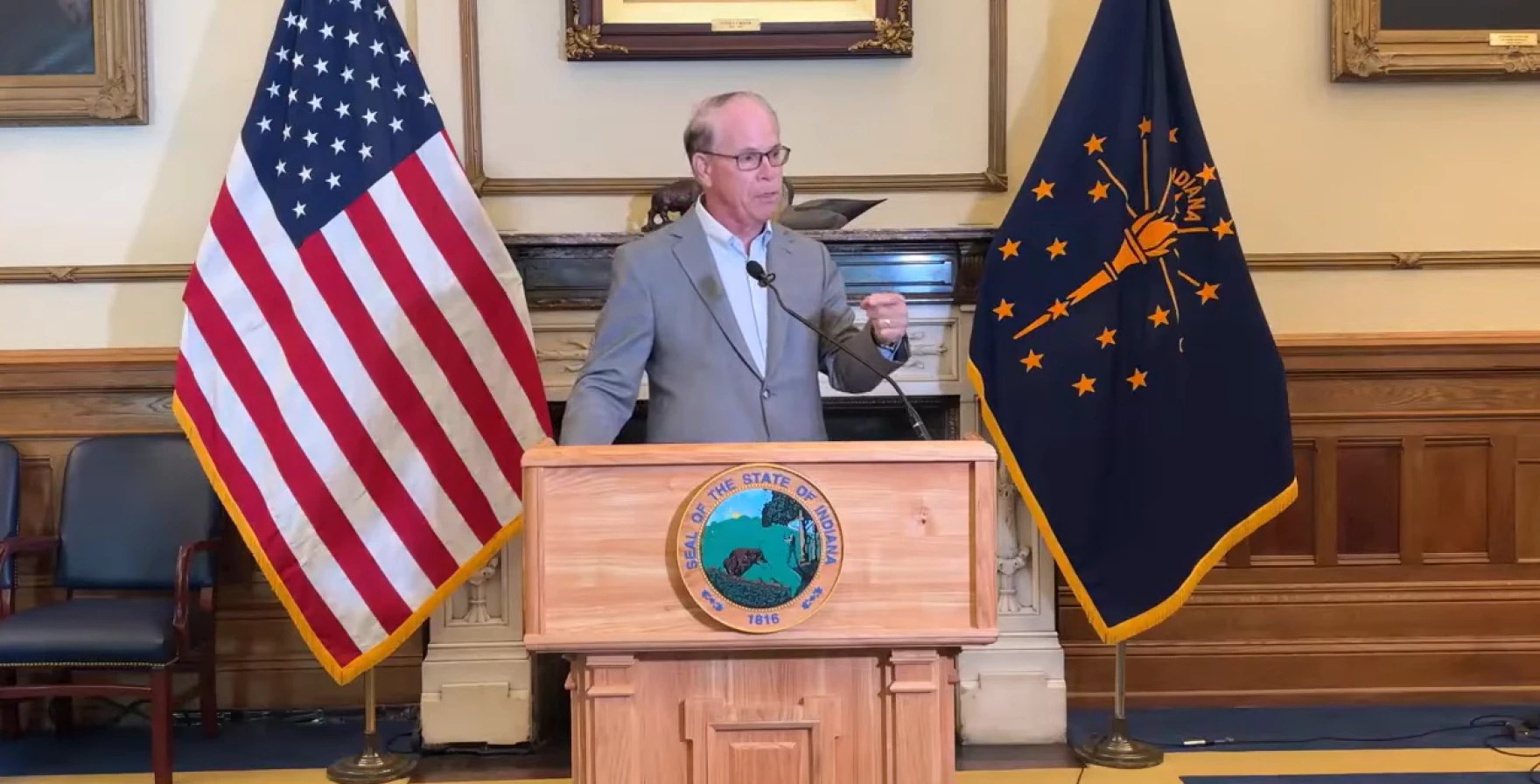
Indiana Gov. Mike Braun says he isn’t sweating Porter County leaders’ opposition to raising food and beverage taxes for a new Chicago Bears stadium the next county over, because really it’s Porter County that would be missing out on all the fun of taking part in shoveling money at the Bears owners:
Under the law, Porter County would have to approve a one-percent food and beverage tax to have representation on the stadium authority. The governor said if it doesn’t get approved, the biggest impact would be on Porter County itself.
“If they choose not to put any skin in the game, they’re not going to have any say-so for what happens from all the economic benefits we’re going to get from it,” Braun said.
Maybe you’re the one up a stump, Porter County! Does a county get a chance to fund a stadium deal every day?
The whole Porter County kerfuffle points up one of the weirder things about the Indiana Bears stadium deal: Though it was passed by the legislature back in February, it didn’t precisely spell out who would be spending what on a stadium, or even where exactly it would be. A newly created sports authority will be able to offer the Bears owners money from a whole bunch of taxes, only some of which actually exist yet:
- All new property tax, income tax, and sales tax for the next 35 years from an omni-TIF district encompassing the stadium and an undetermined number of square miles around it. This could certainly amount to billions of dollars, much of it potentially cannibalized from spending that has nothing to do with the Bears, but just as we saw in Kansas, it’s impossible to say exactly how much without knowing the size of the district.
- A doubling of the Lake County hotel tax from 5% to 10%, which would provide at least $90 million.
- Those 1% food and beverage tax surcharges in Lake and Porter counties, which would be worth about $250 million each, if approved.
- A 12% ticket tax, which would be worth about another $200 million, though as established ticket taxes are unlike other taxes in that they tend to come out of team owners’ revenues.
The best guess at the total public cost is “easily past $4 billion,” but that could go up or down depending on what gets approved in terms of that tax diversion district plus the new taxes. And a quarter-billion dollars from Porter County seems like a significant amount of money, though I suppose Braun is right in that if county leaders balk at that, the state could always compensate by running the omni-TIF district all the way to the Ohio border.
All this makes Indiana’s bid for the Bears a bit of a moving target in the state’s bidding war with Illinois, which is no doubt very much to Bears owner George McCaskey’s liking. (“You’re willing to give us $1.5 billion in property tax breaks and infrastructure money, you say? Well, what if I told you Indiana was offering a TIF district the size of the entire Local Group?”) Right now you have a three-way — or more, given the various Illinois factions — game of chicken going on, and nobody’s showing each other their cards, and … okay, maybe it’s too early in the day for me to be writing extended metaphors. If anyone says they know how much money Bears execs could get out of either Indiana or Illinois, they’re lying, that’s the upshot here.


Temu sued by Oklahoma AG over alleged deceptive practices
Oklahoma AG sues Temu, alleging illegal data harvesting, deceptive practices and counterfeit Oklahoma merchandise.
Online retailer Temu has sold cheap and counterfeit goods, used underhanded marketing tactics and lied about when and how it takes customers’ data, Iowa Attorney General Brenna Bird says.
Bird is suing the China-based retail giant, accusing it of numerous violations of the Iowa Consumer Fraud Act. Temu, which has aggressively been promoted in the United States under its “Shop like a Billionaire” tagline, competes with Amazon and other online retailers and operates online marketplaces for third-party sellers.
The lawsuit, filed July 1, cites years of complaints to the Attorney General’s Office, Better Business Bureau and other watchdog groups about the quality and reliability of Temu shopping, with reports often citing purchased merchandise that bear little resemblance to the photos of items offered for sale.
Those complaints are just the tip of the iceberg, Bird alleges. Her suit accuses Temu of dishonest pricing practices, such as labeling items for sale despite listing them at their normal price. Temu also allegedly uses “gamification” tricks to encourage users to make purchases, sign up their friends on Temu, and other actions, but often fails to deliver on the promised benefits, it says.
In some cases, the company is accused of simply fabricating sales. “Numerous” Iowans have reported receiving and being charged for Temu packages they never ordered and were unable to return, the complaint alleges.
The company also has lied about its business practices in other ways, including covering up its use of forced labor to manufacture many of the items it sells, Bird claims.
App allegedly violates data privacy laws
Temu isn’t just angling to make a sale, Bird claims. She also accuses the company of vacuuming up customers’ private data, even hiding code in the company’s mobile apps to bypass users’ cell phone security and collect private data without their consent.
The complaint states that forensic experts retained by Iowa found the app collects data far beyond what might be necessary to complete transactions, conceals its exfiltration of sensitive data and “reconfigures itself even after having been downloaded to a user’s phone” without consent.
Much of this echoes code previously found in Pinduoduo, another e-commerce app owned by the same Chinese conglomerate, which was banned from the Google Play store in 2023 due to malware concerns. Many of those programmers, and much of the banned code, has been transferred to the Temu app, Bird claims.
Iowa Wave among fake merch sold on Temu
Temu often has been accused of violating intellectual property laws, and those practices have directly affected Iowa, Bird claims. The complaint includes examples of unauthorized University of Iowa, Iowa Wave and Dowling Catholic clothing.
Bird notes in her complaint that a portion of sales of authentic Iowa Wave merchandise goes to benefit pediatric cancer patients and others at the Iowa Stead Family Children’s Hospital.
Iowa businesses and sellers on other marketplaces also have reported Temu stealing their branding and in some cases simply copying their product photos and descriptions to market unauthorized products.
Iowa joins several states, including Oklahoma, Texas and Nebraska, that have filed consumer protection lawsuits against Temu in recent months. Temu did not respond to a message seeking comment.
William Morris covers courts for the Des Moines Register. He can be contacted at wrmorris2@registermedia.com or 715-573-8166.
-

 Hawaii4 minutes ago
Paid parking lots debate continues – Hawaii Tribune-Herald
-

 Idaho6 minutes ago
ATV Crash in Pine Takes Life of Gooding Man
-

 Illinois12 minutes ago
Catholic Charities Fort Worth Expands Research-Backed Anti-Poverty Program to Illinois
-

 Indiana13 minutes ago
Indiana gov to Porter County: If you want to miss out on fun of giving $250m in tax money to Bears, your loss
-

 Iowa19 minutes ago
Iowa attorney general sues Temu, alleging deceptive sales, data theft
-

 Kansas22 minutes ago
Why Chiefs’ Move To Kansas Could Mean Less Income For Their Players
-

 Kentucky27 minutes ago
8 vehicle crash closes I-24 in Kentucky
-

 Louisiana34 minutes ago
Louisiana Supreme Court quashes arrest warrant for AG Liz Murrill

