Indiana
Takeaways from Week 7 of College Football: Indiana earns defining win, James Franklin on the hot seat

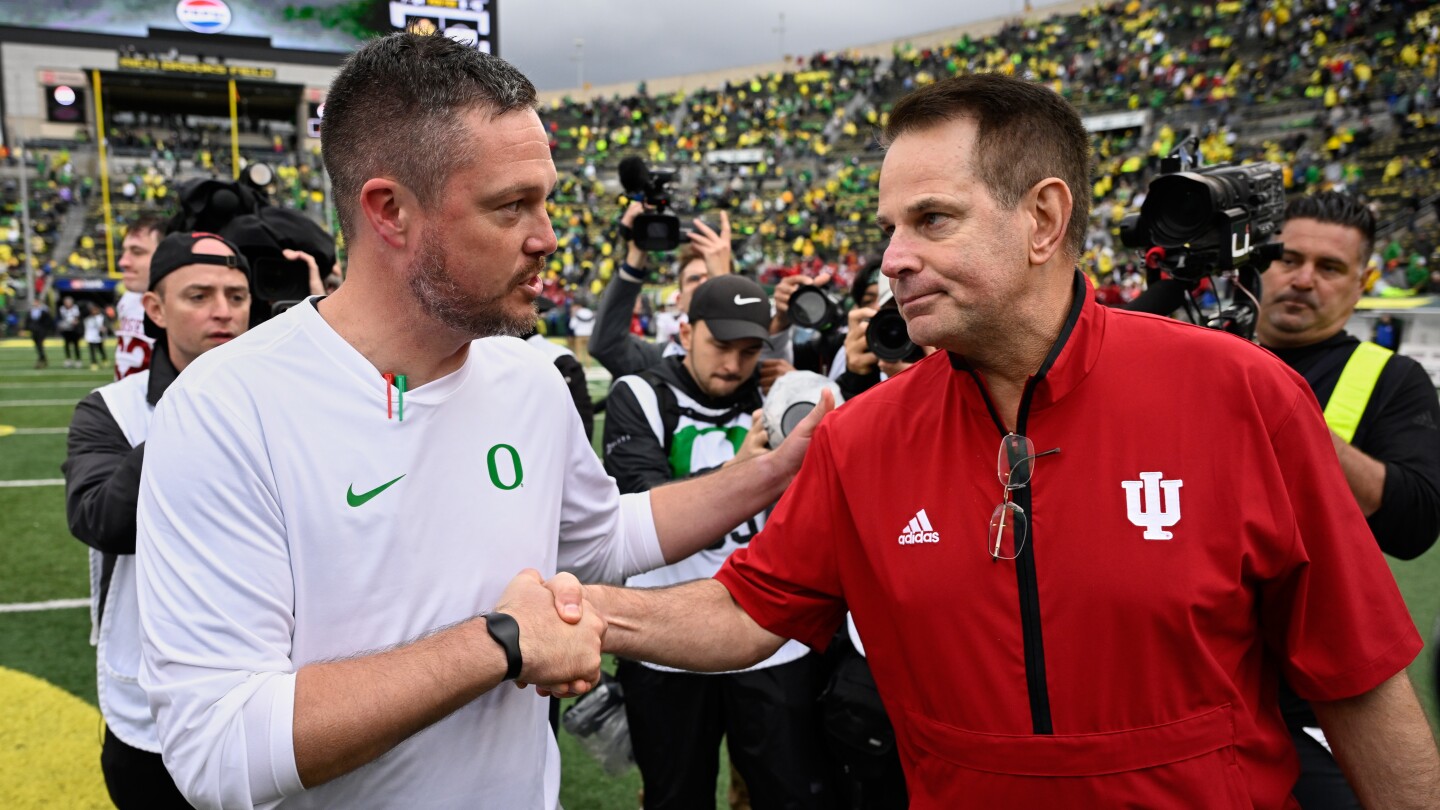
College football is unpredictable and delightful, which is why we live for what happens on Saturdays. Week 7 certainly delivered, from a statement win by Indiana in Autzen Stadium to the biggest win for USC in years.
Each Sunday, I’ll publish my biggest takeaways from the college football weekend. I’ll highlight the most interesting storylines, track College Football Playoff contenders, and specifically shout out individual and team performances that deserve the spotlight.
1. Indiana just had its biggest win in program history.
I have seen all sorts of stats celebrating the Hoosiers’ win over then-No. 3 Oregon. Probably the most notable one is that it’s the first road win over an AP top-five opponent in Indiana football history. But let’s be real for a second. We don’t need qualifiers. This is the best and biggest win in program history, full stop. This is the losingest program in the history of college football! The high points have been few and far between. Last year’s 10 wins were the most in a single season. Indiana has only started a season 6-0 three times in its history … and two of them have come under Curt Cignetti (last year and this year). We are in uncharted territory here! And we might as well say as much!
I don’t know if Indiana is the best team in the country or if the Hoosiers are going to — gasp! — win a national title. But I do know it would be unwise to put any limits on this team.
Indiana secures program-defining win over Oregon
Indiana showed that it can compete with the big boys by walking into Eugene and defeating Oregon.
2. Steve Sarkisian finally found a winning formula for Texas.
The Longhorns’ second-half performance vs. Oklahoma had to be therapeutic for Texas fans. This was an offense that finally had some balance, which made everything easier — both for quarterback Arch Manning (who completed 21 of 27 passes) and play caller Steve Sarkisian, who could finally put his quarterback in positions to succeed thanks to a functional run game. Plus, the vaunted Texas defense returned to form after a rough outing against Florida, forcing three John Mateer interceptions and holding the Sooners to just 88 total yards of offense in the second half. Throw in a fourth-quarter punt-return touchdown, and you’ve got wins in all three phases. Boy, did Texas need a performance like that.
Manning encouraging in Texas’ win over Oklahoma
Arch Manning and Texas got a desperately needed win by playing virtually mistake-free football against rival Oklahoma.
3. Texas A&M might be the best team in the SEC.
Every weekend, I attempt to figure out the pecking order in the SEC, and I often end up more confused than I was when I started. For a few weeks, I felt best about Alabama and Heisman hopeful Ty Simpson, believing I’d pick them on a neutral site against any other SEC opponent. But now I think I’m going to join the Aggies’ bandwagon — even knowing that Texas A&M has a history of late-season collapses. This team feels different, not just because I trust Mike Elko defenses. I like how explosive the pass game can be, with Mario Craver and KC Concepcion, and a fairly reliable rushing attack. I know that Marcel Reed doesn’t always dazzle, but when he’s on, he makes this offense one that can strike fear in opposing SEC defenses.
That, and Alabama’s offensive line continues to be a problem. And Ole Miss nearly lost to Washington State. So, that’s where I am for now.
4. USC might be back.
Well, maybe. At the very least, Lincoln Riley earned the first signature win of his Trojans tenure so far. USC averaged 7.2 yards per play against one of the better defenses in the Big Ten in Michigan. Coming into the game, I thought it could be a huge opportunity for the Trojans to prove they can be tough and physical — that they could win a game at the line of scrimmage. And they did so despite injuries to their running backs. USC has spent the past two seasons trying to develop on the defensive side of the ball (both with coaching hires and personnel), and the Trojans limited a previously prolific rushing attack (that also dealt with injuries) to just 3.5 yards per carry.
But beyond the nuts and bolts of the win, it was just extremely impressive for a program that has had a history of close, painful losses. What better way to make a statement than by not letting Michigan stay close enough to have a chance late? Entering Saturday, Riley was 4-11 vs. ranked opponents at USC. The only way to start to change a narrative is to win a game like that.
5. It’s hard to imagine James Franklin remaining the head coach at Penn State.
I don’t know how soon James Franklin and Penn State will part ways, but it feels impossible to imagine him on the sideline in Nittany Lions’ gear next season. Does Penn State just find frustrated donors to pony up and pay a buyout of more than $50 million? Or does athletic director Pat Kraft get with Franklin to negotiate down the buyout, knowing that Franklin deep down doesn’t want to stay in an environment (and fan base) that has grown so toxic?
Last week, I argued that Franklin should be the one to leave — that he should find one of the Power 4 jobs that open this season and get a fresh start. But at this point, after two inexcusable losses to two of the worst teams in the Big Ten (with a season-ending injury to quarterback Drew Allar to make things even worse), I don’t know that it will be his choice after all. Penn State cannot move forward with him; the situation feels far too untenable.
‘No way forward’ for Franklin at Penn State
With three consecutive Big Ten losses and Drew Allar out for the season, Nicole Auerbach and Joshua Perry have a hard time seeing James Franklin at Penn State moving forward.



Just three days before Selection Sunday in March of 2020, the NCAA announced that March Madness, like so many other events that spring, would be cancelled due to the new virus upending life. The decision marked the first time in tournament history that the final weeks of the college basketball season would not be played, squashing Atlanta’s plans to host the Final Four.
When the following year rolled around, the NCAA decided that March Madness would not succumb to the virus once more.
With a vaccine only on the horizon and hundreds of Americans still dying each day, the organization announced in November of 2020 that while the tournament would go on, it would certainly not be business as usual. All 67 games, NCAA officials said, would be held in one location. Central Indiana was the first choice as Indianapolis had been on tap to host the Final Four April 3-5.
The plan, said NCAA senior vice president of basketball Dan Gavitt in a November 2020 IndyStar article was to present “a safe, responsible and fantastic March Madness tournament unlike any other we’ve experienced.”
In January the NCAA made it official: All games would be played in and around Indianapolis in a modified version of a bubble.
Holding the tournament in one place just made sense, NCAA officials told IndyStar. Unlike in a typical year when a winning team would travel multiple times before the championship, this system would minimize travel, which could inadvertently expose players and coaches to the virus.
Two months later when the tournament kicked off on March 18, 55 of the 67 games were scheduled to be played in Indianapolis venues, such as Gainbridge (then Bankers Life) Fieldhouse, Lucas Oil Stadium, Indiana Farmers Coliseum and Butler’s Hinkle Fieldhouse. Purdue’s Mackey Arena and IU’s Assembly Hall also hosted games.
While the first Covid vaccine had arrived a few months earlier, few people outside of first responders and the most vulnerable had been immunized, so in an effort to avoid large crowds, the Indianapolis sites all capped tickets at 25% capacity. That meant only 17,500 people could attend games at the largest venue, Lucas Oil Stadium. The college arenas allowed far smaller audiences, with IU limiting attendance to 500 people.
A week before the tournament began Marion County Public Health Department officials and Mayor Joe Hogsett asked attendees to make smart public health choices, such as social distancing and obeying the face masks mandate. Referees donned masks as much as possible as did coaches and players on the bench.
The NCAA regularly tested athletes, administering 28,311 tests Covid tests during the tournament, 15 of which came back positive.
Post-mortems after the tournament asked whether the NCAA had made the right call. Two high profile deaths occurred in the aftermath of the tournament — one a University of Alabama superfan who had traveled to Indy for the games and the other a St. Elmo bartender. But proving a direct link between their deaths and the tournament would prove impossible, and some public health experts said the NCAA had done everything it could to protect athletes and fans short of canceling the event.
A study conducted by IU, Regenstrief researchers and others that appeared in August 2021 in the Journal of the American Medical Association found that while mask wearing had theoretically been compulsory, about a quarter of attendees at the games were either not wearing masks or doing so inappropriately. Still, in an IndyStar article about the study Indiana Sports Corps president Ryan Vaughn termed the event “a resounding success.”
The following year, with a vaccine widely available and far fewer daily deaths from the virus, the tournament returned to a typical schedule, concluding in New Orleans’ Ceasars Superdome. More than 69,00 fans attended the final games, according to the NCAA. Local authorities had lifted the mask requirement by this point.
“Last year was about survival. Just having championships in any way, single site, keep everybody safe and be successful,” Gavitt said in an NCAA news release in late April 2022. “I think this year was about advancing.”
Indiana
Federal legislation that Braun calls ‘crazy’ is aimed at Bears and Indiana – Indianapolis Business Journal


INDIANAPOLIS (WISH-TV) – Strong thunderstorms likely later this evening with all severe weather threats possible. It is going to be warm and windy with record highs today. Much cooler air works into Indiana for the end of the week.
TODAY: Partly cloudy conditions later this afternoon with warm and breezy conditions. It is going to be a beautiful and summer-like day across parts of Indiana. We will look for high temperatures to climb into the lower eighties which will set a new daily high record. The record for today is 80 set back in 1907. Winds will be gusty out of the southwest near 20 to 30 mph.

TONIGHT: A cold front approaches the state bringing a really good chance of strong to severe thunderstorms. A few thunderstorms may develop out ahead of the main line and some of those thunderstorms could contain some large hail along with a tornado risk as well. We are under a level 3 risk of strong storms out of a level 5. So there is confidence that a lot of these storms could reach severe criteria. Threats would be damaging winds and large hail. The tornado risk is low across parts of Indianapolis but it is not zero. A slightly higher risk of tornadic activity is possible in northern sections of Indiana.
Heavy rainfall could also lead to some flooding in parts of the state. Areas may see anywhere between 1 to 3 inches of rainfall.
Best timing on the thunderstorm activity will be anytime after 8:00 p.m. and lasting until Friday morning around 4.
TOMORROW: A few early morning rain showers will be possible on Friday. The main weather story is that it will be much cooler. High temperatures will climb around 49 which is below our normal high of 56. Winds switch direction out of the northeast and it will be a bit breezy at times as well. Low temperatures late Friday night into Saturday morning will drop into the upper twenties.
7 DAY EXTENDED FORECAST: A chilly start early Saturday morning but we will see lots of sunshine for the afternoon. High temperatures will climb around 52 for the afternoon.
Cloud cover returns on Sunday but it will be dry for the most part. Look for high temperatures to climb into the lower 60s.
Warmer next week with temperatures reaching the low and even middle and upper 70s by the middle part of the week. A dry start on Monday with some scattered showers possible on Tuesday and Wednesday.

Penny Lee Brown Obituary March 25, 2026 – Eckersell Funeral Home

Bears stadium deal should not include lawmaker perks or raise property taxes

Retro Indy: Five years ago Covid confined March Madness to Indiana

Two Iowans sentenced to prison for creating child pornography

Will Flory Bidunga Return to Kansas, Enter the NBA Draft, or Transfer?

Florida High School Football Rankings: Top 25 teams – Oct. 21

How old is Bo Nix? What to know about Oregon quarterback ahead of 2024 NFL Draft

Cleary's 21 help Le Moyne down Central Connecticut State 69-64 in OT

99th annual Pony Swim held in Virginia

Indiana Members Credit Union announced as new anchor tenant at Bottleworks District

Video: Will ICE Change Under Its New Leader?

DHS shutdown breakthrough comes at cost for Republicans as funding fights nears end

Rubio joins crucial G7 talks as Iran war set to dominate second day

A surprise resignation could open the door for an independent to win a Montana Senate seat

Video: Savannah Guthrie Says She Believes Her Mother Was Taken for Ransom
-

 Detroit, MI1 week ago
Drummer Brian Pastoria, longtime Detroit music advocate, dies at 68
-

 Science1 week ago
How a Melting Glacier in Antarctica Could Affect Tens of Millions Around the Globe
-

 Movie Reviews1 week ago
‘Youth’ Twitter review: Ken Karunaas impresses audiences; Suraj Venjaramoodu adds charm; music wins praise | – The Times of India
-
 Science1 week ago
I had to man up and get a mammogram
-

 Sports6 days ago
IOC addresses execution of 19-year-old Iranian wrestler Saleh Mohammadi
-

 New Mexico5 days ago
Clovis shooting leaves one dead, four injured
-
 Business1 week ago
Disney’s new CEO says his focus is on storytelling and creativity
-

 Texas1 week ago
How to buy Houston vs. Texas A&M 2026 March Madness tickets