Midwest
Indiana school secretary charged after husband finds her with student, probe reveals affair with another: cops

NEWYou can now listen to Fox News articles!
A married Indiana high school secretary was beaten by her husband when he allegedly caught her in a tryst with one student, which led to an investigation in which it was discovered that she had sexual relations with another.
The Union City Police Department was investigating the incident in which Alicia Hughes was battered over the weekend.
Hughes’ husband found her with an 18-year-old student and confronted them, police said. He then beat her, police said.
CALIFORNIA MIDDLE SCHOOL ASSISTANT PRINCIPAL NABBED IN CHILD SEX STING
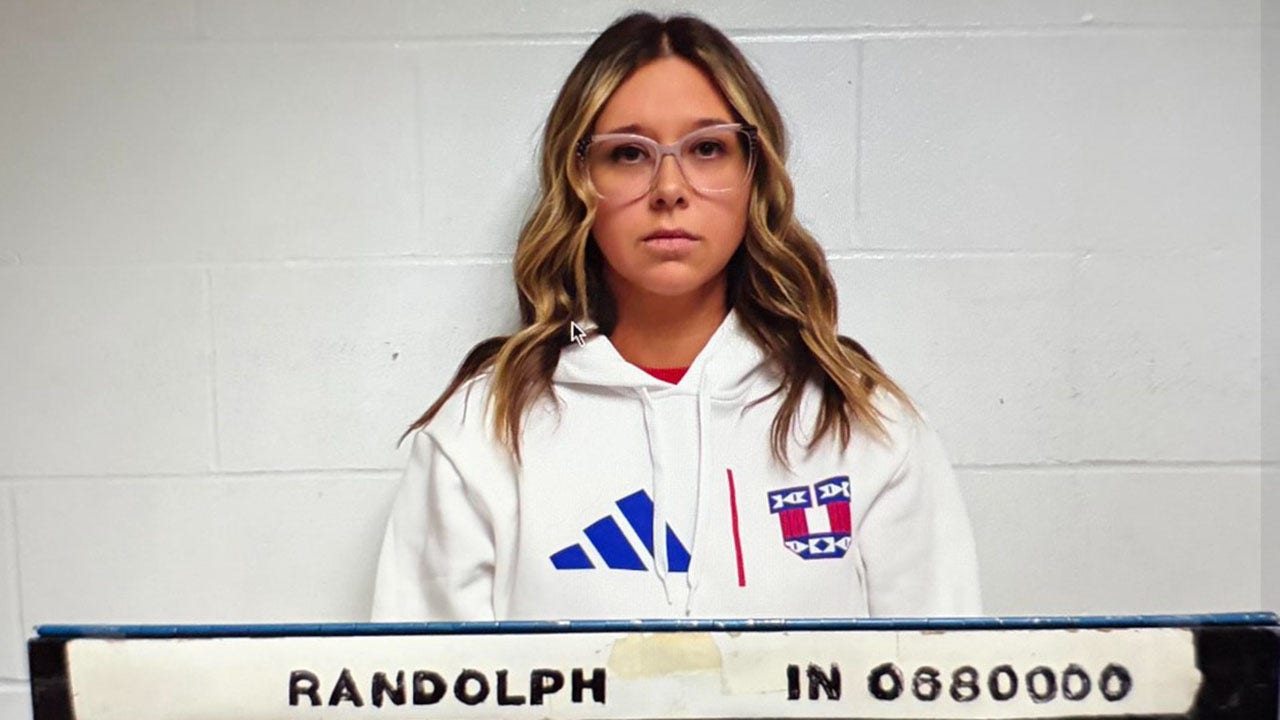
High school secretary Alicia Hughes has been arrested for allegedly having sex with a student. (Union City Police Department)
During a probe into the incident, investigators discovered that Hughes, a secretary at the Randolph Eastern School Corporation school district, also had a sexual relationship with a separate student, age 17, police said.
“Investigators determined that Hughes and the minor engaged in sexual intercourse on at least five occasions,” a police statement said.
Hughes was arrested and charged with five counts of child seduction related to the sexual relationship with the minor student.
ILLEGAL ALIEN YOUTH COACH COULD FACE DEATH PENALTY AFTER ALLEGEDLY MURDERING, RAPING TEEN PLAYER
A classroom pictured with desks. (iStock)
She was taken to the Randolph County Jail and was being held on a $25,000 cash-only bond.
It was unclear if Hughes will be charged for her alleged relationship with the 18-year-old student or if her husband will face charges for the alleged battery.
In a statement, school district Neal Adams said Hughes had been removed from all duties pending “the outcome of the legal process.”
“RESC takes all allegations involving students extremely seriously. Upon becoming aware of concerns, the corporation fully cooperated with law enforcement and will continue to do so as the investigation proceeds,” he said. “We appreciate the professionalism and diligence of local authorities in handling this matter.”
Read the full article from Here



Both generations on the ice Friday are intent on growing the game for today’s kids. Hartje and the Polar Bears believe an important step for women’s hockey in Michigan would be starting a Division I college team.
“I think if the PWHL establishes a team in Detroit, it will put a lot of pressure on the colleges to make sure there’s a D-I team in the state,” Hartje said. “Michigan has the second-highest number of players in the league, and it would have been a dream for us to be able to stay in the state to play.”
It’s been a problem for decades. Pierson had to turn down the offer from Boston University, because her family couldn’t afford to send her to New England for college. Hartje ended up at Yale University, and Megan Keller, who scored the gold medal winning goal for the U.S. in the 2026 Winter Olympics and plays for the PWHL’s Boston Fleet, went from suburban Detroit to Boston College.
Meanwhile, 2026 U.S. men’s Olympic team members and Michigan natives Dylan Larkin of the Red Wings and Zach Werenski of the Columbus Blue Jackets were able to stay in the state to play with the USA Hockey National Team Development Program, then based in Ann Arbor, before moving on to the University of Michigan in the same town.
“Megan’s brother played at Michigan State, and I’m sure she also would have stayed here to play for a Michigan school,” Skarupa said. “It’s imperative that Michigan gets a college program.”
Skarupa is serious about growing the game. She is working with Keller and the NHL Foundation U.S. to identify recipients for its $100,000 Empowerment Grant Program for Girls Hockey.
“Every time I go back to a city, there are new teams, new girls and new faces,” she said. “It’s a testament to growth all over the world, but it is tremendous inside the U.S.”
Milwaukee, WI
Travelers see shorter lines at Milwaukee Mitchell despite the ongoing partial government shutdown

MILWAUKEE — Despite a partial government shutdown causing long TSA lines at airports across the country, travelers at Milwaukee Mitchell airport are experiencing short wait times ahead of spring break.
John Wahlen and his colleague Joe Orendorf were coming back home from North Carolina and prepared for a much different scene.
“We were remarkably surprised that it was as easy as it was,” Wahlen said.
Brendyn Jones/TMJ4
A national TSA spokesperson told TMJ4 that over 3,450 TSA officers called out across the country on Thursday. The national call-out rate was at 11.83% percent, the highest since the shutdown began.
While the TSA could not provide specific numbers for Milwaukee Mitchell, the airport was not in the top-10 for call-out rates.
The highest percentages of call-offs came from much larger airports, including George Bush Intercontinental in Houston at 44 percent, Atlanta at almost 41 percent, and Baltimore at 37 percent.
“We were in smaller airports, Raleigh-Durham, I think we waited for two people, and one of them was him,” Orendorf said.
Watch: Travelers see shorter lines at Milwaukee Mitchell despite the ongoing partial government shutdown
Travelers see shorter lines at Milwaukee Mitchell despite the ongoing partial government shutdown
A spokesperson for Milwaukee Mitchell told TMJ4 that around 11,000 people are expected this Friday and Saturday, and next Friday and Saturday as spring break travel peaks.
President Trump signed an executive order to pay TSA agents, meaning a resolution may be on the horizon. Travelers, including Selena Mauricio, said they are thankful for the agents who are still showing up.

Brendyn Jones/TMJ4
“Their jobs aren’t easy, and I commend the ones that still come to work, definitely,” Mauricio said.
This story was reported on-air by Brendyn Jones and has been converted to this platform with the assistance of AI. Our editorial team verifies all reporting on all platforms for fairness and accuracy.
Let’s talk:
Hey there! At TMJ4 News, we’re all about listening to our audience and tackling the stuff that really matters to you. Got a story idea, tip, or just want to chat about this piece? Hit us up using the form below. For more ways to get in touch, head over to tmj4.com/tips.
It’s about time to watch on your time. Stream local news and weather 24/7 by searching for “TMJ4” on your device.
Available for download on Roku, Apple TV, Amazon Fire TV, and more.
Report a typo or error // Submit a news tip

On a freezing February evening last year, around a dozen people gathered on an interstate overpass in Minneapolis and hoisted a sign in view of oncoming traffic.
The sign — letters screwed to long, thin pieces of lumber — read: “STOP THE COUP.”
A week later, the group gathered again, though they had doubled in number. The week after that, they doubled again.
Over a year later, around 40 neighbors and up to 100 on busy nights now squeeze onto the overpass Thursday evenings with a new message for the rush-hour traffic.
They call themselves Democracy Bridge Minneapolis, and have protested almost every week since President Donald Trump’s second inauguration.
And in the lead-up to the third nationwide No Kings protests tomorrow, Democracy Bridge catalyzed a wave of demonstrations like their own spanning the 1,568-mile length of Interstate 35.
From Duluth, Minn., to San Antonio, 47 different bridge protests cut through the midline of the country Thursday with the same message: “YES DEMOCRACY NO KINGS.”
Grassroots organizations 50501 Kansas City, Indivisible Twin Cities and The Visibility Brigade also took the lead on mobilizing this week.
Organizers said they hope their efforts inspired onlookers to participate in what’s projected to be the largest turnout for a single-day protest in United States history.
“We have to help us and we have to start by letting our neighbors know what the hell is going on and why they should care,” Sarah Linnes-Robinson, a founding member of the group, said.
While millions of Americans will take to the streets in cities across the country, as many as 100,000 people could attend the No Kings Day flagship rally in Minnesota’s capital, St. Paul.
The flagship rally will feature progressive leaders Gov. Tim Walz and U.S. Sen Bernie Sanders, as well as legend Bruce Springsteen, who will headline with his “Streets of Minneapolis.”
“ICE OUT OF MN:” The Twin Cities fight back
Past the stardom, the rallies across the Twin Cities may provide catharsis for residents whose lives over the past several months have been upended by Trump’s winter immigration enforcement operation.
Dubbed “Operation Metro Surge,” Trump’s massive deployment of immigration officials in Minnesota resulted in mass unlawful detentions, repeated violent assaults against peaceful protesters, and ultimately, the killings of two U.S. citizens, who were both shot by federal officers.
Democracy Bridge protesters channeled their outrage over Renee Good’s and Alex Pretti’s killings through their weekly messages.
“DEFUND ICE” and “ICE OUT OF MN” lit up the bridge on Jan. 29, 2026.
Similarly, “HANDS OFF ELECTIONS” appeared following Trump’s threat to “take over voting” this February, as well as signs protesting the escalation of the Iran war.
Other messages, all of which can be viewed on the organization’s website archive, urged for the release of the Epstein files, opposed a war with Venezuela and admonished Trump’s proposed 2027 budget for its potential impact on Minnesotans’ healthcare.
Most messages are succinct and sometimes abbreviated so while organizers said they would like it, words like “authoritarianism” don’t make the cut.
Some have backgrounds in community organizing, while other bridge-goers are architects and retired researchers. Some come straight from pickleball practice and others from church.
“All are welcome so you can have a Ukrainian flag, you can have a Palestinian flag, a right side up flag, an upside down flag I mean come as you are,” Rosemary Dolata, a Minneapolis resident and bridge protest organizer, said.
Mary Jane Levine has lived in Minneapolis since 2000 and works in a garden store. But before that, she was a federal law enforcement officer. It’s what brought her to the bridge.
“I’m horrified by what was done to the civil service and even more horrified to see what my former federal law enforcement officers are doing to our citizens,” Levine said.
Do protests work? What the data and the locals say
With thousands of other local protests planned across the U.S, this follows a trend of increasing decentralization within civic action.
That’s according to data from American University researcher Dana Fisher, who has been conducting surveys of widespread protests since the Women’s March in 2017.
Fisher’s data shows that nationwide protests in recent years have been largely composed of white, highly educated, and primarily older women. While multiple factors are at play, Fisher noted that a lack of diversity is not always reflective of a lack of interest.
As pointed out by organizers as well, many people of color don’t feel safe showing up to a large crowd and making their presence known amid Trump’s deployment of federal agents. And for young people, some are just burned out.
“They’ve had a really hard go of being adults,” Fisher said. “And the country has been in precarious moments of democracy basically consistently.”
In addition to her vast demographic research, Fisher said she’s worried about the national focus on high turnout without a solid plan for what’s next after No Kings Day.
While excited about the potential record turnout this weekend, bridge regulars underscored how their smaller efforts have engendered meaningful local impact in Minneapolis.
Everyone who protests has their first one, and Linnes-Robinson said the project has been a way to meet the moment in a time when many in Minneapolis “are just ready to say yes.”
Fisher added that despite her doubts or larger organizational aims, these local actions remain important for “collective mourning” and fostering “collective identity formation.”
Demonstrators came together overwhelmingly on the top two issues of “Trump” and “Immigration” at the last No Kings Day, according to Fisher’s data.
“While I’m critical of the way the organizers keep banging on the number, I also just want to recognize that they are very much doing other work to get people to build power and capacity in their communities,” Fisher said.
Sarah Strzok, another founding member of the group, described the organizing process as a true grassroots effort. Each Monday, members text in their Signal group to brainstorm and settle on a message for the signs. Neighbors then build the signs from their “letter library” with wooden sticks and sign holders.
Because they are not permitted to fasten the signs to the bridge itself, participants get creative with pieces of bamboo and pool noodles to hold up the signs.
Apart from sign logistics, unforgiving Minnesota weather has been another consideration for bridge regulars. While some still made it outside in freezing temperatures, the group organized an indoor project in the coldest months where others could write letters and assemble whistle kits.
Once daylight savings hit, the group moved their demonstration an hour earlier and community members donated reflective tape to ensure signage visibility and safety.
Dolata lives in South Minneapolis and said protesting at the bridge has been a way to not just advocate for change but connect with the community she’s lived in for more than 25 years.
“It’s just been neighbors reaching out to neighbors,” Dolata said.
This “reaching out” has transcended the bridge demonstrations. This winter, Rebecca Shield told Democracy Docket that some in the group found out that families at local schools were facing food insecurity.
It wasn’t long before the crew decided to chip in. What began as boxes of food for 20 families in need has surged to about 120, Shield said. And bridge friends are pitching in to cover rent for some of the families, too.
The solidarity and community-building that Fisher said No Kings protests have the potential to engender have manifested at the bridge – from mutual aid to merely flashing a smile to a fellow protester in the grocery store.
“It [the bridge] was just another thread that knit us all together,” Strzok said.

EU Parliament unblocks key political hurdle in digital euro talks

Man arrested in plot to firebomb Palestinian activist’s home after undercover op

Video: We Analyzed the Deadly Crash at LaGuardia

PWHL players bond with women’s hockey pioneers at Detroit clinic | NHL.com

Fielder may resign from Board of Supervisors, possibly over illegal leak

Florida High School Football Rankings: Top 25 teams – Oct. 21

How old is Bo Nix? What to know about Oregon quarterback ahead of 2024 NFL Draft

Cleary's 21 help Le Moyne down Central Connecticut State 69-64 in OT

99th annual Pony Swim held in Virginia

Indiana Members Credit Union announced as new anchor tenant at Bottleworks District
EU Parliament unblocks key political hurdle in digital euro talks
Man arrested in plot to firebomb Palestinian activist’s home after undercover op

WATCH: Senate hearing goes silent after Angel Father confronts top Dem over daughter’s death

US diplomat Marco Rubio denounces settler violence, tolls in Hormuz strait

Iran-linked hackers have breached FBI Director Kash Patel’s personal emails | CNN Politics
-

 Detroit, MI1 week ago
Drummer Brian Pastoria, longtime Detroit music advocate, dies at 68
-

 Movie Reviews1 week ago
‘Youth’ Twitter review: Ken Karunaas impresses audiences; Suraj Venjaramoodu adds charm; music wins praise | – The Times of India
-

 Sports7 days ago
IOC addresses execution of 19-year-old Iranian wrestler Saleh Mohammadi
-

 New Mexico5 days ago
Clovis shooting leaves one dead, four injured
-
 Business1 week ago
Disney’s new CEO says his focus is on storytelling and creativity
-

 Technology6 days ago
YouTube job scam text: How to spot it fast
-

 Tennessee4 days ago
Tennessee Police Investigating Alleged Assault Involving ‘Reacher’ Star Alan Ritchson
-

 Texas1 week ago
How to buy Houston vs. Texas A&M 2026 March Madness tickets