Illinois
Top general for Illinois National Guard retiring after joining military nearly 40 years ago


A little over five years ago, Maj. Gen. Richard Neely took the Illinois National Guard flag in a chain of command ceremony.
On May 4, Neely, the adjutant general for Illinois and commander of the Illinois National Guard, will be giving the flag back, marking his retirement from the military after nearly 40 years of service.
“It’s the symbology of one leader giving the flag up and one leader taking the flag,” Neely said, referring to his successor, Maj. Gen. Rodney Boyd, the assistant adjutant general. “One…of my priorities was to ensure the continuity of leadership.
“Our organization won’t miss a beat when that flag is passed.”
The appointment of Boyd by Gov. JB Pritzker, who serves as commander-in-chief of the Illinois National Guard, makes history.
The Chicago native will be the first Black officer and person of color to command the guard, which includes about 13,000 soldiers and airmen and about 2,500 other federal and state employees.
Neely, a 57-year-old native of Easton, about an hour northwest of Springfield, has presided over one of the busiest times in the 301-year history of the Illinois National Guard.
Col. Bradford Leighton, a spokesman for the Illinois National Guard, pointed out that personnel supported 17 different domestic operations in 2020 and 2021. During the previous decade, it supported 13 domestic responses.
Addressing COVID
The largest domestic operation activation in Illinois National Guard history came in response to the COVID pandemic. That’s when personnel performed 250,000 tests, delivered 8 million masks and administered 2 million vaccines.
“We’re not always the experts,” Neely admitted, “but we can help with large tasks. We can organize. We can prepare large logistics issues. That’s what COVID brought us.”
With testing and later with vaccinations, the Guard became a model for delivery.
More: Petition claims new evidence exonerates 3 suspects in 1996 murder case
“I was happy I was the one in the seat during COVID because it was a significant event,” Neely said. “I thought my experience helped me step through that process. We had a good team, but leadership needs to understand it quickly, make decisions and move out on things.”
Deploying around the world
For the last two decades, the Illinois National Guard has been more of “an operational reserve (where in the past we were considered a strategic reserve,” Neely said.
That means personnel are deployed all the time.
“At any one time, 8 to 10% of 13,000 soldiers and airmen are deployed around the world doing global operations,” Neely said. “Before 9/11, that wasn’t so much the case.”
During Neely’s tenure, there have been almost 5,000 personnel federally deployed to 21 countries.
There’s a large presence in Eastern Europe, including Poland, “to ensure violence doesn’t extend out of Ukraine,” Neely said.
More: Champion of students and teachers honored at Springfield area elementary school
The Illinois National Guard has had a relationship with the Polish military for 30-plus years through the State Partnership Program developed with Poland 30 years ago. It came about, Neely said, because of the Chicago area’s large Polish population.
While there are over 100 partnerships in 87 different countries, the Guard and Poland can claim “the gold standard,” Neely said.
Several years ago, Poland started a Territorial Defense Force, a light version of a National Guard, and Poles have been studying in Springfield to see how the Illinois National Guard trains its soldiers and officers.
In 2022, Neely was awarded the Polish Commanders Cross with Silver Star Order of Merit by President Andrjez Duda.
“The recognition was about the entire organization,” Neely said.
In retirement
Neely said he started his military career “at the very bottom,” joining the Army Reserves the summer before his senior year of high school.
Neely, who later slid over to the Air Force side of the Illinois National Guard, joked that the military is “the family business.” Neely’s identical twin brother served in the military as did Neely’s three kids.
Admittedly, he never envisioned sitting in the adjutant general’s seat.
“This is me winning the Lotto 10 times over to be able to lead at the end of my career,” Neely said.
A cybersecurity expert, Neely said he envisioned doing some national security work on the side in retirement.
“But it won’t be full time,” he said. “I promised my family I would pull back on the throttle.”
Contact Steven Spearie: 217-622-1788; sspearie@sj-r.com; X, twitter.com/@StevenSpearie.



Name: Eric Godoy
Title: Associate Professor
Unit: Department of Philosophy
Years at Illinois State: 8 1/2 years
Tell us about your teaching and research in the College of Arts and Sciences.
“Renewable energy alone won’t make our energy systems more just. The production, distribution, and consumption of energy are connected to many ethical issues. For example, even renewable energy projects can pollute environments or displace people. My recent research examines these ethical challenges and asks what a just transition might look like. I’ve also published work on climate ethics, trophy hunting lions, urban park design, interdisciplinary research, and dinosaur films. My most popular course is PHI 236: Values and the Environment, but I also teach many topics in moral, social-political, and environmental philosophy. I’m also a proud affiliate of the Women’s, Gender, and Sexuality Studies Program (WGSS).”
What are your proudest accomplishments during your time at Illinois State?
“I was awarded an American Council of Learned Societies’ fellowship for my work on energy democracy this year. I was nominated by our university for a Carnegie Fellowship in 2024. I was also very honored to receive a College of Arts and Sciences (CAS) Excellence Award for Outstanding Teaching in 2021. But I’m always the proudest when I hear about the success of my former students. I love getting emails about their new careers or their graduate studies in all kinds of fields: law, environmental work, and, of course, philosophy.”
What’s your favorite thing about Illinois State or the College of Arts and Sciences?
“I do my best research in conversation with students and colleagues in different fields. Our students and faculty are so talented. They’re often working on amazing projects. I learn so much from them. They encourage me to explore new research questions I wouldn’t have thought of on my own. Environmental problems are inherently interdisciplinary. I’m very grateful that CAS supports interdisciplinary work and programs, such as WGSS, Environmental Systems Science and Sustainability, and Civic Engagement. Philosophy lends itself so well to interdisciplinary relationships since there are philosophical questions at the heart of every field.”
Department of Philosophy Chair Christopher Horvath on Godoy:
“Dr. Eric Godoy is an innovative, student‑centered educator whose inclusive and interdisciplinary pedagogy consistently elevates the department’s instructional standards. He is deeply committed to creating learning environments that empower students from diverse backgrounds to engage meaningfully with complex philosophical issues. His leadership in curriculum development has made him one of the department’s most forward‑thinking educators. Complementing his teaching excellence, his research provides practical, ethically grounded solutions to energy‑policy conflicts and will shape national conversations about democratic participation in a just transition away from fossil fuels.”
Read more stories from the College of Arts and Sciences at News.IllinoisState.edu/Unit/College-Arts-Sciences and follow the college on Facebook and Instagram.

Murals and memorials of César Chavez are continuing to come down across Chicago after allegations emerged last week that the Latino civil rights activist groomed and sexually assaulted girls and women.
The allegations were revealed in a New York Times investigation published March 18.
Some artworks are being repainted with murals of Dolores Huerta, the longtime ally of Chavez in the labor rights movement. Huerta, 95, told the New York Times that Chavez had sexually assaulted her.
The Illinois Senate adopted a resolution Wednesday honoring Huerta and declaring April 10 as “Dolores Huerta Day” in Illinois.
“In recent months, Dolores Huerta has shown profound resilience and courage in sharing her own experience of harm, doing so in order to uplift the stories of countless women whose voices were overlooked or silenced,” the resolution states.
One of the resolution’s sponsors, State Sen. Celina Villanueva, D-Chicago, said she is also working on a plan to rescind César Chavez Day, which is next week on March 31st.
At Cafe Tola in Lake View, a Chavez mural outside the restaurant’s building was replaced this week with a painting of Huerta, who coined the phrase, “Sí, se puede,” which loosely translates to, “Yes, we can.”
“We are deeply saddened by this news, yet we stand in unwavering support and admiration for Dolores Huerta and every woman who has found the courage to come forward,” Cafe Tola said in a social media post. “This moment is powerful — proof that truth cannot be silenced and that it is never too late to reclaim your voice. We honor that strength.”
A plaque dedicated to the 30th anniversary of the death of César Chavez, honoring him and Sister Dolores Huerta, before it was taped over at the Haymarket Memorial in the West Loop.
In the West Loop, a plaque honoring Chavez’s labor rights movement has been covered with black tape at the Haymarket Memorial. According to the Chicago Federation of Labor, the organization is planning to fully remove it.
“We will be discussing with all our partners on how to best honor both the survivors of Cesar Chavez’s horrific abuse and the workers that were betrayed by Chavez,” a spokesperson for the Chicago Federation of Labor said in a statement.
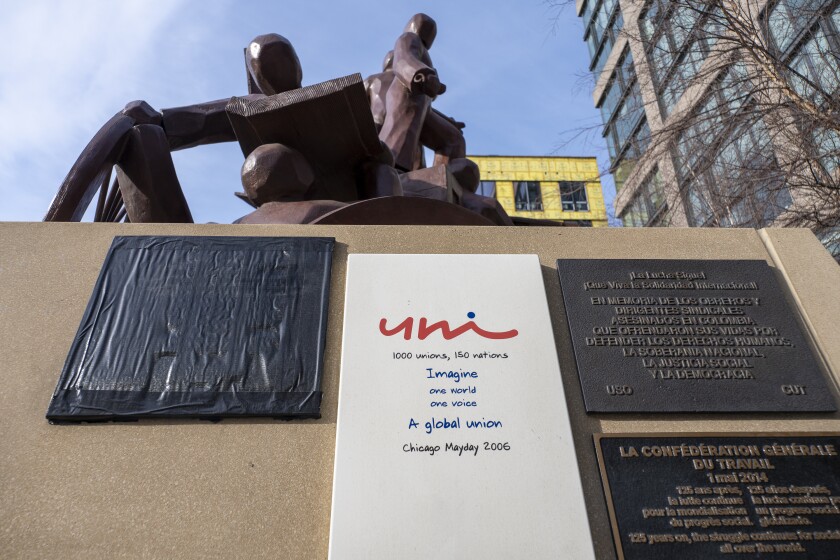
Black tape covers up a plaque (left) that commemorates the 30th anniversary of César Chavez’s death on the base of the Haymarket Memorial in the West Loop, Wednesday, March 25, 2026.
Tyler Pasciak LaRiviere/Sun-Times
Last week, Bob Reiter, president of the Chicago Federation of Labor, said the allegations that Chavez sexually assaulted children, women, workers and labor organizers “is a betrayal to our movement.”
Chavez, who died in 1993, has long been revered in Chicago’s Latino community. In addition to numerous murals of him across the city, a public elementary school in Back of the Yards and a post office in Pilsen are both named after him.
The school, César E. Chavez Multicultural Academic Center, has initiated the process that could lead to a new name. It is receiving community feedback about a possible new name, according to Chicago Public Schools officials. Any recommendation would need approval from the Local School Council and the school board.
Another school in Pilsen, Peter Cooper Dual Language Academy, has a mosaic of Chavez and Huerta side by side. It’s unclear if the school plans to remove the mosaic of Chavez.
The Sun-Times was the first to report that Chavez’s face had been painted over last week on the “Libertad” mural across a long wall at Barrett Park in Pilsen.
A splotch of green paint initially covered the portion where Chavez was depicted, but Park District officials have since painted over that with a continuation of the mural’s background design, a Park District spokesperson said.
Other historical figures on the mural, including Mexican artist Frida Kahlo, Malcolm X, Rosa Parks, and the Rev. Martin Luther King Jr. remain visible on the wall.
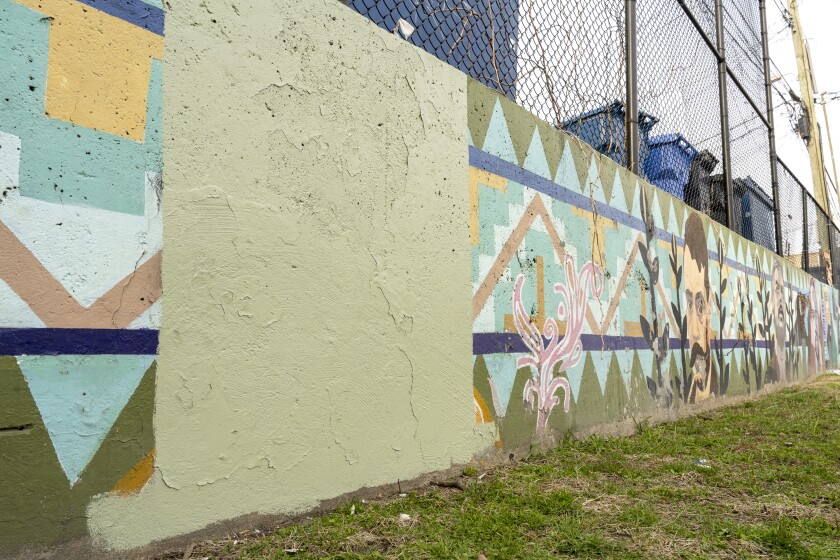
Paint covers Cesar Chavez’s face on a mural depicting civil rights figures that can be seen an exterior wall of Barrett Park in the Pilsen neighborhood, Friday, March 20, 2026.
Tyler Pasciak LaRiviere/Sun-Time
“The Chicago Park District takes recent allegations of misconduct by Cesar Chavez seriously … and are conducting a district-wide review of any other park features that may honor him,” a Park District spokesperson said previously. “Where appropriate, we will take further action consistent with our values and standards.”
The Park District has not identified any other murals or memorials of Chavez on any of its properties, the spokesperson said Wednesday.
Contributing: Isabela Nieto

Dementia risk signals could lie in simple blood pressure readings, researchers say

Indiana coach Cignetti sends message to star transfer with pre-practice dress code lesson

Drone food delivery launches in New Jersey

FKA twigs sues ex-boyfriend Shia LaBeouf over ‘unlawful’ NDA
LAPD chief backed cops who shot at author, Weezer bassist’s ex; commission overruled him

Florida High School Football Rankings: Top 25 teams – Oct. 21

How old is Bo Nix? What to know about Oregon quarterback ahead of 2024 NFL Draft

Cleary's 21 help Le Moyne down Central Connecticut State 69-64 in OT

99th annual Pony Swim held in Virginia

Indiana Members Credit Union announced as new anchor tenant at Bottleworks District

Rubio joins crucial G7 talks as Iran war set to dominate second day

A surprise resignation could open the door for an independent to win a Montana Senate seat

Video: Savannah Guthrie Says She Believes Her Mother Was Taken for Ransom

Stefanik grills University of Michigan leader on lack of audit after string of Chinese national arrests

Photos: More than one million displaced by Israel’s evacuations in Lebanon
-

 Detroit, MI1 week ago
Drummer Brian Pastoria, longtime Detroit music advocate, dies at 68
-

 Science1 week ago
How a Melting Glacier in Antarctica Could Affect Tens of Millions Around the Globe
-

 Movie Reviews1 week ago
‘Youth’ Twitter review: Ken Karunaas impresses audiences; Suraj Venjaramoodu adds charm; music wins praise | – The Times of India
-
 Science1 week ago
I had to man up and get a mammogram
-

 Sports6 days ago
IOC addresses execution of 19-year-old Iranian wrestler Saleh Mohammadi
-

 New Mexico4 days ago
Clovis shooting leaves one dead, four injured
-

 Texas7 days ago
How to buy Houston vs. Texas A&M 2026 March Madness tickets
-

 Tennessee3 days ago
Tennessee Police Investigating Alleged Assault Involving ‘Reacher’ Star Alan Ritchson