Illinois
Illinois lawmakers ease requirements for those seeking to change their name

:quality(70)/cloudfront-us-east-1.images.arcpublishing.com/shawmedia/F2ZBCXQWGFBYVHVETZXVUMZDMY.png?ssl=1 "Illinois lawmakers ease requirements for those seeking to change their name")
SPRINGFIELD – A measure awaiting Gov. JB Pritzker’s signature will help protect transgender people and victims of domestic violence who seek to change their names, according to its proponents.
The bill repeals a requirement that those seeking a name change publish a notice in a local newspaper.
It also allows those seeking a name change to ask the court to “impound” the related court documents. That procedure means the records would not be publicly accessible. It’s similar to, although less restrictive than, “sealing” court documents.
Impoundment is available to anyone who self-attests that public disclosure would “be a hardship and have a negative impact on the person’s health or safety.” The bill lays out several categories of people that could apply for impoundment, including trans people, adoptees, survivors of domestic abuse and human trafficking, refugees and others.
“We are forcing survivors of domestic violence, of human trafficking, people who are trans to out themselves for what?” bill sponsor state Rep. Kevin Olickal, D-Chicago, said Tuesday. “It doesn’t serve a public safety purpose. It only seeks to serve predators and violent extremists who want to find victims, track them down. People want to live in peace. This bill is about privacy and protection.”
House Bill 5164 passed the state Senate 33-16 on Sunday and passed the House 71-38 two days later. The bill still needs a signature from the governor to become law, but if approved, it will go into effect on March 1.
The bill was an initiative of Equality Illinois, Planned Parenthood, the Coalition Against Sexual Assault and the Coalition Against Domestic Violence, according to bill sponsor state Sen. Ram Villivalam, D-Chicago.
Mike Ziri, the public policy director for Equality Illinois, said his organization “regularly” hears from transgender people in Illinois who fear publishing details about their name change.
“In fact, having to publish your name change in a newspaper creates a public list of trans people and puts them at real risk for harassment and harm,” Ziri said in a statement after the bill passed. “We know this bill will help people and is consistent with our state’s values of equality and the freedom to live our lives without harassment or harm.”
The bill also reduces the residency requirement for changing one’s name from six months to three.
The lowered requirement will make it easier for people moving to Illinois from “states that have hostile, dangerous, and discriminatory laws,” said Avi Rudnick, director of legal services at Transformative Justice Law Project of Illinois, which helps transgender people change their names.
Other proponents say that name changes can be a way for individuals to either protect themselves or move on from domestic violence situations.
Under current law, when someone changes their name due to marriage or divorce, they do not have to publish a notice in a newspaper.
Republicans cited concerns over how the process could be used by immigrants or criminals. State Sen. Steve McClure, R-Springfield, said the bill did not contain strong enough language to prevent the possibility of “whitewashing of criminal backgrounds.”
State Sen. Sue Rezin, R-Morris, criticized the fact that the law only requires “self-attestation” to demonstrate that name change records should be impounded. That process allows individuals to self-attest to hardships and says they may – but are not required to – submit documentation.
“This allows for extraordinary potential to abuse the system and manipulate the process and evade federal immigration authorities,” Rezin said.
Villivalam rebutted several of those arguments Sunday, noting that criminal records and debts are tracked through means other than names, such as social security numbers, tax identification numbers and fingerprints.
The measure also requires courts to notify the Illinois State Police of name changes. ISP must then “update any criminal history transcript or offender registration” to include the new and former name of anyone with a criminal history who is older than 18.
Capitol News Illinois is a nonprofit, nonpartisan news service that distributes state government coverage to hundreds of news outlets statewide. It is funded primarily by the Illinois Press Foundation and the Robert R. McCormick Foundation.



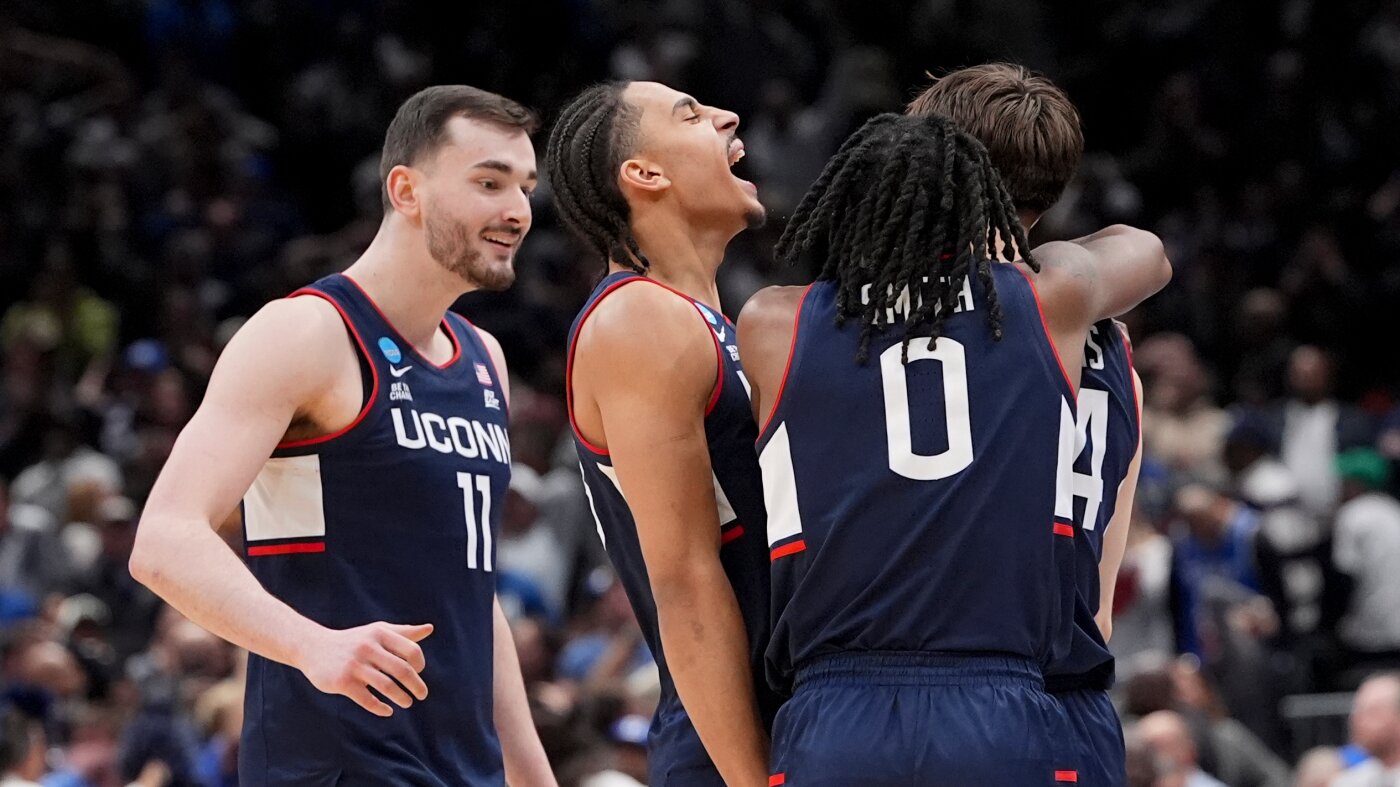
UConn guard Braylon Mullins, right, celebrates his game winning basket with guard Malachi Smith (0) during the second half in the Elite Eight of the NCAA college basketball tournament against Duke, Sunday, March 29, 2026, in Washington.
Stephanie Scarbrough/AP
hide caption
toggle caption
Stephanie Scarbrough/AP
All that talent at Arizona and Michigan. All that momentum and good vibes at UConn. And somebody has to be play the part of the unheralded “little guy.” At the Final Four next weekend, that role belongs, improbably, to Illinois.
In a sign of the times, the Illinii — a Big Ten team with more wins in the conference over the last seven seasons than any other program — will pass for something resembling Cinderella when college basketball’s biggest party kicks off in Indianapolis on Saturday.
The first challenge for coach Brad Underwood’s team will be stopping a hard-charging UConn juggernaut that came from 19 points down and got a game-winner from the logo with 0.4 seconds left from an Indy native — Braylon Mullins — to make its third Final Four in the last four years.
The last two times the Huskies reached this point, they won the championship.
“It’s a UConn culture, a UConn heart,” coach Dan Hurley said. “We believe we’re supposed to win this time of year.”
All these teams do.
Arizona, led by Brayden Burries, and Michigan, with Yaxel Lendeborg, have up to nine NBA prospects between them.
The Wildcats opened as slight favorites — at plus-165 to win the championship, according to BetMGM Sportsbook. That was a shade ahead of the Wolverines, who are plus-180 after their 95-62 romp over Tennessee on Sunday.
But, in one of a few strange twists on the odds chart, the Wildcats are 1 1/2-point underdogs to Michigan in Saturday night’s second semifinal.
Illinois is a 2 1/2-point favorite over UConn and, in reality, it’s the Huskies, at plus-550, who are the biggest long shot in Indy.
Even so, the fact that Illinois — the flagship university in the nation’s sixth most populous state and a school with an enrollment of nearly 60,000 — feels most like this year’s out-of-nowhere underdog speaks more about the current state of college hoops than the Illini themselves.
They are a No. 3 seed — the highest number at the Final Four in two years. (UConn is a 2. Last season, all four No. 1s made it.)
This year’s meeting of 1 vs. 1 — Michigan vs. Arizona — is a heavyweight matchup of power teams from power conferences meeting with everything at stake.
It’s a far cry from a mere three years ago, when mid-majors Florida Atlantic (coached by Dusty May, who now leads the Wolverines) and San Diego State crashed college basketball’s biggest party.
Since then, NIL and the transfer portal have redefined the contours of player movement, another spasm of realignment has made the big conferences bigger (Arizona, now in the Big 12, was in the Pac-12 in 2023), and the high-achieving underdogs that used to make March Madness what it is have gone into a slump.
Double-digit seeds won a total of five games in this tournament (not counting the play-in round). Two years ago, they won 11 and sent one team (N.C. State) to the Final Four.
Not surprisingly, Underwood — the coach who landed on the Illinois radar a decade ago by coaching double-digit seed Stephen F. Austin to a pair of upset wins in the tournament — views his program’s trip to the Final Four more as destiny than a once-in-a-lifetime story.
It is, however, the first trip for Illinois since 2005, when it lost to North Carolina in the title game.
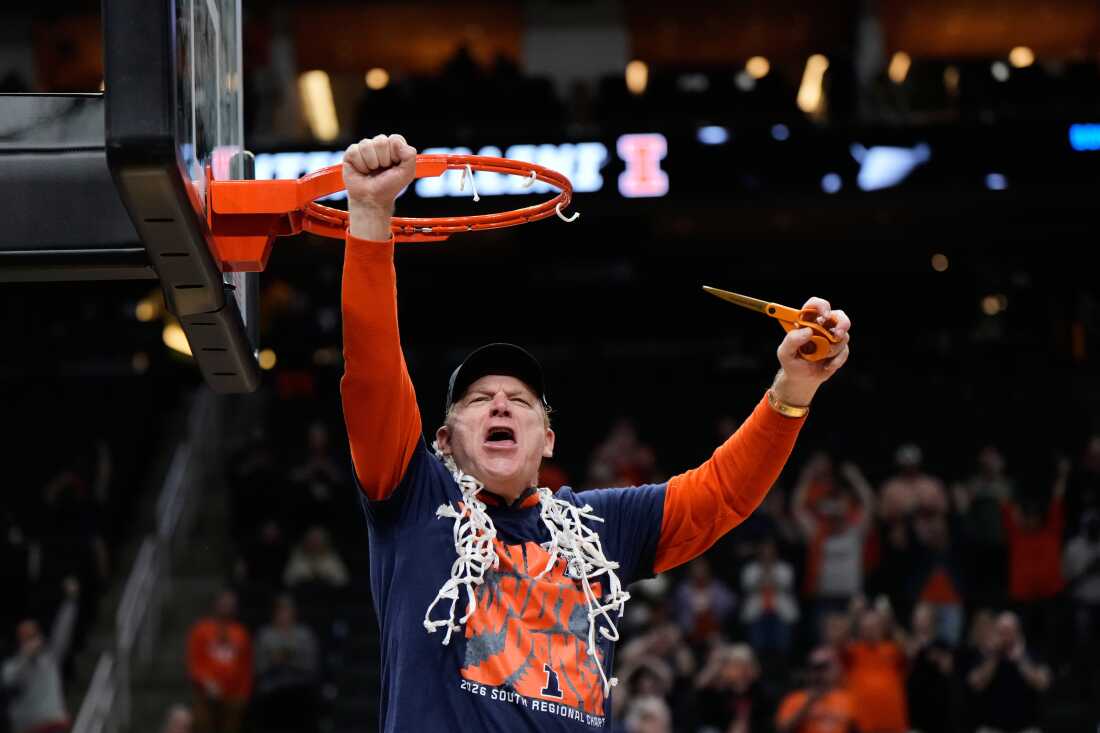
Illinois coach Brad Underwood celebrates after Illinois beat Iowa in an Elite Eight game in the NCAA college basketball tournament Saturday, March 28, 2026, in Houston.
Ashley Landis/AP
hide caption
toggle caption
Ashley Landis/AP
“I don’t want to sound arrogant,” said Underwood, whose teams have won 96 Big Ten games since 2019-20, two more than Purdue. “I’ve never doubted us getting to a Final Four would happen. I have thought we have had other teams capable. But I also know how doggone hard it is to do it.”
The Big Ten knows all about this. Both Illinois and Michigan have a chance to deliver a title for the conference for the first time since Michigan State won it all in 2000.
Illinois vs. UConn
The Illini, led by the so-called “Balkan Bloc” — a cohort of players with roots in Eastern Europe — have a potential NBA lottery pick of their own in guard Keaton Wagler.
Even so, the best-known name on the Illini roster might be Andrej Stojakovic, whose father, Peja, was a three-time NBA All-Star. Illinois is the third school in three years for the younger Stojakovic, who spent one season at Stanford and another at Cal before joining Underwood’s crew.
The task for Illinois: Figuring out who to key on across a roster that has five players who average double figures, led by Tarris Reed Jr.
Michigan vs. Arizona
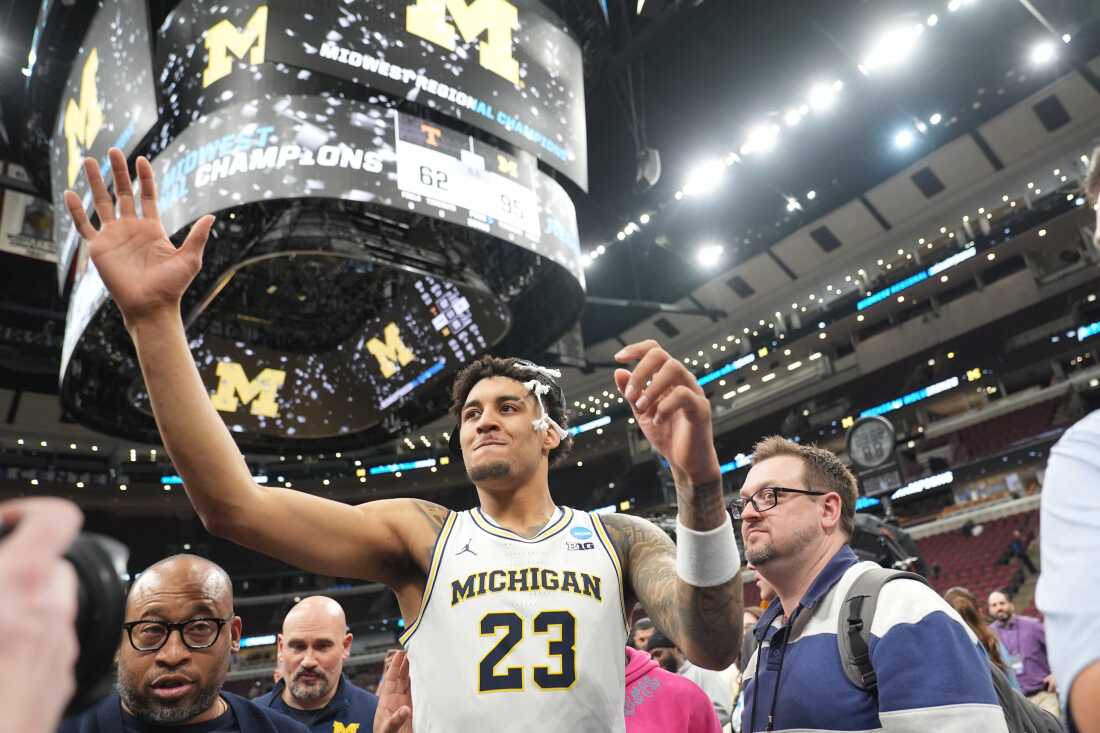
Michigan’s Yaxel Lendeborg (23) celebrates after defeating Tennessee in the Elite Eight of the NCAA college basketball tournament, Sunday, March 29, 2026, in Chicago.
Erin Hooley/AP
hide caption
toggle caption
Erin Hooley/AP
The Wildcats-Wolverines game is a high-powered matchup of programs that have shown there’s more than one way to amass talent in the era of the unlimited transfer portal and big-money name, image and likeness deals.
Four of the five starters for Tommy Lloyd’s Wildcats began their careers in Tucson; the fifth, Big 12 player of the year Jaden Bradley, moved over from Alabama and has been with the Wildcats for three years.

Meanwhile, the top four players in minutes played at Michigan — Lendeborg, Morez Johnson Jr., Aday Mara and Elliot Cadeau — all arrived from the transfer portal.
In a twist that makes perfect sense these days, both coaches parlayed roots in the mid-majors to a spot on the sport’s biggest stage. Lloyd spent decades as a top assistant for Mark Few at Gonzaga before heading to Arizona to rebuild the program after the ouster of Sean Miller in 2021.
May led FAU to the Final Four before heading to the Michigan program that had thrived, then collapsed, under former Fab Five star Juwan Howard.

Once again, the NFL pre-draft circuit is in full effect, as teams spread out their staff all over the country to try and ensure they view as many pro days as physically possible. With some of the most substantial schools being next up on the schedule, it is going to draw national attention from the media, especially with results from the top prospects and potentially some passing drills from the quarterbacks.
Among the plentiful news coming out of these events is some intriguing meetings from the New Orleans Saints, with one of the most recent being Illinois guard Josh Gesky, who they met with at the school.
Gesky had an extremely impressive 2025 season when it comes to the metrics, allowing only 1 sack and 12 pressures, while only having 1 penalty tied to his name. While his run blocking left a bit to be desired, he has shown promise there in previous years, and it is something he has been solid at in various years.
At 6-foot-5 and 335 pounds, he has great size and has quite a few distinctions during his time at Illinois. He was listed as a Big Ten Distinguished Scholar in 2023, an Academic All-Big Ten from 2022 to 2025, and was an All-Big Ten Honorable Mention from 2023 to 2025. These types of things certainly factor into potential draft selections, and with the Saints needing another guard, Gesky could be an option for them in 2026.

No. 3 Illinois knocked off No. 9 Iowa on Saturday night in Houston, now they’re advancing to the Final Four in the men’s NCAA Tournament.
The Fighting Illini pulled away late and ended their the Hawkeye’s Cinderella run in the Elite Eight with a 71-59 victory.
SHOP: Illinois Final Four tickets
Illinois fans know this is special, it’s the team’s first Final Four appearance since 2005, so now it’s time to celebrate.
Get the gear the players wore on the court, including Illinois Final Four hats, Illinois Final Four shirts, and more.
Shop ALL Illinois Final Four gear
Illinois Final Four hat
Illinois Final Four shirt
Illinois Final Four game location
Illinois will play its Final Four game at Lucas Oil Stadium in Indianapolis. Get your Illinois Final Four NCAA Tournament tickets now.
Shop Illinois Final Four tickets
Illinois Final Four appearances
The last time the Illinois Fighting Illini men’s basketball team made the Final Four was in 2005. They also made it in 1989, 1952, 1951 and 1949.
When is the Final Four?
The 2026 NCAA Tournament concludes with the Final Four on Saturday, April 4 and the National Championship game on Monday, April 6. Saturday’s games are scheduled for 6 p.m. and 8:30 p.m. ET respectively, while the National Championship game is set to tip at 8:30 p.m. ET on Monday, April 6.
March Madness 2026 full schedule for the men’s tournament
- March 19-20: First round
- March 21-22: Second round
- March 26-27: Sweet 16
- March 28-29: Elite 8
- April 4-5: Final Four
- April 6: National Championship
Shop ALL March Madness tickets

Wolverines make Frozen Four

Bay Area residents hold rally in SF as war with Iran enters 2nd month

Dallas Jenkins says he is the ‘evangelical mascot of the LDS church’ and talks Easter celebrations

New video shows aftermath of police shooting in Downtown Miami

Boston Celtics Star Jayson Tatum Made History In Hornets Game

Florida High School Football Rankings: Top 25 teams – Oct. 21

How old is Bo Nix? What to know about Oregon quarterback ahead of 2024 NFL Draft

Cleary's 21 help Le Moyne down Central Connecticut State 69-64 in OT

99th annual Pony Swim held in Virginia

Indiana Members Credit Union announced as new anchor tenant at Bottleworks District

Scathing report claims nation’s oldest labor union ‘betrayed’ MAGA members through ‘shocking’ spending

Republican US lawmaker demands Congress vote on any Iran troop deployment

So you went to a No Kings protest. Now what?

JD Vance says he was ‘obsessed’ with UFOs, believes aliens are actually ‘demons’
The EU's recipe for trade deals : easy on beef, tough on wine
-

 Sports1 week ago
IOC addresses execution of 19-year-old Iranian wrestler Saleh Mohammadi
-

 New Mexico1 week ago
Clovis shooting leaves one dead, four injured
-

 Miami, FL4 days ago
Jannik Sinner’s Girlfriend Laila Hasanovic Stuns in Ab-Revealing Post Amid Miami Open
-

 Tennessee6 days ago
Tennessee Police Investigating Alleged Assault Involving ‘Reacher’ Star Alan Ritchson
-

 Minneapolis, MN4 days ago
Boy who shielded classmate during school shooting receives Medal of Honor
-

 Politics1 week ago
Schumer gambit fails as DHS shutdown hits 36 days and airport lines grow
-

 Science1 week ago
Record Heat Meets a Major Snow Drought Across the West
-

 Technology1 week ago
YouTube job scam text: How to spot it fast