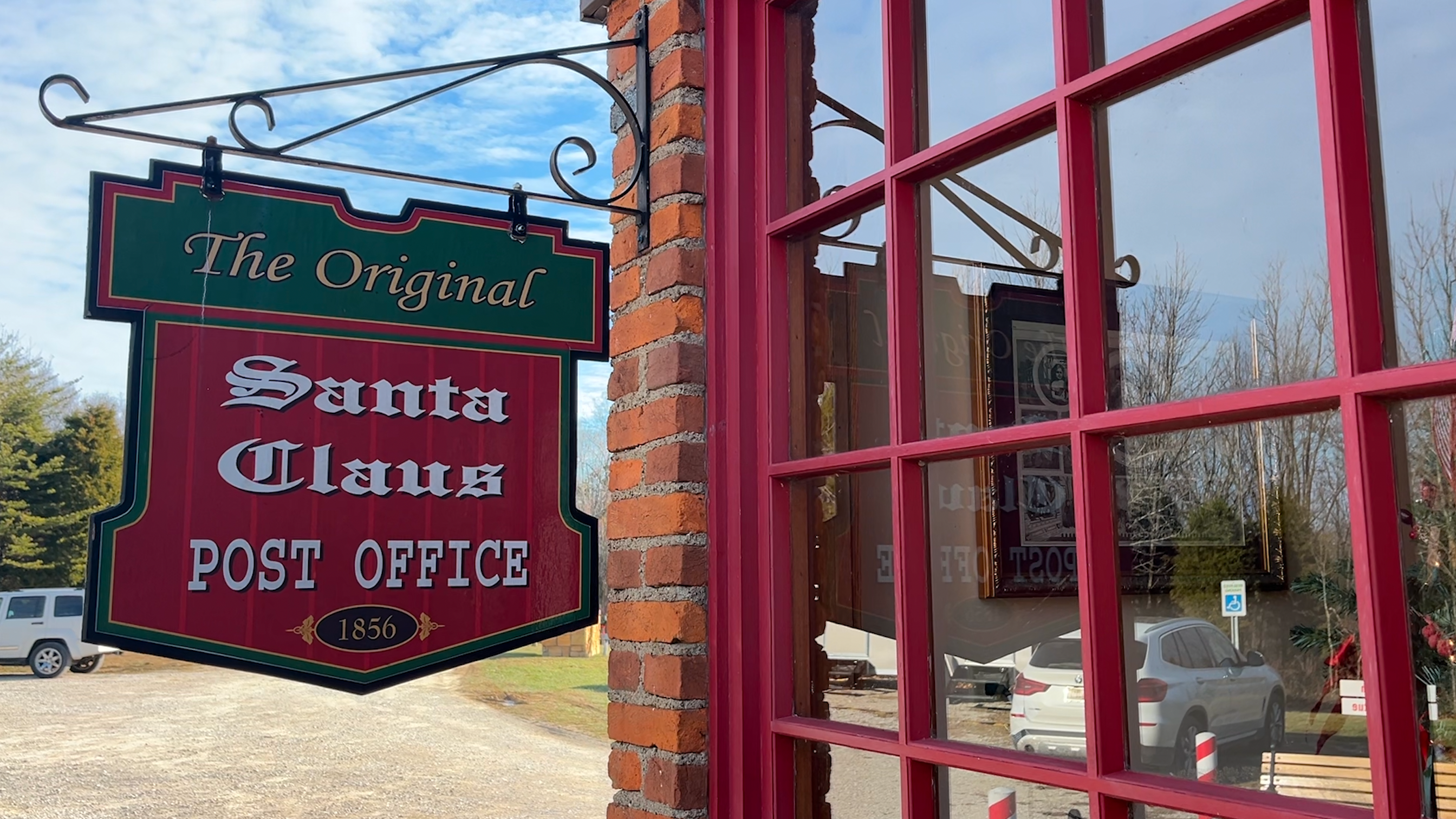
Every Christmas season, letters to Santa flood in from kids around the world — but in Santa Claus, Indiana, volunteers become Santa’s elves to ensure every child gets a reply.
This small town, according to locals, was initially going to be called “Santa Fee.” Its request for city status, however, was denied due to an existing town already named Santa Fe in Indiana.
As a result, it was named Santa Claus instead. It’s the home of a decades-old tradition of responding to letters sent to Santa.
‘BEST CHRISTMAS GIFT’ EVER AS KIDS WITH MISSING LIMBS RECEIVE BIONIC ARMS: ‘AMAZING’
Last year, nearly 25,000 letters arrived — and this year, volunteers expect even more.
Advertisement
Santa Claus, Indiana, may be small, but it has a big holiday spirit. The town’s post office has been receiving letters addressed to Santa for nearly a century.
A child’s letter to Santa is preserved at the Santa Claus Museum in Indiana.(Olivianna Calmes/Fox News)
For years, volunteers have answered those letters, ensuring each child receives a personalized response.
The post office is one of the oldest buildings in the town, dating back to 1856.
FIREFIGHTER DRESSES AS SANTA CLAUS TO BRING JOY TO SICK KIDS: ‘SOMETHING TO BELIEVE IN’
Advertisement
Pat Koch, the town’s “Chief Elf” at the Santa Claus Museum and Village, has been involved in the effort since she was only 12 years old, she told Fox News.
“When my father came back from the Navy, from World War I, he went to the post office to visit the postmaster in Santa Claus, and found that he was just inundated with mail and letters from children,” Koch said.
Pat Koch or “Chief Elf,” at right, shares the ins and outs of how to respond to letters sent to Santa from across the world. (Olivianna Calmes/Fox News)
Today, the effort is a team effort, with “elves” helping to sort, read and reply to thousands of letters.
The original post office is still at the heart of this process.
Advertisement
AMERICAN CULTURE QUIZ: TEST YOURSELF ON FROZEN FIRSTS, SANTA SCHOLARS AND CONSTITUTIONAL ACHIEVEMENTS
Letters are answered in the building’s backroom, a space where the magic of Santa is kept alive year-round.
“I think it’s absolutely wonderful that children still believe, because of all the social media, TV, movies and all that,” said Koch.
A volunteer at the Santa Claus Museum in Indiana replies to a child’s heartfelt letter to Santa.(Olivianna Calmes/Fox News)
The Santa Claus Museum showcases letters dating back to the 1930s, with some written by children from across the world.
Advertisement
Many letters are filled with joy — but some reflect deeper, more difficult situations.
For more Lifestyle articles, visit www.foxnews.com/lifestyle
“We do get many sad letters. I can say last week I think it was a child who was mature said, ‘I hope my mom gets drug tested.’ That’s really sad. And all we can say is ‘Santa is hoping your mother gets better,’” Koch said.
She said answering every letter is important to spread Christmas cheer to kids in all situations.
A welcome sign in Santa Claus, Indiana, “America’s Christmas Hometown.”(Olivianna Calmes)
Advertisement
The elves at the Santa Claus Museum and Village can receive letters to Santa any time of the year at this address:
Santa Claus P.O. Box 1 Santa Claus, IN 47579
The town itself features Holiday World and Splashin’ Safari (formerly called Santa Claus Land), which is said to be one of the world’s first amusement parks.
Advertisement
It also features Christmas-themed shops, restaurants, even a grocery store that embraces the festive atmosphere year-round.
Olivianna Calmes joined Fox News in 2024 as a Multimedia Reporter based in St. Louis, Missouri.
An investigation is underway after police shot and killed a man on Detroit’s west side. (Noelle Friel, Sara Schulz, Copyright 2026 by WDIV ClickOnDetroit – All rights reserved.)
DETROIT – An investigation is underway after police shot and killed a man on Detroit’s west side.
The incident occurred on Thursday (June 25) in the 18900 block of Rosemont Avenue and 7 Mile Road, prompting a response from police and emergency crews, who set up a staging area.
Local 4 is heading to the scene and will provide updates as they become available, but the victim’s condition has not been released as of 7:55 p.m.
Advertisement
The Detroit Police Department’s Media Relations team was responding to the scene, and officials said additional information would be provided, including a media briefing with sound available.
Authorities have not released details about what led up to the shooting or the circumstances involving the officer or officers involved.
This is a breaking news story, and updates will be posted as they become available.
Copyright 2026 by WDIV ClickOnDetroit – All rights reserved.
About the Author
Brandon Carr headshot
Brandon Carr
Brandon Carr is a digital content producer for ClickOnDetroit and has been with WDIV Local 4 since November 2021. Brandon is the 2015 Solomon Kinloch Humanitarian award recipient for Community Service.
MILWAUKEE — Milwaukee city workers have been working overtime and on weekends to patch potholes in what is shaping up to be a record year for that type of work. But for many residents, the patching is not enough.
The city’s Department of Public Works has received more than 18,000 requests for pothole service so far in 2026. Workers have already filled more than 10,000 potholes this year — right around what the city has averaged annually over the past five years.
Following a winter marked by repeated freeze-thaw cycles and a spring that brought additional weather-related challenges, city officials held a news conference Thursday with an update on the situation.
Advertisement
Raneissa Baker, a driver on Milwaukee’s north side, said her car is currently in the shop with suspension damage she says will cost her $1,100 — the result of the sheer number of potholes she has hit this year, not any single one.
“Streets are horrible, and every time that you hit a pothole, all you hear, doo doo doo doo doo,” Baker said.
Watch: Milwaukee residents demand permanent fixes as city logs record pothole repairs
Advertisement
Milwaukee reports high number of pothole requests
Baker said avoiding the craters is not an option and potentially dangerous depending on traffic.
“It’s impossible to try to avoid it,” Baker said.
At the news conference, TMJ4 asked DPW Commissioner Jerrel Kruschke what his message was for drivers like Baker who have had their cars damaged and spent thousands of dollars on repairs.
Advertisement
“The first thing I tell the public is please pay attention. If you focus on driving ahead of time, a lot of times you can avoid potholes on the roadway. We know they exist. We know it’s frustrating,” Kruschke said. “If you do have some sort of damage to your vehicle, there is a claim system that you can go onto the city website and file a claim.”
Mike Beiermeister
Mike & Raneissa Baker watch the press conference.
Baker pushed back on that response.
“He said to pay attention and try to avoid it. How are we going to be able to avoid it if you’re driving and there’s a car right here, and there’s a pothole right here? How am I going to try to avoid that?” Baker said.
Patrick Housfeld, who lives on South 12th Street, said the problem on his block is nothing new.
Advertisement
“This wasn’t new this year; this has happened for 21 years straight,” Housfeld said.
Mike Beiermeister
Patrick Housfeld looks down S. 12th St.
Housfeld has stopped using 12th Street altogether and believes more craters will soon reemerge after the latest round of patching. He called the work on his block performative.
“Make the problem go away. I don’t care what the numbers were or are,” Housfeld said.
Both Baker and Housfeld want more permanent solutions than pothole patching.
Advertisement
Road reconstruction, however, is expensive — running into the millions of dollars depending on the work required.
“You fill it up with Oreo crumbs today, it’s a bigger sinkhole by tomorrow, it’s not making sense, just repair the roads,” Baker said.
DPW estimates it still has about 5,000 potholes left to patch. The city says it will be all hands on deck until that work is complete.
The department says residents can report potholes or repair concerns through Milwaukee’s Service Request page or by calling the city’s Unified Call Center.
This story was reported on-air by a journalist and has been converted to this platform with the assistance of AI. Our editorial team verifies all reporting on all platforms for fairness and accuracy.
Let’s talk:
Hey there! At TMJ4 News, we’re all about listening to our audience and tackling the stuff that really matters to you. Got a story idea, tip, or just want to chat about this piece? Hit us up using the form below. For more ways to get in touch, head over to tmj4.com/tips.
It’s about time to watch on your time. Stream local news and weather 24/7 by searching for “TMJ4” on your device.
Advertisement
Available for download on Roku, Apple TV, Amazon Fire TV, and more.
Minneapolis City Council members approved a five-month pause on new data center development Thursday.
The moratorium does not apply to smaller data centers located downtown that are less than 350,000 square feet.
The Minneapolis City Council voted to temporarily halt new data center projects while city staff study regulations and examine concerns about environmental impacts, energy use and public safety.
The vote comes as opposition to data center projects has surfaced in communities across Minnesota.
Advertisement
In Elk River, Minnesota, this week, the city’s planning commission recommended against a proposal that would pave the way for a data center, despite the fact advocates said the project could generate an estimated $800,000 in additional revenue.
In Inver Grove Heights, Minnesota, a packed city council meeting erupted in boos after officials delayed a final vote on a proposed data center. The vote is now scheduled for Friday.
The issue has drawn strong opinions in Minneapolis.
At a Minneapolis committee meeting last week, a vocal majority spoke out in favor of the pause. Labor groups highlighted the construction jobs data centers can provide, while residents raised concerns about neighborhood impacts and whether the facilities would benefit local communities.
Councilmember Soren Stevenson said residents throughout Minneapolis have been clear in their opposition to additional data center development.
Advertisement
“My constituents and people from across this city are so, so clear that they don’t want data centers at all,” Stevenson said.
Supporters of the moratorium said the temporary pause will give city officials time to study the industry and develop regulations before additional projects move forward.
Council Member Aurin Chowdhury argued that data centers have had disproportionate impacts.
“That industry has shown over and over again negative impacts, especially in communities of color and communities that have been impacted by environmental injustice,” Chowdhury said.
Opponents of the pause warned the move could discourage future investment in Minneapolis and send the wrong message to businesses considering projects in the city.
Advertisement
Councilmember Linea Palmisano said the moratorium could undermine efforts to attract economic development at a time when residents are facing higher property taxes.
“We send a message to the business community that they aren’t important or supported by this council,” Palmisano said. “We send the message that we don’t want their investment.”
The measure now heads to Mayor Jacob Frey, who plans to spend the next several days reviewing the ordinance before deciding whether to sign it, a spokesperson said.