Cleveland, OH
Cleveland has Ohio’s highest apartment rents – NEOtrans
The Collins Apartments on Carter Road is one of two major developments to open in the past year on Scranton Peninsula in Cleveland’s Flats. But it wasn’t enough to meet Greater Cleveland’s demand for more multifamily units (NEOtrans). CLICK IMAGES TO ENLARGE THEM.
Multifamily construction not meeting demand
A new report released today by international real estate firm Colliers shows that multifamily development in Greater Cleveland isn’t keeping up with demand. The result is that average rents in the Cleveland area are now the highest of any metro area in the state.
Colliers said that 1,601 apartments are typically built each year in Greater Cleveland to meet an average annual demand of about 1,976 multifamily housing units — the second-highest demand in the state behind Columbus’ 7,156 units.
But while metro Columbus had 9,123 apartments under construction in the first quarter of 2026, metro Cleveland had only 1,203 apartments being built in that same three-month period.
By comparison, Greater Cincinnati has a typical annual demand for 1,121 units of multifamily housing which is met by an annual average of 1,944 units. But in the first quarter of 2026, Cincinnati had 3,575 apartments under construction.
That translated into an average rent per square foot in January-March 2026 of $1.60 in Greater Cleveland, $1.58 in Cincinnati and $1.47 in Columbus.
More apartment construction is needed in Greater Cleveland to keep up with demand. Without it, the metro area will continue to have the highest rents per square foot in the state (NEOtrans).

The typical size of an apartment in Cincinnati is slightly larger than those in Cleveland, so the average monthly rent for an apartment in Cincinnati is the highest at $1,511. Cleveland is next at $1,419 and Columbus third at $1,405.
“The development pipeline (in Cleveland) continues to shrink, with units under construction falling to about 1,203 from 1,461 last quarter and 3,672 one year ago,” Collier said in its report.
“That drop in future supply is one of the most important trends in the market right now, because it should help Cleveland maintain healthy occupancy and support rent growth as 2026 moves forward,” the report explained, noting that higher rents will attract new construction.
“That is a strong signal for the market, especially after several years of elevated deliveries,” the report noted. “Over the last five years, Cleveland has generally operated in the mid-95 percent occupancy range, and current performance remains in line with that trend.”
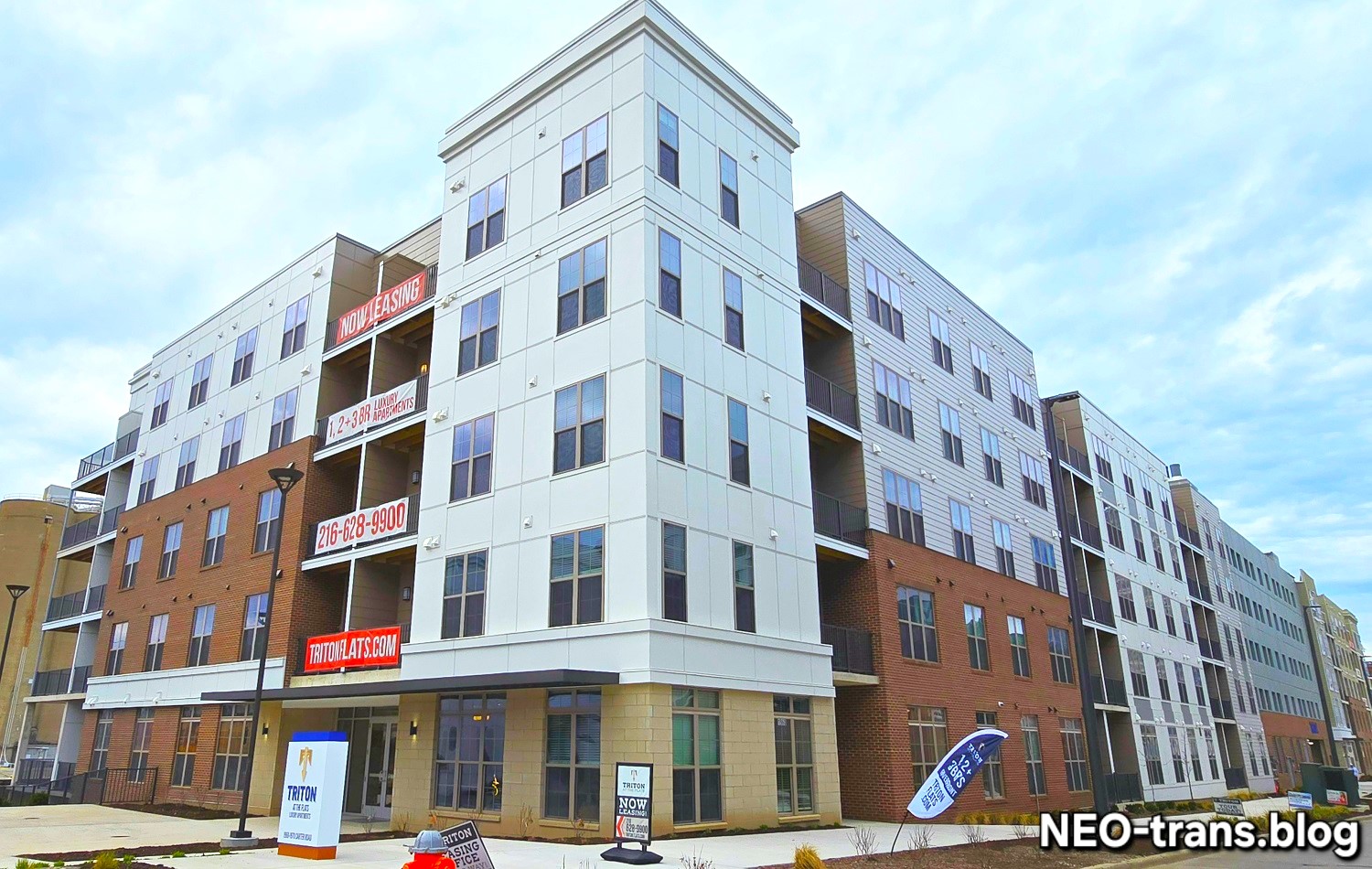
The other big development on Cleveland’s Scranton Peninsula is Triton at The Flats, opening after The Collins across the street (NEOtrans).
In part, Colliers used data generated by Real Capital Analytics, a data model managed by MSCI Inc., a finance, equity and real estate analysis company headquartered in New York City.
“Cleveland’s multifamily market remained healthy in Q1 2026, with inventory rising to approximately 178,925 units and occupancy holding at 95.8 percent,” Colliers said in its report.
The report noted that while construction locally has dropped below demand, vacant units are filling the gap. Yet Cleveland had fewer vacant units than Ohio’s other two big C’s.
“Vacant units totaled about 7,533, down from roughly 7,719 last quarter,” Colliers said of Cleveland’s apartment market. “Demand continued to absorb most of the new supply, keeping overall fundamentals stable.”


Not all new multifamily inventory comes from new construction. In Downtown Cleveland, most of it comes from converting older, obsolete office buildings into housing plus other uses like hotel and retail, as seen here with Project Scarlet’s remake of the Rose Building at East 9th Street and Prospect Avenue (NEOtrans).
Greater Columbus may have Ohio’s largest multifamily inventory at 218,113 apartments, it also has the most vacant units at 10,382. Greater Cincinnati’s inventory had 173,050 apartments with 7,562 of them vacant in the Q1 2026.
“Market conditions also improved from a year ago,” Colliers said. “Occupancy increased from 94.5 percent in Q1 2024 to 95.8 percent in Q1 2026, showing that Cleveland has been able to work through added inventory without a meaningful drop in performance.”
Leasing conditions are still competitive in the Cleveland market and the market remains on solid footing. Colliers said newer projects are creating pressure in certain pockets, especially where owners are competing for renters more aggressively, but the broader market continues to benefit from steady demand and a stable base of occupied units.
“In simple terms, Cleveland is not overheating, but it is also not slipping,” the report summarized. “It is holding up well.”
END