Midwest
10 delicious all-American summertime foods enjoy surprising overseas origins

Americans from sea to shining sea feast on juicy beef burgers dripping with Wisconsin cheddar followed by apple pie or peach cobbler at sun-splashed cookouts each summer.
The more ambitious among us will fuel up for 4th of July road races on Wheaties and fresh-squeezed Florida orange juice.
Every item on that all-American menu has one thing in common.
AMERICAN CULTURE QUIZ: TEST YOUR COMMAND OF STATE BIRDS, STATE SONGS, POP STARS AND POLITICS
Not one of them is made from foods native to the United States — or even to the Western Hemisphere.
Beef, cheese, apples, peaches, oranges and even wheat are among hundreds of common, even iconic, American foods foreign to American soil.
Cheeseburgers are a definitive American food. But neither beef cattle nor dairy cows are native to the Western Hemisphere. They arrived with European explorers in the wake of voyages by Christopher Columbus. (Kerry J. Byrne/Fox News Digital)
Credit a man reviled by academics today: Christopher Columbus.
The Genoese explorer, sailing under the Spanish crown, was much better appreciated by earlier and more enlightened generations.
“Traditional foods of billions of living people are the mute documents of a process set in motion by Columbus.”
Columbus inspired global cultural integration more profoundly than any human before or since. He did it all with sextants instead of social-media hashtags touting his devotion to diversity.
“The ostensibly traditional foods of billions of living people are the mute documents of a process set in motion by Columbus,” food historian Raymond Sokolov wrote in “Why We Eat What We Eat: How Columbus Changed the Way the World Eats.”
Rendering of Christopher Columbus arriving in the Americas in 1492. Chromo-lithograph by Louis Prang and Company. (Getty Images)
The Columbian Exchange, as its known, went both ways.
Roman emperor Julius Caesar never tasted tomato sauce; Ireland patron St. Patrick never peeled a potato; and French heroine Joan of Arc never cherished chocolate souffle.
MEET THE AMERICAN WHO FIRST PLANTED APPLES IN THE COLONIES: WILLIAM BLAXTON, ECCENTRIC SETTLER
Tomatoes, potatoes and chocolate are all New World natives.
Conversely, many foods we cherish as uniquely American today have surprising worldwide origins.
Here are 10.
1. Apples
Apple pie is the standard by which the American-ness of all things is measured. Johnny Appleseed is treasured as the personification of American bounty.
Apples are considered a barometer of American-ness. But they are native to Central Asia. The first apple orchard in the United States was planted by early settler William Blaxton in the 1630s in Boston, Massachusetts. (iStock)
Apples, however, are native to Central Asia. The Pilgrims themselves celebrated the first Thanksgiving in 1621 without apple pie.
The first apple trees were planted 10 years later in Boston by William Blaxton, the city’s first settler.
APPLES VS. ORANGES: WHICH OF THESE FRUITS IS ‘BETTER’ FOR YOU?
The Roxbury russet, possibly descended from Blaxton’s original orchard, and named for a Boston neighborhood, is the oldest varietal in the U.S. today.
2, 3, 4. Butter, cheese, milk
Imagine the Land of Milk & Honey without either.
That was the Americas before Columbus. No delicious metaphor to address your sweet love, no way to taunt the greasy-fingered player who drops the ball.
“There were no dairy products, no milk, no cream, no butter, no cheese (before European exploration).”
No way to celebrate victory at the Brickyard on Memorial Day weekend.
The winner of the Indianapolis 500 celebrates his triumph each year by drinking, and often dousing himself, with milk handed to him by an Indiana dairy farmer.
Marcus Ericsson of Sweden celebrates in Victory Lane by pouring milk on his head after winning the 106th Running of The Indianapolis 500 at Indianapolis Motor Speedway in Indianapolis, Indiana, May 29, 2022. (Jamie Squire/Getty Images)
“There were no dairy products, no milk, no cream, no butter, no cheese,” before European exploration, writes Sokolov.
Dairy cows and domesticated livestock arrived only with European exploration. Honey bees, too, are an Old World import.
5, 6, 7. Bacon, barbecue, burgers
Sizzling bacon, smoky pork, beef brisket, and cheddar-coated cheeseburgers form a holy alliance of all-American deliciousness.
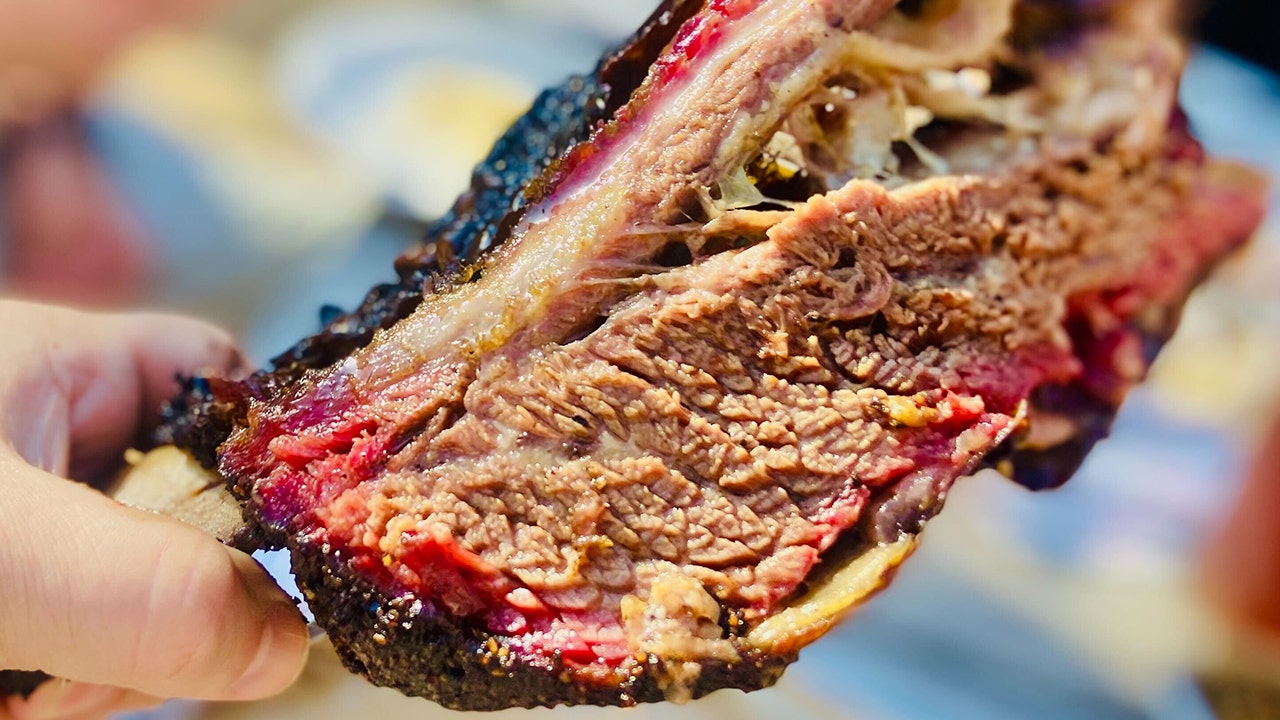
But pork and beef are both global imports that followed trans-Atlantic trade. That’s right: New York sirloin, Texas beef ribs and Carolina pulled pork are culturally appropriated.
A giant smoky barbecue beef rib from Pecan Lodge in Dallas, Texas. Beef livestock are not native to the Americas. Cattle — and red meat — arrived with European explorers in the 15th and 16th centuries. (Kerry J. Byrne/Fox News Digital)
“Red meat from domestic livestock [was] unknown in Mexico before the Spanish imported (it) … Before 1492, Mexican cuisine had no dishes with beef, pork or lamb.”
The livestock prospered and spread across what’s now the United States.
They gave us cattle drives, cowboys and John Wayne westerns.
8. Oranges
The U.S. boasts the Orange State, the Orange Bowl and several Orange counties.
But it had no oranges before Columbus.
The sunny citrus fruit, symbolic of both California and Florida, is native to Southeast Asia.
Oranges are signature cash crops for both California and Florida. But oranges are not native to the Western Hemisphere. They arrived in the wake of the Christopher Columbus explorations. (iStock courtesy of contributor CactuSoup)
The fruit was delivered to the New World by Columbus himself during a subsequent voyage in 1493.
“Soon afterward, the Spanish brought citrus to Florida,” reports the Florida Division of Historical Resources. “Florida Indians obtained seeds from Spanish missionaries and helped establish the growth of the fruit.”
9. Peaches
Atlanta would be a maze of unnamed streets today, Georgia would be best known as the land of a second-rate fiddle-playing devil, and “Reunited” would have been a 1970s solo hit by Herb, without Columbus.
MEET THE AMERICAN WHO INVENTED SLICED BREAD: OTTO ROHWEDDER, HARD-LUCK HAWKEYE
Peaches are native to China, but took a fancy to American soil.
Thomas Jefferson found peaches peachy — and grew dozens of varieties at Monticello, his hilltop Virginia farmstead.
Peaches grow at an orchard in Reynolds, Georgia, on Friday, July 8, 2022. Despite their ubiquitous association with the state, peaches are no longer Georgia’s biggest fruit crop. (Dustin Chambers/Bloomberg via Getty Images)
“The peach was introduced either by the Spanish settlers in St. Augustine, Florida, in 1565 or by the French to an isolated Gulf of Mexico settlement in 1562,” reports the Monticello website.
“It was probably grown in Mexico at an even earlier date.”
10. Wheat (and the Breakfast of Champions)
Wheaties, dubbed the “Breakfast of Champions,” has provided a forum to celebrate great American athletes for nearly a century (tennis legend Billie Jean King is the latest).
The General Mills cereal, and the amber waves of grain used to make it, are coincidental American culinary icons.
Wheaties were discovered in 1921 as a “result of an accidental spill of a wheat bran mixture into a hot stove,” General Mills reports on its website.
Tennis legend Billie Jean King is a 39-time Grand Slam champion and an equal rights champion. She is appearing on limited-edition boxes of Wheaties, dubbed “the Breakfast of Champions,” starting May 2024. (General Mills via AP)
Wheat was a staple of the Spanish diet.
It flourished in the Americas, first in Mexico and spreading north.
The grain was “planted wherever the conquistadors established farms,” writes Sokolov.
“By 1535, Mexico was exporting wheat to the Antilles.”
For more Lifestyle articles, visit www.foxnews.com/lifestyle.
Read the full article from Here

Midwest
Terrifying moment caught on camera as road collapse suddenly swallows vehicles at busy intersection

NEWYou can now listen to Fox News articles!
Dramatic video showed the moment a road collapsed below two unsuspecting motorists near the University of Nebraska-Omaha Tuesday, sending their vehicles feet below ground.
Footage taken by university security cameras appeared to show the two vehicles rolling up to an intersection, side-by-side, before a car pulled up behind them, seemingly triggering the collapse.
Emergency crews responded to the incident at 67th and Pacific streets at about 3:30 p.m., local outlet WOWT reported.
The collapse appeared to be triggered by a pickup truck behind the two cars. (UNO Public Safety/TMX)
The vehicles’ occupants had escaped the hole by the time authorities arrived.
“This caught everybody by surprise,” University of Nebraska-Omaha Public Safety Lt. Dan Martin told the outlet.
Dust could be seen as the vehicles fell into the pavement. (UNO Public Safety/TMX)
SOUTH KOREAN TOURISTS DISAPPEAR DURING ROAD TRIP BETWEEN GRAND CANYON, LAS VEGAS
No injuries were reported, though WOWT reported a water main broke during the collapse.
It is unclear what led to the collapse.
The outlet reported a heavy-duty tow truck with a crane retrieved the cars a few hours later, and crews worked to pull concrete from the crater.
It is unclear what led to the road collapse. (UNO Public Safety/TMX)
CLICK HERE TO DOWNLOAD THE FOX NEWS APP
Martin warned the sinkhole could expand, though it appears no additional sinkholes had been spotted as of Wednesday night.
Officials told WOWT the street will remain closed for “several days,” and motorists should avoid the area.
Related Article

Read the full article from Here

“Slow down and move over” is the message that Michigan State Police is sending to drivers after one of its troopers in a parked patrol car was struck while investigating a crash this weekend. The driver of that vehicle fled the scene.
Michigan State Police tells CBS News Detroit that we’re two months into the year, and it has had six incidents across the state where patrol cars were struck by oncoming vehicles. One of those incidents occurred on Sunday evening.
“Could have been much more tragic,” said MSP Lieutenant Rene Gonzalez, First District public information officer.
Gonzalez says on Sunday, an MSP trooper was near M-10 and Schaefer Highway in Detroit, simply doing his job, when his patrol car was hit from behind.
“Trooper was out there, and he was investigating a crash when, at the time, a Jeep SUV drove into the rear of the parked vehicle,” Gonzalez said.
The impact slid the trooper’s car into a concrete wall. The 29-year-old Detroit woman driving the Jeep SUV struck the center median, got out of the vehicle, and ran away.
“Not sure why they did it. Maybe not paying attention if they were distracted. They’re attempting to locate her at this time,” said Lt. Gonzalez.
The trooper walked away with minor injuries. Gonzalez says this incident is an example of why Michigan’s Move Over Law was put in place many years ago. The law, which went into effect in 2019, requires drivers to move over into the next lane and reduce their speed by at least 10 mph when emergency or service vehicles — police, fire, rescue, ambulance and road service — have their lights activated.
Drivers who are not able to move over are still required to reduce their speed.
“Trying to do our jobs, however, people are not paying attention. The law is easy. It’s simple. You see us, you see our lights activated, you have to slow down ten miles below the posted speed limit, and then if able, move over to the next occupied available lane,” Gonzalez said.
Gonzalez says crashes like this can be deadly and often avoided.
“One life lost over something that was a totally preventable crash, it’s way too much. We’re asking that you slow down and move over when you see our lights. It’s a simple message that we’ve been pushing out for years,” he said.
Sunday’s crash remains under investigation. Michigan State Police detectives are still working to track down the 29-year-old suspect.
In the meantime, police are out enforcing the Move Over Law.

Porter has helped the Bucks stay afloat; what’s his Milwaukee future?
Kevin Porter Jr. has helped the Milwaukee Bucks stay afloat without an injured Giannis Antetokounmpo; what’s Porter Jr.’s future in Milwaukee?
The Milwaukee Bucks host the Boston Celtics at Fiserv Forum just over 24 hours after one of their most disappointing losses of the season, when they scored just eight fourth-quarter points and gave up a 39-point swing in the second half in a blowout loss at Chicago on March 1.
Boston comes into town as one of the league’s hottest teams having won eight of its last 10 and after beating Philadelphia on March 1. The Celtics (40-20) are currently the No. 2 seed in the Eastern Conference and are looking to stay in front of New York.
The Bucks (26-33), meanwhile, had been winning games but have dropped two in a row and three of their last five. In those three losses, all to teams currently in the Eastern Conference playoff picture, the team failed to score 100 points.
Is Giannis playing?
Yes.
Giannis Antetokounmpo began the day as questionable to play, and was upgraded to available after his pregame workout. It was the first time he had been listed as anything other than “out” since reinjuring his calf on Jan. 23. The game will mark the return of the former two-time MVP, who has missed the last 15 games with a strain of his soleus muscle in his right calf.
What is the Bucks record without Giannis?
11-17.
Milwaukee is 15-15 when Antetokounmpo plays any number of minutes. They are 1-2 when he has exited games early due to injury.
Is Jayson Tatum playing?
No.
Boston’s all-NBA wing is continuing to work his way back from a torn Achilles tendon suffered during the playoffs in May. Tatum has been doing five-on-five work lately.
Boston Celtics injury report
- Jayson Tatum, out (Achilles)
- Jaylen Brown, out (illness)
- Neemias Queta, out (rest)
Taurean Prince, out (neck surgery)
Giannis Antetokounmpo, questionable (right calf strain)
Bucks probable starters
- Guard: AJ Green, Ryan Rollins, Kevin Porter Jr.
- Forward: Giannis Antetokounmpo
- Center: Myles Turner
What time is the Bucks game?
The game is scheduled to begin at 6:30 p.m. CT.
What channel is the Bucks game on?
The game will be broadcast locally on FanDuel Sports Network Wisconsin with Lisa Byington, Wesley Matthews and Melanie Ricks on the call. The game was originally supposed to be a national broadcast on Peacock but was moved to NBA TV.
NBA playoff standings
The Bucks are currently out of the postseason picture entirely. Here are the play-in standings in the Eastern Conference heading into game play on March 2:
No. 7: Orlando (31-28): The Bucks and Magic have split the season series 1-1. The Bucks host the Magic on March 8.
No. 8: Miami (32-29): The Bucks and Magic have split the season series 1-1. Milwaukee travels to Miami on March 12.
No. 9: Atlanta (31-31): The Bucks lead the season series 1-0. The Bucks host the Hawks on March 4 and then travel to Atlanta on March 14.
No. 10: Charlotte (30-31): The Bucks own the tiebreaker over the Hornets having won the season series 3-1.
No. 11: Milwaukee (26-33): The Bucks have had better luck against the play-in teams to date, as they are just 5-13 against the top six seeds in the conference.
“We say we didn’t play ourselves out of it,” Bucks head coach Doc Rivers said. “Obviously I’m competitive. I think we should’ve had an even better record. But, not having your best player for that long and staying above .500 is huge for us. It’s funny, when he went out (Jan. 23) the talk around me was ‘being .500’ and I was like we can be better than that. We were. I’ll take it. But, never satisfied.”
The four teams in the play-in will face one another to determine the final two playoff teams (which will face the top two seeds). Teams that hold the Nos. 7 and 8 seeds only have to win one game to advance, teams that hold the Nos. 8 and 9 seeds must win twice to advance
Bucks vs. Celtics odds
Boston is a 7.5-point favorite over Milwaukee with the over/under set at 216.5 points, per BetMGM.

Trump sends official notification to Congress on strikes against Iran

Punch the monkey, viral star, experiences dramatic breakthrough among zoo mates

NBA player calls for Hawks to cancel their ‘Magic City’ strip club promotional night out of respect for women

Why the Microsoft 365 Copilot bug matters for data security
California gas is pricey already. The Iran war could cost you even more

Florida High School Football Rankings: Top 25 teams – Oct. 21

Cleary's 21 help Le Moyne down Central Connecticut State 69-64 in OT

How old is Bo Nix? What to know about Oregon quarterback ahead of 2024 NFL Draft

99th annual Pony Swim held in Virginia

Indiana Members Credit Union announced as new anchor tenant at Bottleworks District
Trump sends official notification to Congress on strikes against Iran

Unexpected birth brings hope to near-extinct Amazon tribe

Supreme Court blocks redrawing of New York congressional map, dealing a win for GOP

Map: Earthquake Shakes Central California

Gas prices could jump as Middle East tensions threaten global oil supply
-

 World5 days ago
Exclusive: DeepSeek withholds latest AI model from US chipmakers including Nvidia, sources say
-

 Massachusetts5 days ago
Mother and daughter injured in Taunton house explosion
-

 Denver, CO5 days ago
10 acres charred, 5 injured in Thornton grass fire, evacuation orders lifted
-

 Louisiana1 week ago
Wildfire near Gum Swamp Road in Livingston Parish now under control; more than 200 acres burned
-

 Technology1 week ago
YouTube TV billing scam emails are hitting inboxes
-

 Politics1 week ago
OpenAI didn’t contact police despite employees flagging mass shooter’s concerning chatbot interactions: REPORT
-

 Technology1 week ago
Stellantis is in a crisis of its own making
-

 News1 week ago
World reacts as US top court limits Trump’s tariff powers