Lifestyle
You go to this L.A. play. When you get there, you find out you have 60 minutes to escape


A few minutes after the play begins, the actors stop, empty their pockets and repeat their last few lines. And then they do it again. And again. And again. This live approximation of a vinyl record that catches on loop goes on for a few more minutes, the actors getting slightly louder and a tinge more testy as they continue the repetition.
They can’t move, they say, as they are “waiting for Godot.” But they are actually waiting for us, the audience, to get out of our seats, walk onstage and start to piece together a puzzle out of the fragmented pieces of paper they‘ve dropped.
Cards and letters lay on the ground for audience members to discover the next clue.
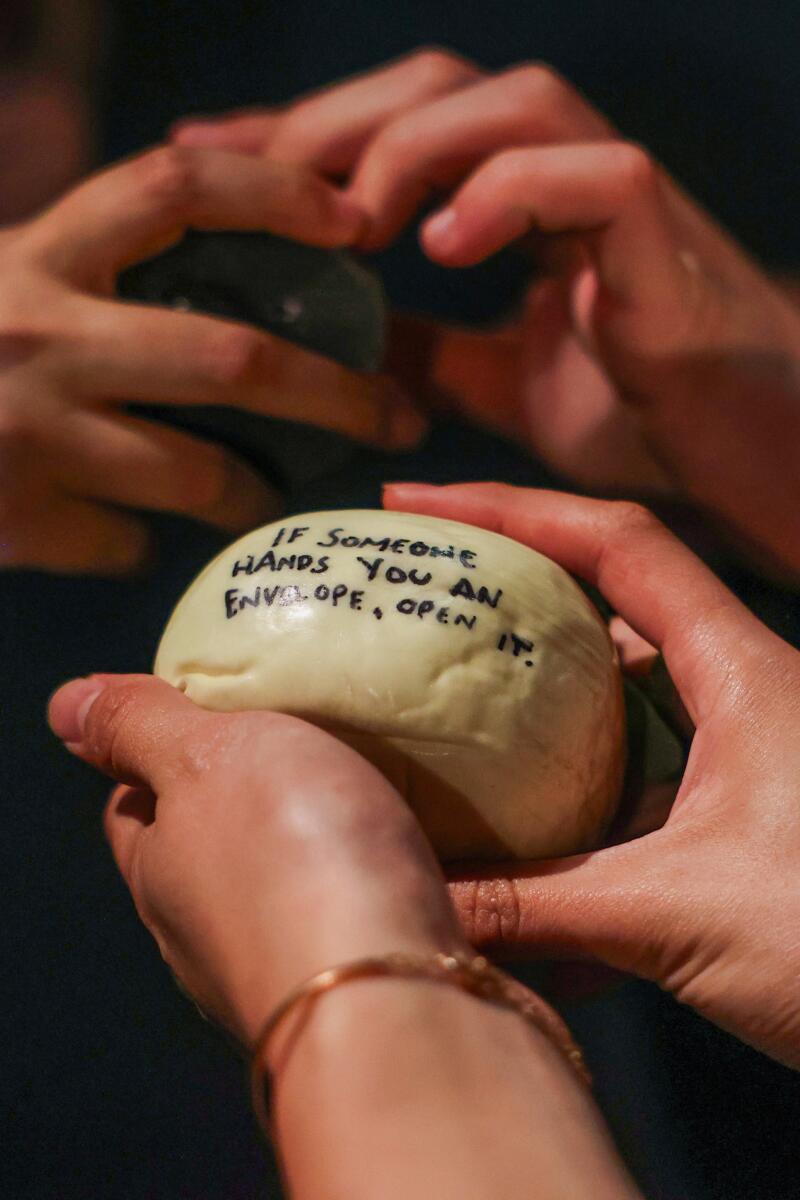
Melanie Pentecost holds a rock that gives the next context clue to to move the play forward.
This is “Escape From Godot,” an escape room that is also a work of theater — or vice versa. It upends the conventions of both. This is a play in which audience members become participants, the game requiring patrons to hop on the dials and interact with props in order to propel the narrative forward. Puzzles are hidden in the script, ensuring that the players become actors and are in abstract communication with the performers.
But its greatest trick? Inspired by Samuel Beckett’s “Waiting for Godot,” the theatrical escape room taps into the themes of the original work, creating an open-for-interpretation piece of playfully interactive art that grapples with existential questions — how we communicate, or fail to, with others, and the balance among selfish behavior, free will and empathy. Like Beckett’s play, there is no Godot who will come, but we are all caught in a world where the mundane, the absurd and our own desire for answers propel us forward.
Our group — I’m playing with seven strangers — hesitates to jump onstage and set the game afoot. It’s a break of decorum, both of theater protocol and personal boundaries. One player nervously scans his ticket, trying to find a missing clue, another flips through a notebook that was placed on her chair and most of us look at each other and whisper questions about what to do. Realizing, after about seven minutes, that there will be no end to “Escape From Godot” if we don’t move, my group begins to hesitatingly work together. In order for the actors to proceed to the next scene, we need to get them a message crafted from the ephemera that they have dropped.

Actor Phil Daddario kicks into the air during his performance.

Daddario wipes sweat from his face while performing.

Audience members look on the ground for context clues to solve the next puzzle.
“I bet you were not the longest group that has sat,” the show’s co-creator, Jeff Crocker, later tells me when I describe those seven minutes of awkwardness. Jeff is one half of Mister & Mischief, an L.A.-based husband-and-wife duo that has crafted experiences for theme parks, zoos, museums and more. (Jeff’s wife, Andy Crocker, recently created a game-like experience for the Los Angeles Public Library system.) “Escape From Godot” is their first escape room.
“Typically, theater-minded folks, the last thing they’re ever going to do is get up onstage in the middle of the scene,” Jeff says. “That’s a hidden puzzle right there. Are you the person who is bold enough to walk onstage in the middle of a performance in order to make this repetition cease? There’s a lot of weird little social bits like that happening.”
“Escape From Godot” premiered at the Hollywood Fringe Festival in 2018 and has been periodically revived over the years, its latest as part of this months RECON event at the Universal City Hilton, a convention held by escape room aficionado site Room Escape Artist. An initial run of dates through Aug. 25 at Atwater’s Moving Arts Theatre sold out, so “Escape From Godot” has been extended through Sept. 8.
The idea stemmed from Crocker hearing about an escape room in Europe that had taken place throughout a train, a promotional event tied to a film. Joking about potential properties they could base a project on, the Crockers hit on “Waiting for Godot.”
“Andy has a theater degree, and ‘Waiting for Godot’ is classically known as this play where nothing happens,” Jeff says. “To folks who don’t create theater, you hear that as the B-word, boring. It’s a go-to play where people wait for a person who never shows up. There’s more to it than that, and when you see a not-great production of ‘Waiting for Godot,’ it can feel like you want to escape. I’ve seen really great productions of it, and there’s a reason it’s a classic.”
In “Escape From Godot,” puzzles may be hidden in the bowler hats of the performers. Do we ask them to surrender their apparel or wait in the hopes that they will drop them?

Actor Mason Conrad holds a large suitcase while performing in “Escape from Godot.”

Actor Justin Okin looks through the stage play script for lines to give audience members context for the next clue.
Like Beckett’s play, characters in questionable physical shape will appear on the stage, but any sense of compassion is soon overtaken by the desire to solve the next puzzle via the props they‘re carrying. Boxes and baskets with locks may be dropped onstage, their combinations found in the monologues of the actors — Justin Okin as GiGi and Bill Salyers as DoDo, stand-ins for Beckett’s Vladimir and Estragon.
“Escape From Godot” will even nod to other theatrical works. My favorite puzzle turned out to involve a combination lock affixed to a basket, in which uncovering the solution required us to listen to a monologue that alluded to famous cats in history and culture. “Escape From Godot” won’t even start unless guests solve an initial puzzle, one the necessitates we align our tickets with a theater seating chart and find the correct seat. One could opt not to play, as long as others are, and sit and watch, taking in a script that toys with our place and faith in the world, albeit with a reference to the musical “Cats.”
The longer the audience goes without hitting on the right solution, the louder and faster the monologues will become. It creates tension and tests a group to maintain a sense of calm and patience. Nothing gets too hairy; the silliness of the situation dominates the tone.

“Escape from Godot” actors applaud the audience at the end of the play, including, from left, Tiffany Ogburn, Phil Daddario, Mason Conrad, Bill Salyers and Justin Okin.
“We purely set out to fulfill our original delightful idea of having fun from escaping from a notoriously monotonous play, but in doing so, as we started to develop what the puzzles were and the way we wanted the audience to interact, it did start to support the themes of the play while also poking a little fun at it,” Jeff says. “You get the little bits of what Beckett was trying to say about what existence wants to be, what belief in God wants to be, but doing it in a way that is mischievous.”
By the time the show ends, roles have been reversed. Members of the audience have been cast as performers and the actors at times became the audience, trapped with repeating dramatic orations while watching us play. It’s a final message that isn’t too divorced from the Beckett text: We’re all performers, too often waiting for a cue.


If you’re struggling to use up leftovers like a half-eaten rotisserie chicken, turn the assignment into a creative exercise, says chef Margaret Li. It’ll make the cooking process more fun and less guilt-driven.
Pulse/Getty Images/Corbis RF Stills
hide caption
toggle caption
Pulse/Getty Images/Corbis RF Stills
On a recent weeknight, I opened up my fridge and found an assortment of half-eaten or ignored food.
That included takeout that I didn’t find appetizing enough to eat for lunch. A rotisserie chicken with most of the meat picked off. A couple of raw vegetables from the farmers market that were starting to wilt.
“There’s nothing to eat,” I told myself. Yet even I knew that was ridiculous. There was plenty of food in my fridge. I just didn’t feel inspired to cook with it.
So I asked some chefs for guidance. How could I more consistently use leftovers and the other ingredients I tend to overlook?
Start with a mindset shift, says Margaret Li, chef and co-author of the cookbook Perfectly Good Food: A Totally Achievable Zero Waste Approach to Home Cooking. Think about cooking with leftovers as a creative, experimental exercise, not a guilt-driven one.
“It ends up being this fun game where you are creating something from what seems like nothing and solving this puzzle, and then you get to eat it,” she says.
There are other good reasons to use up your food scraps. Nationally, about a quarter of food products go to waste, according to the nonprofit ReFED. In my own household, where we spend about $200 a week on groceries, that means I might be throwing out the equivalent of $50 of food — an unnecessary burden on my wallet, not to mention the environment.
The chefs I spoke to had some practical tips about using up more of the food we buy. Here are a few that I put to the test.
Find your “hero recipes”
Build up an arsenal of go-to recipes that are flexible enough to use up just about any ingredient. Li calls them “hero recipes.”
I tried one of these from her cookbook, called “Make-It-Your-Own Stir-Fry.” (Scroll down for the recipe.) It includes loose ingredients like “1 pound crisp-crunchy vegetables” or “4 cups leafy greens.”
In the spirit of the recipe, I pulled vegetables out of my fridge at random and did not measure them out. The sauce was a simple mixture of soy sauce, vinegar, sugar and water. By the time I topped my bowl with chopped scallions, the dish looked like a gourmet meal, not an afterthought.

Other ideas: “You could put anything in a frittata, and it’ll be great,” says Tamar Adler, chef and author of The Everlasting Meal Cookbook: Leftovers A-Z.
Or, if you have day-old rice on hand, cook it alongside other ingredients to make fried rice. “Saute some aromatics — ginger, garlic, onion — in oil,” Adler says. Then add your rice and whatever leftover bits you have, like the rotisserie chicken and older produce I had in my fridge.
“Just take the approach of making it more flavorful and crispy and then spicy, and then usually adding a squeeze of lemon,” Adler says.
Label your leftovers
Keep a permanent marker and painter’s tape in your kitchen to label and date your leftovers, Li says. “That is a classic chef’s method for knowing what something is and when it was made. That saves you the guessing game.”
Adler takes the concept a step further and labels her leftovers with their intended use. Leftover blueberries are labeled “muffins-to-be on Tuesday,” she says. “I really like doing that — assigning the destiny of the food.”

So after a night of Ethiopian takeout, when we ended up with an entire container of leftover injera, I followed Adler’s advice and thought about what it might become in the future.
I imagined scrambling the spongy, tangy bread with eggs, akin to scrambling matzo into matzo brei. “Injera for eggs,” I wrote on the container. Sure enough, their destiny was fulfilled the following morning.

Li keeps a dedicated bag in her freezer just for scraps from which to make chicken or vegetable stock. That bag houses carrot peels, the ends of onions, extra garlic cloves and chicken bones.
Flavia Morlachetti/Getty Images/Moment RF
hide caption
toggle caption
Flavia Morlachetti/Getty Images/Moment RF
Don’t forget your odds and ends
Adler encouraged me to never, ever throw away the stems of herbs. Stems don’t get as much glory as tender, pretty leaves, but they still have the same herby taste.
“I’m going to chop these herbs up or stick them in a blender with a clove of garlic,” she says. Then add olive oil. “And then it’s just gonna be my base sauce for everything.”
So I foraged a few varieties of half-cut herbs from my refrigerator drawers, most of them sad looking and unidentifiable.
I threw out the stems that had turned brown and gooey and put the rest in a blender. I added garlic on Adler’s instructions, nuts and kale for bulk, and plenty of olive oil and salt. Then, on a whim, I added a splash of olive juice for brightness.
The result was somewhere between a pesto and a chimichurri, and it elevated that night’s otherwise routine dinner. And Adler was right: Once the stems were blended, it tasted exactly the same as the leaves. (The same idea applies for broccoli stems in a cheesy broccoli soup, Li says.)
Li likes to keep her odds and ends organized with an “Eat Me First” box in her fridge. That’s where she keeps half-used lemons, leftover coconut milk or produce that’s starting to get wrinkly. “You kind of have an idea for, OK, here’s where you look first,” she says.
Don’t strive for perfection
Cooking these meals did feel like a game, as Li had suggested. It brought me unexpected joy to use up as many existing ingredients as possible — to the point where I often spent much longer in the kitchen because I kept thinking of new ideas: If I turn these wrinkly sweet potatoes into a soup, then I can caramelize this half-cut onion for a topping, and then I can use the leftover soup as a sauce tomorrow …
Did I cook more often, though? Probably not. My cooking energy burned brighter but fizzled out after a few nights, at which point I ordered takeout.
So I was glad to hear Li’s take: If you’re too hard on yourself, you’re not going to enjoy it at all. “ I try not to be too obsessive about eating absolutely everything,” she says. If my takeout was truly terrible, I’m allowed to toss it or, better yet, compost it.
If you really want to use up everything, you can always chuck ingredients into the freezer. Li has dedicated freezer bags for different dishes, like vegetable scraps for soups or fruit discards for smoothies. (She labels them, of course.)
And how does that smoothie taste? It’s “delicious,” she says, “even if it’s made up of all the things that have been rejected in the past,” she says.
Recipe: Make-It-Your-Own Stir-Fry
Excerpted from Perfectly Good Food: A Totally Achievable Zero Waste Approach to Home Cooking. Copyright ©2023 by Irene Li and Margaret Li. Used with permission of the publisher, W. W. Norton & Company, Inc. All rights reserved.
Sauce
- 1 tablespoon soy sauce
- 1 tablespoon water
- 1 teaspoon sugar
- 1 teaspoon black vinegar, rice vinegar, lime juice, or other acid
- 1 tablespoon neutral oil, or enough to lightly coat the bottom of your wok or skillet
- 1 garlic clove, thinly sliced or minced, or more as desired
- ½-inch piece fresh ginger, minced or grated (optional)
- Pinch chili flakes or 1 small chile pepper, diced (optional)
- 4 cups leafy greens, torn into bite-size pieces, or 1 pound crisp-crunchy vegetables, cut into chunks
- Kosher salt
Stir the sauce ingredients together in a small bowl and set by the stove.
Heat a wok or large skillet over high heat until just smoking, then add the neutral oil and tilt to coat the bottom of the pan.
Add the garlic, ginger (if using), and chili flakes (if using) and stir-fry for 10 seconds. Add the greens and/or vegetables, in stages as necessary, and toss in the garlicky oil, then add the sauce and cook to your liking, stirring frequently.
Vegetable chunks may need 4 to 7 minutes — if you want to speed up the process, cover the pot so the vegetables steam for a minute or two, then uncover and toss again. Sturdy greens may need 3 to 5 minutes to get tender (we like to let them sit for a bit and char for extra texture).
Lighter leaves will need less than a minute to wilt down. Stir in a spoonful of any additional sauce you like, season with salt to taste, then sprinkle with your favorite garnishes and a generous drizzle of sesame oil.
A sprinkle of crunch is a great way to finish a stir-fry. Our favorites include crushed cashews or peanuts, toasted sesame seeds, thinly sliced scallions, and fried onions or shallots.
Your turn: What are your favorite go-to leftover recipes?
We’d love to hear from you! Share your recipe with us at lifekit@npr.org with your full name. We may publish it on NPR.org.
The story was edited by Malaka Gharib. The visual editor is CJ Riculan. We’d love to hear from you. Leave us a voicemail at 202-216-9823, or email us at LifeKit@npr.org.
Listen to Life Kit on Apple Podcasts and Spotify, and sign up for our newsletter. Follow us on Instagram: @nprlifekit.

Stephen Malkmus & the Jicks perform onstage during day two of the Boston Calling Music Festival at Boston City Hall Plaza on September 26, 2015 in Boston, Massachusetts. (Photo by Mike Lawrie/Getty Images)
Mike Lawrie/Getty Images
hide caption
toggle caption
Mike Lawrie/Getty Images
This week’s show was recorded in Chicago with host Peter Sagal, judge and scorekeeper Alzo Slade, Not My Job guest Stephen Malkmus and panelists Emmy Blotnick, Joyelle Nicole Johnson, and Gianmarco Soresi. Click the audio link above to hear the whole show.
Who’s Alzo This Time
Pool Problems; Don’t Forget to Hydrate; The Rise of Hot Podium Guy
Panel Questions
TSA Gets A Dressing Down
Bluff The Listener
Our panelists tell three stories about game shows in the news, only one of which is true.
Not My Job: Stephen Malmus, lead singer and guitarist for Pavement, answers our questions about road construction
Indie rock legend and founder of Pavement, Stephen Malkmus, joins us to play a game called, “Pavement repairs are underway!” Three questions about road construction.
Panel Questions
The Battle Over A Home Sale; The Best Three Words To Get Over A Loss and Out of a Meeting?; A New Job in the Dating World
Limericks
Alzo Slade reads three news-related limericks: Good News For Gym Slobs; Cruisin’ For A Tattooin’; Fringe Food Benefits
Lightning Fill In The Blank
All the news we couldn’t fit anywhere else
Predictions
Our panelists predict what will find after the reflecting pool is emptied

When Julio Miranda-Martin began his apartment search, he had one nonnegotiable: He wanted a dedicated dining room to entertain his friends. He was scouring Zillow in 2025 when a listing for a railroad-style, one-bedroom on the edge of West Hollywood came up that included the requisite dining room. It was also walking distance to his part-time job as a marketing coordinator at furniture store Lawson-Fenning. More importantly, at $2,500 a month it was within his budget.
-
Share via
Miranda-Martin met with his landlord the same day he found the listing, who told him he looks like his son. Feeling like finding this 950-square-foot apartment was kismet, Miranda-Martin signed the lease and set about creating a sophisticated and color-saturated sanctuary. Miranda-Martin decided he needed to make two major investments before moving in: painting the walls and changing the lighting. “I was finally able to move into a place that I actually like, not just out of necessity. I was like, let’s make it feel like my own,” says Miranda-Martin, who refers to the space as his “living canvas.”

In this series, we spotlight L.A. rentals with style. From perfect gallery walls to temporary decor hacks, these renters get creative, even in small spaces. And Angelenos need the inspiration: Most are renters.
The apartment is on the second floor of a fourplex, up a windowless staircase. Miranda-Martin embraced the lack of light and painted it a high-gloss crimson. Without natural light, he hard-wired sconces found on Facebook Marketplace that recall ornamental 18th century candlesticks. They cast a dim but moody light throughout the staircase, ending with an ornate mirror at the top. The mirror shows a glimpse of the apartment’s interior in its reflection when Miranda-Martin opens the door. “Every time people walk in, especially at night, it’s such a dramatic entry,” he explains. “It’s very cinematic,” agrees friend and co-worker Kristin Reeder, who is often a guest at his soirees, “like something from ‘Eyes Wide Shut.’ ”
1

2

3

1. Julio Miranda-Martin’s apartment decor starts in the bold staircase that leads to his door. 2. A mirror at the top of the staircase offers extra depth. 3. Julio Miranda-Martin fills the bookshelf in his dining room with books and treasures.
In contrast, the living room offers a calmer palette of sky blues and earthy browns. Miranda-Martin tends to choose paint colors based on the light. The living room, with abundant west-facing windows brings in soft, bright light. Miranda-Martin painted it with Benjamin Moore’s Navajo, a flat white, as a backdrop to the softer hues of the furniture he designed at his furniture and lighting company, Studio MM. “It adds a stillness,” he says.
The room is anchored by a large velvet couch in a rich brown. The modular couch is anchored on each side with Art-Deco influenced side tables, lamps and light blue slipper chairs he designed, setting up a cozy tableau for hosting his friends. Pale pink cushioned ottomans provide additional seating that can easily be moved around the room to accommodate additional guests.

A velvet couch acts as a statement piece in the apartment living room.
(Etienne Laurent/For the Times)
French doors separate the living room from the dining room. The chartreuse-infused dining room returns to a more dramatic colorway. With less natural light, Miranda-Martin wanted to play up the idea of dining-room-as-treehouse, reflecting the second-floor foliage visible from the small windows. Rather than trying to brighten the room, he leaned into the moodiness by buying inexpensive, USB battery-powered spotlights that are mounted on the ceiling with magnets. Taking an alcohol marker, he tinted the lights a soft amber, allowing him to highlight the art in the room without adding harsh overhead lighting.

The dining room is meant to reflect the foliage just outside the window.
(Etienne Laurent/For the Times)
A shell-adorned mirror anchors the wall facing the windows and built-in shelving, making the room feel larger. Miranda-Martin sourced two shell-shaped sconces that flank the mirror at an estate sale in San Francisco. Most of the art and home decor comes from Facebook Marketplace and Craigslist, or is thrifted from local stores. Estate sales are also a source, though Miranda-Martin feels the rising popularity of these sales in Los Angeles has led to an increase in pricing. “They’ve gotten so over the top now in L.A. [They’re] super expensive. You’re not really gonna find a deal,” he laments, citing the armed security checking bags recently at some of the hottest estate sales.
In addition to changing the lighting and painting the walls, Miranda-Martin prioritized the window treatments, with pinch pleat curtains from Ikea. “Drapery can just make a space feel super elevated,” he advises. He prefers a mix of new and vintage decor, balancing both for an eclectic but deeply personal look to his home. He tries not to overthink his aesthetic choices. “I think it’s very instinctual. I’m not really thinking, ‘Is this in good taste or is this going to be weird?,’ ” he says.
Down the hall, the bedroom’s mostly white design theme returns to a more serene composition, providing a quiet sanctuary. Miranda-Martin removed the headboard from his bed, making it seem like it’s floating between the night tables he designed. “Everything feels sort of streamlined and smooth,” says Miranda-Martin. Like the living room, the bedroom is painted the same flat white but the quality of the eastern light filtering into the bedroom casts a buttery glow.
1

2

3

1. Ceramics fill inset shelves in the kitchen. 2. A glass case in the apartment corridor between the dining room and the bedroom. 3. With its lighter decor, the bedroom was meant to be a sanctuary.
The small kitchen retains its midcentury charm, but open shelving above the counter provides an airier, more contemporary cupboard to show off Miranda-Martin’s dish and glassware collection. The easier access comes in handy when he’s entertaining. His apartment is the perfect pre-game space for him and his friends before a night on the town. He tries to make sure he pre-batches cocktails before his guests arrive.
He also likes to host more elaborate dinner parties and game nights. He attributes his love of entertaining to his upbringing as an only child in Downey. “I like hosting because I enjoy being around more people than when I was growing up,” explains Miranda-Martin. His goal, ultimately, is to bring together disparate groups of people from different spheres in a space everyone will feel comfortable in. Dinner parties at Miranda-Martin’s “feel like an event,” says Reeder. “It’s something you’re excited for and you want to get dressed up for.”
“I’m kind of going through a phase right now where I need to be around people,” admits Miranda-Martin. “I think I just hate being alone.”
-
Lifestyle6 minutes ago
This mindset shift can help you get better at using up your leftovers
-

 Technology16 minutes ago
TMD’s keyless bike lock is a $280 solution to a $60 problem
-

 World21 minutes ago
American rescue teams pull infant alive from rubble in Venezuela days after devastating twin earthquakes
-

 Politics28 minutes ago
Trump scores another endorsement win with Louisiana Senate runoff victory
-

 Health31 minutes ago
New blood test detects 90% of aggressive prostate cancer cases, beating current screenings
-

 Sports37 minutes ago
2026 World Cup Round of 16 Odds: Which Teams Will Make It?
-

 Technology44 minutes ago
Apple raises prices as AI chip costs surge
-
 Business46 minutes ago
Wildfire rebuilding boosts L.A. County job growth in May

