Lifestyle
Turf is out. Native grasses are in. Here are 4 lush low-water options

Tearing out your lawn can be a tough decision, especially if you have children or dogs who love to roll and play.
Or — no judgment here — maybe you just enjoy the visual serenity of a swath of green in a region where the hills go brown in the summer.
The good news is there are low-water, lushly green native lawn alternatives to tall fescue, the most popular water-guzzling king of turf grasses. But here’s the truth about these other options:
“There isn’t anything out there, native or exotic, that is going to stay green all year round in Southern California without some water,” said horticulturist Carol Bornstein, native plant guru and author of two definitive books about California landscaping, including “Reimagining the California Lawn.”
Christie Mahr casts a shadow across a patch of Kurapia groundcover in the backyard of her Ventura home.
(Michael Owen Baker / For The Times)
The trick is understanding that less is more when it comes to watering any lawn, native grasses or no, she said.
“There is no lawn in Southern California that needs water every day, even in a super hot, dry microclimate,” she said, “You want to wean your lawn off that kind of life support by watering less often and more deeply — basically water when it needs it.”
Unfortunately many lawn owners haven’t gotten this message, said Jim Blair, a turfgrass specialist who oversees UC Riverside’s Turfgrass Research program. Most people are still overwatering their traditional turf lawns with frequent short sessions that encourage shallow, easily dried-out roots. And when they change over to native grass lawns, they don’t change their watering patterns, Blair said, ending up with diseased or dead native lawns due to overwatering.
Native grasses usually require less water than traditional turf lawns because their roots grow much deeper — up to 10 feet deep in some cases — allowing them to find water stored in the ground and weather longer periods of drought.
They’ve also adapted by going dormant during certain parts of the year, like Bermuda, a warm-season grass, which does fine in hot summer months but turns brown during the winter.
For instance Blue grama (Bouteloua gracilis) is one of the native grasses Bornstein favors for lawns. It does go dormant in the winter, she said, “with a blond coloration which I think is quite beautiful. But trying to keep it green all year is challenging because too much water will kill them” by rotting the roots.
So that’s another lesson about native grasses — your expectations will have to change along with your irrigation techniques, because turf lawns and native grass lawns aren’t interchangeable, said Baird.
John Ellis’ yard features his lawn of native fescue grasses, and an agave ‘blue glow’ plant.
(Michael Owen Baker / For The Times)
John Ellis lays in his lawn, surrounded by three kinds of native fescue grasses.
(Michael Owen Baker / For The Times)
Traditional turf grasses like tall fescue and Bermuda were developed for two purposes — “to withstand persistent low mowing and regular traffic,” Baird said. If that’s what you want, Baird said there is a Bermuda hybrid on the market, developed in Georgia called TifTuf that has the same low-water needs as native grasses.
But if you’re sick of mowing (or paying someone else to do it), or you just want to reduce water use while creating habitat for local pollinators, birds and other creatures, then native grasses can give you the (mostly) green you crave with a lot less effort and expenses.
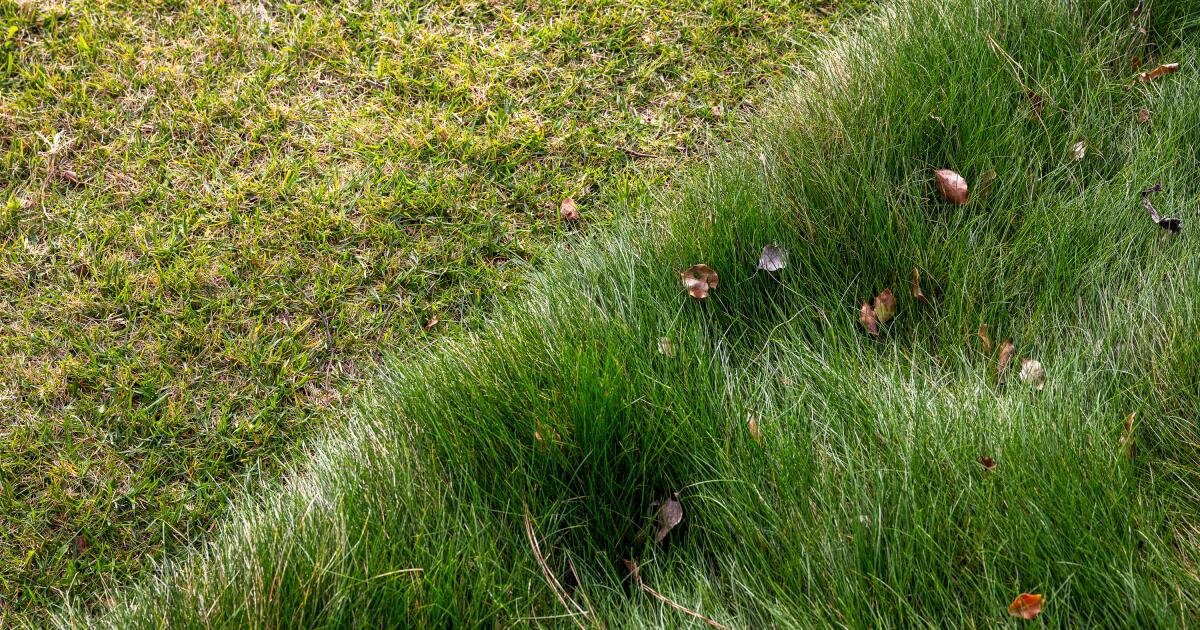
These will not be the flat carpet lawns of yore — although Kurapia lawns come close, at least from a distance. Native bent grass (Agrostis pallens) or native fescues like Festuca rubra grow in graceful mounding swirls and tufts that catch the light like glistening swells on a lake. They are beautiful to behold but not so easy to run through.
And unless you plant sod, which is available with some native grasses or grass mixes, it can take a while for the grasses to knit together into what we think of as a traditional lawn.
That’s one of many reasons you should consider reducing the dimensions of your old turf lawn when you decide to plant a new lawn with native grasses. Create planting beds in part of the old lawn area to grow food for your family and/or support pollinators, birds and other local wildlife by planting native trees, shrubs and flowers.
Good drainage is critical to maintaining the health of native lawns, said Briana Lyon of California Wild Gardens in Pasadena, an online-only nursery whose products include native grass lawns. Some native wetland grasses like California Meadow Barley (Hordeum brachyantherum ssp. californicum) can live for a short time in standing water, but these are best used to line bioswales where you want to clean rainwater running off from roofs or streets.
Most native grasses prefer dry conditions and full sun. Some, like the fescues, can do well in shade, but Lyon recommends prepping the soil by tilling the top soil 4 to 6 inches deep and adding a mixture of compost and a drainage medium like decomposed granite or sand to encourage good drainage, especially if the ground previously had standing water during heavy rains.
The Kurapia groundcover, juxtaposed with concrete, in the backyard of Ray and Christie Mahr’s home.
(Michael Owen Baker / For The Times)
A corner of John Ellis’ fescue grass lawn.
(Michael Owen Baker / For The Times)
You don’t want to add too many amendments like compost or worm castings, however. “You don’t want to discourage the roots from doing a deep exploration by staying with the yummy stuff on top,” she said.
Weeds are also a problem, especially when the native grasses are trying to get established. Kurapia and some of the grasses can eventually grow dense enough to crowd out most weeds, as long as the weeds don’t get a foothold and crowd the natives out first, so expect to do some regular weed patrols the first year to keep unwanted plants away.
Finally, understand that the type of native grass you choose really depends on how you plan to use the space. If you want a relatively flat, easy-care space where pets and children can frolic then Kurapia may be your best choice. But if your biggest interest is creating an ornamental lawn that’s a feast for the eyes, then look towards the sculptural, undulating bent grasses or fescues.
Here’s a list of some of the more popular native grasses to consider, with this note too: Some of these grasses are native to other parts of North America too, or even other countries, in addition to California, so if in doubt, check the botanical names, consult with guides like Bornstein’s books or talk to native plant experts at the Theodore Payne Foundation, Tree of Life Nursery, the California Botanic Garden in Claremont or the Santa Barbara Botanic Garden.
A close up view of Kurapia groundcover at Christie and Ray Mahr’s Ventura home.
(Michael Owen Baker / For The Times)
1. Kurapia
People use lots of exclamation points when they talk about Kurapia, which, for the record, isn’t a grass at all. It’s a sterile patented hybrid of a native broadleaf groundcover from the verbena family commonly known as frog fruit or lippia (Phyla nodiflora), named after the Japanese hybridizer, Utsunomiya University professor Hitoshi Kuramochi, and the origin plant, lippia. Robert Sjoquist of Soils Solutions in Ventura can’t sing its praises high enough. Sjoquist is a distributor who sells native grasses all over Southern California, but Kurapia is one of his favorites, he said, because it spreads like a carpet with pretty clover-like flowers, requires almost no water or maintenance to stay beautifully green, quickly stabilizes hillsides and slopes and helps prevent wildfire damage by snuffing out embers as they fall.
It also spreads quickly and is relatively easy to propagate, which is why the breeder, Kurapia Inc., carefully guards its latest strains, Kurapia New White and Kurapia Pink (named for the color of its flowers). These new strains can only be purchased online, through the company, said senior manager Lawrence Ziese. They’re only available in plug form now, although the company hopes to have a sod version available soon. A flat of 72 plugs, which covers roughly 97 square feet, costs $173 for the “new white” color and $187 for the pink.
Ziese said the new versions grow more densely than the company’s first offering, known as Kurapia S1, which is grown in 2-by-5-foot sod sections by Delta Bluegrass in Stockton and delivered by truck. (West Coast Turf of Palm Desert also sells Kurapia S1 sod, but is currently out of stock.) Sod is more expensive — about $315 to $340 to cover roughly 100 square feet — but you also get an established lawn in less than half the time, said Sjoquist.
Christie and Ray Mahr stand with their dogs Maggie, front, and Colt on the Kurapia groundcover in their backyard.
(Michael Owen Baker / For The Times)
“It looks so good it almost looks like fake grass because of how uniform and low growing it is,” said Lyon. It thrives in poor soils, even sand and salty soils, as long as it has good drainage, she said. It’s important to keep it weeded in the beginning, until it becomes established.
Christie and Ray Mahr of Ventura say they and their dogs love the 3-year-old Kurapia lawn in their backyard. They planted the lawn themselves from plugs — a job that took just a couple hours, Christie said — and it took some maintenance the first few months to keep weeds from resprouting. But she and Ray say that’s nothing compared to the work that went in to mowing and watering the Marathon turf lawn they had before. Now they rarely water the lawn. It seems to get enough water from the drip lines for trees and other plants.
They use hand clippers to keep tendrils from growing beyond the lawn boundaries and Ray mows just once or twice a year to remove the flowers that come in the spring to early summer. “They most definitely brings bees to your garden,” Christie said. “I won’t even come out here and walk unless I’ve got tennis shoes on because otherwise you know you’re going to step on a bee or a butterfly.”
Lippia, used as an alternative to traditional lawn, in Redlands.
(Brian Chau)
2. Frog fruit, a.k.a. lippia (Phyla nodiflora)
The parent of Kurapia is endemic to California and many other parts of the world, including Texas and the southeastern coast of the United States. Like Kurapia, it needs very little water and thrives in heat. Southern California landscape designers looked into lippia as a lawn replacement in the 1970s, Lyon said, but quickly abandoned the idea “because it seeded so aggressively,” spreading into neighboring yards or planting areas where it wasn’t wanted.
But Brian Chau of Redlands said he hasn’t really seen that problem in his front yard. Chau usually blogs about fishing, but he created a YouTube video to show off his lush lippia lawn, which he planted in 2021. He first tore out his traditional lawn and planted yarrow, which didn’t do very well, so he tilled the yard again, removing the yarrow (which still sprouts up now and again) and planted lippia. Chau said he chose lippia rather than Kurapia because it was a “fraction of the cost” to purchase — $15 for a flat of roughly 50 plugs at the time, versus around $60 for Kurapia, he said.
He buried a drip irrigation system in his yard, which he doesn’t use at all during the cooler months, and turns on for just a few minutes two or three times a week during the hottest part of summer to keep his lawn watered. “It’s just a burst of water during those times, but now I’m trying to do it just once a week for a longer period, just to experiment.”
The lawn grows more leggy and less vigorously in shady parts of his yard, and like Kurapia, its flowers are a huge draw for bees and other pollinators, Chau said. “So if you’re allergic or terrified of bees, this lawn isn’t for you, but if you don’t mind bees, the lippia is great for attracting pollinators to our fruit trees and native plants.”
Chau said his son plays on the lawn regularly. “He runs around and beats the lawn down, but it doesn’t complain too much,” he said. “It always bounces back, but it would be detrimental to have an animal rooting around in it.” He uses hand clippers to trim back the plants trying to grow outside the lawn borders, and replants those cuttings to fill in areas that are looking thin. The cuttings “root very easily in water or moist soil,” he said, “so I don’t have to buy flats anymore.”
Native bent grass at the Carpenteria Seaside Park.
(Jeanette Marantos / Los Angeles Times)
3. Native bent grass (Agrostis pallens)
If you love the look of a wild meadow-like lawn, native bent grass is a beautiful and fairly durable choice. Lyon said bent grass makes one of the most pet and kid friendly native grass lawns.
The city of Carpenteria planted a bent grass lawn from seed when it created Seaside Park near the library in 2014, and it’s been a handsome, easy-care choice that requires little water, said Tiffany Smith, the city’s parks and facilities maintenance supervisor.
“We mow it probably every three months at the most, so three or four times a year, and the water savings are huge. We water with regular lawn sprinklers once a week in the summer for 20 minutes or so, just enough to get the water down 2 inches,” she said. “And we’ve had almost no weeds. Every once in a while a broad leaf weed comes up and we just pull it. … We love it.”
She said they mow the lawn down to about 3 inches tall, but it grows back quickly into luxuriant waves.
Carpenteria rarely sees summer temperatures much higher than 90, but in the hottest months the lawn never seems stressed — even after people have been sitting in it. It only gets light foot traffic, Smith said, but the city is so pleased with its performance after 10 years that it’s considering whether to remove the turf lawn around the library and replant with bent grass to create a uniform look.
“I bet we could easily cut our water use by two thirds,” she said.
Three native fescue grasses create a lush green meadow effect in the front yard of John Ellis’ Westlake Village home.
(Michael Owen Baker / For The Times)
4. Native fescues (Festucas)
If you want a lush, light-catching lawn to gaze upon, native fescues are one of your best bets, especially in a shady area, said Lyon.
Delta Bluegrass makes a mow-free sod mix of three native fescues — Idaho fescue (Festuca idahoensis), Molate fescue (Festuca rubra) and Western Mokelumne fescue (Festuca occidentalis) that requires very little care, said John Ellis, who replaced the 1,000-square-foot turf lawn outside his Westlake Village home with mow-free fescues in December 2022.
His children are grown and no pets play on the lawn out front, so it doesn’t get much traffic, Ellis said, “but I will tell you that every kid or dog that comes by rolls around the grass. They touch it and they’re walking in it.”
Too much traffic isn’t great for the fescues, however, said Lyon, because the fescues are probably the least drought tolerant of the native grasses, and incompatible with pets. “It kills patches of the lawn if a dog pees on it.”
But if you’re looking for sculptural beauty, this is the lawn for you. Ellis figures his irrigation costs have dropped by 60%, even in his area near Thousand Oaks where temperatures can easily hover around 100 degrees during the summer. He bought the sod through Soils Solutions and hired Robert Olsen of Goldenstate Landscapes in Camarillo to remove the old lawn and install a copper-lined drip irrigation system on a smart system that adjusts watering based on moisture in the ground. All told, he figures he spent $9,000 on the project, and is delighted with the results.
John Ellis’ lawn of native fescue grass, left, by his neighbor’s lawn, right.
(Michael Owen Baker / For The Times)
His biggest comment from neighbors is wondering if he plans to mow his lawn, Ellis said, but he likes the look of the grass flopping over. His work included installing a 12-inch barrier between his yard and his neighbor’s to ensure his grasses didn’t mingle with theirs, but the difference in color is startling. His neighbors’ lawns are both green and thick, but they look pale in comparison to his deep green growth.
Ellis said he’s had some issues with tendrils of his old Bermuda grass trying to grow through. But most weeds have been smothered, and he’s been able to pull out any Bermuda grasses he finds. “You have to stay on top of it,” he said, “but so far this has been the best choice for us.”



Neve Campbell in Scream 7.
Paramount Pictures
hide caption
toggle caption
Paramount Pictures
The OG Scream Queen Neve Campbell returns. Scream 7 re-centers the franchise back on Sidney Prescott. She has a new life, a family, and lots of baggage. You know the drill: Someone dressing up as the masked slasher Ghostface comes for her, her family and friends. There’s lots of stabbing and murder and so many red herrings it’s practically a smorgasbord.
Follow Pop Culture Happy Hour on Letterboxd at letterboxd.com/nprpopculture

Abriana Vicioso is the host of the Flower Hour, which takes place monthly.
(Jennifer McCord / For The Times)
Each flower carries a personal history. For Abriana Vicioso, the calla lily was her parents’ wedding flower — a symbol of her mother’s beauty. “She had this big, beautiful white calla lily in her hair,” Vicioso says. “I love my parents. They’re the reason I’m here. I’ll never forget where I came from.”
The Flower Hour begins with Vicioso announcing, with a warm smile: “Today is about touching grass.” The florist-by-trade gestures behind her to hundreds of flowers contained in buckets — blue thistles, ivory anemones and calla lilies painted silver — all twisted and unfurling into the air. “Tonight is going to be so sweet and intimate,” Vicioso says, eyeing the beautiful chaos at her feet. A grin buds across her face.
Moments before the workshop, participants sit at candlelit tables exchanging horoscopes and comparing their favorite flowers. A mention of the illustrious bird-of-paradise flower elicits coos and awe from the women. Izamar Vazquez, who is from Jalisco, Mexico, reveals her fondness for roses, which make her feel connected to her Mexican roots.
Vicioso hosts her flower-themed wellness workshop near the iconic Original Los Angeles Flower Market in downtown L.A. In January, the first Flower Hour event sold out, prompting her to make it a monthly series. Vicioso describes the event as a “three-part journey” where participants are invited to drink herbal tea, smoke rose-petal-rolled cannabis joints and create a floral arrangement. “The guide is to connect with the medicine of flowers,” Vicioso says.


Rose petal joints, tea and flower arranging are all part of The Flower Hour event’s offerings.
The event is hosted at the Art Club, a membership-based co-working space. “The Flower Hour is really beautiful. Everyone gets to explore their creativity while meeting new people,” says Lindsay Williams, the co-owner of the Art Club.
The idea for Flower Hour came to Vicioso during a conversation with her mother. “We joke all the time that flowers were destined to make their way into my life,” she says. She works as a florist and models on the side, even appearing in the pages of Vogue. Vicioso grew up in a Caribbean household, where flowers and offerings were part of daily life. “In my culture and religion, a lot of my family practices — an Afro-Caribbean religion — we build altars.”
Like many cultures, flowers carry sentimental value in her religion. “I’m Caribbean, so a lot of my family practices a Yoruba religion, which comes from Africa. In the Caribbean, it’s well known as Santería.”

-
Share via
After a difficult year and a breakup, Vicioso wanted to marry her love of flowers with community building. Because Vicioso uses cannabis medicinally, the workshop naturally includes a smoking component. “My family has smoked cannabis for a lot of reasons for a long time. It’s a really healing plant,” she explains.
In the workshop, even the cannabis gets the floral treatment. Vicioso presents her rose-petal-wrapped joints on a silver platter at each table. She rolled each by hand. “If you’ve never smoked a rose-petal-rolled joint, the difference with this is it’s going to have roses that have a slight tobacco effect,” she announces.
During the workshop, Vicioso stresses the importance of buying cannabis from local vendors. The cannabis provided was purchased from a Northern Californian vendor. The wellness workshop aims to reclaim the healing ritual of smoking cannabis. “This is a plant that has been commercialized,” Vicioso says. “There’s a lot of Black and Brown people who are in jail for this plant.”
The resulting workshop is what Vicioso describes as “an immersive wellness experience that is the intersection of wellness, creativity, community and an appreciation of flowers.” The workshop serves as a reminder to enjoy Earth’s innate beauty in the form of flowers — including cannabis. “It’s this gift that the universe gave us for free and that I have this deep connection with,” Vicioso says.


Conversation cards to generate discussion among participants (top, letf). The workshop serves as a “third space” for Angelenos to engage in tactile creativity and community building outside of traditional nightlife settings.
After enjoying lavender chamomile tea and smoking a joint, Vicioso introduces the flowers to the group before inviting them to pick their own. She emphasizes each flower’s personality traits, describing green dianthus as a “Dr. Seuss” plant. Then, there are calla lilies with their “main character moment.” It gets personal. “Start thinking of a flower in your life that you can discover,” she says. “If you’re feeling like you need inspiration, you can always remember that these flowers have stories.”
Vicioso infuses wisdom into her instruction on floral arrangements: There are no mistakes. Let the flowers tell you where they want to go, she urges. Intuition will be your guide — the wilder, the better.
“Hecho in Mexico” reads a sticker on a bunch of green stems. “Like me,” says Vazquez with a laugh. “They’re all doing their own thing. Like a family,” she says later, arranging stems.

The Flower Hour participants and Vicioso, center, chat as they build their own floral arrangements at the sold-out event.
Two participants — Vazquez and Rebeca Alvarado — are friends who run a floral design company together called Izza Rose. Like Vicioso, the friends have a connection to flowers through their Latin American culture. They met Vicioso in the floral industry and were overjoyed to discover her workshop.
“This is a great way to connect with other people,” says Vazquez.
Alvarado agrees, adding: “You’re getting to know people outside of going to bars. You can connect in different ways when there’s an activity.”
Vazquez uses flowers to stay connected to her Mexican heritage, adding that she prefers to support Mexican vendors. In recent months, the downtown L.A. flower market has struggled to recover from ongoing ICE raids. “Some are scared to come back,” says Vazquez.


Hand-rolled cannabis joints wrapped in rose petals are presented on a silver platter at The ArtClub (top, right). The Flower Hour aims to reclaim the healing rituals of cannabis and flowers.
Another participant, Barbara Rios, was attracted to the workshop for stress relief. “You can hang out with your friends, but it’s nice to do things with your hands,” she says. “I work a stressful job, and it’s nice to have that third space that we’re all craving.”
On this February night, the participants were predominantly women, save for one man. In the future, Vicioso hopes that more men learn to engage with flowers. “There’s a statistic about men receiving flowers for the first time at their funerals, and I think we have changed that,” she says.
To conclude the workshop, Vicioso encourages participants to build lasting friendships and incorporate flower arranging into their daily practice — even if it’s just with a small, inexpensive bouquet.
“Get some flowers together, go to the park, hang out with each other and hang out with me,” she says. Participants leave with flower arrangements in hand. In the darkness of the night air, it briefly looks as though the women carry silver calla lilies that are blooming from their palms.


An underwater view shows US’ Lilly King competing in a heat of the women’s 200m breaststroke swimming event during the Paris 2024 Olympic Games at the Paris La Defense Arena in Nanterre, west of Paris, on July 31, 2024. (Photo by François-Xavier MARIT / AFP) (Photo by FRANCOIS-XAVIER MARIT/AFP via Getty Images)
François-Xavier Marit/Getty Images
hide caption
toggle caption
François-Xavier Marit/Getty Images
This week’s show was recorded in Bloomington, Indiana with host Peter Sagal, judge and scorekeeper Bill Kurtis, Not My Job guest Lilly King and panelists Alonzo Bodden, Josh Gondelman, and Faith Salie. Click the audio link above to hear the whole show.
Who’s Bill This Time
State of the Union is Hot; The Tribal Council Convenes Again; A Glow Up In the Doll Aisle
Panel Questions
The Toot Tracker
Bluff The Listener
Our panelists tell three stories about a travel hack in the news, only one of which is true.
Not My Job: Olympic Swimmer Lilly King answers our questions about Lil’ Kings
Olympic Swimmer Lilly King plays our game called, “Lilly King meet these Lil’ Kings” Three questions about short kings.
Panel Questions
Cleaning Out The Cabinet; Bedtime Stacking
Limericks
Bill Kurtis reads three news-related limericks: Getting Cozy With Cross Country Skiing; Pickleball’s New Competition; Bees Get Freaky
Lightning Fill In The Blank
All the news we couldn’t fit anywhere else
Predictions
Our panelists predict, after American Girls, what’ll be the next toy to get an update.

Rep. Kevin Kiley announces run in California’s redrawn 6th Congressional District

How the Colorado Rockies Are Actually Building Its Opening Day Roster

Lawmakers again push to restore Shore Line East service to 2019 levels

Delaware Supreme Court upholds reforms to curb ‘DExit’ concerns

Florida High School Boys Basketball 2026 Playoff Brackets, Schedule (FHSAA) – March 2, 2026

Florida High School Football Rankings: Top 25 teams – Oct. 21

Cleary's 21 help Le Moyne down Central Connecticut State 69-64 in OT

How old is Bo Nix? What to know about Oregon quarterback ahead of 2024 NFL Draft

99th annual Pony Swim held in Virginia

Indiana Members Credit Union announced as new anchor tenant at Bottleworks District

Map: Earthquake Shakes Central California

Gas prices could jump as Middle East tensions threaten global oil supply

Pakistan calls troops, orders 3-day curfew as 24 killed in pro-Iran rallies

US says Kuwait accidentally shot down 3 American jets

House Republicans push Johnson to go to war with Senate over SAVE Act
-

 World5 days ago
Exclusive: DeepSeek withholds latest AI model from US chipmakers including Nvidia, sources say
-

 Massachusetts5 days ago
Mother and daughter injured in Taunton house explosion
-

 Denver, CO5 days ago
10 acres charred, 5 injured in Thornton grass fire, evacuation orders lifted
-

 Louisiana1 week ago
Wildfire near Gum Swamp Road in Livingston Parish now under control; more than 200 acres burned
-

 Technology1 week ago
YouTube TV billing scam emails are hitting inboxes
-

 Politics1 week ago
OpenAI didn’t contact police despite employees flagging mass shooter’s concerning chatbot interactions: REPORT
-

 Technology1 week ago
Stellantis is in a crisis of its own making
-

 News1 week ago
World reacts as US top court limits Trump’s tariff powers