Lifestyle
Timothée Chalamet, a Neil Diamond tribute band and more in theaters for Christmas


Timothée Chalamet in Marty Supreme.
A24
hide caption
toggle caption
A24
A ping pong hustler for the ages, a Neil Diamond interpreter for the ’80s, choral music both comic and spiritual, plus tormented teens, twisted families, and a giant snake on the loose. It’s quite the jolly holiday at your local cineplex.
They join a new Avatar sequel, a Bradley Cooper-directed drama, and more in theaters.
Marty Supreme
In theaters Thursday
YouTube
I feel as if I should tell you to speed-read this review, preferably with Fats Domino’s “The Fat Man” blaring in your ear. Josh Safdie’s adrenaline-fueled, screwball comedy about a table tennis hustler who dreams of world domination — in a sport that hasn’t registered yet with the American public — is a mesmerizing cinematic tour de force. Timothée Chalamet plays Marty Mauser (loosely based on real-life 1940s and ’50s U.S. ping pong champ and petty criminal Marty Reisman), graduating from determined kid-with-a-passion to aggrieved also-ran-in-full-melt-down mode, attracting and then alienating everyone he comes across. We meet him as a New York shoe salesman having storeroom trysts with his married childhood sweetheart (Odessa A’zion) and prepping for a bout in England for which he can’t even afford plane fare.
Marty establishes with a series of heists and scams that he’s got no problem cheating or stealing to get there, then regales the press with a pugnacious racist routine that lands him on front pages before his first serve. Chalamet’s live-wire approach is neatly countered by a serenely sensual turn by Gwyneth Paltrow as an aging movie star who finds Marty amusing and alarming in about equal measure. And the film’s just getting started at that point, careening towards a championship in Japan with the propulsive, harrowing, rush-to-judgment feel of Safdie’s Uncut Gems mixed up with dizzying comedy. It’s a thrill ride, pure and simple. — Bob Mondello
Song Sung Blue
In theaters Thursday
YouTube
Mike and Claire Sardina, the real-life, blue-collar Milwaukee couple who formed a Neil Diamond tribute act in the 1980s, get the sequin-and-spangle treatment in this Hugh Jackman and Kate Hudson love-fest. Writer and director Craig Brewer keeps the music central and the sentiment tolerable as the couple meets cute, bonds quick, and forms a musical act known professionally as Lightning and Thunder. The stars are well-matched and appealing — Hudson does a winning Patsy Cline impersonation, and Jackman completely nails Neil Diamond’s sound and bearing. The couple’s story, which has more downs than ups, doesn’t quite match the mood of a movie determined to be ever-and-always-up. Still, the stars are engaging, the supporting cast great fun, and the music rousing. — Bob Mondello
Anaconda
In theaters Thursday
YouTube
The original Anaconda movie came out almost 30 years ago, sending an assortment of ’90s movie stars down the Amazon, where they were menaced and occasionally crushed and/or devoured by giant deadly snakes. That film, starring Jennifer Lopez and Ice Cube, was a hit that spawned a handful of lightly regarded sequels.

Heavy on meta references to the original film, the new Anaconda is not quite a reboot, it’s not quite a sequel, and it’s played for laughs. Jack Black and Paul Rudd star as lifelong friends who grew up wanting to be filmmakers. But they’ve followed different career paths — Paul Rudd’s character is a struggling actor whose biggest role was a bit part on the TV show S.W.A.T., while Jack Black’s character makes wedding videos while yearning to shoot something more creative. They gather their old friends and collaborators — played by Thandiwe Newton and Steve Zahn — and head to the Amazon to shoot a meta reimagining of Anaconda. As you can imagine, this proves harder than it sounds. — Stephen Thompson
The Plague
In limited theaters Wednesday
YouTube
The first image is an eerie, underwater shot — sun-dappled blues, greens, and greys — its peace suddenly exploded as bodies plunge into the pool. Middle school boys, limbs all akimbo, almost literally at sea, as they struggle for equilibrium. It’s an apt beginning for the story of a youngster trying to figure out where he fits in among the cliques at a summer water polo camp. Ben (Everett Blunck) is the camp newbie, Jake (Kayo Martin) its smirking cool kid who picks up on his fellow campers’ idiosyncrasies and exploits them.
He tells Ben that Eli (Kenny Rasmussen), a withdrawn boy with a rash, has the “plague” and must be avoided. Ben, seeing the obvious pain the outcast is in, can’t square that with his own sense of decency, but also doesn’t want to be ostracized, and his attempt to split the difference leads the film into Lord of the Flies territory. Charlie Polinger’s directorial debut looks breathtaking, feels unnerving, and traffics cleverly in body-horror tropes as it basically establishes that 12-year-old boys are savages who should never be without adult supervision. — Bob Mondello
Father Mother Sister Brother
In limited theaters Wednesday
YouTube
You might expect Jim Jarmusch to look at family relationships with a certain eccentricity, but not necessarily in the elegantly framed way he does in this triptych about adult children and the parents they don’t begin to understand. The Father segment casts Adam Driver and Mayim Bialik as siblings who are stiff with each other, and even less comfortable with their garrulous con man of a dad (Tom Waits). Driver’s come with provisions and cash, Bialik’s come armed with an arched eyebrow, and Waits is ready for them both.
The second part, Mother, finds a sublimely chilly Charlotte Rampling hosting an awkward once-a-year tea for her daughters, one primly nervous (Cate Blanchett), the other pink-haired and boisterous (Vicky Krieps). And the final third, Sister Brother, finds Indya Moore and Luka Sabbat bonding in their recently deceased parents’ now-empty Paris apartment. This segment seems less about estrangement, until you realize how little they actually know about their dear departed folks. There are running jokes about Rolexes, the expression “Bob’s your uncle,” and toasts to tie things together, along with a sweet, reflective tone that makes this one of the year’s most compassionate films. — Bob Mondello
The Choral
In limited theaters Thursday
YouTube
Director Nicholas Hytner and screenwriter Alan Bennett, who previously teamed up on The Madness of King George, The History Boys, and The Lady in the Van, are plumbing shallower depths in this gentle dramedy about an amateur chorus in 1916. When their choirmaster leaves to fight in World War I, grieving mill owner Roger Allam, who funds the chorus, reluctantly hires Dr. Guthrie (Ralph Fiennes), a gifted choirmaster but a divisive choice in this intensely nationalistic moment — because he’s spent the last few years in Germany. He also exhibits “peculiarities” (code for being gay) but this seems less important to the locals.
Fiennes is briskly dismissive of local traditions, snippy about English appreciation for the arts, and celebrated enough in music circles to persuade composer Edward Elgar (Simon Russell Beale) to let them perform his oratorio “The Dream of Gerontius.” Elgar is less thrilled when he discovers the chorus is turning the oratorio into a story about the war, casting its elderly hero as a young soldier and generally making it what later generations would call “relevant.” It’s all sweet and sentimental, and though it’s being released during awards seasons, feels as if it really wants to be considered for best picture of 1933. — Bob Mondello
No Other Choice
In select theaters Thursday
YouTube
“I’ve got it all,” says paper factory supervisor Man-su as he hugs his family at a barbecue in the backyard of his elegant Korean home. He’s grilling some eels given to him by the paper company’s new American owners, secure in the knowledge that this must mean they value him. This being a social satire by director Park Chan-wook, it’s reasonable to expect he will shortly be dealt a blow, and one day later, he’s been axed. (The film is based on Donald E. Westlake’s 1997 horror-thriller novel The Ax). He’s distraught but can’t express, or even really understand, that he feels he has lost his manhood, his mojo, and his reason for being.
On top of that, his industry is consolidating, so finding another job before his severance pay runs out and he loses his house (his childhood home) will be tricky. Asked if he’d consider a job outside the paper industry, Man-su (Lee Byung-hun) says that for him there is “no other choice,” echoing the words his American bosses uttered about bringing down costs as they did layoffs. But with the end of severance payments looming, he hatches a plan to knock off his job market competition one by one. Isn’t this mass murder? Well, he has “no other choice.”
At first it seems as if we’re in serial-killer comedy territory, but the filmmaker widens the frame to include narrative side trips — a stepson who’s stealing cellphones, a daughter who’s a cello prodigy, a wife who’s working for a dentist that Man-su suspects has designs on her. Oh, and pig-farm trauma from his youth, and a passion for greenhouse gardening. Director Park has a lot going on, and a final paper-plant-mechanization sequence suggests that all these stabs at human agency may just have been humanity’s last gasp. — Bob Mondello
The Testament of Ann Lee
In limited theaters Thursday
YouTube
Ambitious, stylized, intense, and thoroughly unorthodox, Mona Fastvold’s religious biopic tells the story of Shakers founder Ann Lee (a wild-eyed, fiercely committed Amanda Seyfried) as a full-scale musical drama. That’s not to say there are finger-snapping tunes. The score adapts 18th century Shaker spirituals, and the choreography involves the thrusting limbs and clawing fingers of the seizure-like dancing that earned this puritan sect of “Shaking” Quakers their nickname.
We meet Ann as a pious youngster more interested in spiritual matters than matters of the flesh. Marriage to a man who enjoys inflicting pain during sex, and the deaths of her four children in infancy lead Ann to the conclusion that lifelong celibacy is among the keys to salvation. With the help of her younger brother (Lewis Pullman), she finds adherents to a religious philosophy that also emphasizes gender equality and simple living, and leads them to found a utopian, crafts-based community in America. Director Fastvold and her co-writer Brady Corbet (the couple flipped roles from last year’s The Brutalist) serve up Ann’s spiritual journey in ecstatically musical terms, which is at once distancing and … well, ecstatic, though it pales a bit over the course of two-and-a-quarter hours. — Bob Mondello






Neve Campbell in Scream 7.
Paramount Pictures
hide caption
toggle caption
Paramount Pictures
The OG Scream Queen Neve Campbell returns. Scream 7 re-centers the franchise back on Sidney Prescott. She has a new life, a family, and lots of baggage. You know the drill: Someone dressing up as the masked slasher Ghostface comes for her, her family and friends. There’s lots of stabbing and murder and so many red herrings it’s practically a smorgasbord.
Follow Pop Culture Happy Hour on Letterboxd at letterboxd.com/nprpopculture

Abriana Vicioso is the host of the Flower Hour, which takes place monthly.
(Jennifer McCord / For The Times)
Each flower carries a personal history. For Abriana Vicioso, the calla lily was her parents’ wedding flower — a symbol of her mother’s beauty. “She had this big, beautiful white calla lily in her hair,” Vicioso says. “I love my parents. They’re the reason I’m here. I’ll never forget where I came from.”
The Flower Hour begins with Vicioso announcing, with a warm smile: “Today is about touching grass.” The florist-by-trade gestures behind her to hundreds of flowers contained in buckets — blue thistles, ivory anemones and calla lilies painted silver — all twisted and unfurling into the air. “Tonight is going to be so sweet and intimate,” Vicioso says, eyeing the beautiful chaos at her feet. A grin buds across her face.
Moments before the workshop, participants sit at candlelit tables exchanging horoscopes and comparing their favorite flowers. A mention of the illustrious bird-of-paradise flower elicits coos and awe from the women. Izamar Vazquez, who is from Jalisco, Mexico, reveals her fondness for roses, which make her feel connected to her Mexican roots.
Vicioso hosts her flower-themed wellness workshop near the iconic Original Los Angeles Flower Market in downtown L.A. In January, the first Flower Hour event sold out, prompting her to make it a monthly series. Vicioso describes the event as a “three-part journey” where participants are invited to drink herbal tea, smoke rose-petal-rolled cannabis joints and create a floral arrangement. “The guide is to connect with the medicine of flowers,” Vicioso says.


Rose petal joints, tea and flower arranging are all part of The Flower Hour event’s offerings.
The event is hosted at the Art Club, a membership-based co-working space. “The Flower Hour is really beautiful. Everyone gets to explore their creativity while meeting new people,” says Lindsay Williams, the co-owner of the Art Club.
The idea for Flower Hour came to Vicioso during a conversation with her mother. “We joke all the time that flowers were destined to make their way into my life,” she says. She works as a florist and models on the side, even appearing in the pages of Vogue. Vicioso grew up in a Caribbean household, where flowers and offerings were part of daily life. “In my culture and religion, a lot of my family practices — an Afro-Caribbean religion — we build altars.”
Like many cultures, flowers carry sentimental value in her religion. “I’m Caribbean, so a lot of my family practices a Yoruba religion, which comes from Africa. In the Caribbean, it’s well known as Santería.”

-
Share via
After a difficult year and a breakup, Vicioso wanted to marry her love of flowers with community building. Because Vicioso uses cannabis medicinally, the workshop naturally includes a smoking component. “My family has smoked cannabis for a lot of reasons for a long time. It’s a really healing plant,” she explains.
In the workshop, even the cannabis gets the floral treatment. Vicioso presents her rose-petal-wrapped joints on a silver platter at each table. She rolled each by hand. “If you’ve never smoked a rose-petal-rolled joint, the difference with this is it’s going to have roses that have a slight tobacco effect,” she announces.
During the workshop, Vicioso stresses the importance of buying cannabis from local vendors. The cannabis provided was purchased from a Northern Californian vendor. The wellness workshop aims to reclaim the healing ritual of smoking cannabis. “This is a plant that has been commercialized,” Vicioso says. “There’s a lot of Black and Brown people who are in jail for this plant.”
The resulting workshop is what Vicioso describes as “an immersive wellness experience that is the intersection of wellness, creativity, community and an appreciation of flowers.” The workshop serves as a reminder to enjoy Earth’s innate beauty in the form of flowers — including cannabis. “It’s this gift that the universe gave us for free and that I have this deep connection with,” Vicioso says.


Conversation cards to generate discussion among participants (top, letf). The workshop serves as a “third space” for Angelenos to engage in tactile creativity and community building outside of traditional nightlife settings.
After enjoying lavender chamomile tea and smoking a joint, Vicioso introduces the flowers to the group before inviting them to pick their own. She emphasizes each flower’s personality traits, describing green dianthus as a “Dr. Seuss” plant. Then, there are calla lilies with their “main character moment.” It gets personal. “Start thinking of a flower in your life that you can discover,” she says. “If you’re feeling like you need inspiration, you can always remember that these flowers have stories.”
Vicioso infuses wisdom into her instruction on floral arrangements: There are no mistakes. Let the flowers tell you where they want to go, she urges. Intuition will be your guide — the wilder, the better.
“Hecho in Mexico” reads a sticker on a bunch of green stems. “Like me,” says Vazquez with a laugh. “They’re all doing their own thing. Like a family,” she says later, arranging stems.

The Flower Hour participants and Vicioso, center, chat as they build their own floral arrangements at the sold-out event.
Two participants — Vazquez and Rebeca Alvarado — are friends who run a floral design company together called Izza Rose. Like Vicioso, the friends have a connection to flowers through their Latin American culture. They met Vicioso in the floral industry and were overjoyed to discover her workshop.
“This is a great way to connect with other people,” says Vazquez.
Alvarado agrees, adding: “You’re getting to know people outside of going to bars. You can connect in different ways when there’s an activity.”
Vazquez uses flowers to stay connected to her Mexican heritage, adding that she prefers to support Mexican vendors. In recent months, the downtown L.A. flower market has struggled to recover from ongoing ICE raids. “Some are scared to come back,” says Vazquez.


Hand-rolled cannabis joints wrapped in rose petals are presented on a silver platter at The ArtClub (top, right). The Flower Hour aims to reclaim the healing rituals of cannabis and flowers.
Another participant, Barbara Rios, was attracted to the workshop for stress relief. “You can hang out with your friends, but it’s nice to do things with your hands,” she says. “I work a stressful job, and it’s nice to have that third space that we’re all craving.”
On this February night, the participants were predominantly women, save for one man. In the future, Vicioso hopes that more men learn to engage with flowers. “There’s a statistic about men receiving flowers for the first time at their funerals, and I think we have changed that,” she says.
To conclude the workshop, Vicioso encourages participants to build lasting friendships and incorporate flower arranging into their daily practice — even if it’s just with a small, inexpensive bouquet.
“Get some flowers together, go to the park, hang out with each other and hang out with me,” she says. Participants leave with flower arrangements in hand. In the darkness of the night air, it briefly looks as though the women carry silver calla lilies that are blooming from their palms.

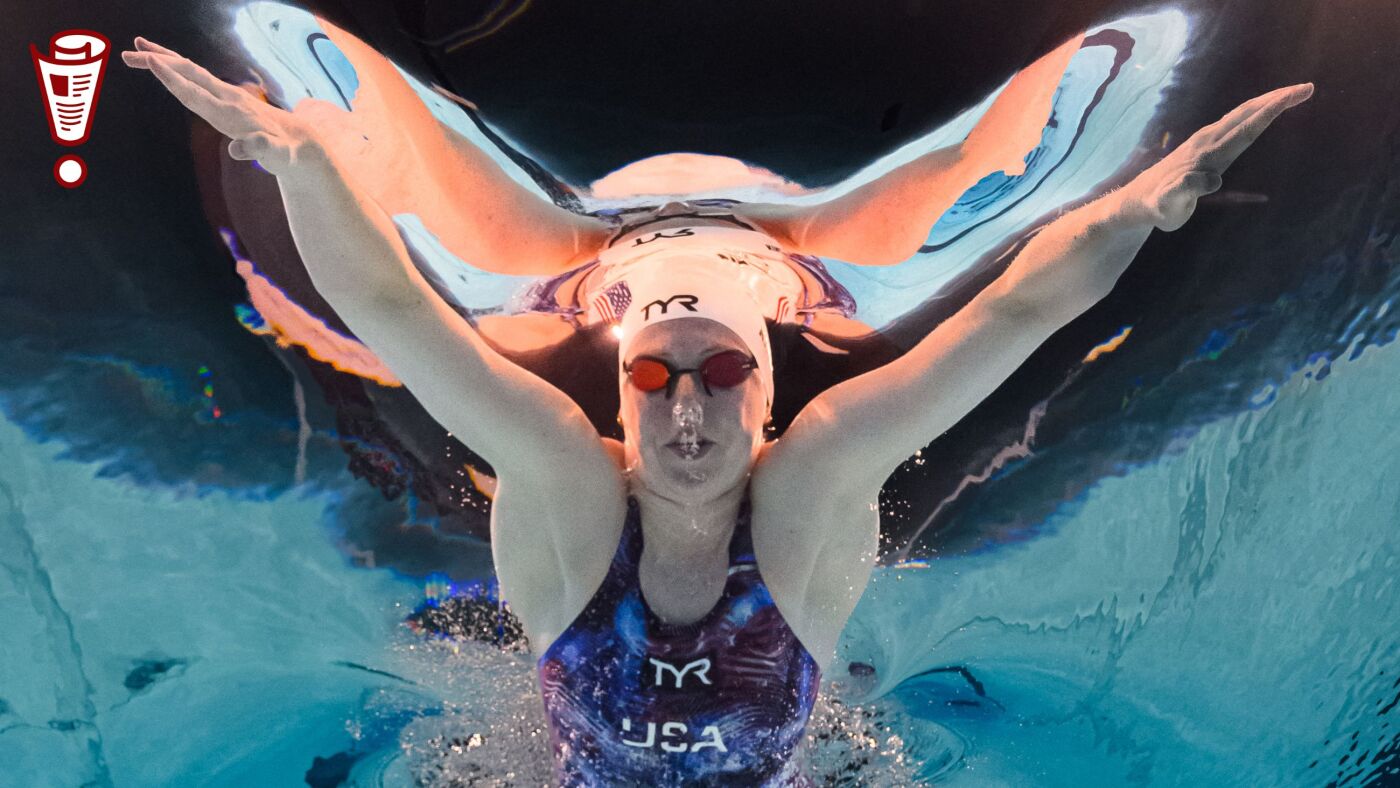
An underwater view shows US’ Lilly King competing in a heat of the women’s 200m breaststroke swimming event during the Paris 2024 Olympic Games at the Paris La Defense Arena in Nanterre, west of Paris, on July 31, 2024. (Photo by François-Xavier MARIT / AFP) (Photo by FRANCOIS-XAVIER MARIT/AFP via Getty Images)
François-Xavier Marit/Getty Images
hide caption
toggle caption
François-Xavier Marit/Getty Images
This week’s show was recorded in Bloomington, Indiana with host Peter Sagal, judge and scorekeeper Bill Kurtis, Not My Job guest Lilly King and panelists Alonzo Bodden, Josh Gondelman, and Faith Salie. Click the audio link above to hear the whole show.
Who’s Bill This Time
State of the Union is Hot; The Tribal Council Convenes Again; A Glow Up In the Doll Aisle
Panel Questions
The Toot Tracker
Bluff The Listener
Our panelists tell three stories about a travel hack in the news, only one of which is true.
Not My Job: Olympic Swimmer Lilly King answers our questions about Lil’ Kings
Olympic Swimmer Lilly King plays our game called, “Lilly King meet these Lil’ Kings” Three questions about short kings.
Panel Questions
Cleaning Out The Cabinet; Bedtime Stacking
Limericks
Bill Kurtis reads three news-related limericks: Getting Cozy With Cross Country Skiing; Pickleball’s New Competition; Bees Get Freaky
Lightning Fill In The Blank
All the news we couldn’t fit anywhere else
Predictions
Our panelists predict, after American Girls, what’ll be the next toy to get an update.

Can fire-resistant homes be sexy? ‘You be the judge,’ says this Palisades architect

Shaikin: Clayton Kershaw’s ‘perfect’ ending has one final chapter in WBC

Unexpected birth brings hope to near-extinct Amazon tribe

Supreme Court blocks redrawing of New York congressional map, dealing a win for GOP

Oregon Dems block effort to alert ICE before illegal immigrant murderers are released

Florida High School Football Rankings: Top 25 teams – Oct. 21

Cleary's 21 help Le Moyne down Central Connecticut State 69-64 in OT

How old is Bo Nix? What to know about Oregon quarterback ahead of 2024 NFL Draft

99th annual Pony Swim held in Virginia

Indiana Members Credit Union announced as new anchor tenant at Bottleworks District
Unexpected birth brings hope to near-extinct Amazon tribe
Supreme Court blocks redrawing of New York congressional map, dealing a win for GOP

Map: Earthquake Shakes Central California

Gas prices could jump as Middle East tensions threaten global oil supply

Pakistan calls troops, orders 3-day curfew as 24 killed in pro-Iran rallies
-

 World5 days ago
Exclusive: DeepSeek withholds latest AI model from US chipmakers including Nvidia, sources say
-

 Massachusetts5 days ago
Mother and daughter injured in Taunton house explosion
-

 Denver, CO5 days ago
10 acres charred, 5 injured in Thornton grass fire, evacuation orders lifted
-

 Louisiana1 week ago
Wildfire near Gum Swamp Road in Livingston Parish now under control; more than 200 acres burned
-

 Technology1 week ago
YouTube TV billing scam emails are hitting inboxes
-

 Politics1 week ago
OpenAI didn’t contact police despite employees flagging mass shooter’s concerning chatbot interactions: REPORT
-

 Technology1 week ago
Stellantis is in a crisis of its own making
-

 News1 week ago
World reacts as US top court limits Trump’s tariff powers