Lifestyle
Time loop stories aren't all 'Groundhog Day' rip-offs. Time loop stories aren't all…


Here we go again: Time loop stories were around long before the 1993 movie Groundhog Day. So a friendly reminder that one person’s discovery of something isn’t the same as its invention.
Columbia Pictures/Getty Images
hide caption
toggle caption
Columbia Pictures/Getty Images

Here we go again: Time loop stories were around long before the 1993 movie Groundhog Day. So a friendly reminder that one person’s discovery of something isn’t the same as its invention.
Columbia Pictures/Getty Images
What if I told you that on Groundhog Day, I am thinking about the way we wind up in a repeating conversation about movies like Groundhog Day that reminds me of the way that, in Groundhog Day, Bill Murray keeps waking up on Groundhog Day? Would you feel like you were reading the same phrase over and over again?
Time loop stories are popular. They go like this: a character lives through some portion of their lives — most often a day — and then they suddenly find themselves back in time, experiencing the same events again and again. Usually, but not always, the character’s struggle is to escape the time loop and proceed with a normal life, sometimes after indulging in many (many) loops to see what happens or to gain knowledge that they retain in subsequent loops.
YouTube
Most recently, I saw a time loop in a Hallmark movie about Hanukkah called Round and Round. (And that was not its first Hallmark incarnation.) The idea was used well in Palm Springs with Andy Samberg and Cristin Milioti, and in the Happy Death Day movies, and in the great Netflix series Russian Doll. You could argue that many video games are functionally time loops as you experience them; if you die in The Last of Us, you just start over at the last save point and exactly the same things happen to you, and you try to get it right, and only then can you continue.
YouTube
But the closest association a lot of people have with time loops in popular culture is with Groundhog Day. In fact, on the online index TV Tropes, they call this whole idea “the Groundhog Day loop.”
Which is funny, because … this idea didn’t originate with Groundhog Day! At all! If you don’t believe me, believe the Wikipedia page called “Time loop” that calls out examples going back to a Russian novel from 1915. Much later, in 1992, just about a year before Groundhog Day came out, Star Trek: The Next Generation aired an episode called “Cause and Effect” in which the crew is stuck in a loop. There’s a 1973 short story called “12:01 P.M.,” by Richard A. Lupoff, in which a man relives the same hour over and over.
Language will do what it does; it doesn’t really matter that it goes by “the Groundhog Day loop” as a shorthand; that’s reasonable and sensible, since it’s familiar. But when Palm Springs came out, there were people who called it a rip-off of Groundhog Day, and that’s … unfortunate. Ascribing the invention of an idea to a specific implementation of it can misunderstand as intellectual property what is actually the natural evolution of interesting ideas. Not to overextend the focus on looping constructions, but “Row, Row, Row Your Boat” didn’t invent the idea of a round, and not every round is copying it, even if the handiest way to explain a round might be to say, “You know, like ‘Row, Row, Row Your Boat.’” The idea of the time loop is best understood as folk culture beyond the reach of either official copyright or ethical “rip-off” analysis.
A movie screen at Snappy Burger drive-thru in Las Vegas displays images of cast members Bill Murray and Andie MacDowell during a Groundhog Day celebration on Feb. 2, 2021.
Ethan Miller/Getty Images
hide caption
toggle caption
Ethan Miller/Getty Images
More important, though, one person’s discovery of something isn’t the same as its invention. An anecdote: I was a guest on a podcast once, let’s say Podcast A, that had a format that someone immediately announced with great indignation was clearly stolen — stolen, I tell you! — from another one he listened to, Podcast B. But it turned out the one I guested on was using the format years earlier. When this was pointed out, the accuser did not conclude that he had it backwards, and in fact B stole it from A (nor did I). He shrugged and concluded that in that case, it was a coincidence. But he’d had a reflex: I have seen this concept somewhere else, so that’s where it comes from, so it is stolen.
What does this have to do with recipes? I’m so glad you asked. I have my vices, and one is that I love to hate recipe comments, especially in The New York Times. The best-known category is probably the comment that says, “I didn’t have any onions so I used beets, and I didn’t have any chicken so I used hot dogs, and I didn’t have any lemons so I poured Fanta on it, and I have to tell you, this recipe is not good at all.” But there is also a type that says something like, “You stole this from [name of chef], who published almost this exact recipe in [name of publication] two years ago.”
(This is distinct from explaining, by the way, that a food you know well has been stripped of its cultural origins, which is important work.)
But nobody in the last 20 years invented any combination of, say, the 20 most common ingredients for people to have in their kitchens using the most common techniques. There’s little you can do with, say, chicken, butter, salt, pepper, onions, carrots and peas in a saute pan that somebody might not decide is “stolen.” In fact, there are limitations on copyright for recipes, which is a good thing, because who’s going to own the copyright on scrambled eggs? Or even something more involved, like the basic structure of a spinach salad? Recipe development is often about iterating, tweaking and perfecting. The idea is rarely to claim that you have come up with something nobody has ever done before in any form in all of history.
Writing movies or TV can be the same way. The bottom line: a time loop story is sort of like a spinach salad. It’s beyond ownership, beyond association with one particular version. Here’s hoping we all have a good lunch and six more weeks of winter.
This piece also appeared in NPR’s Pop Culture Happy Hour newsletter. Sign up for the newsletter so you don’t miss the next one, plus get weekly recommendations about what’s making us happy.
Listen to Pop Culture Happy Hour on Apple Podcasts and Spotify.



Maxim Naumov performs in exhibition after being named to the 2026 U.S. Olympic Figure Skating Team at the Enterprise Center in St. Louis on Jan. 11.
Brian Munoz/St. Louis Public Radio
hide caption
toggle caption
Brian Munoz/St. Louis Public Radio
Want more Olympics updates? Get our behind-the-scenes newsletter for what it’s like to be at these Games.
At the U.S. Figure Skating Championships in January, almost exactly a year after he lost his parents — who were also his coaches — Max Naumov won a bronze medal and a spot on the Olympic team.
“Fulfilling the dream that we collectively had as a family since I first was on the ice at five years old … It means absolutely everything,” Naumov, now 24, said from nationals in St. Louis. “And I know they’re looking down, smiling, and proud.”

Last January, when Naumov placed fourth at nationals for the third year in a row, he joined his parents, Vadim Naumov and Evgenia Shishkova, for a heart-to-heart in their hotel room in Wichita, Kan. to talk strategy. He remembers not being able to hug his mom. She was sick and did not want him to fall ill so close to his next competition.
“It was a very productive, emotional and just inspiring conversation,” said Naumov. “My dad said that we have to change our mindset, we have to get more consistent in the areas that we talked about and just overall have a resilient attitude to the entire approach of the season.”
That was one of the last times they spoke.
Naumov flew home to Massachusetts after the event ended. His parents — renowned Russian-born pairs skaters who coached at the Skating Club of Boston — stayed a few extra days in Wichita for an invitation-only development camp for promising young skaters and their support systems.

Many of those skaters, relatives and coaches, including Naumov’s parents, were among the 67 people who died on Jan. 29, 2025, when a U.S. Army Black Hawk helicopter collided with an American Airlines regional jet on its landing at the Ronald Reagan Washington National Airport. The tragedy killed 28 members of the tight-knit figure skating community, many of them based in the Boston and D.C. areas.
The loss of the rising skating stars, beloved parent volunteers and longtime coaches is felt acutely at their home rinks and throughout the entire skating world, especially as the anniversary of the crash approaches. It comes just a week before the start of the Winter Olympics, when Naumov’s story — and the sport itself — will come under an even brighter spotlight.

Maxim Naumov holds a photo of his parents while he waits for his scores after competing in the men’s short program competition during the 2026 U.S. Figure Skating Championships in St. Louis on Jan. 8. His parents were killed last year when an American Airlines regional jet collided with a U.S. Army Blackhawk helicopter over the Potomac River, near Washington, D.C.
Brian Munoz/St. Louis Public Radio
hide caption
toggle caption
Brian Munoz/St. Louis Public Radio
“They were truly just really good people that we respect, family of choice,” said Doug Zeghibe, the CEO of the Skating Club of Boston, which lost two teenage skaters and their moms, in addition to Naumov’s parents. “And I think we’re at the point now where missing them is turning into: what can we do to honor them and remember them and make sure we carry them forward.”
Many in the skating community told NPR that, a year on, there is a continued focus on honoring the victims’ legacies both on and off the ice. Tributes include makeshift memorials and poignant performances, as well as financial and mental health resources for other young skaters — many of whom have Olympic dreams of their own.
“We’re all feeling a greater sense of purpose,” Zeghibe said.
How skaters are channeling their grief
Those interviewed recalled the days after the crash as a painful blur.
“We were all just in shock and nobody knew what to do,” said Heather Nemier, president of the Washington Figure Skating Club, which has some 1,400 members at roughly half a dozen rinks across the D.C. area. “A lot of kids came to the rink and left because they just felt like they couldn’t skate.”

Heather Nemier, president of the Washington Figure Skating Club at the Ashburn Ice House in Ashburn, Va., where a number of the figure skaters trained who were victims in the air crash last January.
Tyrone Turner for NPR
hide caption
toggle caption
Tyrone Turner for NPR
The Washington Figure Skating Club lost seven members: three skaters — Franco Aparicio and sisters Everly (Evy) and Alydia (Liddy) Livingston — their coach, and three of their parents. Nemier said the unofficial spots at the Virginia rink where those skaters usually left their stuff sat empty for weeks, since no one wanted to occupy them.
But over the course of the year, she said, their fellow skaters have found ways to process that grief, with help from mental health counselors, therapy dogs, friendship bracelets, letter writing, public memorials and quiet spaces for reflection.
And many have returned to the ice with a newfound motivation. (That was also the case for Naumov, who was unsure if he would skate again until he returned to competition in the summer.)
“I’ve heard a number of [D.C.-area skaters] say, ‘You know, Evy can’t skate anymore but I can, and I’m going to get out there and do my best,’” Nemier said.

At the Ashburn Ice House, a memorial was created with photos and information honoring a coach, three skaters and their parents who died in the crash.
Tyrone Turner for NPR
hide caption
toggle caption
Tyrone Turner for NPR
Sofia Bezkorovainaya, now 15, did just that. The Virginia-based skater moved the crowd — and the internet — at January’s U.S. Figure Skating Championships in St. Louis with her “Over the Rainbow” short program, a tribute to Everly Livingston, her best friend of nearly a decade.
“If there were flies on the ice, she’d pick them up and bring them to the heater so that they could come back to life,” Bezkorovainaya told NPR after competing in St. Louis. “She always cared about everybody, and she was such an amazing skater.”
For months after the crash, Bezkorovainaya said she was “sad all the time” and feared she would never feel better. She even switched to another Virginia rink because of how empty her old one felt without the familiar faces.
Then she decided to learn Livingston’s choreography and compete with it in her memory.
In the opening and closing moments of the program, Bezkorovainaya said, “I look up to the bright lights up there and I hug myself and I imagine her hugging me.” Her long program is dedicated to her late longtime coach, Inna Volyanskaya, whose distinctive corrections she says she can still hear in her head while practicing.
“Doing these programs was like having them with me this season,” she said. “And before I got on the ice, I could always pray to Inna and Evy and everyone else who I was friends with on that plane … like, ‘Please help me do a clean program today.’”
Bezkorovainaya was one of three skaters at nationals whose program explicitly paid tribute to loved ones lost in the crash. Others, including Naumov, held up photos as they waited for their scores.

Sofia Bezkorovainaya skates during the “Legacy On Ice” U.S. Figure Skating Benefit at Capital One Arena in Washington, D.C., on March 2, 2025. She one of three skaters at nationals whose program explicitly paid tribute to loved ones lost in the crash.
Scott Taetsch/Getty Images
hide caption
toggle caption
Scott Taetsch/Getty Images
“I think it’s admirable that they’ve come up with ways of coping with such a terrible loss that is meaningful to them and is meaningful to other people, too,” Nemier said. “And to be able to share that with the public and with the skating community, I think is really important.”
Boston-based Patrick Blackwell, 17, skated to honor his friend Spencer Lane, even including a clip of the music Lane had planned to compete with this season. Blackwell ultimately won gold at the junior level, which he said was “not just for me but the ones who passed a year ago.”
“It’s kind of my gift to Spencer, his dad and every other family member, being able to bring gold home to a place where a lot of lives were lost,” he said.
Clubs look to keep legacies alive
Local and national figure skating organizations are working on more permanent ways to honor the victims’ memories.
And in early March, the U.S. figure skating community came together in Washington, D.C. for “Legacy on Ice,” a benefit show that raised $1.2 million for first responders and victims’ loved ones. It featured moving performances by a huge roster of Olympians, past and present, as well as several young skaters directly affected by the crash, including Naumov.
More recently, the focus has shifted to the next generation of skaters: making sure they remember those who were lost, and making it easier for them to pursue the dreams they shared.
The Skating Club of Boston, for example, has created the “Always Champions Campaign” to fund two permanent scholarships, one in honor of each of the two skaters it lost, with criteria set by their families.
The campaign also aims to rename one of the rinks in Boston and create a memorial wall in honor of the six victims.

Flowers and remembrances are displayed for the six athletes, coaches and family members who perished in a plane crash, at The Skating Club of Boston in Norwood, Mass., on March 25, 2025.
Charles Krupa/AP
hide caption
toggle caption
Charles Krupa/AP
“They were all examples — the skaters, the parents, the coaches — of people who we saw, if not six, seven days out of the week,” said club director Mia Corsini Bailey. “Their commitment to the sport on multiple levels is something that we’re carrying forward.”
In the D.C. area, the Washington Figure Skating Club has endowed trophies in memory of the three skaters it lost, with plans to add the winners’ names to a ringside plaque updated every year.
The club is also using its existing foundation to support young figure skaters through the “Livingston Family Dream Fund,” which was set up by relatives of the family of four. The club used the money to give $1,000 grants to the skaters who participated in this year’s national development camp, according to Nemier. There were eight of them, she said, compared to about a dozen last year.
Another painful dimension of the tragedy, one increasingly top of mind in an Olympic year, is where the skaters returning from last year’s development camp were in their careers: right on the brink of making it to nationals, and beyond.
“Those were some of the kids that could have made it to the next Olympics or the Olympics after that,” said Bezkorovainaya, the junior skater.
Corsini Bailey, of Boston, recalls sitting down with 16-year-old Spencer Lane and his parents to talk about that very prospect just before the national development camp last year, and said she saw a similarly bright future for 13-year-old Jinna Han.
“The talent was there, the star power was there, and they truly were that next generation,” she said. “And now we look to: how are their legacies inspiring that next generation … whether they were their peers or they were the younger skaters who were looking up to them. Again, we carry them with us every single day.”

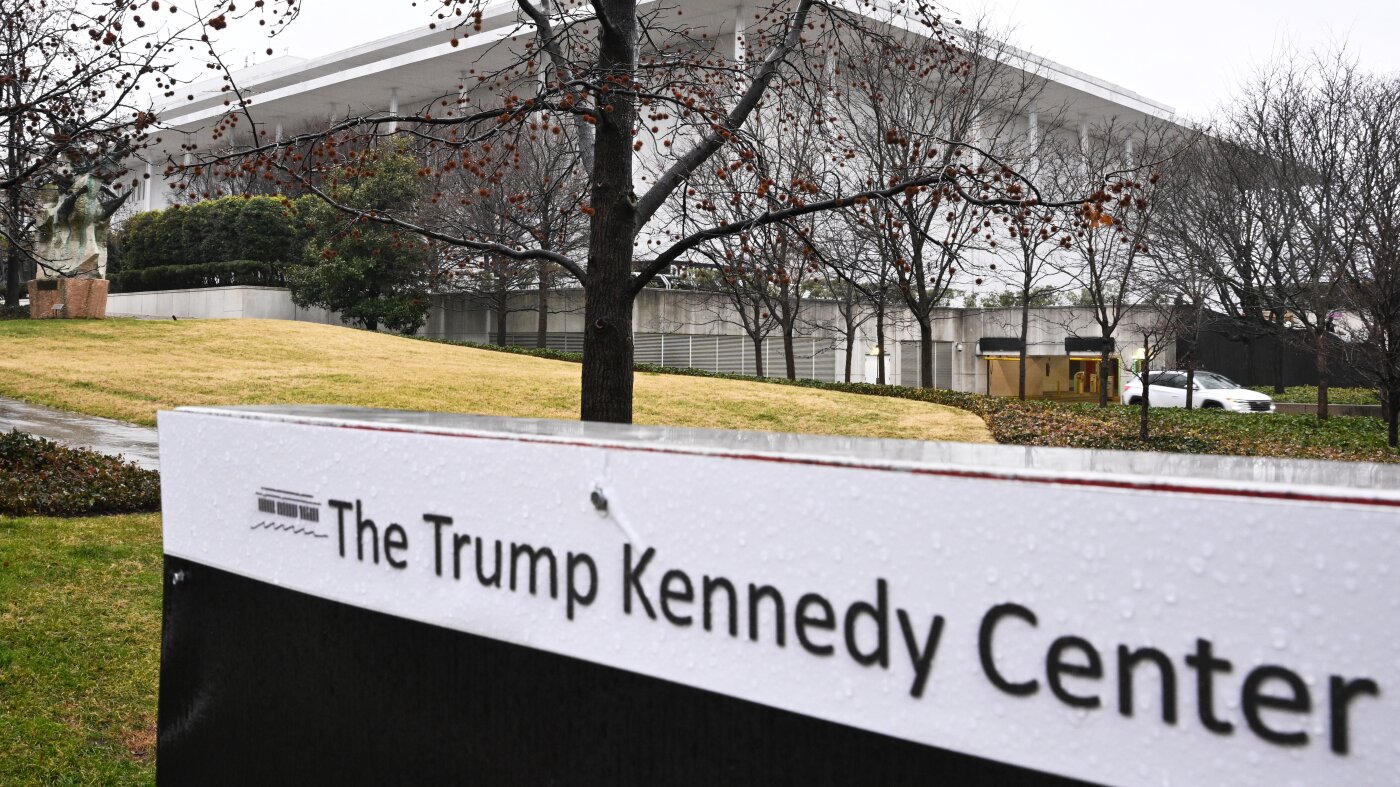
A recently installed sign at the Kennedy Center in Washington, D.C., as photographed on Jan. 10. The center’s name change has not been approved by Congress.
Mandel Ngan/AFP via Getty Images
hide caption
toggle caption
Mandel Ngan/AFP via Getty Images
Two senior staffers have departed the John F. Kennedy Center for the Performing Arts in Washington, D.C. — one of whom was officially on the job for less than two weeks.
Kevin Couch had been announced as the Kennedy Center’s new senior vice president of artistic planning on Jan. 16, at which point he was hailed as a “visionary entertainment leader” with “over two decades of experience in artist management, global booking and high-level brand partnerships,” including booking live events in San Antonio, Tulsa, Little Rock and Springfield, Mo.

Couch, who is a drummer, confirmed to NPR on Wednesday evening that he had resigned from the federally funded center, but declined to share any details.
Meanwhile, the Kennedy Center’s senior director of artistic operations, Sarah Kramer, confirmed to NPR on Wednesday evening that she had been fired after a decade working there.
The Kennedy Center did not respond to NPR’s multiple requests for comment.
Since President Trump became chair of the performing arts complex and later moved to change its name to the Trump Kennedy Center, several prominent artists have canceled their planned performances and presentations of their work. Cancellations announced this month include the composer Philip Glass, opera star Renée Fleming, the banjo player Bela Fleck and the Seattle Children’s Theatre. The Kennedy Center has told NPR in prior statements that the artists cancelling have been doing so under pressure from “leftist activists.”
The center’s name change did not receive the required approval from Congress. Last month, Rep. Joyce Beatty (D-Ohio), an ex-officio member of the Kennedy Center’s board, filed a lawsuit against President Trump, the center’s president Richard Grenell, and others over the name change.
Jennifer Vanasco edited this story.

Measles cases confirmed among immigration detainees in Arizona

University of Arkansas selects Oak View Group for event bookings at Razorback Stadium, Bud Walton Arena

Letters to the Editor: Population growth in California is stalling. Is that really a bad thing?

‘Can’t operate business as usual when this is going on’: CO businesses participate in nationwide shutdown

Frigid cold temperatures to start the day

Florida High School Football Rankings: Top 25 teams – Oct. 21

Cleary's 21 help Le Moyne down Central Connecticut State 69-64 in OT

How old is Bo Nix? What to know about Oregon quarterback ahead of 2024 NFL Draft

99th annual Pony Swim held in Virginia

Indiana Members Credit Union announced as new anchor tenant at Bottleworks District

AOC voices support for anti-ICE shutdown, declines to participate

Zelenskyy seeks 50,000 Russian ‘losses’ a month to win the Ukraine war

Trump sues IRS and Treasury for $10 billion over leaked tax information

Map: 4.2-Magnitude Earthquake Shakes Montana

Virginia Democrats seek dozens of new tax hikes, including on dog walking and dry cleaning
-

 Illinois1 week ago
Illinois school closings tomorrow: How to check if your school is closed due to extreme cold
-

 Pennsylvania4 days ago
Rare ‘avalanche’ blocks Pennsylvania road during major snowstorm
-
 Science1 week ago
Contributor: New food pyramid is a recipe for health disasters
-

 Technology1 week ago
Ring claims it’s not giving ICE access to its cameras
-
 Science1 week ago
Fed up with perimenopause or menopause? The We Do Not Care Club is here for you
-
Movie Reviews1 week ago
Movie Review: In ‘Mercy,’ Chris Pratt is on trial with an artificial intelligence judge
-

 Politics1 week ago
Supreme Court appears ready to keep Lisa Cook on Federal Reserve board despite Trump efforts to fire her
-

 News1 week ago
Video: Jack Smith Defends His Trump Indictments During House Hearing

