Lifestyle
The transformative joys (and pains) of painting your own house

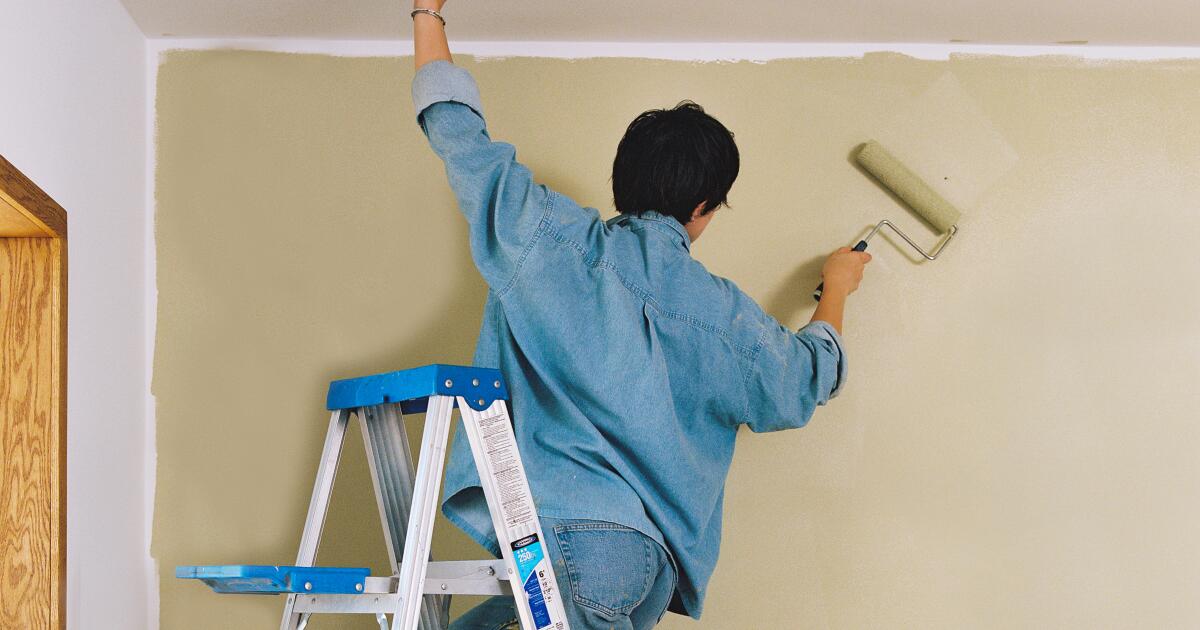
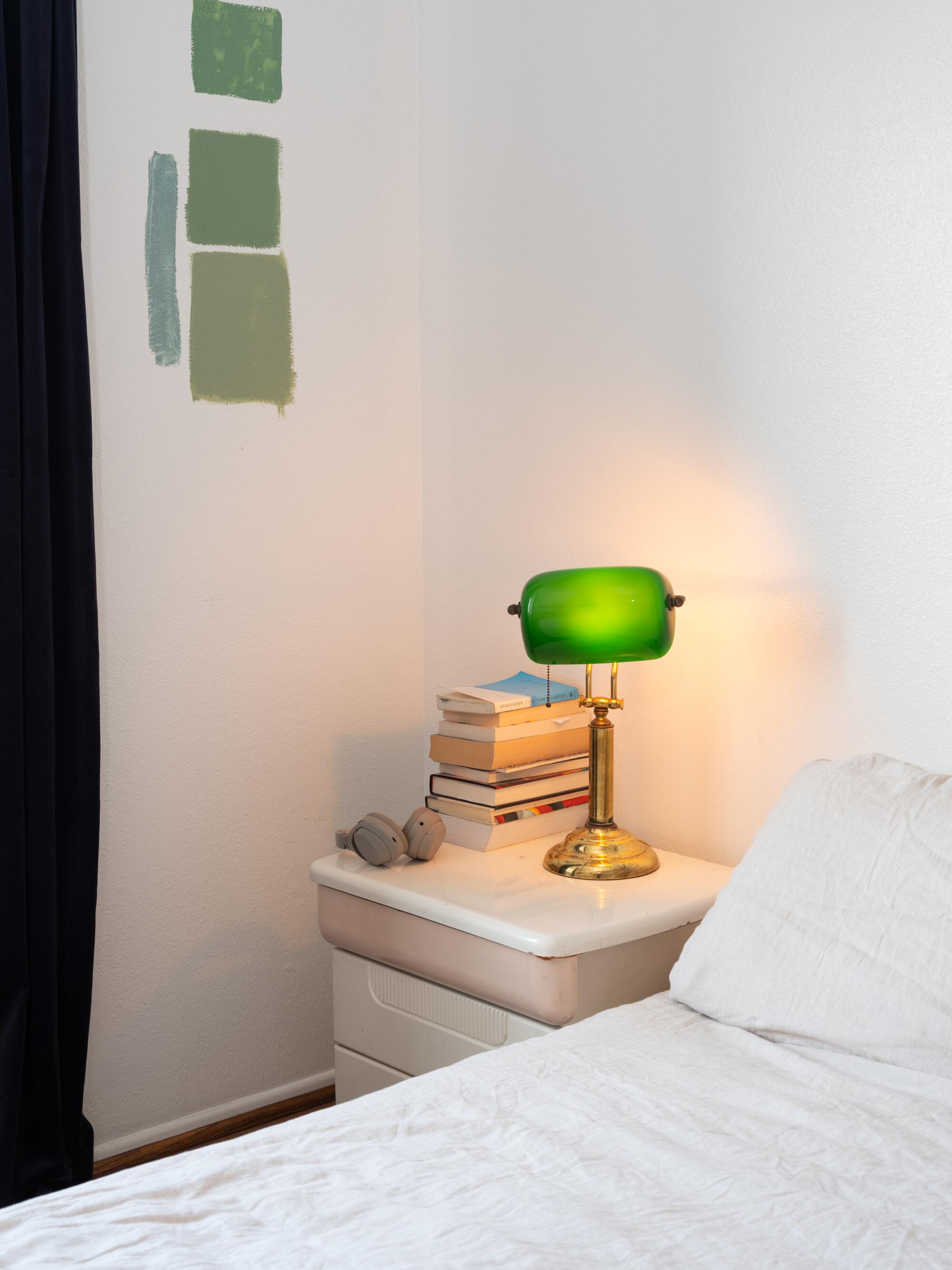
There are 38 walls in my house, including the ceilings. Of those, 14 are fully painted, 10 are in varying stages of completion, seven are covered in paint swatches and two are haphazardly skim-coated. The remaining five are as nature (the previous homeowners) made them, for now. I am now used to living in a kind of aesthetic limbo. I work beside a stack of gallon cans, paint trays and crumpled canvas drop cloths, below a half-painted ceiling. I no longer notice the flashes of lime green tape caressing door frames, encircling bathroom floors and smothering naked outlets. For the last six months, I’ve gone to sleep each night confronted with the same impossible choice swatched on the wall: Should the bedroom be Farrow & Ball’s Breakfast Room Green, Behr’s Roof Top Garden or Backdrop’s Lawn Party?
This purgatory is entirely of my own design — there are no professionals involved. Professionals get the job done. They make decisions, they bring their own rollers, they already own ladders. I self-impose and prolong these chaotic experiments because collectively, they form a promise: that one day I’ll be able to live happily in the house I’ve always wanted.
It’s hard to believe it’s already been two years. My relationship with my house is intense, tumultuous. Driven by a dark kineticism, it vacillates between contempt and gratitude at a velocity that catches my husband, my therapist, even me off-guard. It helps to start at the beginning.
I don’t remember how many houses we saw before the one that eventually became ours, but it was a lot. We started house hunting a little too late, just as interest rates started to claw their way back from historic lows. L.A.’s open houses were thick with the resulting panic, generated by throngs of millennial couples, looking-glass versions of ourselves, all desperate to get ahead of the curve.
At a viewing for a “developer’s dream” in Alhambra (complete with black mold blooming on the walls), I watched a fellow buyer-to-be grab onto the arm of the selling agent as she shouted to the rest of us that she wanted this house, that she would buy it today and that she would pay for it in cash. The market sensed our desperation. Prices rose quickly. Listings sold for tens of thousands over asking. Then hundreds of thousands.
On Redfin, a listing that attracts significant traffic is given the designation of a “Hot Home.” The first Hot Homes we found were architecturally significant with character and updated kitchens. Soon, they were simple, but solid, with more than one bathroom. Then came the quick flips with baggage, bisected by easements or on shaky foundations. Eventually, even the gnarliest tear-downs were in high demand. So when we met our house, we were immediately taken by its lack of homeowner-installed balconies, exposed wiring and sodden floors. There were no sewage problems, no five-foot-tall bathrooms, no wild animals living inside. It might not have been Hot, sure, but it was a Home. Beautification, we agreed, could come later. When our offer was accepted, we felt so lucky that we started counting our blessings and stopped running the numbers. And house stuff, it turns out, is very, very expensive.
The urge to paint is primitive and innate. Cavemen, famously, liked to doodle on the walls with pigments ground from charred wood, stone, bone and minerals, bound with plant sap and animal fat.
Faced with bloated mortgage payments locked in at an inarguably mid-interest rate, I turned to DIY. I forced myself to watch excruciatingly paced episodes of “This Old House.” I bought a voltage tester. I took a woodshop class, giddy with visions of Donald Judd-inspired furniture and dovetailed cabinets (I made a cutting board). But dabblings in more advanced forms of home improvement have been unequivocal failures. The enormous hole I cut in a load-bearing wall in a Gordon Matta-Clark-informed burst of inspiration required extensive professional intervention. A bathroom I decided to “redo” has sat undone for more than a year. I’ve learned that a lack of experience and ADHD, combined with the consumption of time-lapsed home renovation videos on social media, is an intoxicating and dangerous cocktail I’m better off without.
If you’re relatively able-bodied and OK with doing a bad job (which I always am), painting is pretty easy. And its transformative powers are overwhelmingly effective.
But paint. Paint is my friend. Unlike electrical work or cabinet construction, paint is statistically less likely to kill, injure or dismember you. Its essential tools are inexpensive and intuitive. If you’re relatively able-bodied and OK with doing a bad job (which I always am), painting is pretty easy. And its transformative powers are overwhelmingly effective.
I’m not alone in this belief. The urge to paint is primitive and innate. Cavemen, famously, liked to doodle on the walls with pigments ground from charred wood, stone, bone and minerals, bound with plant sap and animal fat. In honor of my ancestors, I eschew steps like sanding and priming. Choosing, almost every time, to paint first and ask forgiveness later. “Color good,” I reassure myself as I apply a coat of Backdrop’s reddish-purple Lobby Scene to a perfectly serviceable Ikea cabinet, boring bad.
Remembering the 16th and 17th century artisans commissioned to adorn the walls of wealthy Europeans’ homes with murals and trompe-l’oeil, I encourage my friends’ 4-year-old to draw on the living room wall. We were planning to paint over it until more urgent, enticing walls cut ahead in the queue. Her portrait of our dog, while anachronistic to the period, is still on view.
My practice isn’t always joyful. As I get down on my hands and knees to scrape paint drips off the floor, the results of my husband’s exuberant roller work, I empathize with the Puritans who looked down upon those who would dare paint their walls. “Heretics!,” they cried. Centuries later, my voice joins their chorus: “Drop cloths!”
There are 38 walls in my house, including the ceilings. Of those, 14 are fully painted, 10 are in varying stages of completion, seven are covered in paint swatches and two are haphazardly skim-coated.
How old were you when you were asked for the very first time what your favorite color was? And how many times over the years has that answer changed, surprising even yourself? The paint and coatings market, built on our endlessly varied and forever shifting color preferences, is robust, with a reported market size of $206 billion in 2023. It might not surprise you to know that paint’s business started to really pick up swiftly around 2021, the year U.S. homeownership rates hit a 9-year high. We were one year into a global pandemic, and the nonessential among us were grateful for our health but sick of our surroundings. Snarled supply chains and crowded ports meant massive delays for furniture and furnishings. So we turned to paint.
The paint mass market has no shortage of options available: Behr, the pitiless paint god at whose Home Depot altar I am often forced to worship, boasts nearly 4,000 colors, and selecting one is just the beginning. “Do you want Behr Premium Plus®, Behr Scuff Defense®, Behr Marquee®, Behr Dynasty®?” the Home Depot paint associate silently asks, pointing at an infographic laminated on the counter top. Flustered, I step out of line to Google “Behr prmeium.plus vs. detnasty reddit,” and gesture to the next person to go ahead. The other mainstream paint brands, Benjamin Moore (3,500 colors) and Sherwin-Williams (1,700), offer similar experiences.
Our home’s previous owners painted every wall a cool, semi-glossed gray with greenish undertones. Under the piercing, cool white LED flush mounts installed every few feet, the effect was undeniably institutional. Paint was the obvious first step.
There was a time when I reveled in the sheer volume of the spectrum. Our home’s previous owners painted every wall a cool, semi-glossed gray with greenish undertones. Under the piercing, cool white LED flush mounts installed every few feet, the effect was undeniably institutional. Paint was the obvious first step. I drove happily to Home Depot, to Lowe’s, to Ace Hardware and picked free samples from the rainbow walls like flowers. Then came a bloody, months-long campaign to find a warm, non-white neutral for my office. It took eight samples and six trips to two hardware stores before I found it: Benjamin Moore’s Gentle Cream. But I was exhausted, spent, color-sick.
There are easier, softer, pricier ways. Backdrop Home (82 colors), Farrow & Ball (152 colors) and Little Greene (196 colors) way. Backdrop Home, in particular, has zeroed in with shameful, heat-seeking precision on aesthetically obsessed millennials who crave curves and architectural significance but can’t afford the homes that have them. Silverlake Dad is a slate blue-gray. Barragán-Cito, a bright pink, will speak to anyone who shelled out an extra $25 to take their own photos at the architect’s Mexico City home tour. The brand’s earnestness feels very L.A., which makes sense: When Backdrop co-founder Natalie Ebel and her family moved to Silver Lake post-pandemic, they brought the brand’s operations and production with them.
Ebel says L.A. is “adventurous with color … It’s a lot easier to play with color when you’re surrounded by color. And maybe it’s the size of the homes. In L.A., you have more real estate, you have more space and you’re open more to experimentation with the light, the windows, the sun.”
I was once skeptical of the Backdrops, the Farrow & Balls, dismissing them as the refuge of the less creative who weren’t capable of conceiving their own Color of the Year. But faced with so many walls still to go, I’ve found myself finally softening, succumbing.
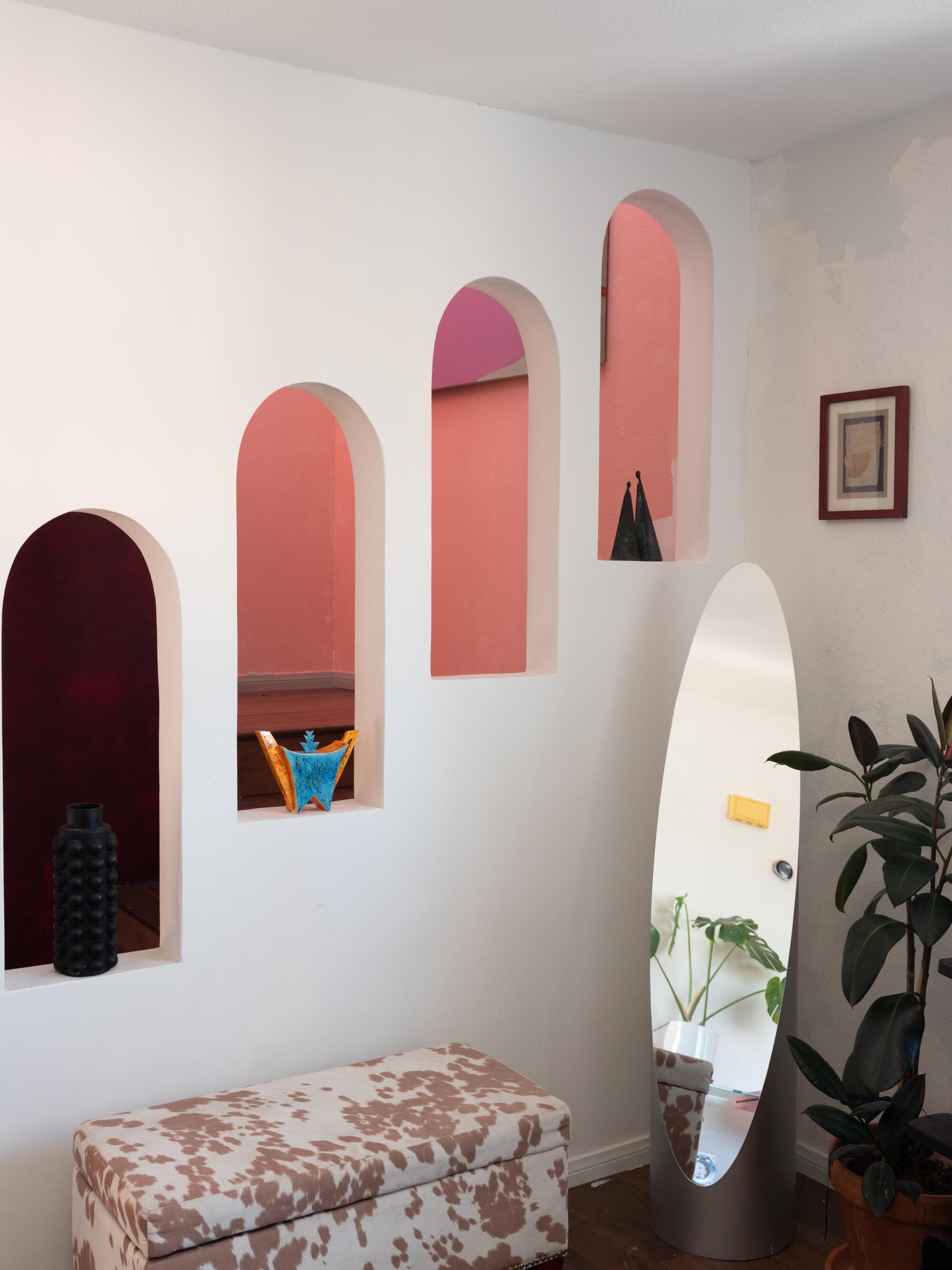
My house and I are birth-year twins, 1990 babies, Year of the Horse. When you get down to it, my house is very much a classic L.A. house — two boxy stories stacked atop a wide garage, straddling a hillside. It stands shoulder-to-shoulder with four identical siblings. I never know how to describe it, but you’d know it if you saw it. “Oh, it’s one of those,” a friend said, walking up to the door for the first time. “Why didn’t you just say so?”
It wasn’t the house I imagined myself living in. My dream house (think Jeff Shelton’s biomorphic surrealist creations) doesn’t exist in L.A. nature, at least not in my budget. Last year, according to the National Assn. of Homeowners, 32% were first-time buyers, with a median age of 35. In other words: millennials. Millennials, like me, were buying properties they could barely afford and, as supply shrank, perhaps didn’t particularly like. Our houses just didn’t feel like us.
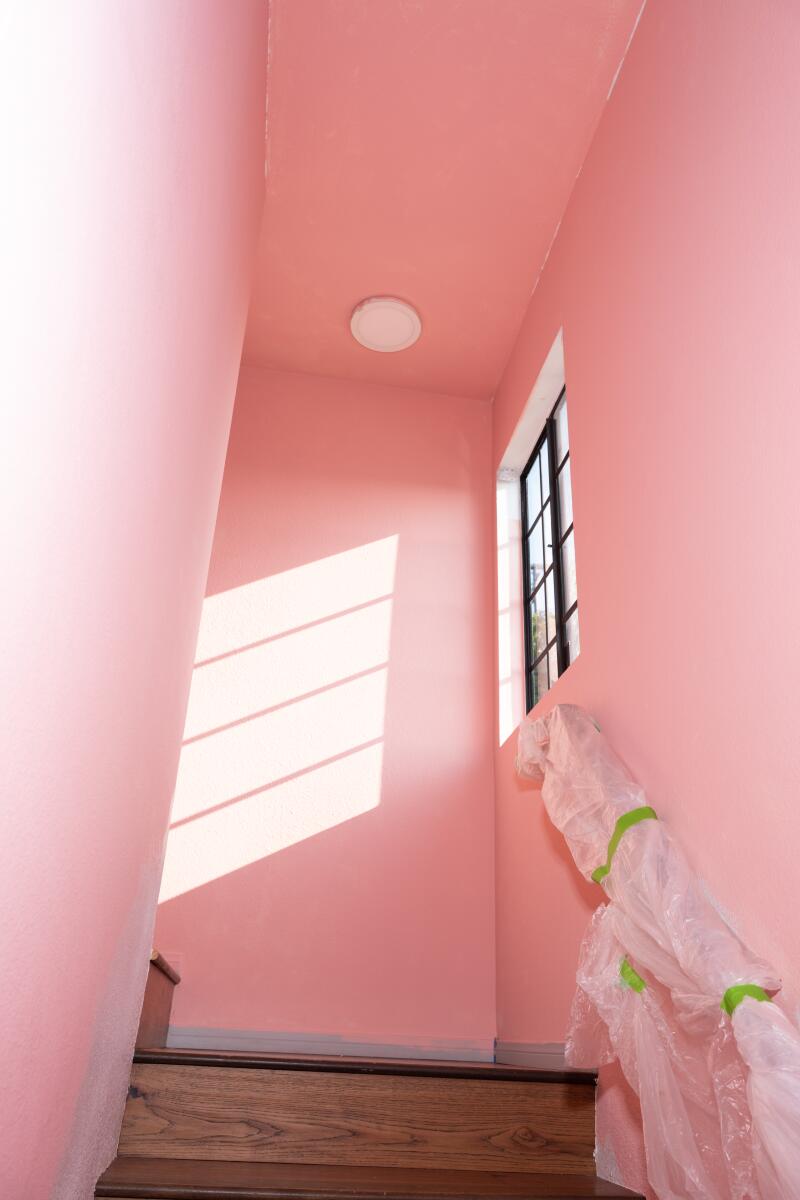
Maybe paint is the cheapest, easiest, fastest way to make our houses as unique as we think we are. It felt like a hypothesis worth testing. Over the last two years, I’ve drenched the bathroom in glossy navy, bisected an office with teal and mustard, painted the stairwell a bright, matte powdery pink. I’ve resurrected kitchen cabinets with a deep blue and spray-painted the corresponding pulls bright red. I painted the fireplace a truly heinous shade of green called simply Frog, only to re-paint it Frosted Sage, only to skimcoat over both (it currently stands naked and anxious, waiting for its next outfit change).
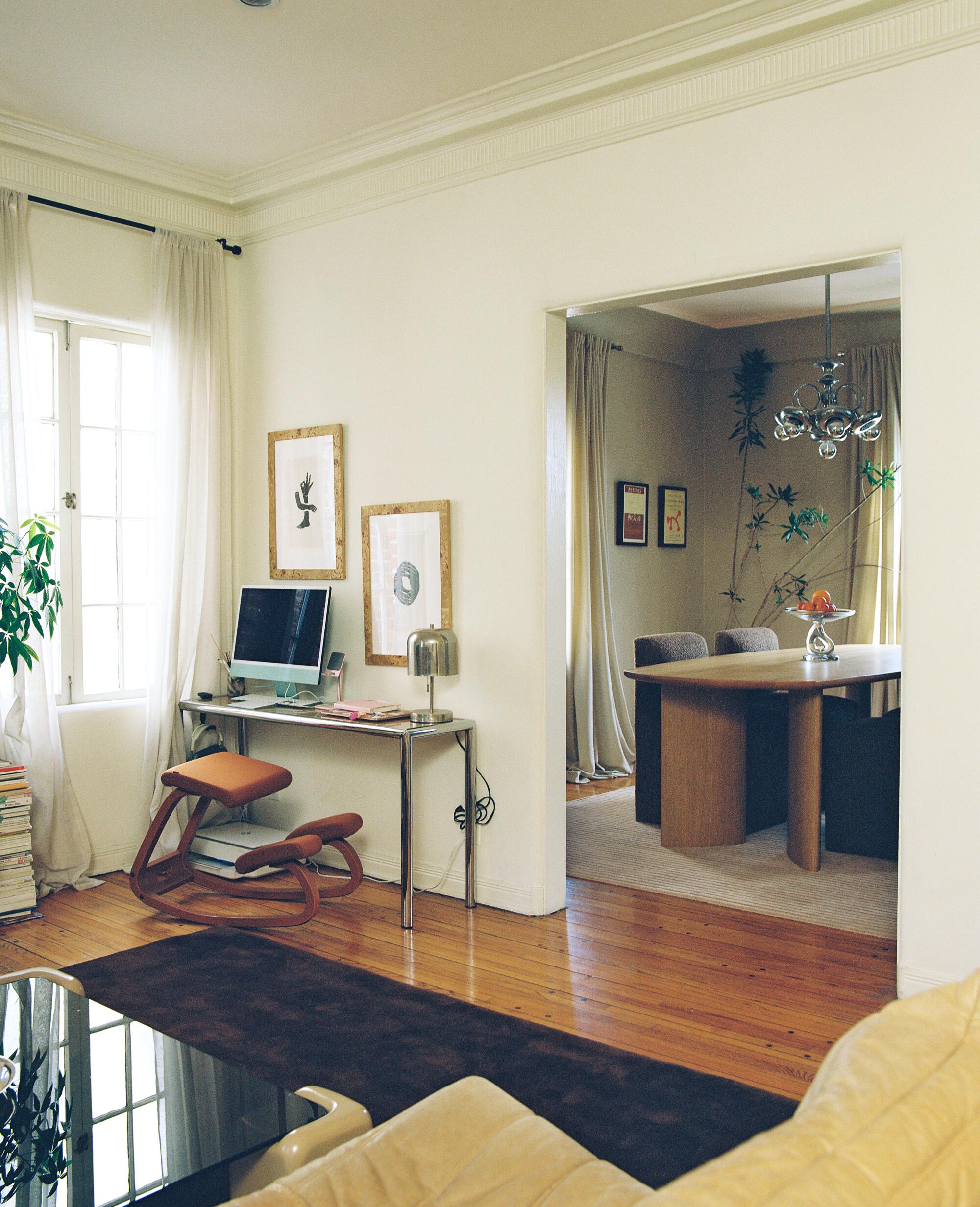
Alyssa Coscarelli’s Los Angeles home, painted with Backdrop colors.
Painting has almost become one of our love languages: part quality time, part acts of service. The house, we know, appreciates the physical touch.
I paint when I’m bored, when I’m excited, when I’m sad, when I’m anxious. I leave the tarps and paint trays out — perpetual invitations to explore. I’ve welcomed my husband home with a fresh wall of swatches; he’s surprised me by finishing walls I’d been forced to abandon during the workday. Painting has almost become one of our love languages: part quality time, part acts of service. The house, we know, appreciates the physical touch.
“I have a question,” a friend recently asked. “Do you think you’ll ever be done painting?” I considered it for a moment, but knew the answer was no. On the one hand, I’m fighting an unwinnable battle against awkward architecture armed only with pigmented latex, and stopping now would be surrender. But it’s not just this house — any house I live in would be one I needed to paint. Priming, painting, re-painting, I feel something shift and open. With every wall, every stroke of the roller, every roll of tape, the more I love my canvas. The more it feels like home.
Liz Raiss is a writer, editor and furniture enthusiast based in Los Angeles. She runs the (formerly anonymous) Instagram account @design.out.of.reach.




An underwater view shows US’ Lilly King competing in a heat of the women’s 200m breaststroke swimming event during the Paris 2024 Olympic Games at the Paris La Defense Arena in Nanterre, west of Paris, on July 31, 2024. (Photo by François-Xavier MARIT / AFP) (Photo by FRANCOIS-XAVIER MARIT/AFP via Getty Images)
François-Xavier Marit/Getty Images
hide caption
toggle caption
François-Xavier Marit/Getty Images
This week’s show was recorded in Bloomington, Indiana with host Peter Sagal, judge and scorekeeper Bill Kurtis, Not My Job guest Lilly King and panelists Alonzo Bodden, Josh Gondelman, and Faith Salie. Click the audio link above to hear the whole show.
Who’s Bill This Time
State of the Union is Hot; The Tribal Council Convenes Again; A Glow Up In the Doll Aisle
Panel Questions
The Toot Tracker
Bluff The Listener
Our panelists tell three stories about a travel hack in the news, only one of which is true.
Not My Job: Olympic Swimmer Lilly King answers our questions about Lil’ Kings
Olympic Swimmer Lilly King plays our game called, “Lilly King meet these Lil’ Kings” Three questions about short kings.
Panel Questions
Cleaning Out The Cabinet; Bedtime Stacking
Limericks
Bill Kurtis reads three news-related limericks: Getting Cozy With Cross Country Skiing; Pickleball’s New Competition; Bees Get Freaky
Lightning Fill In The Blank
All the news we couldn’t fit anywhere else
Predictions
Our panelists predict, after American Girls, what’ll be the next toy to get an update.

Law Roach
Zendaya and Tom’s Wedding Already Happened …
Y’all Missed It!!!
Published
Zendaya and Tom Holland are married … so claims her longtime stylist, Law Roach.
Here’s the deal … the celebrity stylist — who started styling Zendaya way back in 2011 — spoke to Access Hollywood on the Actors Awards red carpet where he sang out “The wedding has already happened, you missed it.”
Waiting for your permission to load the Instagram Media.
The AH reporter asks in shock if that’s true … and, Law responds by saying it’s “very true” before walking off.
This isn’t the first time Tom and Zendaya’s relationship status has made headlines on a red carpet … remember at the Golden Globes in 2025, Zendaya had a ring on that finger — and, the next day, we found out the two were engaged.

TMZ.com
Zendaya and Tom met on the set of “Spider-Man: Homecoming” in 2016, started dating a couple years later and went public with their relationship in 2021.
We’ve reached out to Tom and Zendaya’s teams … so far, no word back.

Online prediction market platforms allow people to place bets on wide-ranging subjects such as sports, finance, politics and currents events.
Photo Illustration by Scott Olson/Getty Images
hide caption
toggle caption
Photo Illustration by Scott Olson/Getty Images
The rise of prediction markets means you can now bet on just about anything, right from your phone. Apps like Kalshi and Polymarket have grown exponentially in President Trump’s second term, as his administration has rolled back regulations designed to keep the industry in check. Billions of dollars have flooded in, and users are placing bets on everything from whether it will rain in Seattle today to whether the US will take over control of Greenland. Who’s winning big on these apps? And who is losing? NPR correspondent Bobby Allyn joins The Sunday Story to explain how these markets came to be and where they are going.
This episode was produced by Andrew Mambo. It was edited by Liana Simstrom and Brett Neely. Fact-checking by Barclay Walsh and Susie Cummings. It was engineered by Robert Rodriguez.
We’d love to hear from you. Send us an email at TheSundayStory@npr.org.
Listen to Up First on Apple Podcasts and Spotify.

2026 NFL mock draft 6.0: Ohio State defenders rise after stellar combines; edge rushers dominate first round

Oklahoma Ford Sports Blitz: Mar. 1, 2026
Oregon Lottery Pick 4 results for March 1

Iran vows revenge after the killing of its top leader

Man allegedly kills man in R.I. before causing car crash that killed 2 in Mass.

Florida High School Football Rankings: Top 25 teams – Oct. 21

Cleary's 21 help Le Moyne down Central Connecticut State 69-64 in OT

How old is Bo Nix? What to know about Oregon quarterback ahead of 2024 NFL Draft

99th annual Pony Swim held in Virginia

Indiana Members Credit Union announced as new anchor tenant at Bottleworks District

House Republicans push Johnson to go to war with Senate over SAVE Act

Israel FM says Europe too divided, slams Spanish PM

Satellite images provide view inside Iran at war

Video: What the Texas Primary Battle Means for the Midterms

Dems’ potential 2028 hopefuls come out against US strikes on Iran
-

 World4 days ago
Exclusive: DeepSeek withholds latest AI model from US chipmakers including Nvidia, sources say
-

 Massachusetts4 days ago
Mother and daughter injured in Taunton house explosion
-

 Denver, CO4 days ago
10 acres charred, 5 injured in Thornton grass fire, evacuation orders lifted
-

 Louisiana7 days ago
Wildfire near Gum Swamp Road in Livingston Parish now under control; more than 200 acres burned
-

 Technology1 week ago
YouTube TV billing scam emails are hitting inboxes
-

 Politics1 week ago
OpenAI didn’t contact police despite employees flagging mass shooter’s concerning chatbot interactions: REPORT
-

 Technology1 week ago
Stellantis is in a crisis of its own making
-

 News1 week ago
World reacts as US top court limits Trump’s tariff powers