Lifestyle
'The Apprentice' director talks about the film Donald Trump doesn't want you to see


Jeremy Strong (left) as Roy Cohn and Sebastian Stan (right) as Donald Trump appear in Ali Abbasi’s film The Apprentice.
Pief Weyman/Briarcliff Entertainment
hide caption
toggle caption
Pief Weyman/Briarcliff Entertainment
At first glance, Ali Abbasi might seem like the least likely candidate to make a film about former President Donald Trump’s origin story.
The 43-year-old director was born in Tehran, lives in Denmark and has made films that deal with the supernatural (Border, 2018), horror (Shelley, 2016) and serial murder (Holy Spider, 2022). But that background also gives him a uniquely detached outlook on a deeply polarizing topic on the eve of November’s presidential election in which Trump is seeking another term.
“You’re so good with monsters and trolls… Do you want to make a movie about Donald Trump?” Abbasi recalls screenwriter Gabriel Sherman’s manager telling him in 2018. The Apprentice, out in theaters on Oct. 11, takes what Abbasi calls a “radically humanist angle.” The story focuses on Trump’s (Sebastian Stan) formative years as a New York real estate businessman under the tutelage of Roy Cohn (Jeremy Strong), his attorney and unlikely mentor.
YouTube
Trump at first seems like a plucky, somewhat naïve young man trying to please his father
Similarly, Trump’s mistreatment of a dying Cohn toward the end of the film elicits empathy for the one-time mafia fixer and “Red Scare” prosecutor. Abbasi also mined Trump’s relationships with his older brother Fred (Charlie Carrick) and with his first wife Ivana (Maria Bakalova).
Another character in the story is New York itself, portrayed in its ’70s and ’80s grime and grit glory with grainy, saturated documentary-like images.
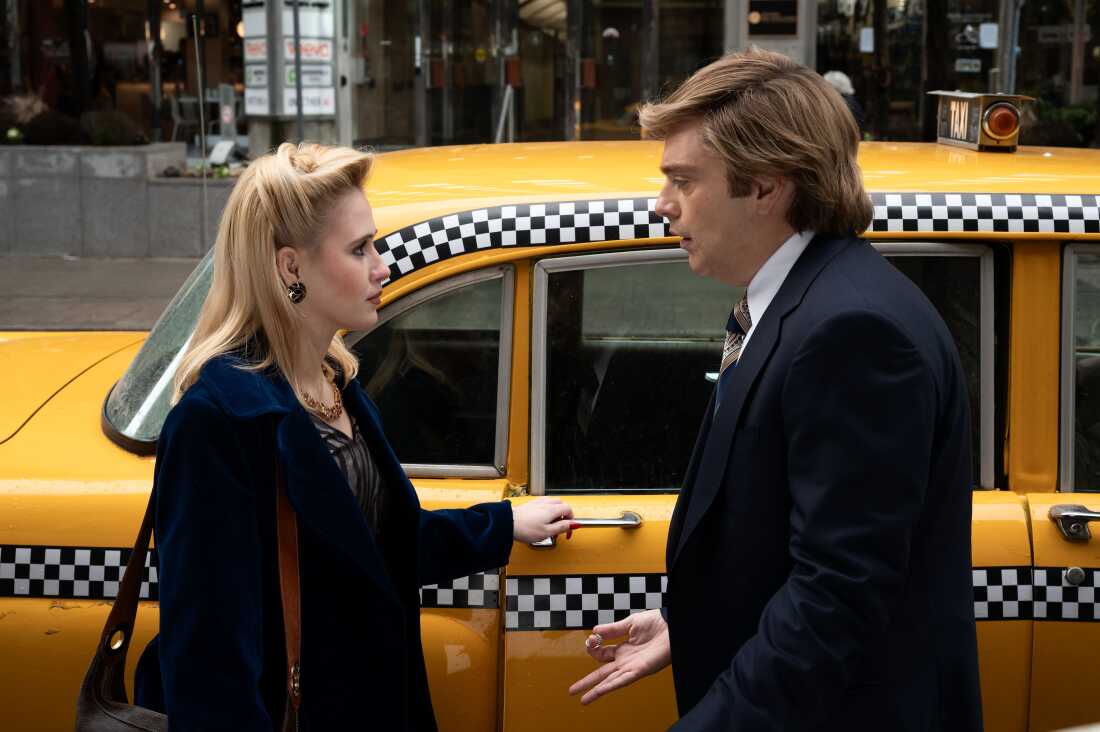
Maria Bakalova plays Ivana Trump in Ali Abbasi’s The Apprentice, opposite Sebastian Stan as Donald Trump.
Pief Weyman/Briarcliff Entertainment
hide caption
toggle caption
Pief Weyman/Briarcliff Entertainment
Cohn, who also appears as a maligned figure in Tony Kushner’s play Angels in America, “is not as well known as he should be,” Abbasi told NPR’s A Martínez. “He was famously a closeted gay, homophobic, anti-intellectual intellectual, some say a self-hating Jew, all these contradictory things… But he was also a very colorful, very interesting person and charming and had a room full of frog dolls.”
Cohn died of AIDS complications in 1986, but he insisted to the end that his disease was liver cancer. In the months leading to his death, the man who had rubbed shoulders with celebrities and political heavyweights was disbarred and sued by the IRS for $7 million in back taxes.

Director Ali Abbasi on the set of The Apprentice.
Pief Weyman/Briarcliff Entertainment
hide caption
toggle caption
Pief Weyman/Briarcliff Entertainment
Abbasi sees Cohn as an integral part of the genealogy of the American populist right, and particularly adept at creating his own truth via the media. In one scene, Cohn tells Trump: “There is no right and wrong. There is no morality. There is no truth with a capital T. It’s a construct. It’s a fiction. It’s manmade. None of it matters except winning.”
The director recalls a conversation he had with Sherman, the screenwriter, about how Trump’s rise in American politics has been portrayed in the past.
“I told him that there’s this thing I feel in America that our liberal friends, they think he’s a monster and he showed up and destroyed the health care, destroyed the infrastructure. That also implies that we’re innocent, that we good liberal people, we tried to stop him and failed,” Abbasi said. “But that’s not the case… We’re sort of saying, ‘Oh, you think he’s the other. Let’s watch him. Let’s watch us, from his perspective. Is he really the other? Is it that different? Really?’”
Humanist or not, Trump’s portrait is unflattering and the film has been mired in controversy from the beginning
The film depicts a scene of Trump allegedly raping Ivana. In her divorce deposition, the Czech-born entrepreneur and model said that Trump had raped her in 1989 after undergoing a painful scalp reduction to remove a bald spot. She later walked back that claim in a statement published in the Harry Hurt III biography Lost Tycoon: The Many Lives of Donald J. Trump (1993). In that statement, Ivana Trump said: “I referred to this as a ‘rape,’ but I do not want my words to be interpreted in a literal or criminal sense.” She died in 2022.

The Apprentice depicts Ivana (Maria Bakalova) and Donald Trump (Sebastian Stan) falling in and out of love.
Pief Weyman/Briarcliff Entertainment
hide caption
toggle caption
Pief Weyman/Briarcliff Entertainment
Trump’s team made legal threats to prevent The Apprentice from being screened in the U.S. “When when we were premiering [at the] Cannes Film Festival, they made a very conscious attempt to scare away all the distributors, sending us a cease and desist letter… They were really succeeding in burying us, up until very, very recently,” Abbasi said.
At the same time, he added, financing for the film “fell apart” several times because liberal figures in the Hollywood scene thought the film was “too sympathetic” of Trump.
“What’s crazy is the whole notion that this is a controversial movie because there’s nothing really controversial about this… you could write the script with info from Wikipedia,” Abbasi added. “For me, that’s the most controversial part is that corporate Hollywood thinks that we’re dangerous and out there.”
Abbasi speaks of his film as “an experience” that takes the viewer through the arc of Trump going from fledgling businessman to the politician he is today. Rather than examining the hyper-polarized nature of American politics, Abbasi is interested in the underlying structure that fosters this kind of polarization.
“If there is a bigger sort of message in the movie, for me, it’s that… the fundamental levers of power, they’re not as partisan,” he said.
“This sort of flexibility of ideology, I think that’s interesting, because then it means that someone like Mr. Trump, when the time arrives, becomes a Republican after being Democrat for 30 years. I think that is the way to look at this system and, sort of try to tear this two-party thing… apart and look at the sort of the naked structure of power.”
The broadcast version of this story was produced by Julie Depenbrock. The digital version was edited by Obed Manuel.

Lifestyle
The BoF Podcast | Decoding Paris Haute Couture: Wonder, Restraint and the Call of the Void


Lifestyle
L.A. Affairs: It’s hot when a man drives to me. But would this new guy make the trek from the Valley?
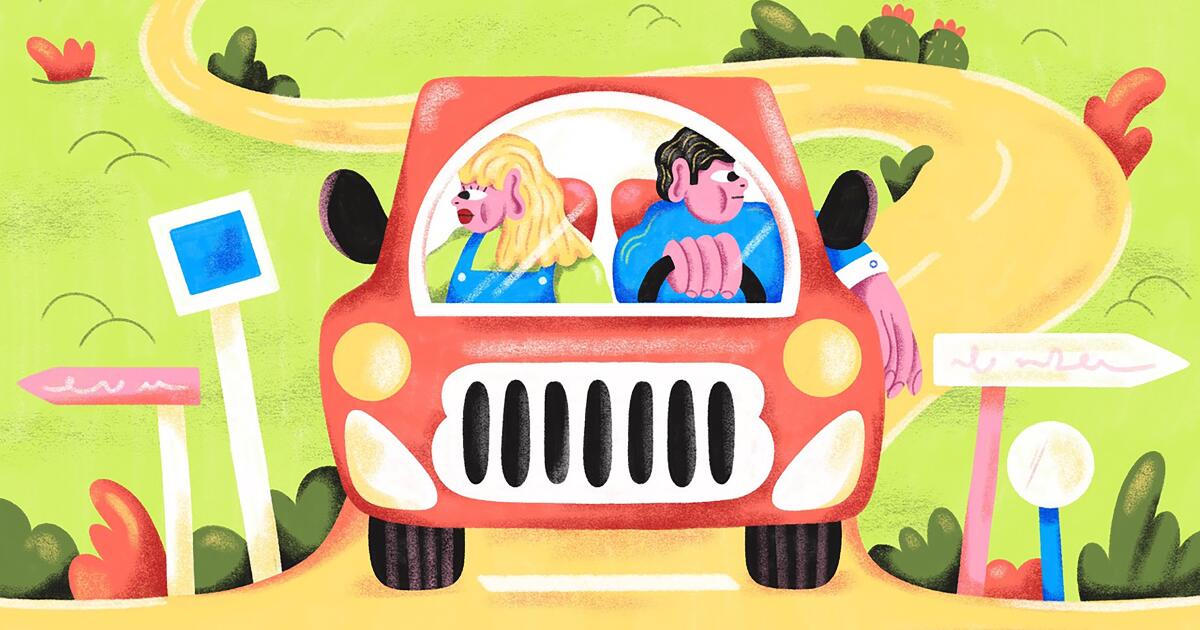
I met Dan on Hinge.
He lives in Woodland Hills, and I live in Venice. In Los Angeles, this is considered a long-distance relationship. In another city it might be nothing. Here, it’s a factor.
But I believe that with the right person, you can make anything work, so I stay open. I’m a native New Yorker, and if I were living in Brooklyn and a guy lived on the Upper West Side, that would be a 45-minute subway ride, which is truly nothing in New York. So with that same logic, I try to have flexibility with men in L.A.
When we started planning our first date, Dan suggested three options: a hike on mushrooms, a wine tasting or a walk on the beach.
A hike on mushrooms is something I’d only do with someone I already trust, not someone I just met online. I don’t do first-date hikes because I don’t like feeling trapped if the guy’s a dud. So I chose the wine tasting.
Then I learned the wine tasting was in West Hills.
On a Friday night, driving there from Venice would be insane. So I said I didn’t want to meet there because of the traffic. He suggested Malibu. That was also not ideal on a Friday.
I was getting annoyed — this was a pink flag because in my dating world, the guy is supposed to come to the woman’s neighborhood in the early days. I’ve gone out with plenty of men from the Valley who effortlessly suggested they come to me. It’s not rare or impossible.
I suggested he come to the Westside. I didn’t specifically say Venice, and in hindsight, I probably should have. He landed on Brentwood, which was manageable for both of us. On our first date, we met at an Irish pub on Wilshire Boulevard. He was cuter and more interesting than I had expected, and with the Guinness flowing, we had fun.
When I got home, he texted me: “Well, I like you 🙂 Less the tik tok and the lack of rock music in your life, but it’s not a deal breaker — there are other qualities 🙂 What are your thoughts?”
I noticed the slight negativity but was mostly dazzled that a man texted immediately after the date to say he liked me. In the modern dating economy, this felt rare.
The next day, both of our evening plans fell through, so we made a last-minute date. The wine tasting he originally suggested still sounded like fun, and although it meant me driving to the Valley, I was up for it now that we’d met.
We sipped flights at Malibu Wines & Beer Garden in its airy, romantic courtyard and played a flirty version of Truth or Dare. Halfway through, he dared me to kiss him.
We ended with sushi on Ventura Boulevard and a short make-out session in his car. He invited me to Thanksgiving at his uncle’s, which felt too soon, but also sweet.
After the second date, he texted and said he had his kids that week and was also hosting an event on Thursday, so his only day to meet was Wednesday. I said great.
On Tuesday night, he checked if we were still on, and I said yes.
Then he texted: “I’m flexible on time but not on location. I have a big event on Thursday, hopefully you can come to me again.”
My stomach tightened. This again?
So I texted back: “I drove to you last time, which was a bit of an exception for me especially in the early days, but the wine tasting location sounded special. Usually guys come to my area. How about we switch it up this time?”
He replied: “I appreciate the effort! Because of my event, I’d rather be close to a computer just if needed … Here is what i offer:
— I’ll come to your area anytime next week/end
— Lunch/dinner on me
I want to continue where we stopped last time 😉 No pressure of course, but let’s snuggle”
I responded: “Ok let’s meet next week. Snuggles sound nice … let’s see what happens …”
Then he wrote: “So I won’t see you tomorrow?”
I replied: “Unless you wanna come to me and bring your laptop along, let’s rain check until you have more flexibility.”
He said: “Dang, you are hard. I’ll let you know tomorrow around midday if it’s ok.”
And then — surprise — he decided to come.
He drove to Venice for a 5 p.m. date. He said his ETA was 5 p.m., and it ended up being 5:25 p.m., typical 405 Freeway.
When he showed up, he was in a cranky mood. On our way to KazuNori in Marina del Rey, I thanked him for picking me up and told him I think it’s hot when the guy comes to the girl.
“You’re just saying that because you want me to come to you more,” he said, not playfully, but aggressively.
That was basically the end for me. But there I was, in his car, heading to dinner. So I stayed pleasant and tried to make the best of it.
I shared that in the early stages of dating, I find it’s good etiquette for the guy to come to the woman’s neighborhood. He immediately disagreed and started ranting about how dating rules are ridiculous and how they swing in women’s favor. He resented paying for dates and declared he wasn’t looking to “sponsor a woman’s life.”
“If women want equality and equal rights,” he said, “then it should apply all across the board, including dating, and the man shouldn’t have to pay.”
I said women don’t actually have equal rights because we get paid less than men and often receive lower salaries than men in the same position.
I tried to change the subject and reset the mood, but he insisted we keep hashing it out.
I tried to explain masculine/feminine dynamics: providing and protecting, giving and receiving.
“What does the man get out of this arrangement?” he asked.
It was like watching someone’s personality warp into Mr. Hyde. Then he brought up another point: He’s a single dad of two kids, so he gets tired; and because I don’t have kids, that should factor into who drives where.
At this point, I was barely engaging and focused on eating my hand rolls, and I couldn’t wait to get home.
The check came, and I happily split it, wanting nothing further from him.
In the car back to my place, he remarked: “It’s obvious we’re never gonna see each other again.”
Obvious, but did it need to be stated?
Then he showed me a Spotify playlist he’d made for me of his favorite electronic music, because he knows I like EDM.
“Oh, that’s sweet,” I said.
“Yeah, that’s how I show interest. Through things like this, not who drives to who,” he replied.
When I got out of the car, we wished each other luck, and I headed inside and shut the door.
Two hours later, he sent me the playlist. I’ve yet to listen to it.
It wasn’t the distance that ruined it. It was the resentment. I’m not looking for a man who feels burdened by the effort. I’m looking for a man who sees the value of courting a woman in the first place.
The author is a writer, comedian and former psychologist who lives in Venice. She is the creator of the new vertical series “Manfari.” She’s on Instagram: @solange_neue and @manfari.show.
L.A. Affairs chronicles the search for romantic love in all its glorious expressions in the L.A. area, and we want to hear your true story. We pay $400 for a published essay. Email LAAffairs@latimes.com. You can find submission guidelines here. You can find past columns here.
-

 Technology6 minutes ago
No, Flock isn’t threatening people for debating surveillance
-

 World9 minutes ago
Israel signals readiness for another Iran strike as Trump declares ceasefire over
-

 Politics15 minutes ago
Kelley Paul: America’s Founders were the ‘first civil rights heroes’
-

 Health22 minutes ago
Your resting heart rate could reveal more about your health than you think, doctors say
-

 Sports24 minutes ago
Shohei Ohtani ruled out of MLB All-Star Game as Dodgers plan to manage nagging injury
-

 Technology36 minutes ago
Fake VA shoe offer targets veterans
-
 Business40 minutes ago
Los Angeles hotels saved by last-minute surge in World Cup bookings
-
 Entertainment45 minutes ago
Emily Ratajkowski’s viral essay on sex life as a single mom scores her a seven-figure book deal

