Lifestyle
T-Boy Wrestling is a sizzling showcase of trans masculinity — sweat, twerking and all

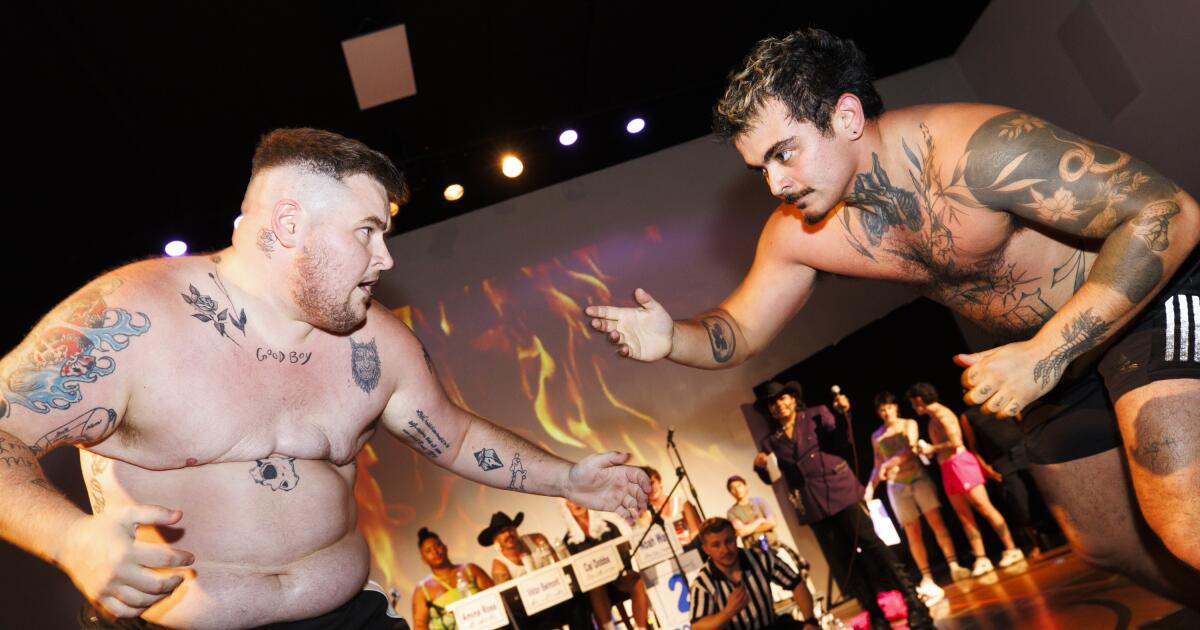
“Dale!” drag king Mauro Cuchi shouts into the mic. “Eso!” the crowd roars back. A spotlight shines on two glistening bodies facing off on the wrestling mat, each scantily clad and grappling to subdue the other in a takedown. But just as one manages to top the other, they start aggressively making out.
The packed crowd hollers. The ground shakes from stomping feet. Some audience members fan themselves from the sudden rise in temperature in the room.
Not your typical wrestling tournament, this is T-Boy Wrestling, an event featuring a lineup of more than 30 queer and trans people eager to show off their homo-athleticism in all its unadulterated absurdity and horniness. Hosted by social group Trans Dudes of LA, the event — one of the first of its kind in L.A. — sold over 500 seats inside the Silverlake Independent Jewish Community Center while an additional 500 viewers watch via live stream on Twitch.
On this night, the community center’s dimmed gymnasium is transformed into a makeshift fight ring lined with pink, blue and white trans pride flags and fiery flames projected onto the wall.
Mauro Cuchi, the announcer of the event, greets wrestlers.
“It’s awesome. It’s a little unhinged. I love it,” says James Nicolai, an audience member who arrived with a friend without either of them knowing any of the amateur wrestlers on the roster. “It’s just beautiful seeing all the different types of ways that you can be trans and nonbinary, and just be in a space we don’t have to hide who we are and we can be celebrated.”
Not every wrestler identifies as a man. Some have had top surgery, others haven’t. Some are on testosterone. Others have no intention of starting hormone replacement therapy. But at T-Boy Wrestling, all expressions of trans masculinity are welcome to tussle on the mat.
“White skinny trans dudes, it’s all you see when you look at the media,” says Adam Bandrowski, 24, who started Trans Dudes of LA a little over a year ago when he saw a dearth of representation. He and his co-organizer Mich Miller stand out in the crowd in their ironically formal black tuxedos with ties that spell out the acronym “TDLA.”
Their goal for T-Boy Wrestling has been to highlight an expansive idea of trans masculinity that includes people who are still figuring out their relationship to gender. “Come see what you identify with,” Bandrowski says. “If it helps you figure yourself out, we are happy.”
Trans men and trans masculine people are redefining masculinity
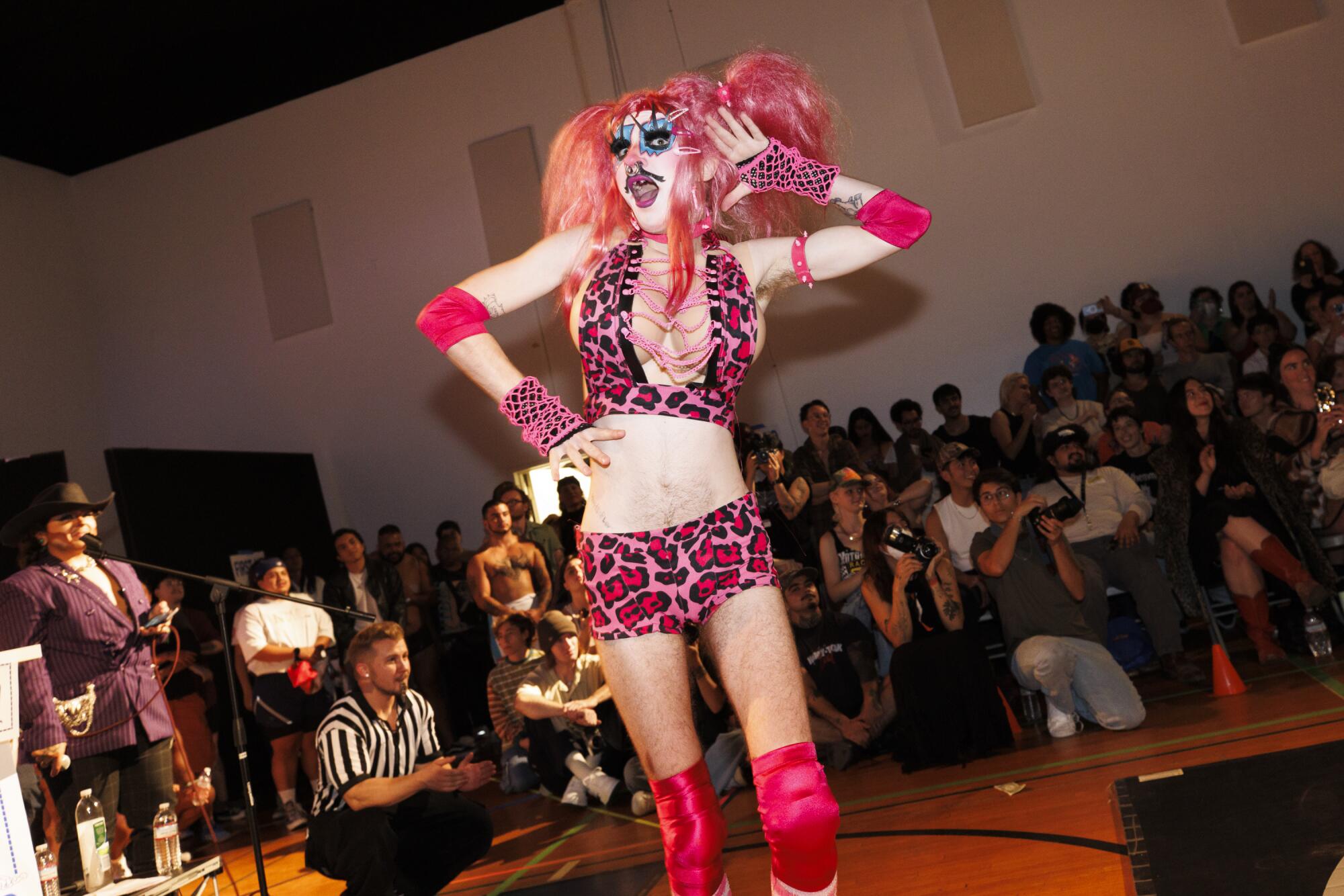
Frolic and Frot’s adult creator Piranha performs a drag show at the event.
In Los Angeles, one of the queerest cities in the United States, there are surprisingly few spaces where trans masculine individuals can find solidarity and community. For some, trying to fit into queer spaces after transitioning can be an isolating experience once they start to pass as men.
“In general, people can’t necessarily look at me and know that I’m trans,” says Devyn Payne, jumping rope outside to warm up ahead of his match. It’s now different for him to enter LGBTQ+ rooms where lesbians might read him as a straight man or gay men might not recognize him as trans.
“Passing as a Black man, my experience has been different in sapphic spaces … I don’t necessarily feel welcomed [anymore].”
The 27-year-old used to wrestle competitively in high school, but three years after coming out as trans he is now rediscovering his joy in the sport and reconnecting with the queer community in a different way — tonight by wrestling another trans man in a neon green jock strap under the alter ego “T-Payne.”
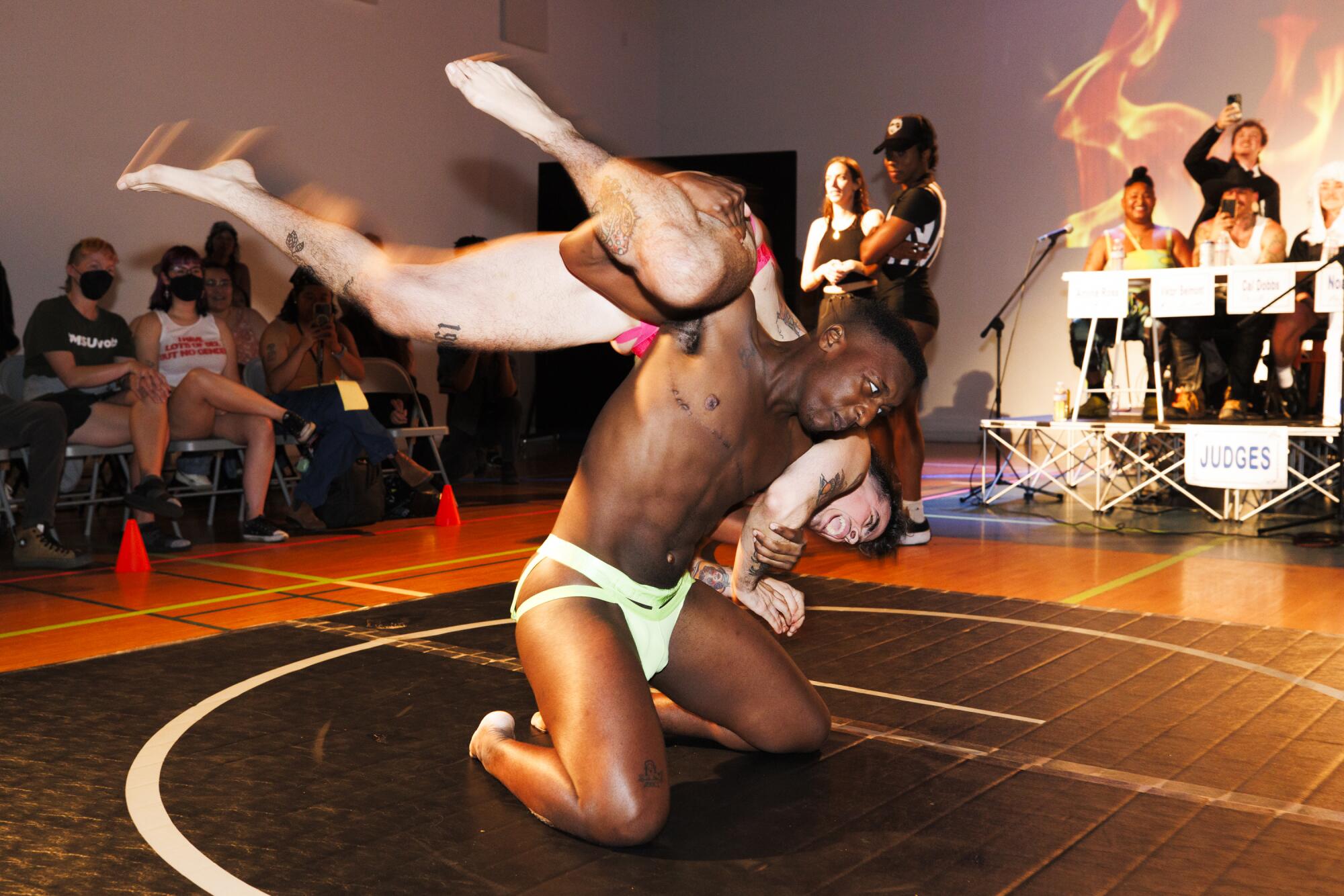
Wrestlers Devyn Payne “T Payne,” bottom, and Sara Ambra “Saralita” compete at the Trans Dudes of LA T-Boy Wrestling event.
“Before I went to my first Trans Dudes of LA event, I had no trans men friends,” Payne says. “I can’t necessarily relate to [cisgender men]. So it’s great to have people who I can talk about the changes of being on testosterone.”
Each match unfolds as a three-part act in one-minute rounds, with the goal of the pairs to dominate the other partner and force both of their shoulders onto the ground.
But every performance also brings unexpected campy theatrics: gratuitous twerking; a prosthetic leg became an improvisational weapon; a whipped cream pie was smashed against the face; a banana pulled out of boxers, peeled and eaten in front of an adulatory audience.
“Knuck if you Buck” blasts in the background as a pair of competitors straddle each other on the mat. The energy often shifts within seconds as wrestlers might cradle each other gently and then suddenly body slam their opponent. Referees whistle above the commotion, dramatically slapping the floor after a takedown.
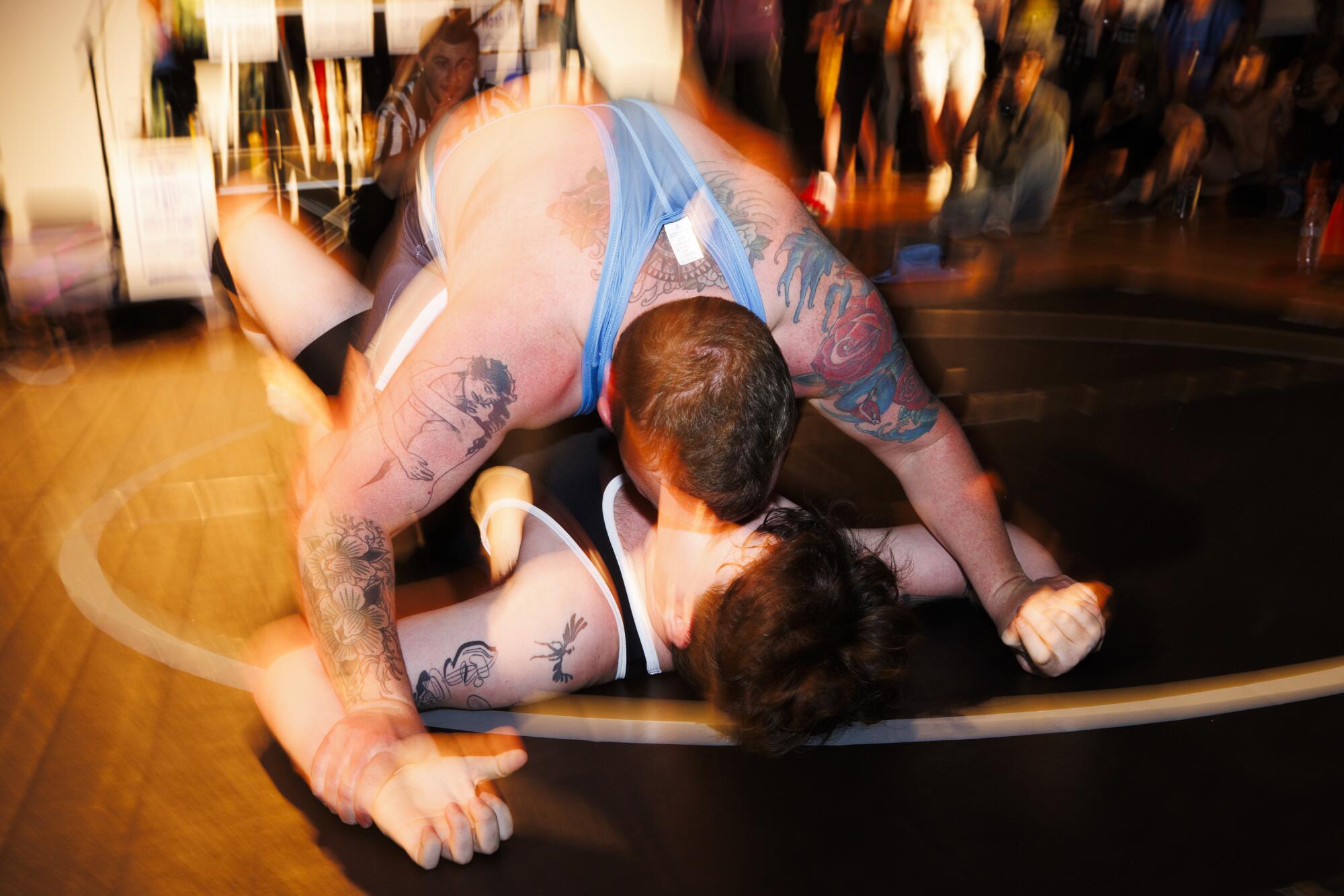
Landon St. James “Chaos King” takes down August Rain with a kiss pin at the Trans Dudes of LA “T Boy Wrestling” event.
The singularity of this type of event has drawn people from all over Southern California, even historically conservative South Orange County. Young adults Micah Slentz and Bonnie Miles of Aliso Viejo drove five hours just to see the wrestling.
“We didn’t think it was real in the first place,” says Miles, 19, whose black T-shirt was bleached to read “Slut Punk.”
Why were they so committed to attend despite their initial doubts? “I love trans boys,” says Slentz, 18, who had Facetimed his partner to dial them into watching the match. “I’m dating one.”
In this room full of transgender people, the weight of a gender binary disappears. Masculinity becomes play material, a performance to bend and break. People dressed for the part exude “Brokeback Mountain” homo-eroticism, another pair act out a construction worker role-play in a BDSM scene in which a plastic hammer is shoved in the mouth.
Cal Dobbs, dressed for the part as a judge for the tournament, wears a white wig reminiscent of the founding fathers and a thong under his black robes. (“RBG, classic sex symbol,” Dobbs explained of his costume inspiration from the late Supreme Court Justice.)
“Trans men and trans masculine people are redefining masculinity,” says the 27-year-old, who was the first trans person to run across the transcontinental United States. “[Wrestling] is a hyper masculine sport, [but the competitors] bring an element of humor and romance and cuteness to it that makes everyone feel really comfy and safe.”
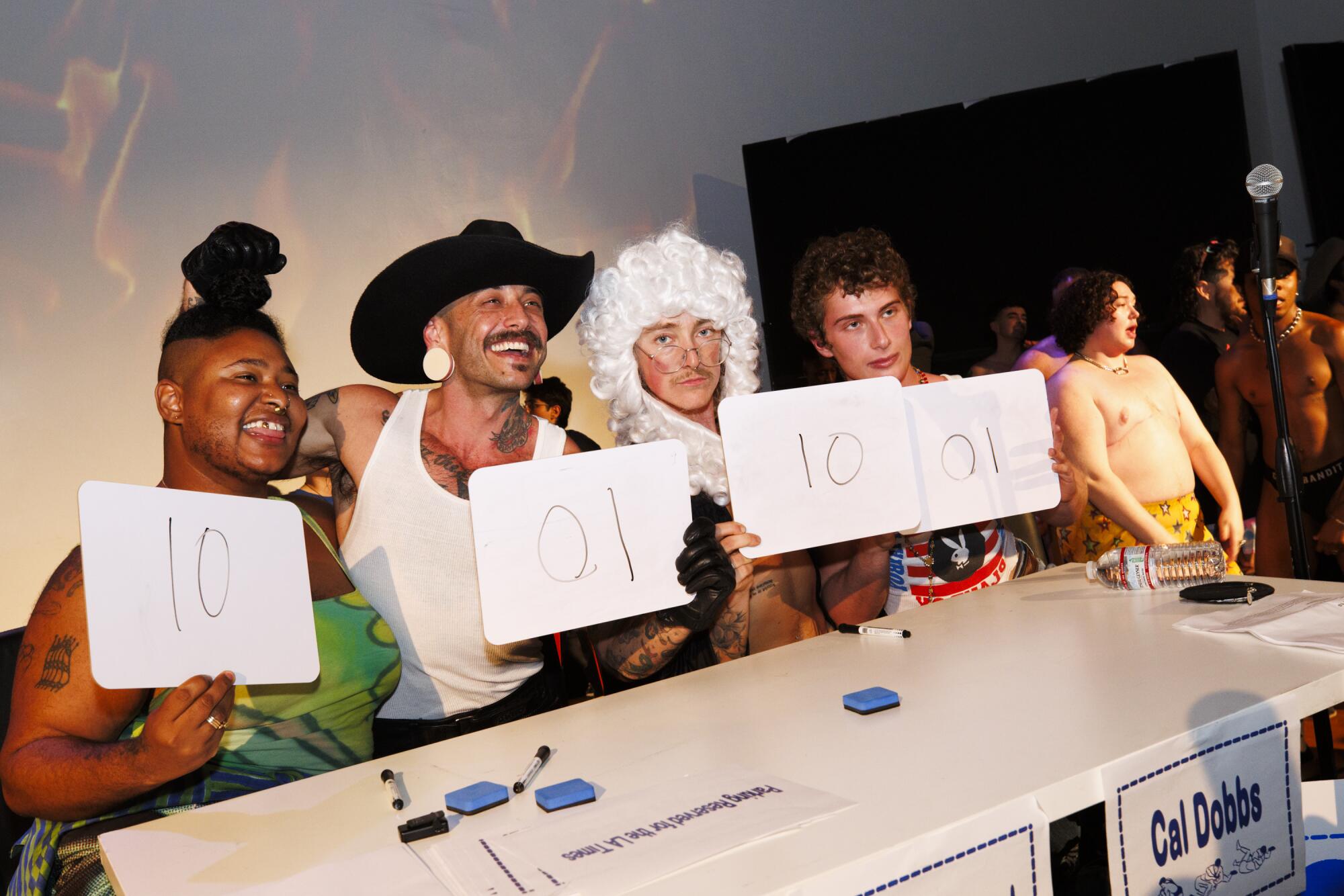
The judges panel present their scores at the Trans Dudes of LA T-Boy Wrestling event.
It isn’t lost on Dobbs that this moment of joy is also set against a backdrop of intense discrimination against the transgender community in a year when a record-breaking amount of legislation has been proposed to restrict access to gender-affirming care.
To Dobbs, trans joy and representation in a space like this can be a potent weapon against that hate. “[Republicans] are scared of us because we’re too sexy,” says Dobbs. “Scientifically, trans masculine and trans men have better butts than cisgender men … as professional judges, we’ve been looking at everyone’s butt.”
Preparation is important, but improvisation is key to winning
In the weeks leading up to the big performance, Elías Naranjo and Arón Sánchez-Vidal had practiced their wrestling routine weekly for a month, familiarizing themselves with consent and boundaries to make sure they wouldn’t hurt each other.
“I was asking them, ‘Is it OK if we kiss? Is it OK if I pick you up and grind on you?’
And he was like, ‘Yeah, I’m open to it,’ ” says Naranjo. But on the spot the two also decided to improvise as Sánchez-Vidal took his testosterone shot on the wrestling mat — a moment met with thunderous applause.
The two entered the ring waving Mexican and Peruvian flags dressed as vaqueros. “EL VAQUERO… STR8 4 PAY?” read a sign that Sánchez-Vidal’s girlfriend had made to cheer on her partner.
“There’s so much in being brown and trans and queer,” says Naranjo. “We want to show up and take up space … we’re Peruvian, hot and trans.” The two won best partners, splitting a $150 cash prize at the end of the tournament.
Inclusiveness was on the forefront of co-organizers Miller and Bandrowski’s minds as they planned this event. They prepped over 200 hot dogs to feed their hungry fans, a hot and heavy playlist to rally their attendees, and hired ASL interpreters to make the event accessible for deaf members of the queer community. This was their biggest event yet.
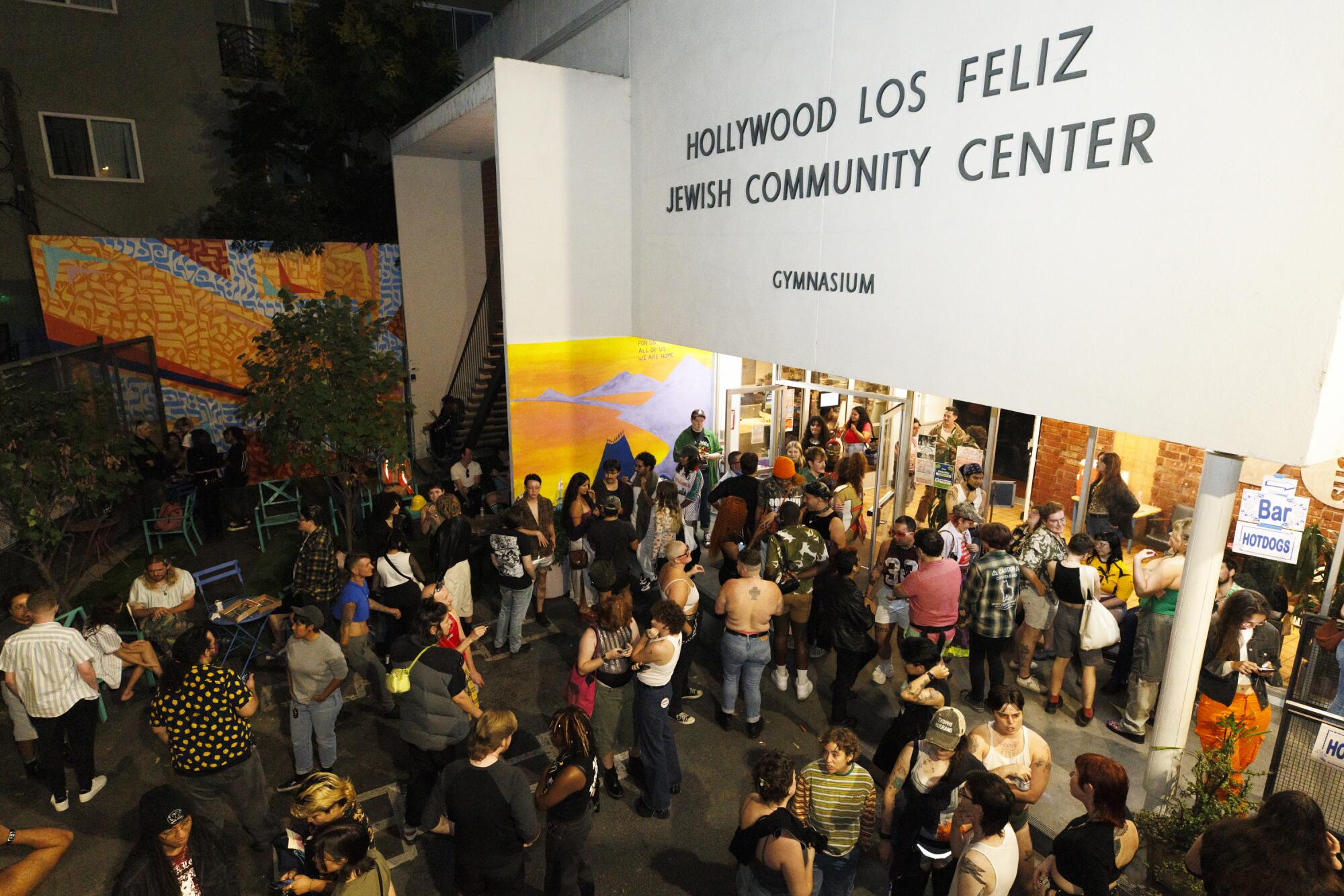
Attendees congregate outside in between rounds at the Trans Dudes of LA T-Boy Wrestling event at the Hollywood Los Feliz Jewish Community Center.
Miller, 31, who runs the Print Shop LA, a collaborative print-making studio, first heard of Trans Dudes of LA after seeing an event flier on Sunset Boulevard that Bandrowski had posted. Since then, their partnership has blossomed as Miller has at times offered space for events and Bandrowski, an illustrator, has designed event fliers.
“Our age difference plays really well into it,” says Miller of their and Bandrowski’s ability to draw both Gen Z and millennial queers to their events. “We’re both artists who have an affinity for the absurd and for goofy, healing each other through play.”
Bandrowski and Miller hope to replicate the success of their event when they reprise it in March 2025 and eventually take T-Boy Wrestling worldwide. They’re working on an independent LLC for Trans Dudes of LA and are open to sponsorships to fund more ambitious projects. But Miller says the goal is still to remain true to T-Boy Wrestling’s DIY and punk roots.
“We don’t need it to be super polished,” Miller says. “We want it to be kind of raw. We were never doing this to make money. It’s more about activating the money that we’re making to continue on doing cool stuff and pay ourselves so that we can keep doing it and pay other creators.”
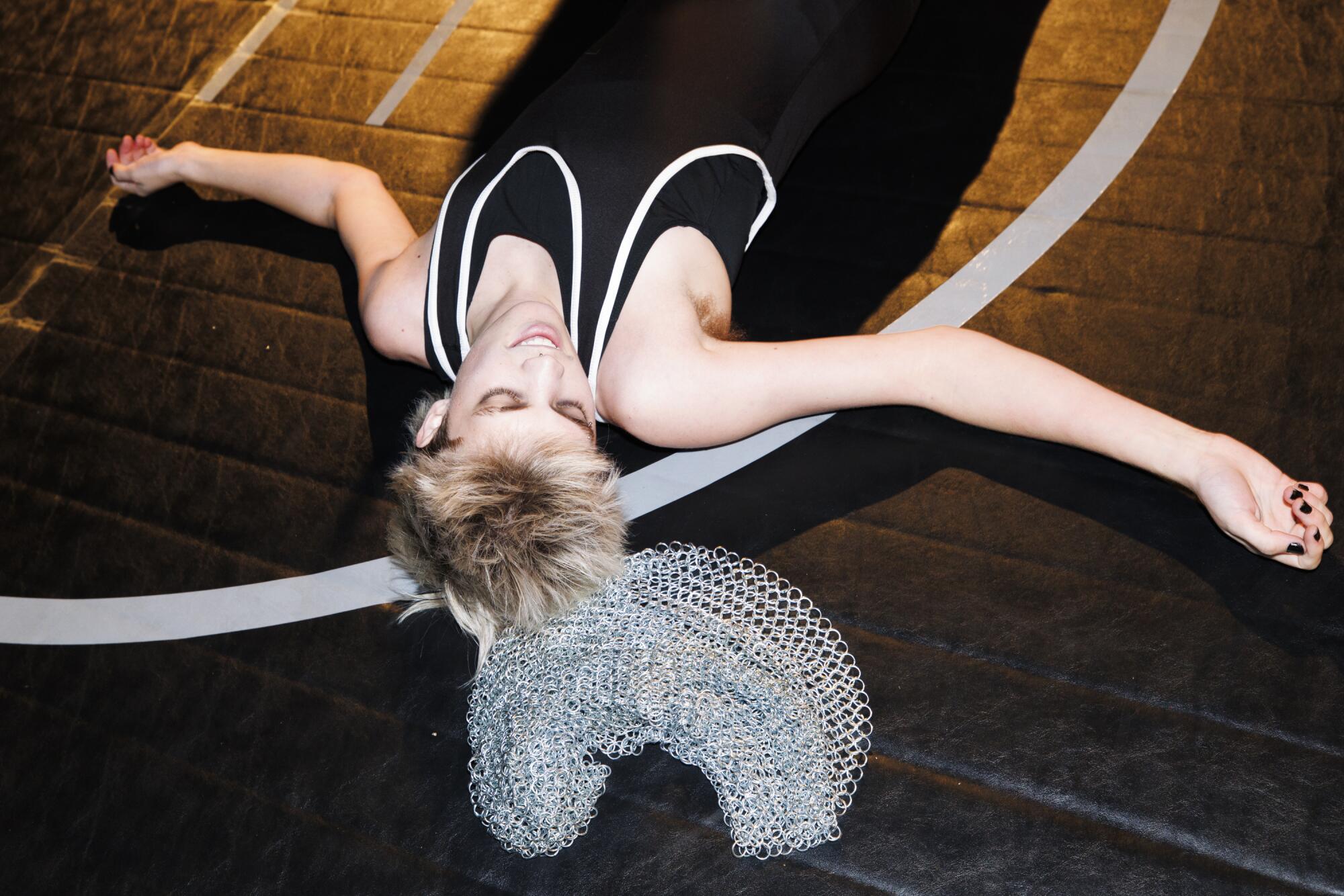
Eli Wenzell lies on the mat after competing.
As for the palpable T4T attraction on the mat? It’s real, Miller says. Beyond trans brotherhood, people are also finding romance at their events.
“Two of the wrestlers have gotten together,” says Miller. “And I’m sure there’s more we don’t even know about.”
At the end of the night, the mat has been wiped down of the bawdy affair. No matter who was pinned down and tossed, the event was a win for trans representation and joy.

Lifestyle
The BoF Podcast | Decoding Paris Haute Couture: Wonder, Restraint and the Call of the Void


Lifestyle
L.A. Affairs: It’s hot when a man drives to me. But would this new guy make the trek from the Valley?
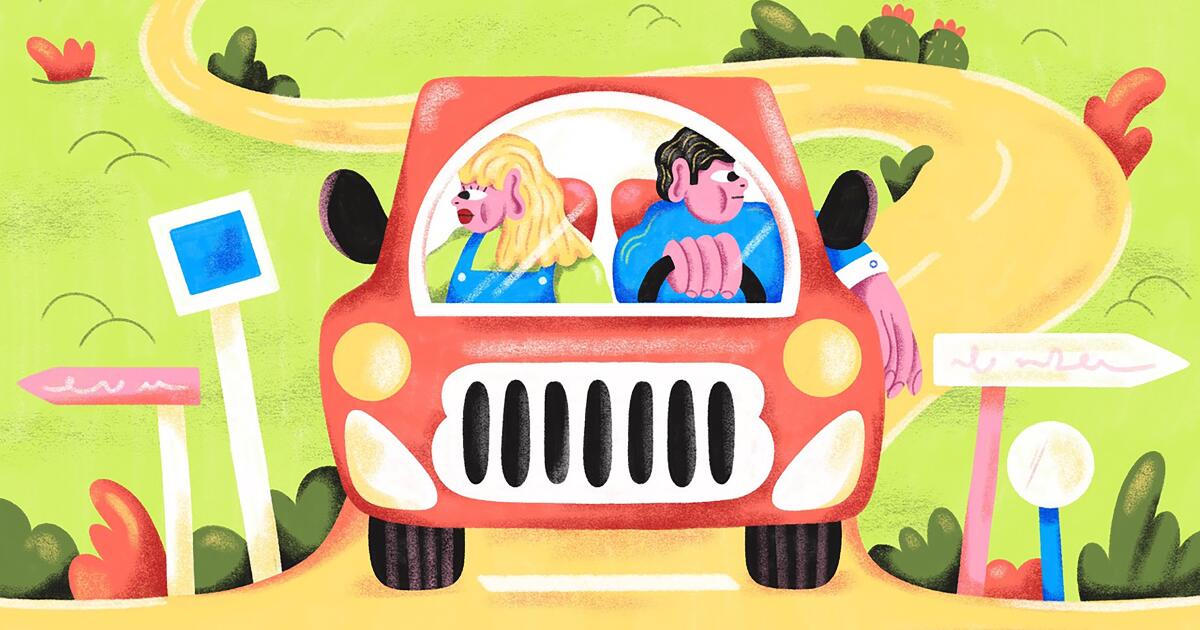
I met Dan on Hinge.
He lives in Woodland Hills, and I live in Venice. In Los Angeles, this is considered a long-distance relationship. In another city it might be nothing. Here, it’s a factor.
But I believe that with the right person, you can make anything work, so I stay open. I’m a native New Yorker, and if I were living in Brooklyn and a guy lived on the Upper West Side, that would be a 45-minute subway ride, which is truly nothing in New York. So with that same logic, I try to have flexibility with men in L.A.
When we started planning our first date, Dan suggested three options: a hike on mushrooms, a wine tasting or a walk on the beach.
A hike on mushrooms is something I’d only do with someone I already trust, not someone I just met online. I don’t do first-date hikes because I don’t like feeling trapped if the guy’s a dud. So I chose the wine tasting.
Then I learned the wine tasting was in West Hills.
On a Friday night, driving there from Venice would be insane. So I said I didn’t want to meet there because of the traffic. He suggested Malibu. That was also not ideal on a Friday.
I was getting annoyed — this was a pink flag because in my dating world, the guy is supposed to come to the woman’s neighborhood in the early days. I’ve gone out with plenty of men from the Valley who effortlessly suggested they come to me. It’s not rare or impossible.
I suggested he come to the Westside. I didn’t specifically say Venice, and in hindsight, I probably should have. He landed on Brentwood, which was manageable for both of us. On our first date, we met at an Irish pub on Wilshire Boulevard. He was cuter and more interesting than I had expected, and with the Guinness flowing, we had fun.
When I got home, he texted me: “Well, I like you 🙂 Less the tik tok and the lack of rock music in your life, but it’s not a deal breaker — there are other qualities 🙂 What are your thoughts?”
I noticed the slight negativity but was mostly dazzled that a man texted immediately after the date to say he liked me. In the modern dating economy, this felt rare.
The next day, both of our evening plans fell through, so we made a last-minute date. The wine tasting he originally suggested still sounded like fun, and although it meant me driving to the Valley, I was up for it now that we’d met.
We sipped flights at Malibu Wines & Beer Garden in its airy, romantic courtyard and played a flirty version of Truth or Dare. Halfway through, he dared me to kiss him.
We ended with sushi on Ventura Boulevard and a short make-out session in his car. He invited me to Thanksgiving at his uncle’s, which felt too soon, but also sweet.
After the second date, he texted and said he had his kids that week and was also hosting an event on Thursday, so his only day to meet was Wednesday. I said great.
On Tuesday night, he checked if we were still on, and I said yes.
Then he texted: “I’m flexible on time but not on location. I have a big event on Thursday, hopefully you can come to me again.”
My stomach tightened. This again?
So I texted back: “I drove to you last time, which was a bit of an exception for me especially in the early days, but the wine tasting location sounded special. Usually guys come to my area. How about we switch it up this time?”
He replied: “I appreciate the effort! Because of my event, I’d rather be close to a computer just if needed … Here is what i offer:
— I’ll come to your area anytime next week/end
— Lunch/dinner on me
I want to continue where we stopped last time 😉 No pressure of course, but let’s snuggle”
I responded: “Ok let’s meet next week. Snuggles sound nice … let’s see what happens …”
Then he wrote: “So I won’t see you tomorrow?”
I replied: “Unless you wanna come to me and bring your laptop along, let’s rain check until you have more flexibility.”
He said: “Dang, you are hard. I’ll let you know tomorrow around midday if it’s ok.”
And then — surprise — he decided to come.
He drove to Venice for a 5 p.m. date. He said his ETA was 5 p.m., and it ended up being 5:25 p.m., typical 405 Freeway.
When he showed up, he was in a cranky mood. On our way to KazuNori in Marina del Rey, I thanked him for picking me up and told him I think it’s hot when the guy comes to the girl.
“You’re just saying that because you want me to come to you more,” he said, not playfully, but aggressively.
That was basically the end for me. But there I was, in his car, heading to dinner. So I stayed pleasant and tried to make the best of it.
I shared that in the early stages of dating, I find it’s good etiquette for the guy to come to the woman’s neighborhood. He immediately disagreed and started ranting about how dating rules are ridiculous and how they swing in women’s favor. He resented paying for dates and declared he wasn’t looking to “sponsor a woman’s life.”
“If women want equality and equal rights,” he said, “then it should apply all across the board, including dating, and the man shouldn’t have to pay.”
I said women don’t actually have equal rights because we get paid less than men and often receive lower salaries than men in the same position.
I tried to change the subject and reset the mood, but he insisted we keep hashing it out.
I tried to explain masculine/feminine dynamics: providing and protecting, giving and receiving.
“What does the man get out of this arrangement?” he asked.
It was like watching someone’s personality warp into Mr. Hyde. Then he brought up another point: He’s a single dad of two kids, so he gets tired; and because I don’t have kids, that should factor into who drives where.
At this point, I was barely engaging and focused on eating my hand rolls, and I couldn’t wait to get home.
The check came, and I happily split it, wanting nothing further from him.
In the car back to my place, he remarked: “It’s obvious we’re never gonna see each other again.”
Obvious, but did it need to be stated?
Then he showed me a Spotify playlist he’d made for me of his favorite electronic music, because he knows I like EDM.
“Oh, that’s sweet,” I said.
“Yeah, that’s how I show interest. Through things like this, not who drives to who,” he replied.
When I got out of the car, we wished each other luck, and I headed inside and shut the door.
Two hours later, he sent me the playlist. I’ve yet to listen to it.
It wasn’t the distance that ruined it. It was the resentment. I’m not looking for a man who feels burdened by the effort. I’m looking for a man who sees the value of courting a woman in the first place.
The author is a writer, comedian and former psychologist who lives in Venice. She is the creator of the new vertical series “Manfari.” She’s on Instagram: @solange_neue and @manfari.show.
L.A. Affairs chronicles the search for romantic love in all its glorious expressions in the L.A. area, and we want to hear your true story. We pay $400 for a published essay. Email LAAffairs@latimes.com. You can find submission guidelines here. You can find past columns here.
-

 Technology6 minutes ago
No, Flock isn’t threatening people for debating surveillance
-

 World9 minutes ago
Israel signals readiness for another Iran strike as Trump declares ceasefire over
-

 Politics14 minutes ago
Kelley Paul: America’s Founders were the ‘first civil rights heroes’
-

 Health21 minutes ago
Your resting heart rate could reveal more about your health than you think, doctors say
-

 Sports24 minutes ago
Shohei Ohtani ruled out of MLB All-Star Game as Dodgers plan to manage nagging injury
-

 Technology36 minutes ago
Fake VA shoe offer targets veterans
-
 Business39 minutes ago
Los Angeles hotels saved by last-minute surge in World Cup bookings
-
 Entertainment44 minutes ago
Emily Ratajkowski’s viral essay on sex life as a single mom scores her a seven-figure book deal

