Lifestyle
'Splinters' is a tribute to the love of a mother for a daughter


When Leslie Jamison’s daughter was 13 months old, she and her husband, the baby’s father, C, separated.
Splinters: Another Kind of Love Story, the famed essayist’s newest book, follows this rupture — some of what preceded it but mostly what came after. The book has received plenty of advance buzz, much of which positions it as being about her relationship with C and their divorce, which I found puzzling; C is certainly a part of the book, but a small one, flitting in and out of view, never coming into full focus. His privacy is kept intact — Jamison mentions a child from his first marriage and acknowledges that she and C agreed she wouldn’t write about them — to the point where he presents as somewhat of a cypher. Which is to say that readers looking for a juicy narrative mired in the throes of marital drama will be disappointed. Those who take the book’s subtitle seriously, however, will find much to admire and enjoy in its pages, which are, more than anything else, a tribute to the rapturous love Jamison has for her daughter, as well as her attempts to love, or at least accept, the parts of herself that thrive in intensity and turmoil.
Jamison briefly narrates the whirlwind relationship she and C had, how he casually proposed to her while they were lying in bed in a garret in Paris. She’s aware, at least in hindsight, that she agreed to the marriage less because she wanted to commit to him, specifically, or to the life that the two of them as particular individuals could build. Instead, she admits: “I said yes, because I was in love with him, and because I wanted my whole self to want something, no questions asked.” When they married shortly thereafter in Las Vegas, she hoped she “could become a person who didn’t change [her] mind. That sounds ridiculous when you say it plainly, but who hasn’t yearned for it? Who hasn’t wanted a binding contract with the self?” This is the book’s second major thread — in addition to her daughter — the desire for consistency, and the stories the author tells herself or tries to fit herself into, in order to find it.
There is a circularity to Splinters; over and over again, in different variations of her signature, beautifully frank language, Jamison writes about her fantasy of stability and her uncertainty as to whether it’s a dream she actually wants fulfilled. Is it easier for her to simply want some kind of solidity? Is the yearning itself providing a steadiness all its own? The question becomes somewhat moot when her daughter is born; an infant and later a toddler’s need for their parent is nothing if not consistent, ongoing, and inescapable.
Other aspects of Jamison’s life don’t remain particularly steady. Over the course of the book, she begins to date again and becomes completely infatuated with a man with whom she knows she will never settle down since he’s not the settling type, a fact he makes clear early on. Later, once the intensity of this love affair is over, she begins dating someone who is in some ways the ideal of security, a man who works at a hedge fund and paints abstract art on the side. He also brings out Jamison’s painful self-minimizing tendencies; she wants to impress him, to be the kind of person he wants her to be, to gain and keep his approval. She recognizes this — but self-awareness alone is rarely enough to get most of us to change behaviors we’ve become uncomfortably comfortable with.
Throughout the book, Jamison brings in the work of other artists and writers that she admires, merging her creative and parental roles by bringing her infant daughter to museums with her, or by discovering how other parent-artists brought their own children into their artwork — or didn’t. There’s no waxing poetic over the way having a child brings so much more inspiration into one’s life, but there’s also no doom-and-gloom prophecies about a child bringing to an end one’s creative endeavors, a balance which I personally found especially pleasing as a writer and expecting parent myself. Elsewhere Jamison knows she has trouble dwelling in the gray areas, preferring the certainties of extremes, but in caring for her daughter, she finds — at least on the page — a way to live with it all, the sleeplessness and the joy, the rapture and the frustration, the immense love and the wish to have a single moment alone.
Splinters doesn’t provide a unifying revelation, and even though it’s relatively linear, Jamison doesn’t end up in a place that’s so different from where she started out. This can be easy to overlook, as she’s a master at closing nearly every paragraph with what lands as an epiphany: “There was a clarity to him — to his passion, and even to his anger — that felt clean and stark, like a rugged landscape with all the fog burned off” or “The moral of the story was: Forget about the story. Just take care of your daughter” or “I wasn’t sure anyone would root for me, if she wasn’t my friend or my mom. I wasn’t sure what narrative arc I was tracking, or what ending I deserved.”
But in truth, Jamison knows from the very start of the book what she struggles with, and what the grand challenge of her life has been, and might well continue to be: “To stop fetishizing the delusion of pure feeling, or a love unpolluted by damage. To commit to the compromised version instead.” It’s easier said than done, of course; but Splinters is a beautiful tribute to the continued failure as well as the worthy ongoing attempt.
Ilana Masad is a fiction writer, book critic, and author of the novel All My Mother’s Lovers.



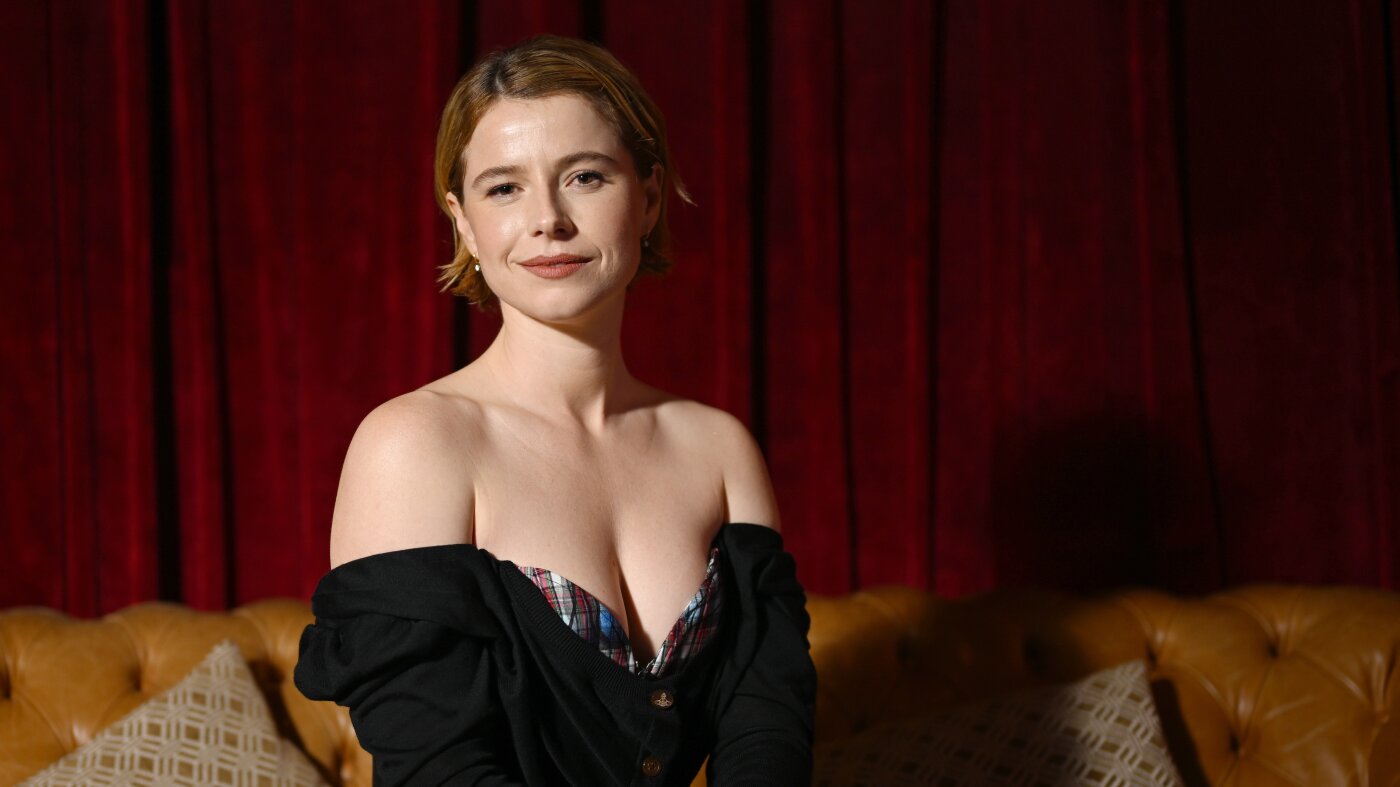
Jessie Buckley has been nominated for an Academy Award for best actress for her portrayal of William Shakespeare’s wife in Hamnet.
Kate Green/Getty Images
hide caption
toggle caption
Kate Green/Getty Images
Actor Jessie Buckley says she’s always been drawn to the “shadowy bits” of her characters — aspects that are disobedient, or “too much.” Perhaps that’s what led her to play Agnes, the wife of William Shakespeare, in Hamnet.
Buckley says the film, which is based on Maggie O’Farrell’s 2020 novel, offered a chance to counter a common narrative about the playwright’s wife: that she “had kept him back from his genius,” Buckley says.

But, she adds, “What Maggie O’Farrell so brilliantly did, not just with Agnes and Shakespeare’s wife, but also with Hamnet, their son, was to bring these people … and give them status beside this great man. … [And] give the full landscape of what it is to be a woman.”
The film is nominated for eight Academy Awards, including best actress for Buckley. In it, she plays a woman deeply connected to nature, who faces conflicts in her marriage, as well as the death of their son Hamnet.
Buckley found out she was pregnant a week after the film wrapped. She’s since given birth to her first child, a daughter.

“The thing that this story offered me, that brought me into this next chapter of my life as a mother was tenderness,” she says. “A mother’s tenderness is ferocious. To love, to birth is no joke. To be born is no joke. And the minute something’s born into the world, you’re always in the precipice of life and death. That’s our path. … I wanted to be a mother so much that that overrode the thought of being afraid of it.”

Jessie Buckley stars as Agnes and Joe Alwyn plays her brother Bartholomew in Hamnet.
Courtesy of Focus Features/Courtesy of Focus Features
hide caption
toggle caption
Courtesy of Focus Features/Courtesy of Focus Features
Interview highlights
On filming the scene where she howls in grief when her son dies
I didn’t know that that was going to happen or come out, it wasn’t in the script. I think really [director] Chloé [Zhao] asked all of us to dare to be as present as possible. Of course, leading up to it, you’re aware this scene is coming, but that scene doesn’t stand on its own. By the time I’d met that scene, I had developed such a deep bond with Jacobi Jupe, who plays Hamnet, and [co-stars] Paul [Mescal] and Emily Watson, and all the children and we really were a family. And Jacobi Jupe who plays Hamnet is such an incredible little actor and an incredible soul, and we really were a team. …

The death of a child is unfathomable. I don’t know where it begins and ends. Out of utter respect, I tried to touch an imaginary truth of it in our story as best I could, but there’s no way to define that kind of grief. I’m sure it’s different for so many people. And in that moment, all I had was my imagination but also this relationship that was right in front of me with this little boy and that’s what came out of that.
On what inspired her to pursue singing growing up
I grew up around a lot of music. My mom is a harpist and a singer and my dad has always been passionate about music, so it was always something in our house and always something that was encouraged. … Early on, I have very strong memories of seeing and hearing my mom sing in church and this quite intense mercurial conversation that would happen between her, the story and the people that would listen to her. And at the end of it, something had been cracked between them and these strangers would come up with tears in their eyes. And I guess I saw the power of storytelling through my mom’s singing at a very young age, and that was definitely something that made me think I want to do that.
On her first big break performing as a teen on the BBC singing competition I’d Do Anything — and being criticized by judges about her physical appearance
I was raw. I hadn’t trained. I had a lot to learn and to grow in. I was only 17. I think there was part of their criticism which I think was destructive and unfair when it became about my awkwardness, or they would say I was masculine and send me to kind of a femininity school. … They sent me to [the musical production of] Chicago to put heels on and a leotard and learn how to walk in high heels, which was pretty humiliating, to be honest, and I’m sad about that because I think I was discovering myself as a young woman in the world and wasn’t fully formed. … I was different. I was wild, I had a lot of feeling inside me. I could hardly keep my hands beside myself and I think to kind of criticize a body of a young woman at that time and to make her feel conscious of that was lazy and, I think, boring.
On filming parts of the 2026 film The Bride! while pregnant
I really loved working when I was pregnant. I thought it was a pretty wild experience, especially because I was playing Mary Shelley and I was talking about [this] monstrosity, and here I was with two heartbeats inside me. Becoming a mom and being pregnant did something, I think, for me. My experience of it, it’s so real that it really focuses [me to be] allergic to fake or to disconnection.
Since my daughter has come and I know what that connection is and the real feeling of being in a relationship with somebody … as an actress, it’s very exciting to recognize that in yourself and really take ownership of yourself.
I’m excited to go back and work on this other side of becoming a mother in so many ways, because I’ve shed 10 layers of skin by loving more and experiencing life in such a new way with my daughter. I’m also scared to work again because it’s hard to be a mother and to work. That’s like a constant tug because I love what I do and I’m passionate and I want to continue to grow and learn and fill those spaces that are yet to be filled — and also be a mother. And I think every mother can recognize that tug.
On the possibility of bringing her daughter to travel with her as she works
I haven’t filmed for nearly a year and I cannot wait. I’m hungry to create again. And my daughter will come with me. She’s seven months, so at the moment she can travel with us and it’s a beautiful life. And she meets all these amazing people and I have a feeling that she loves life and that’s a great thing to see in a child. And I hope that’s something that I’ve imparted to her in the short time that she’s been on this earth is that life is beautiful and great and complex and alive and there’s no part of you that needs to be less in your life. You might have to work it out, but it’s worth it.
Lauren Krenzel and Susan Nyakundi produced and edited this interview for broadcast. Bridget Bentz, Molly Seavy-Nesper and Beth Novey adapted it for the web.

Bruce Campbell
I’m Battling Cancer
Published
Bruce Campbell has revealed he has cancer, but says it’s a type that’s treatable, though not curable.
“The Evil Dead” actor shared the news Monday in a message to fans, writing, “Hi folks, these days, when someone is having a health issue, it’s referred to as an ‘opportunity,’ so let’s go with that — I’m having one of those.” He continued, “It’s also called a type of cancer that’s ‘treatable’ not ‘curable.’ I apologize if that’s a shock — it was to me too.”

Campbell said he wouldn’t go into further detail about his diagnosis, but explained his work schedule will be changing. “Appearances and cons and work in general need to take back seat to treatment,” he wrote, adding he plans to focus on getting “as well as I possibly can over the summer.”
As a result, Campbell says he has to cancel several convention appearances this summer, noting, “Treatment needs and professional obligations don’t always go hand-in-hand.”
He says his plan is to tour this fall in support of his new film, “Ernie & Emma,” which he stars in and directs.
Ending on a determined note, Campbell told fans, “I am a tough old son-of-a-bitch … and I expect to be around a while.”

Neve Campbell in Scream 7.
Paramount Pictures
hide caption
toggle caption
Paramount Pictures
The OG Scream Queen Neve Campbell returns. Scream 7 re-centers the franchise back on Sidney Prescott. She has a new life, a family, and lots of baggage. You know the drill: Someone dressing up as the masked slasher Ghostface comes for her, her family and friends. There’s lots of stabbing and murder and so many red herrings it’s practically a smorgasbord.
Follow Pop Culture Happy Hour on Letterboxd at letterboxd.com/nprpopculture

Newark-bound United flight returns to LA airport for evacuation after reported fire

New Mexico Livestock Board accused of abuse of power in rancher, inspector feud

North Carolina primary could mean Roy Cooper vs Michael Whatley in pivotal fall Senate race

Gas prices rise slightly in North Dakota amid Iran conflict

Woman dies after saving grandchild playing in driveway from out-of-control car, Ohio officials say

Florida High School Football Rankings: Top 25 teams – Oct. 21

Cleary's 21 help Le Moyne down Central Connecticut State 69-64 in OT

How old is Bo Nix? What to know about Oregon quarterback ahead of 2024 NFL Draft

99th annual Pony Swim held in Virginia

Indiana Members Credit Union announced as new anchor tenant at Bottleworks District

Trump sends official notification to Congress on strikes against Iran

Unexpected birth brings hope to near-extinct Amazon tribe

Supreme Court blocks redrawing of New York congressional map, dealing a win for GOP

Map: Earthquake Shakes Central California

Gas prices could jump as Middle East tensions threaten global oil supply
-

 World5 days ago
Exclusive: DeepSeek withholds latest AI model from US chipmakers including Nvidia, sources say
-

 Massachusetts6 days ago
Mother and daughter injured in Taunton house explosion
-

 Denver, CO5 days ago
10 acres charred, 5 injured in Thornton grass fire, evacuation orders lifted
-

 Louisiana1 week ago
Wildfire near Gum Swamp Road in Livingston Parish now under control; more than 200 acres burned
-

 Technology1 week ago
YouTube TV billing scam emails are hitting inboxes
-

 Politics1 week ago
OpenAI didn’t contact police despite employees flagging mass shooter’s concerning chatbot interactions: REPORT
-

 Technology1 week ago
Stellantis is in a crisis of its own making
-

 Oregon4 days ago
2026 OSAA Oregon Wrestling State Championship Results And Brackets – FloWrestling