Lifestyle
Opinion: Bob Newhart showed us the extraordinary in the ordinary

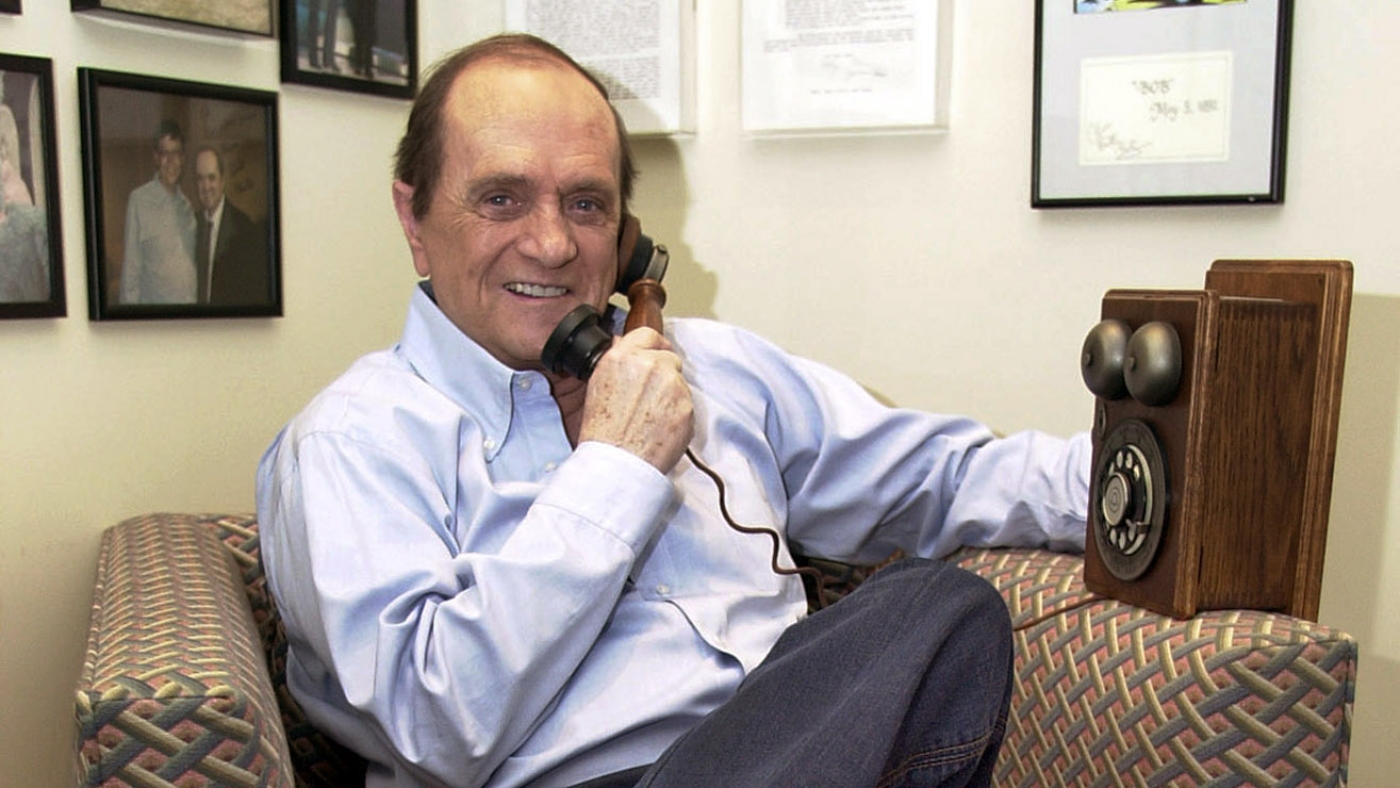
Comedian Bob Newhart pretends to speak on an antique telephone at his home in the Bel Air Estates community of Los Angeles, June 25, 2003.
Jerome T. Nakagawa/AP
hide caption
toggle caption
Jerome T. Nakagawa/AP
The life of Bob Newhart, who died this week at the age of 94, may remind us to see some of the glitter that can be cloaked in places that may seem like mere background.
He was working as an accountant in Chicago in the mid-1950’s, where, he used to insist, his motto was, “that’s close enough!” To relieve the tedium of cubicles and calculators, he and a friend began to concoct routines of telephone calls between historical figures.
When his friend left to take a job in New York, Newhart kept doing the phone bits, with just one side of the call.
Like say, Abraham Lincoln’s PR man telling the president, “The next time they bug you about Grant’s drinking, tell ‘em you’re gonna find out what brand he drinks and send a case of it to all your other generals … Trust me, Abe,” the PR man reassures a skeptical Lincoln. “It’s funny. Do it!”

Or the head of a 16th century British shipping company taking a call from Sir Walter Raleigh in the New World.
“Toe-bacco?” he asks “… Let me get this straight, now, Walt, you bought 80 tons of leaves? … You can chew it? Or put it in a pipe? Or … put it on a piece of paper, and roll it up … ”
The shipping exec has to stifle his laughter. And of course, we might now regret that there wasn’t more 16th century skepticism about rolling up tobacco leaves and smoking them.
Tapes of Newhart’s routines eventually made their way to a record company. The result was the 1960 comedy album, The Button-Down Mind of Bob Newhart. The former accountant won the 1961 Album of the Year Grammy over his fellow nominees Nat King Cole, Harry Belafonte and Frank Sinatra.
Newhart went on to have two hit sitcoms, in which he portrayed mild-seeming men, the first a Chicago psychologist, the second a Vermont innkeeper, trying to maneuver in a world of colorful characters. And of course there’s the role that introduced him to a new generation: Papa Elf in Elf.
In 2002, Newhart won the Mark Twain Prize for American Humor. On the stage of the Kennedy Center that night, he told a crowd in silk and sequins, “Standing here is a long way from the accounting department at the Glidden company.”

Lifestyle
John Cena wanted to step away from the WWE ring before he became ‘too slow for the show’ : Wild Card with Rachel Martin

A note from Wild Card host Rachel Martin: First a confession: I have never watched a WWE match in its entirety. Don’t get me wrong, I appreciate the athleticism and the performance, it’s just not my thing. But there is something about John Cena I’ve never been able to shake.
Yes, he is a wrestling legend, but he has built a career as an entertainer that transcends the ring. The first time I saw him lead a cast was the 2019 family movie “Playing with Fire” and his rapport with kids in that film didn’t seem like acting at all. The man contains multitudes!
He co-stars with Eric Andre in his newest film, “Little Brother.”

Xie Miao and Yang Enyou in The Furious.
Norachai Kajchapanont/Lionsgate
hide caption
toggle caption
Norachai Kajchapanont/Lionsgate
There have been some fantastic movies released this year, and we know you can’t see them all. So we’re recommending four recent movies we missed that you should add to your watchlist: The Furious, Tuner, She’s The He, and Heresy.
If you need a few more fun film recommendations, check out these episodes:
Fun movies you may have missed
Our favorite movies on Tubi
We debate the best movies to watch on an airplane
Connect with Pop Culture Happy Hour:
Letterboxd / Facebook
Our weekly newsletter
Support Pop Culture Happy Hour+

A tarp covers the facade of the John F. Kennedy Memorial Center for the Performing Arts in Washington, D.C., on June 13. A federal judge has asked the arts complex’s leadership to explain the purpose of the tarp and the surrounding scaffolding.
Alex Wroblewski/AFP via Getty Images
hide caption
toggle caption
Alex Wroblewski/AFP via Getty Images
On Wednesday, the federal judge overseeing the Kennedy Center lawsuit ordered the center to give him a status report on the center’s operation and programming within the next few weeks. Judge Christopher R. Cooper also said that the Kennedy Center must explain the purpose and status of the tarp and scaffolding that have been placed over the front of the arts complex, where until recently both President Trump and President John F. Kennedy’s names were both displayed.
In a directive issued last Tuesday, Judge Cooper had given Kennedy Center administrators three days to update him on the arts complex’s immediate plans regarding construction, programming and public access. Trump, who now serves as the center’s chairman, had announced July 5 as the date the venue would close for major renovations.

Last Friday, on Cooper’s due date, lawyers for the Kennedy Center filed a request asking for an extension. In that filing, Matt Floca, who was promoted as the center’s president and CEO in March, said that the Kennedy Center’s current management intends to present its board with “an array of options” for trustees to vote on at their next meeting on an unspecified date in mid-July.
According to Floca, the options are a complete closure for extensive renovations; a partial closure “enabling some continued public access and limited programming” while some renovations are undertaken; and “a highly limited series of phased closures to address only the center’s most serious infrastructure needs while scheduling and maintaining a full slate of programming.”
In his newest order, Cooper denied Floca’s request for an extension. And he mandated that the center file a status report within seven days of the center’s July board meeting or by July 31, whichever date is earliest. He also ruled that the report must “indicate the purpose for and status of the tarp and scaffolding,” which were erected by workers over the center’s front signage in the early morning hours of June 13.
When asked for comment Wednesday, the Kennedy Center pointed back to the documents its legal team submitted to the court.
The tarp and scaffolding on the center’s front portico went up after the Kennedy Center’s administration slow-walked the court-mandated removal of President Trump’s name from the front of the center and from all digital materials, which was supposed to happen no later than June 12. Workers removed the lettering overnight into the following morning, hours after the federal court’s original deadline, and covered the center’s sign with a tarpaulin.
As of Monday, the sign remains hidden from the public.

Trump’s name was scrubbed from all of the Kennedy Center’s digital content on June 4, the same day an email order to do so was issued by the complex’s legal team; NPR obtained this memo the day it was sent out to Kennedy Center staff.
These court orders are part of the ongoing lawsuit filed by Rep. Joyce Beatty, D-Ohio, against President Trump and the board of the Kennedy Center. Earlier this year, Cooper ruled that Beatty, an ex-officio member of the Kennedy Center board, must be allowed to participate in board meetings. NPR has asked Beatty if she plans to vote at the July board meeting, but did not receive an immediate response.
It would be very difficult for the Kennedy Center to revive a thriving programming lineup for the months ahead. Over the past year, many prominent artists canceled their planned appearances, citing the politicization of the venue. Most of the center’s programming staff have departed, either via layoffs or resignations. Unlike top administrators at other major performing arts venues around the country, Matt Floca has no experience in artistic direction, fundraising or arts administration; formerly, he was the center’s head of facilities, and he holds a bachelor’s degree in construction management.
Established artists who typically perform at the Kennedy Center generally have their touring schedules set at least a year in advance, if not multiple years ahead. In years past, the center has publicly announced its upcoming season in mid-spring for performances beginning in September and running through the following summer.

Currently, only a handful of outdoor free movie screenings of nostalgic favorites like The Princess Diaries and Clue appear on the center’s calendar of events, along with some participatory workshops for kids. In the past, the Kennedy Center presented over 2,000 arts and education events each year.
The center also recently became ensnarled in litigation with one of its longtime tenants and artistic partners. On June 12, the Washington National Opera, a company formerly in residence at the Kennedy Center, sued the complex for $17 million. It claims that the Kennedy Center had withheld “years’ worth of donor gifts, bequests and endowment funds” that had been intended specifically for the WNO.
-

 Oklahoma31 seconds ago
What Houston Does Better Than Oklahoma State and Why It Matters
-

 Oregon6 minutes ago
Marion County may join 6 other counties to control garbage, recycling
-

 Pennsylvania13 minutes ago
The Dish: Caesar salad with a twist from Rivertown Taps in Phoenixville, Pa.
-

 Rhode Island16 minutes ago
RI becomes first state to establish grocery self-checkout limits
-

 South-Carolina21 minutes ago
Spartanburg’s Riley Vaughn named Gatorade Girls Track and Field Player of Year in SC
-

 South Dakota28 minutes ago
South Dakota Supreme Court upholds Box Elder burglary, assault convictions
-

 Tennessee31 minutes ago
Middle Tennessee man facing 64-count indictment involving child sex crimes, police say
-

 Texas36 minutes ago
A Judge Issued a Rebuke to the Texas GOP’s Claims About the East Plano Islamic Center

