Lifestyle
OG Cannabis Cafe, L.A.'s first pub for pot people, blazes back after a 4-year hiatus

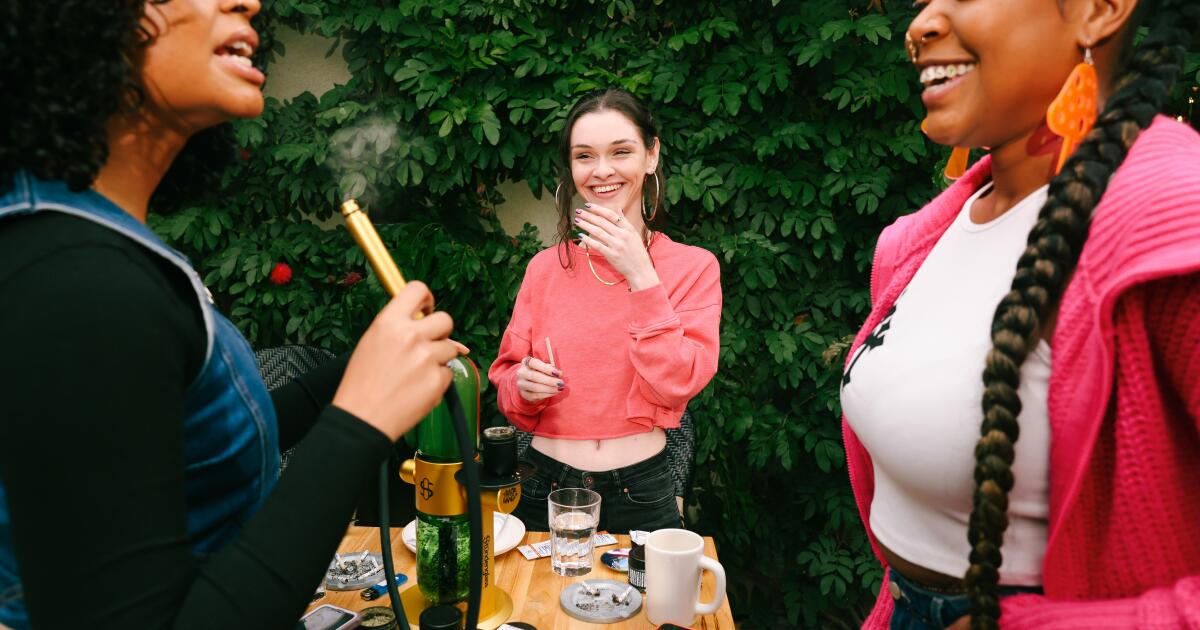
At first glance, the scene unfolding on a leafy, half-crowded patio in West Hollywood looks like any other gastropub on a Sunday afternoon. In one corner, a table of nine celebrates a milestone birthday around a vase filled with 21 delicate pink roses. In another, a table of five carries on three conversations at once while two propped up smartphones stream football games.
The occupants of a table for two in the middle of the patio whisper sweet nothings to each other and smile widely. Nearby, a party of one in a turquoise blue, flare-legged pantsuit contemplates how to tuck into a generous plate of waffles stacked with fried chicken and drizzled with syrup.
It’s with the second glance — or more likely the first deep inhale — that it all snaps into focus: when you realize that not far from the vase of roses, the birthday honoree is preparing to fire up a Stündenglass gravity bong, the football fans are passing around a dab rig shaped like Baby Yoda and the woman in the flare-legged pantsuit has a fork in one hand and a lighted joint in the other.
And they’re all busy consuming weed at OG Cannabis Cafe, the first place in the state where one could legally get high and chow down when it opened on Oct. 1, 2019, only to shutter 5½ months later because of the COVID-19 pandemic. Rumors of its re-opening had come and gone ever since, including a much-hyped re-brand by the owners of High Times magazine. Still, the doors remained closed.
Now, after nearly four years, OG Cannabis Cafe is back open for business.
However, the local consumption-lounge scene has changed dramatically in that time with the opening of three other places to publicly (and legally) puff pot open within 2½ miles of the cafe’s North La Brea Avenue location: the Artist Tree Studio Dispensary Lounge, the Woods and PleasureMed, which includes the restaurant-with-a-side-of-reefer Irie. (They’re all in West Hollywood, the only city in Greater Los Angeles that has legally licensed consumption lounges up and running.)
After recent visits, it was apparent that OG Cannabis Cafe has remained very much the way it was when it opened (and closed) its doors.
“To be honest, we haven’t changed anything — it’s exactly the same except for the cannabis menu and some small changes to the menu,” the original cafe’s co-founder, Sean Black, said about reopening in an environment where he’s no longer the only game in town. “I love the idea of there being different kinds of cannabis experiences. I haven’t yet been to Irie for the high-end dining experience but I’m excited to try it. And I love the Woods. I had such a good time there.”
When asked if he and his partners feel any pressure in the new environment, Black waved it off. “We believe that we have created here a cannabis tourist destination … and we feel an obligation to ensure that people who come from other areas of the world, who are cannabis enthusiasts, have their first public opportunity to consume cannabis and have a meal in [what we believe is] the very first place in the world that you could do that.”
Rosie Aguirre brought her own Grogu dab rig and cannabis concentrate to smoke.
Nayeli Hernandez, right, takes a bong rip on her 21st birthday.
Jackie Palatnikov, left, photographs friend Gal, while the two dine at the newly reopened OG Cannabis Cafe.
What hasn’t changed
The space is still configured so cannabis can legally be consumed inside the cafe (which seats 40) as well as on the patio (which has an 80-person capacity), while beer and wine (but not weed) can be ordered on another patio. A hearty bar-food menu — think Buffalo chicken wings, nachos, smashburgers, truffle Parmesan fries and the like — is available throughout.
Behind the pub-grub menu is a new chef, Jonah Johnson of Jonah’s Kitchen in Santa Monica, who replaced Andrea Drummer, who was at the helm the first time around.
Due to federal banking laws, any cannabis purchased on site needs to be paid for in cash (there is an ATM available), though credit cards are accepted for food and drink purchases. In one small but noticeable departure from the before times, the same server takes orders for both comestibles and combustibles instead of having separate servers for food and flower.
Frederick Marshall says he’s been stopping by the cafe “about five times a week” since it reopened.
What has changed
Speaking of weed (that’s why you’re here, right?), the herbal offerings are probably the biggest switch-up for this incarnation of the cafe.
The cannabis menu features just three brands, two of which have yet to launch into dispensaries. On offer are infused pre-rolled joints and ground flower from flavor-forward, colorfully packaged Dizzies ($25 to $60, the only brand available elsewhere); pre-rolls and flower from indoor-grown Wav ($45 to $100); and greenhouse-grown (and incredibly fragrant) Helena Farms, available in loose flower or pre-roll form (ranging from $20 for 3.5 grams of flower up to $120 for a 1-ounce pack of 70 joints — a crowd-pleasing party-starter if ever there was one).
Among the offerings on the cannabis menu is a 1-ounce box of 70 pre-rolled joints from soon-to-launch, L.A.-based brand Helena Farms.
All three of the brands are owned by L.A.-based Elevate Holdings, for which Black happens to be a partner and serves as the chief creative officer. (He’s also one of 11 partners involved in OG Cannabis Cafe 2.0.) “They lent us the money to reopen the cafe,” Black said of Elevate Holdings, noting that exclusively featuring one company’s herbal offerings leans into the original purpose of his restaurant-meets-weed concept.
“I founded Lowell Herb Co. in 2011,” he said, “and we first opened this as the Lowell Cafe.” Black said the original vision was to feature Lowell’s products on the smokable side of the menu as a marketing play. That all changed when he and Lowell parted ways just months after the doors opened in 2019.
“So [now,] it’s actually fulfilling its original purpose — promoting cannabis,” Black said, “in addition to being a fun little outdoor cafe where you can get high instead of getting drunk. That’s the whole premise. It’s pretty simple.”
The indoor area at the cafe also serves food and cannabis and seats about 40 people.
A pub for pot people
Black isn’t the only one making the alternative-to-alcohol, pub-for-pot-people comparison either. A Sunday visit in mid-January found Montana Alexander, 25, ready to smoke up with a table full of friends. She had made the trek from Santa Clarita after discovering the cafe on Instagram. “This place is literally a dream,” Alexander said between puffs, “because I don’t drink, so when my friends go to bars I’m like, ‘So lame.’”
Alexander’s sentiment was echoed by Nayeli Hernandez of Porter Ranch, the aforementioned birthday girl. “I don’t really drink,” she told The Times. “So from the time I turned 20, I was thinking about doing this,” she said. Hernandez’s mother, sitting next to her at the head of the table, chimed in.
“I was down for it,” said Christina Hernandez of her daughter’s request. “This is what they do now.”
Miguel Aguirre fires up a Wav Purple Zushi pre-rolled joint while watching a football game.
A neon sign bearing the logo of the OG Cannabis Cafe lights up a back wall.
Act Up India, left, and DJ Tricey Trice “shotgun” a hit on the leafy green outdoor patio.
Coming soon: comedy night, queer night and marijuana meditation
Although the cafe quietly re-opened to patrons in late October, things are set to kick into high gear this month, starting with a big watch party for the big football game on Feb. 11 (smoke a bowl for the … well, you get the picture) hosted by former mixed martial arts fighter Nick Diaz.
“The week of the Super Bowl is going to be packed,” Dejanae Evins, the cafe’s experiential marketing and events manager, told The Times. “On the 13th, we’ll be starting our [every-other-Tuesday] queer wine night called Verse, which will be co-hosted by Ashlee Belzo[of cannabis collective] Puff Dao on our wine patio, where people can enjoy a glass of wine, small bites and a DJ. And then, if they want to end their night with a joint and a sundae on the other side, they can do that.”
In addition, Evins said there will be weekly comedy nights from 7:30 to 10 p.m. Wednesdays (next week, it’s bumped to Thursday because of Valentine’s Day). Also beginning Feb. 13, there will be morning meditations (think sound baths and guided meditation) on the second and fourth Tuesday mornings of each month. “People will be able to come in,” Evins said, “really start their day on a high note and then move into doing something productive, whether that’s co-working or meeting friends for lunch. It’s our way of staying connected to the wellness community.
“We also have some really big plans for 420,” Evins said of the annual April 20 celebration of all things cannabis that’s less than three months away. “So definitely stay tuned for that.”
Cannabis Cafe
1201 N. La Brea Ave.
West Hollywood
Noon to 10 p.m. Tuesday through Friday, 10 a.m. to 10 p.m. Saturday and Sunday
cannabis.cafe
Know before you go
- You must be 21 or older to enter the cannabis-consuming side of the cafe, and a valid, government-issued ID is required.
- Unlike the other local consumption lounges, you can bring your own cannabis (or cannabis extracts) to smoke here — for a “tokage” fee, which is currently $25 for table of three or fewer and $50 for tables of four or more.
- Also unlike other local consumption lounges, the cafe doesn’t operate alongside a traditional dispensary, which means you can’t just pop in, buy a bag and bounce. But you can consume a little and then cut out, Black says.
- Rolling papers, grinders, lighters and rolling trays are provided, and you may also bring your own pipe or glass. Bongs and pipes may be purchased on-site, and Stündenglass gravity bongs can be rented for $50.
- On-site valet parking is available for $10 (for your designated driver). Remember: When you’re high, you shouldn’t operate anything larger than a soup spoon much less a vehicle of any kind.
- Walk-ins are accepted on a space-available basis, but reservations are encouraged and may be made via OpenTable.
- Although the establishment serves cannabis and food, it does not serve cannabis-infused food.




An underwater view shows US’ Lilly King competing in a heat of the women’s 200m breaststroke swimming event during the Paris 2024 Olympic Games at the Paris La Defense Arena in Nanterre, west of Paris, on July 31, 2024. (Photo by François-Xavier MARIT / AFP) (Photo by FRANCOIS-XAVIER MARIT/AFP via Getty Images)
François-Xavier Marit/Getty Images
hide caption
toggle caption
François-Xavier Marit/Getty Images
This week’s show was recorded in Bloomington, Indiana with host Peter Sagal, judge and scorekeeper Bill Kurtis, Not My Job guest Lilly King and panelists Alonzo Bodden, Josh Gondelman, and Faith Salie. Click the audio link above to hear the whole show.
Who’s Bill This Time
State of the Union is Hot; The Tribal Council Convenes Again; A Glow Up In the Doll Aisle
Panel Questions
The Toot Tracker
Bluff The Listener
Our panelists tell three stories about a travel hack in the news, only one of which is true.
Not My Job: Olympic Swimmer Lilly King answers our questions about Lil’ Kings
Olympic Swimmer Lilly King plays our game called, “Lilly King meet these Lil’ Kings” Three questions about short kings.
Panel Questions
Cleaning Out The Cabinet; Bedtime Stacking
Limericks
Bill Kurtis reads three news-related limericks: Getting Cozy With Cross Country Skiing; Pickleball’s New Competition; Bees Get Freaky
Lightning Fill In The Blank
All the news we couldn’t fit anywhere else
Predictions
Our panelists predict, after American Girls, what’ll be the next toy to get an update.

Law Roach
Zendaya and Tom’s Wedding Already Happened …
Y’all Missed It!!!
Published
Zendaya and Tom Holland are married … so claims her longtime stylist, Law Roach.
Here’s the deal … the celebrity stylist — who started styling Zendaya way back in 2011 — spoke to Access Hollywood on the Actors Awards red carpet where he sang out “The wedding has already happened, you missed it.”
Waiting for your permission to load the Instagram Media.
The AH reporter asks in shock if that’s true … and, Law responds by saying it’s “very true” before walking off.
This isn’t the first time Tom and Zendaya’s relationship status has made headlines on a red carpet … remember at the Golden Globes in 2025, Zendaya had a ring on that finger — and, the next day, we found out the two were engaged.

TMZ.com
Zendaya and Tom met on the set of “Spider-Man: Homecoming” in 2016, started dating a couple years later and went public with their relationship in 2021.
We’ve reached out to Tom and Zendaya’s teams … so far, no word back.

Online prediction market platforms allow people to place bets on wide-ranging subjects such as sports, finance, politics and currents events.
Photo Illustration by Scott Olson/Getty Images
hide caption
toggle caption
Photo Illustration by Scott Olson/Getty Images
The rise of prediction markets means you can now bet on just about anything, right from your phone. Apps like Kalshi and Polymarket have grown exponentially in President Trump’s second term, as his administration has rolled back regulations designed to keep the industry in check. Billions of dollars have flooded in, and users are placing bets on everything from whether it will rain in Seattle today to whether the US will take over control of Greenland. Who’s winning big on these apps? And who is losing? NPR correspondent Bobby Allyn joins The Sunday Story to explain how these markets came to be and where they are going.
This episode was produced by Andrew Mambo. It was edited by Liana Simstrom and Brett Neely. Fact-checking by Barclay Walsh and Susie Cummings. It was engineered by Robert Rodriguez.
We’d love to hear from you. Send us an email at TheSundayStory@npr.org.
Listen to Up First on Apple Podcasts and Spotify.
‘Wait Wait’ for February 28. 2026: Live in Bloomington with Lilly King!

This Windows gaming handheld has a screen that folds in half

Tel Aviv analyst shelters from 30 missile sirens in 48 hours, says Iran ‘won’t recover’

House Republicans push Johnson to go to war with Senate over SAVE Act

Diabetes surge among Americans could be driven by ‘healthy’ breakfasts, doctor warns

Florida High School Football Rankings: Top 25 teams – Oct. 21

Cleary's 21 help Le Moyne down Central Connecticut State 69-64 in OT

How old is Bo Nix? What to know about Oregon quarterback ahead of 2024 NFL Draft

99th annual Pony Swim held in Virginia

Indiana Members Credit Union announced as new anchor tenant at Bottleworks District
House Republicans push Johnson to go to war with Senate over SAVE Act

Israel FM says Europe too divided, slams Spanish PM

Satellite images provide view inside Iran at war

Video: What the Texas Primary Battle Means for the Midterms

Dems’ potential 2028 hopefuls come out against US strikes on Iran
-

 World4 days ago
Exclusive: DeepSeek withholds latest AI model from US chipmakers including Nvidia, sources say
-

 Massachusetts4 days ago
Mother and daughter injured in Taunton house explosion
-

 Montana1 week ago
2026 MHSA Montana Wrestling State Championship Brackets And Results – FloWrestling
-

 Denver, CO4 days ago
10 acres charred, 5 injured in Thornton grass fire, evacuation orders lifted
-

 Louisiana7 days ago
Wildfire near Gum Swamp Road in Livingston Parish now under control; more than 200 acres burned
-

 Technology1 week ago
YouTube TV billing scam emails are hitting inboxes
-

 Technology1 week ago
Stellantis is in a crisis of its own making
-

 Politics1 week ago
OpenAI didn’t contact police despite employees flagging mass shooter’s concerning chatbot interactions: REPORT