Lifestyle
‘Modern Love’ Podcast: Natasha Rothwell on Figuring Out What She Wants In a Relationship


- speaker 1
-
Love now and —
- speaker 2
-
Did you fall in love last night?
- speaker 3
-
Just tell her I love her.
- speaker 4
-
Love is stronger than anything you can see.
- speaker 5
-
Feel the love.
- speaker 6
-
Love.
- speaker 7
-
And I love you more than anything.
- speaker 8
-
What is love?
- speaker 9
-
Here’s to love.
- speaker 10
-
Love.
[MUSIC PLAYING]
From “The New York Times,” I’m Anna Martin. This is “Modern Love.” Every week, we bring you stories about love, lust, and all the messiness of relationships, inspired by the “Modern Love” column. This week, Emmy-nominated actor and writer Natasha Rothwell.
You might recognize her from the HBO show “The White Lotus,” where she plays Belinda, a spa manager. This season, Season 3, she’s finally getting some spa treatments for herself while she’s on a work exchange in Thailand. But in Season 1, when we first met her, she was trying to figure out how to become her own boss as she worked at a hotel in Hawaii.
- archived recording belinda
-
Yeah, I just got to work myself. [LAUGHS]
- archived recording
-
You’re never not at work.
- archived recording belinda
-
Well, you think I’m working hard now, wait till I start my own business.
- archived recording
-
What are you talking about?
- archived recording belinda
-
I don’t know. I think I’m getting ahead of myself.
Like her character, Rothwell is no stranger to manifesting what she wants. Way before she was even cast in “The White Lotus,” she dreamed of working with its creator, Mike White.
He is someone that I was just like, I want to be in his orbit. And then when the show came to be, I was terrified. I didn’t even want to take the meeting, because it was COVID 2020, pre-vaccination. It was scary times. And I could have said no and just stayed home and wiped down my groceries. [LAUGHS]
Being scared or nervous didn’t stop her from going after her dreams. And that’s what the majority of Rothwell’s characters are like. They’re willing to push through discomfort to put their needs first.
Take, for example, the show Rothwell created and starred in, which ran for one season on Hulu. It’s called “How to Die Alone.” In it, her character Mel is on a journey of self-love. In this one moment on the show, she needs a push from her friends to go after a promotion, even though it could jeopardize her relationship with the guy she’s interested in.
- archived recording
-
Putting yourself first is not being selfish.
- archived recording mel
-
Yes, it is. If it hurts somebody, you got to put your needs aside.
- archived recording
-
Be honest, do you want to take this management class?
- archived recording mel
-
It does come with a raise.
- archived recording
-
Bitch, take the class!
Today, Rothwell reads a “Modern Love” essay called “I Decentered Men — Decentering Desire for Men is Harder” by Jasmine Brawley. It’s pretty easy to understand why she picked this essay. Whether through her characters or in her own life, Rothwell understands the challenges and the joys of putting your own needs first. Stay with us.
[MINIMAL INSTRUMENTAL MUSIC]
[INSTRUMENTAL MUSIC PLAYING]
Natasha Rothwell, welcome to “Modern Love.”
Thank you for having me.
Natasha, I want to start by asking you about something that you’ve talked really openly about and seem to be a huge fan of, and that is vision boarding.
[LAUGHS]:
Am I correct in saying you’re a fan of that?
I am. I am.
I feel more and more people are talking about vision boarding. I’m constantly fed content on my Instagram about manifesting your dream life. What is vision boarding to you, and how are you doing it?
I think for someone like me, I’m busy a lot. And I feel like the end of the year, it’s an opportunity to take time and think about what I’m wanting from the year ahead.
Can you tell me or share some specific things you’ve put on a vision board, and perhaps if it’s worked out for you?
Yeah. On previous boards, I printed out a clipart version of a call sheet. For every show, you get this call sheet, and it’s got all the details of the production — everyone who’s working, when they’re working. Then a list of the cast, and it’s in numerical order. And number one is typically the person on the call sheet that is the lead, or the most important person.
And I wanted that. I wanted to work towards that, and I did. I had my own show called “How to Die Alone.” And I created it.
And I just remember seeing my name as number one. And I was like, I did it! I did it! I did it.
Natasha, I have to be honest with you. I have never vision boarded in my life. And hearing you talk about it, I’m like, wow, it has really worked out for you. And maybe I’m missing out on something, but I just feel like I’ve been kind of resistant to it.
Yeah.
Because it feels —
It’s kind of cringe, yeah.
No, but I do want things, right? I want them a lot. I want a lot of things.
Well, yeah. I was that way by even speaking my wants and needs.
Yeah.
And so I was so tight-lipped about saying what I wanted out loud, because it felt like too much just to say I want these things. But now I go into meetings and I say, I want hardware. I was like, let’s write a show. I want hardware on my shelf. I want —
Oh, I didn’t know what you meant by that. I was like, she wants a hammer.
I want a really nice brass door handle. No, I want trophies, you know what I mean?
Yes, totally! OK, hell yeah.
Yeah. And a lot of executives I’m in meetings with, when they hear me say that, they kind of perk up. And I’m like, I said the quiet part out loud.
Mm!
We love this. We do this because it’s our heart’s passion. But at the end of the day, we want the respect and the recognition of our peers, and that’s one of the ways. And so I feel like putting things on the vision board, as cringe as it is, it is this sort of tongue-in-cheek, playful reminder.
What do you think changed for you that made you able to do that?
Girl, therapy! 20 years. I’ve been grinding.
20 years.
But I was such a people pleaser. I was such a people pleaser. So much so — I can’t believe I’m telling you this story.
I was a vegetarian for 12 years. But there was a moment where I ate meat, and it was because I didn’t have the courage to tell my best friend at the time. Her mother made chicken enchiladas when I came to visit.
And so I sat there, and I was just like, I guess I’m going to eat this. And I ate it. Got real, real sick because it had been a long time since I’d eaten meat. That’s how much of a people pleaser I was.
You’re just sitting there, the plate of poultry that you haven’t ingested in years in front of you. And you’re like, I will put this in. Wow! OK.
That’s a peak unable to speak my needs.
That is tough. Real physical implications to that one, too.
Exactly.
That’s rough.
That was pre-therapy. So now I’m no longer making concessions. I’m articulating my needs and saying my dreams out loud.
I’ve actually read in an interview with you that you call yourself a recovering people pleaser. You’re saying it’s therapy, but I want to get a little more specific, just because I actually think it’s very apt to the “Modern Love” essay you’re going to read. How did you recover from that tendency? How did you center yourself and your needs?
Well, I think for me, instead of deriving value from another person and their pleasure, I centered myself. I became the main character of my life. And it’s that main character energy that I just never had.
And it’s also consequence, because I’m consuming television in which thick Black women were never centered. And so it was walking through the world not thinking that I should put myself first. And so it’s a perspective shift.
And at the direction of my therapist, she encouraged me to follow some fatty baddies on Instagram to diversify my perspective. Because I think so often I’m inundated with straight-sized women, and subconsciously that plays on my value. And so I started cutting the ones that were lingerie models and doing boudoir pictures, and I put them on my vision board.
I love that.
Because I just wanted to lean into the sexy and wanted-ness of those images. And so much of what therapy is, it’s giving you tools. But you have to decide whether or not you pick them up, right?
And you have to decide in the moment of when these thoughts come up, do I entertain it? Do I give it weight? Do I identify with it? Or can I just acknowledge it in this moment that I want to please this person and decide if that’s an authentic feeling that I genuinely want to, or if I’m just trying to placate a version of myself that derived worth from their pleasure?
And that feels very resonant with the “Modern Love” essay you chose to read today. This is by a woman, this author, who seems like she’s figured out how to put herself first. She prides herself on not needing validation from romantic partners.
She really, I will say this, seems to have her vision board on lock. She knows what she wants out of life. Why don’t you go ahead and read this essay for us?
“I Decentered Men — Decentering Desire for Men is Harder,” by Jasmine Brawley. “You don’t want to get married?” Roy said. I always bristled at this question.
“No,” I said with a sheepish smile and modest shrug. I’ve learned to make people, namely men, feel comfortable with my steely answer through humble body language. It’s too much of a burden to want that, when I also want to live a really big life.
Roy’s brow wrinkled as he played with the lukewarm French fries on his plate. This sunny diner reminded me of my favorite Southern aunt’s kitchen. Maybe that’s why I felt so at home sitting there with him — or maybe it was just him.
“I think I get what you’re saying,” he said in his Texas drawl. A long beat passed. This was one of the many things I liked about him — his flirty relationship with measured silences.
Finally, he said, “I want to get married one day. You know why? I know my big life will be bigger with her.”
I met Roy at a bar crawl in Dallas on Juneteenth 2022 — one of the best times and places to be Black, young and proud. Fresh off of my flight from Chicago, I was warm, drunk and happy as I followed my girlfriends through a throng of party goers, when I felt a tug at my denim shorts. I turned around to see Roy standing there, all tall, dark, and smiley. “May I help you?” I asked. “Yeah, I think you can.”
We wound up dancing, joking, and touching long enough for my friends to have to come find me in the crowd to share that they were moving on to the next bar. Before following them out, Roy and I exchanged numbers.
I never expected to hear from him again. Just like with most flirtatious touch points I’d had with men over the years, I couldn’t have cared less. At 32, I had long given myself permission to reach self-actualization with or without ever finding everlasting romantic love. I had familial love, friend love.
Unlike some of my girlfriends whose ultimate joy hinged on their nameless, faceless future husband and children, I often panicked at the thought of tethering myself to such things. There’s so much more to life, I would think to myself, as my friends talked about their dream dress or the ideal diamond cut for the ring they would proudly wear for the rest of their lives. How they would be the matriarch in their modern day version of the Huxtables, the epitome of the Black and excellent nuclear family structure. All of that just made me nauseated to think about.
I would like to think my disconnect from domesticity stemmed from a string of teenage and 20-something heartaches at the hand of relationships and situationships gone wrong, but it started way before that.
In second grade, I noticed how serious the girls would get around their crushes, and how they would change their little burgeoning personalities to suit what they thought would get the boys’ attention. Even then, at six, I thought, ew.
I read that many adolescent girls are inundated during their formative years with images that shape their expectations of love, which informs most of their biggest decisions in life. And most of the yearnings that they would later have to be a wife were just the manifestation of early conditioning from the Disney fairy tale movies they watched growing up.
That’s exactly why I didn’t let myself expect too much from Roy that first night we met. Yeah, the flirting felt delicious. And he showed the classic signs that he liked me just as much.
But so what? I had no vision of what was next, and was fine leaving him where I met him. I hadn’t dated anyone in nearly a year at that point — and it was wonderful, which was a bit weird.
So I took to the internet to investigate, and I found the TikTok-ified term for what I had been feeling for most of my life. I had officially decentered men. It’s a movement that holds space for women to put themselves first, rather than focusing everything — whether they realize it or not — on men’s opinions and influence.
After falling down the TikTok rabbit hole, I realized one of the things I found I loved most about the phenomenon was that the movement wasn’t about rejecting your femininity. It also wasn’t about hating, intentionally repelling, or removing men, either. Men simply took too much energy to care about — for me, anyway. And this was about women not putting men at the center of their lives.
It’s not a new concept at all. At least four waves of feminism involve some form of women centering themselves over men in their lives — even cis het women. Finally, I felt like I wasn’t alone in my disinterest with the concept of landing and keeping a man to be the validation of my existence as a woman. And yet, my heart still leapt when Roy texted me two days later.
My face hurt from all the smiling I did when we went on our perfect first date the next evening. My stomach ached from the deep belly laughs his well-timed jokes pulled from me.
We wound up spending the entire night together, bonding in a way I hadn’t with a guy since before I recognized the type of damage men could do if I wasn’t vigilant with my heart. God, who was I becoming?
Over the next several months, any time I was in Dallas for work or to visit friends, Roy was a priority. When I was there, I was his. The irony, though, is that I would go a long time not talking to him at all — no texts, no calls, nothing. It was a great way to affirm to myself that I came first, to not get too lost in the flowery, poetic nature of it all.
My life was still mine. My feet were still on the ground. There would be no family planning, no delusion, no fantasizing or floaty daydreaming about what a home would feel like if the two of us created one together.
Nope. I’d think, men aren’t my focus. Roy isn’t my focus. And that worked well, until I made plans to see him during a trip to Dallas for my best friend’s birthday.
I texted him an itinerary, planned a dinner, bought expensive gifts, quaffed, waxed, and primed myself in anticipation for the time we would spend together. Upon touching down, I sent him a simple text that said, “do you still have time for me? Just arrived in your city.” “Absolutely,” he replied.
I texted him the location of the restaurant I had painstakingly chosen for us to have dinner that night. I sent another text a few hours later to make sure the time I chose worked for him. The hours ticked by. Nothing.
The next day, his radio silence alarmed me. So I reached out again to make sure he was OK. He responded, “sorry, I got caught up in some things. Can’t wait to see you today.”
“Totally fine,” I told him. A do over could happen that day at brunch, or that night at the lounge my friends and I planned to go to. He agreed.
I shared all the meet up details, cautiously giddy again. I imagined how the night would go. And people would remark on how good Roy’s and my version of Black love looked when we walked into the venue, hand-in-hand. But he never showed up.
The next day, as I sat on the plane ride home, I had time to ponder just how much more space Roy took up in my life than I realized, and how his absence reinforced that. As much as I wanted to believe that my dream career, healthy friendships, and self-indulgent hobbies took up all the real estate in my heart, there was still enough wiggle room for something else to get in — love?
Eventually, as I deplaned in Chicago, Roy texted a short, vague apology for his unresponsiveness. There was noticeably no further explanation for what caused it. At that point, it didn’t matter to me. I needed to hurry up and get home to steam the sexy dress I planned to wear for the dinner reservation happening in a few hours.
I had a hot date, with myself.”
After the break, Natasha talks about her experiences with the Roys in her own life. That’s next.
[MINIMAL INSTRUMENTAL MUSIC]
All right, Natasha, tell me your immediate reactions to this essay. What does it bring up for you?
I’m so angry at Roy. I still —
Thank you!
Like, my god! The number of times I’ve had Roys in my life where they have fumbled the bag. Where I’m like, do you know who I am — and not even career-wise, but just as a human? Do you know what I mean?
Totally!
I’m surrounded by boss ass bitches who got Roys in their life wasting their time.
This is dedicated to all the Roys out there.
Yes.
This is a country — this is a world full of Roys.
Yes!
And that sucks. Let’s just say that.
That sucks.
That sucks.
That sucks.
And the work of so many incredible women — I would like to include myself in that —
Yes, girl!
— is just sort of sifting through the Roys.
Yeah.
I’m doing a shovel motion, for those who are listening. But I don’t know why I’m digging. I’m digging in my mind.
I feel you when you were doing that motion. I’m like, yeah, it feels oppressive —
Yes!
— to be, one, confronted with hope. Like, that feels almost violent for the hope to be provoked and taken away by the same person.
Can you share maybe an example from your own life where, as you put it, a Roy fumbled it? And how did you handle it? How did you pick yourself up and move forward after that hope disappeared?
Yeah. So many Roys to choose from for this story.
Well, you take your pick.
There’s definitely been a moment where a Roy played upon that kind of particular and acute vulnerability of women who are longing for partnership and to be seen. And it’s kind of insidious how it slips in. It’s like, good morning.
Yeah.
The infamous fuck boy good morning text.
Totally.
And I fell for it hook, line, and sinker. And now you have schedule send. So these Roys probably have many, many women that they’re —
I never thought about that.
Oh, I think about it all the time. I’m like, I wonder where I am in the lineup with this guy.
Shoot! Oh, my god. OK, well, that’s a whole can of worms I’ll think about later tonight.
But I do think the bait is particularly appetizing for those of us, yourself included, who are like boss ass bitches, who are in this alpha mode, running their lives, running businesses. Because it’s this “are you OK” is the subtext. And how often do we have someone check in on us because people think we have it handled. And so it’s this little comfort pocket you can nuzzle into of just —
Yeah.
—“yeah, good morning to you, too. How was your day? Thanks for asking.” [LAUGHS]
What do you think made you susceptible to the powers of Roy at that point?
Yeah, I think most Roys can slip in when — I think my life can be rather chaotic. And when I forget to pour into myself and a Roy’s like, I got a pitcher of water, that’s an easier lift than pouring into myself. I’d be like, oh, I’ll drink from this source.
Yeah.
So those moments I’m the most susceptible is when I know that I need to fill my cup, because you can’t pour from an empty cup. And rather than fill the cup myself, it’s when I’m going for the whatever drink that they are offering, metaphorically.
Mm-hmm.
And that’s when I betray myself. Because I do think what Jasmine is doing is talking about the need to fill her own cup. She takes herself out on this date. And she’s not waiting for a man to treat her well, she’s going to treat herself well. And I think that’s how you combat it.
This is giving a whole new meaning to when you call someone “thirsty.”
Listen, the metaphor comes from real.
There you go.
But that is so true.
I want to talk about something the author of the essay, Jasmine Brawley, says at the beginning of her piece. She goes all the way back to her childhood. And she writes about how many — this is a quote — “many adolescent girls are inundated during their formative years with images that shape their expectations of love, which inform most of their biggest decisions in life.” Was that true for you growing up? What expectations did you have of love, and how were they formed?
I had immense expectations [LAUGHS]: about love. And I think part of it, my parents celebrated 46 years of being married on the 23rd of February.
Wow. Congratulations, mom and dad.
I mean, truly. And as wonderful of an example that is, it’s oppressive. That’s a high bar, you know what I mean? It’s like, not everyone’s going to have that.
And compounding that was romcoms, and “When Harry Met Sally,” and all of these cinematic depictions that love was the cure all. Right? And it definitely formed my opinion of what to expect.
In terms of my parents, very famously my mom says she was on this youth trip with the church and my dad was on the bus. And they were sitting together and my mom fell asleep on his arm. And she’s just like, in that moment, I felt like God was telling me this is my person.
Wow!
So that just sent me, a clumsy 15-year-old, all through Westlake High School grabbing random dudes’ arms, being like, is this the one? Is this the one?
Sorry, let me just fall asleep really quick.
Yeah, just like, is this — nope, nope. And it’s just like, “yo, Natasha’s walking around school just grabbing boys’ arms.” And I’m like, “I’m doing something, thanks. I’m waiting for God to speak to me through this bicep.”
Hello? Yeah.
I can laugh at it now, but I think that the impulse is beautiful to want to be loved, to want to love, to want to be seen. And I think that the beauty of this essay, it’s reminding you to fall in love and to chase and to woo yourself. Because I didn’t have that part of my equation for the longest time.
I want to say for the better part of the last 10, 15 years, I’ve been courting myself. I’ve been really trying to center myself in the same way that she describes. And it resonated with me so hard because, again, she acknowledges that the desire is always going to be there. But you have the —
The desire for men.
Yeah.
Yeah, or a partner.
A partner, yeah. And you have the agency to also choose yourself. You can decide.
You say for the last 10 or 15 years, which is a long-term relationship, you have been courting yourself. You’ve been wooing yourself. Can you give me a specific look into what that means for you? For Jasmine, the author of the essay, it’s wearing a sexy dress and eating a delicious meal. What does that mean in your life to you?
For me — and I want to clarify. The last 15 years, it wasn’t a perfect, blissful relationship with myself. At times it was abusive. I would not treat myself very well. And I would be sleep deprived, haven’t eaten.
And what it looks like for me now in a big way, is honoring my wants and my needs. Giving myself permission to rest. And I think there are so many small micro moments of love that we can do for ourselves.
And, yes, the bath was great, and the candles and all of that. But it’s like, you know what? I’m going to sleep in tonight. Or you know what? I don’t want to go to this party that everyone says I have to go to. I just want to stay home and crossword. That’s what I’m going to do.
Or vision board — to bring it back.
Or vision board, right. If it’s the end of the year, I’m vision boarding. But most of the times, it’s crosswording.
Yeah, I think loving ourselves often means protecting ourselves, as you’re pointing out — protecting our peace, protecting the ways we like to live, or take care of ourselves. But then I guess the question is, what happens when something or someone new enters the picture? I’m thinking about the author of this essay, how she’d carefully constructed her life to not revolve around men. And then she meets Roy, and he throws everything off-balance. Do you think the author was panicked by that?
The panic, at least as I see it, it’s that fear that the independence and strength that you’ve found will be betrayed by the desire that you have for this person. And I think it is something that you can’t predict or know. You can lose yourself at any time. And I think that’s the risk-reward of it.
When I lived in New York, there was a Roy. And I’d realized he was a Roy, and we stopped talking. And I’d always wanted to walk across the Brooklyn Bridge. I lived in Brooklyn, and I was saving it. I was saving it, because I wanted to do it on a date. I was like, this would be so romantic when that happened.
And after this particular Roy, it wasn’t a fancy black dress like Jasmine wore and got ready to go out. But I walked across the bridge and I went to Grimaldi’s Pizza —
Yum.
— and took myself on the date that I was waiting for this Roy to take me on. You know? And I still worry that the panic is real of just like, I don’t want to meet someone and give up this independent version of myself that I’ve found.
You’re strutting across that bridge, you’re eating some pizza, and you’re like, fuck a Roy. Can we have that in the —
Fuck a Roy!
Yeah. [LAUGHS]
Fuck a Roy.
Fuck a Roy.
Fuck a Roy all the way. Listen, I was so deliriously happy. I felt like I was breaking rules, you know what I mean? And it felt so empowering to be like, I am not going to put life on hold with the hopes that a Roy will catch up to where I am.
Mm-hmm.
And yeah, had me a little pepperoni slice.
We got to end the interview there. “Had me a little pepperoni slice.” Natasha Rothwell, thank you so much for this conversation today.
Thank you.
[MUSIC PLAYING]
This episode was produced by Emily Lang, with help from Reva Goldberg, Davis Land, and Amy Pearl. It was edited by Gianna Palmer and our executive producer Jen Poyant. Production management by Christina Djossa.
The “Modern Love” theme music is by Dan Powell. Original music in this episode by Elisheba Ittoop, Marion Lozano, Pat McCusker, Roman Niemisto, Aman Sahota, and Carole Sabaro. This episode was mixed by Sonia Herrero, with studio support from Maddy Masiello and Nick Pittman. Special thanks to Mahima Chablani, Nell Gallogly, and Jeffrey Miranda. And to our video team, Brooke Minters, Felice Leone, Dave Mayers, and Eddie Costas.
The “Modern Love” column is edited by Daniel Jones. Miya Lee is the editor of “Modern Love Projects.” If you want to submit an essay or a tiny love story to “The New York Times,” we’ve got the instructions in our show notes.
I’m Anna Martin. Thanks for listening.
[MUSIC PLAYING]



Lifestyle
Terry Tempest Williams on why women with big ideas get labeled ‘crazy’ : Wild Card with Rachel Martin
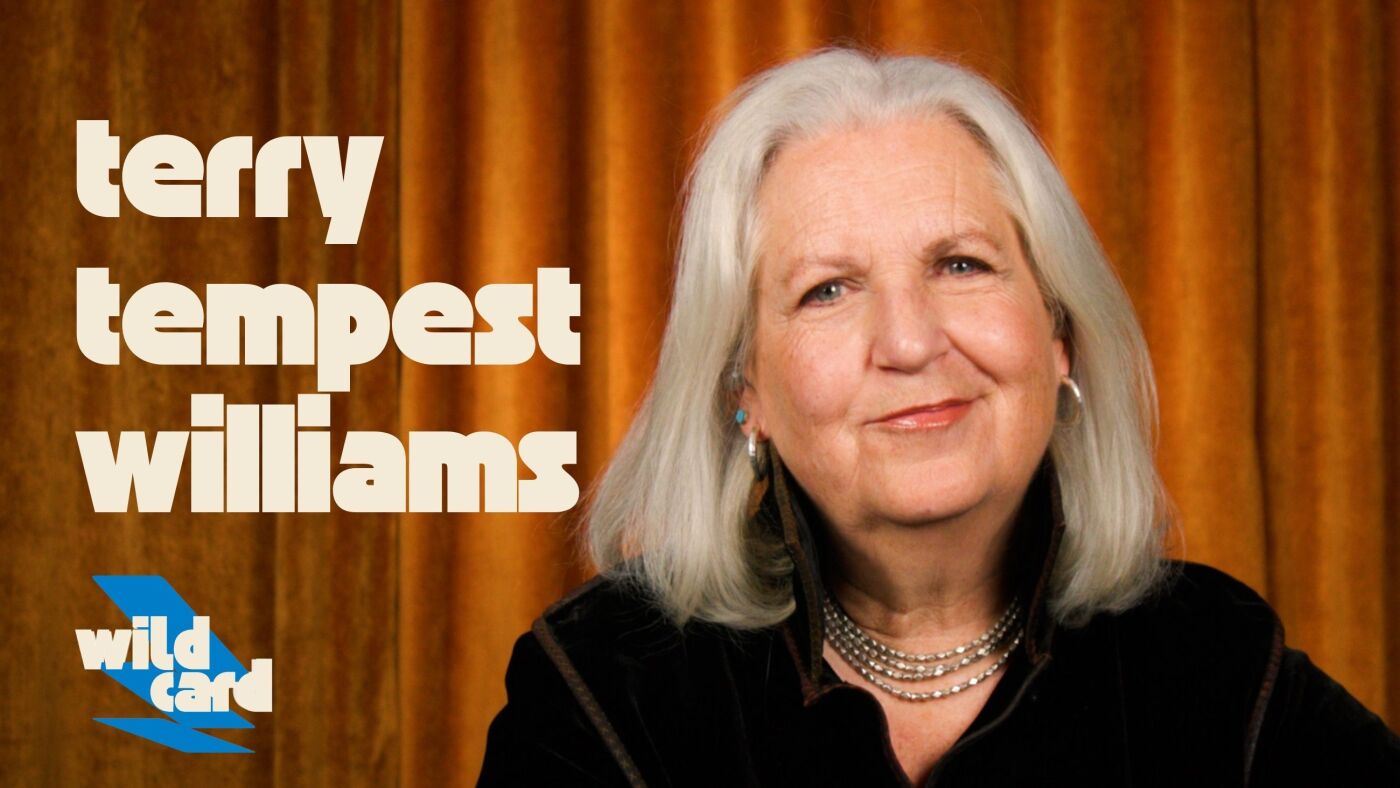
A note from Wild Card host Rachel Martin: I met Terry Tempest Williams about 25 years ago at a writer’s conference in Yosemite Valley. I was a young reporter who was there to do a story about how literature was addressing climate change and she made such a huge impression on me. I had never heard someone talk about the natural world the way Terry did and she had a spiritual depth I hadn’t encountered in my life at that point.
To this day, Terry’s writing always reorients me towards what is good, what is beautiful, and what is true. Her newest book is called “The Glorians.”

For its upcoming Los Angeles venue, experiential art firm Meow Wolf will focus on the art of storytelling, with a specific eye toward skewering our city’s moviemaking magic. To help bring that vision to life, Meow Wolf has entered into a creative partnership with Titmouse, one of L.A.’s most renowned independent animation houses.
The Hollywood-based studio behind popular series such as “Big Mouth” and “Star Trek: Lower Decks” will create animation that will be shown throughout the West L.A. venue, which is on target for a late 2026 opening at the Howard Hughes entertainment complex.
It’s a move that represents a shift for Santa Fe, N.M.-based Meow Wolf. Over the last decade-plus, the art collective has grown beyond its anything-goes, punk-meets-psychedelic roots into an organization with full-scale, maximalist installations in its hometown, Denver, Las Vegas, Houston and the Dallas suburbs. In the past, Meow Wolf kept most of its media in-house.
As part of its larger-than-life participatory art installations, Meow Wolf L.A. will feature a mix of live action and animation, the former filmed by Meow Wolf in its Santa Fe studio. Meow Wolf’s James Stephenson, a senior VP with the company and its creative director of emerging media, said the degree to which the L.A. exhibition will lean into various animation styles necessitated an outside partner. Titmouse’s work, in development by a number of directors with contrasting tones, will be shown on a variety of formats, ranging from cinema screens to full-room projections.
“I really believe in animation as an art form, and I know the Titmouse folks do too,” Stephenson says. “Animation is made by artists. It’s made by artists with their own hands. It’s something that is still very rooted in craft.”
Meow Wolf’s L.A. space is set in a former cinema complex, and will champion its location, taking guests on a journey through a converted movie house and beyond, into a sci-fi-inspired fantasyland with sentient spaceships and a 30-foot-tall mushroom tower. Meow Wolf creatives have spoken of the fantastical movie theater as one that will feature animated, self-aware candy before attendees enter the main exhibition space, making Titmouse’s work some of the first art guests will encounter. Titmouse co-founder Chris Prynoski has said the studio has lined up at least six directors for the exhibit.
An in-progress art installation destined for Meow Wolf L.A. at the art collective’s Santa Fe, N.M., headquarters. The L.A. exhibition will feature animation from Titmouse.
(Gabriela Campos / For The Times)
Titmouse, says Stephenson, is the right partner because “they’re known less for a house style, and more for a house vibe.” Over the years, Titmouse has been behind such diverse shows as “Scavengers Reign,” owning a Jean Giraud influence rooted in French and Spanish surrealism, the lively “Jentry Chau vs. the Underworld,” with an unique color palette that took inspiration from anime and Chinese mythology, the exaggerated comic book feel of Adult Swim’s “Metalocalypse,” and the approachable yet expressive tone of “Star Trek: Lower Decks.”
“Meow Wolf’s vibe is similar to Titmouse’s vibe,” Stephenson says. “It’s artist-first, artist-driven, independent and kinda edgy. They are always trying to find the edge of what’s possible. They try to see how far they can go, and it’s done for fun and in the spirit of taking risks.”
Prynoski says working with Meow Wolf will give Titmouse a sense of artistic freedom it doesn’t always have when delivering content for more traditional Hollywood partners. He says the multi-director approach is a callback to the early days of Warner Bros. Animation, when individual creators put their own stamp on Looney Tunes material.
“I use Bugs Bunny as an example,” Prynoski says. “You’ve got a Friz Freleng Bugs Bunny short. You’ve got a Chuck Jones Bugs Bunny short. You’ve got a Tex Avery Bugs Bunny short. They’re all different versions of Bugs Bunny, and people who are really paying attention can tell which director directed each one. Even though to the layman, these are all Bugs Bunny, but if you lined them up, they are drawing in different styles, sensibilities and techniques.”
Prynoski says that was a centerpiece of his pitch to Meow Wolf, noting that characters will reappear in multiple installations, each handled by a different artist. Meow Wolf L.A., in fact, will be the firm’s most character-driven exhibition, as guests will follow the storylines of three main protagonists throughout the space.
In announcing the partnership, Meow Wolf and Titmouse released an image from an animated work directed by Luca Vitale. It features a key character having a moment with a hummingbird and it’s done in an elegant, slightly anime-influenced style. It’s an image full of movement, reflecting a character in transition with inviting pastels and bold dashes.
“I like that image because I think it captures some of the sense of wonder that we want people to feel,” Stephenson says. “The character is having an encounter with the elusive nature of creativity and reality in a way that makes them have a different perspective of what’s possible.”
Other contributing animation directors to Meow Wolf L.A. include Space Dawg, Felix Colgrave, Alexander Vanderplank and Phimémon Martin, and Jun Ioneda.
Titmouse’s partnership with Meow Wolf will extend beyond the L.A. exhibition. The two will be working on the development of Meow Wolf New York, which is slated to open some time after Los Angeles, and are collaborating on a planned animated series, which Prynoski is spearheading.
Meow Wolf exhibits are the result of sometimes hundreds of disparate artists coming together in a shared space. Distilling that into a signature, singular style for a series could be a challenge. Stephenson pinpoints some guiding principles.
“You really need to feel the hand of the artist,” he says. “You need to feel a DIY aesthetic. You need to feel the materiality. Those are very specific to what we are.”

The Kennedy Center on June 28, with its facade signage still covered by a tarp and scaffolding.
Alex Wroblewski/AFP via Getty Images
hide caption
toggle caption
Alex Wroblewski/AFP via Getty Images
On Wednesday, a federal appeals court denied President Trump’s request to stop the removal of his name from Washington, D.C.’s Kennedy Center. The signage on the building has been covered with tarp and scaffolding since June 13, but in a court filing last month, the center’s current executive director said that Trump’s name has been removed.
In their decision, three judges from the U.S. District Court of Appeals for the District of Columbia Circuit said that the president had failed to prove that the arts center would be “irreparably injured” without Trump’s name attached to it.

NPR requested comment from the Kennedy Center, but did not receive an immediate reply.
This latest round of court decisions is part of the ongoing litigation filed by Rep. Joyce Beatty, D-Ohio, against President Trump and the board of the Kennedy Center. In a statement emailed Wednesday to NPR, Beatty said: “Today’s ruling again affirms that this administration’s efforts to rename the Kennedy Center were unlawful. His name no longer desecrates this sacred memorial, which belongs to the American people. Now it is time for the Trump administration to accept this, comply with the law, and take the tarps down.”
In previous court filings, Trump’s legal team had asserted that removing the president’s name from the arts complex, both on the physical building and in its digital materials, would inflict irreparable harm in both time and money already spent. In the denial, the three judges — Patricia Millett, Robert Wilkins and Gregory Katsas — wrote that since Trump’s name has already been removed, “a stay would not avert those harms.”
Furthermore, Trump had claimed that without his name attached, future fundraising would be threatened “and [will] contribute to the financial decline of the Center.” In response, the appeals judges wrote: “Appellants, however, have failed to support this assertion with any specific facts or evidence. They offer only the conclusory assertions of the Kennedy Center’s Executive Director that were made in a factually unsupported declaration.” The center’s current executive director, Matt Floca, specializes in physical plant management.

The presiding judge in the case, Christopher R. Cooper, has ordered that the center provide him a status report on the center’s operation and programming before the end of this month. As of Wednesday, the center’s calendar lists a small roster of programs, including outdoor free movie screenings, workshops for children, and five free live performances in July on its Millennium Stage. In the past, the Kennedy Center presented over 2,000 arts and education events each year, including free daily Millennium Stage performances.

-

 Boston, MA3 minutes ago
Lawsuit: ICE detained East Boston father despite legal status
-

 Denver, CO8 minutes ago
Victor Marx wins GOP primary for Colorado governor, defeating veteran lawmaker after unorthodox campaign
-

 Seattle, WA15 minutes ago
Widower of pregnant woman who was shot to death in Seattle sues homelessness authority
-

 San Diego, CA18 minutes ago
Terrifying moment huge sea lions chase tourists off popular California beach
-

 Milwaukee, WI30 minutes ago
Milwaukee leaders condemn ICE arrests as agency ignores City mask ordinance
-

 Atlanta, GA33 minutes ago
Georgia Secretary of State opens investigation into voter registration mailers sent to deceased residents
-

 Minneapolis, MN38 minutes ago
Minneapolis chief communications officer Adam Fetcher out amid possible criminal charges
-

 Indianapolis, IN45 minutes ago
Indiana Workforce Pell Grant options limited so far

