Lifestyle
Legoland grows up. What it’s like to ride the new Space Mountain-inspired Galacticoaster

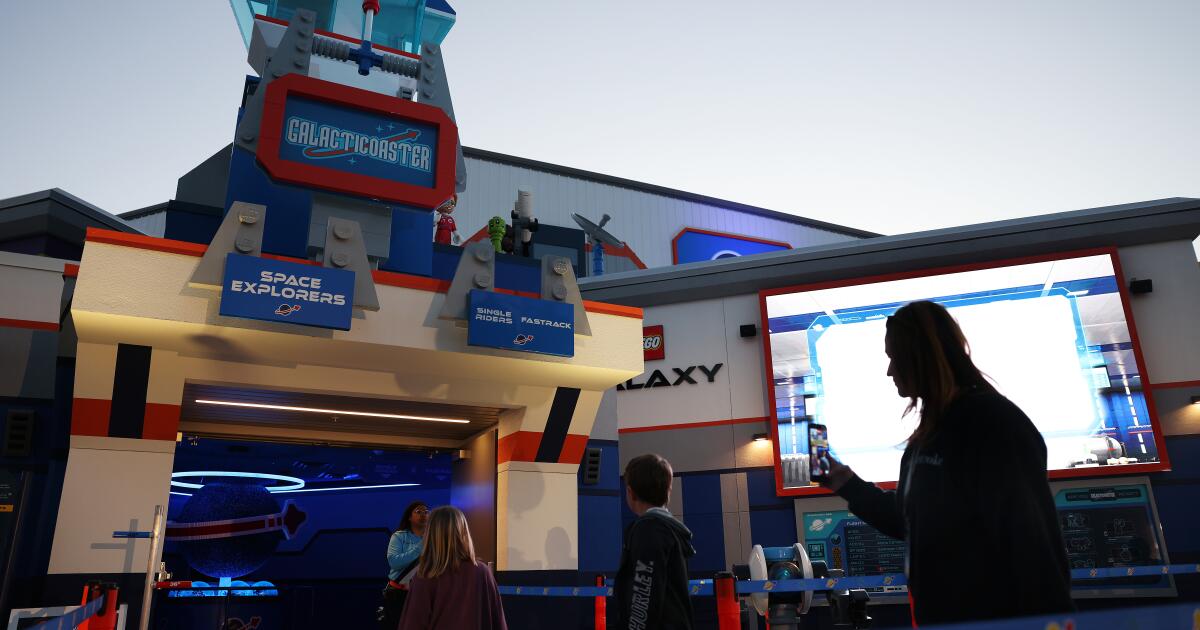
Legoland is growing up.
The Carlsbad theme park will on Friday open Lego Galaxy, a new 2.4-acre themed land that will feature its most adult-focused attraction yet in the Galacticoaster. An indoor, space-themed thrill ride, Galacticoaster is brief but impressionable, a spinning race through a darkened landscape to save a Lego-infused galaxy from an “asteroid of probable destruction.”
At 40 mph, it’s the park’s fastest ride, but coming in at about 60 seconds and focusing on banking and turning means it still has full family appeal. Expect it to serve as an introductory, big kid coaster for many. It’s infused with lighthearted humor — floating farmers and barnyard animals cruise among the stars — lending it a rather relaxed atmosphere for a save-the-world, fast-paced attraction. In other words, it’s sleek, it’s hurried and it’s cutesy.
-
Share via
“My favorite is the surfing alien,” says Tom Storer, North American project director for Merlin Magic Making, the creative team behind Lego experiences. “She’s my favorite thing to see in there. It’s right after the blast. It will sneak up on you.”
The Galacticoaster is the centerpiece of Lego Galaxy, which also includes two smaller outdoor attractions, a vintage-style shoot-’em-up video game and a play area for little ones. Its part of a $90-million investment in Legoland’s California and Florida parks on behalf of parent Merlin Entertainment (an identical Galacticoaster can be found in Lego’s Florida park). Lego Galaxy hopes to draw visitors — and perhaps new audiences — by focusing on slicker, more modern technology and injecting in the park the sort of excitable ride more commonly found at Legoland’s Southern California competitors.
Storer, for instance, isn’t shy about the Galacticoaster’s inspiration.

2

3

1. Visitors wait to ride the Galacticoaster. 2. Los Angeles residents Veronica and Eloy Navarro with their children Zoe, 10, left, and Levi, 9, right, ride the Galacticoaster. 3. San Diego residents Yesenia Auer, 38, left, with her cousin Kelly Luquin, 34, right, and Luquin’s sons Emiliano and Leo, from left, are all smiles after riding the new indoor coaster.
“What is the space roller coaster of 2026? Space Mountain is a classic from back in the day,” he says, referring to the Disneyland Resort staple launched in 1977. “But this is kind of the new way.”
It is faster and brighter than Space Mountain, as the Galacticoaster is heavily populated with twinkling stars, planetary projections and many a Lego brick creation. But while Space Mountain tops off at about 32 mph, it likely still has Galacticoaster beat in the intensity factor due to its lift hill, sudden dips, jolting turns and near pitch-black darkness. No matter, says Storer, as here the objective was to place guests in a welcoming adventure with plenty to look at.
“When you think of outer space, you instantly think of stars and planets,” Storer says. “We have a really cool digital planet and we have stars everywhere.”
The Galacticoaster sits four per car, loading attendees parallel in a row via a moving platform. Once seated and locked in, it nearly immediately takes off, jetting riders into a darkened hallway with white lights before injecting them into a Lego galaxy. Lego aficionados or those who grew up with the sets will likely spy many an allusion to past toys. In the ride’s queue, for instance, guests in line will walk past a wall that features a timeline of many a Lego space set. Action comes fast, but surrounds guests, as the coaster cars rotate around a hurtling asteroid.

Visitors wait in line to ride the new indoor coaster at Legoland designed for families.
While it twists from side to side, which has drawn light comparisons to Guardians of the Galaxy: Cosmic Rewind at Walt Disney World’s Epcot, with some referring to this as sort of a starter version of that more powerful coaster, it’s a smooth and relatively unobtrusive twisting. Those prone to motion sickness — and I am one of them — likely need not be too concerned here.
While Legoland has other coasters, many are known as what Storer refers to as “pink knuckle” coasters, slang for safe for kids and families. Galacticoaster, with a minimum height requirement of 36 inches, certainly is as well, but the creative executive hopes it falls somewhere between the pink and white knuckle level of force, the latter term reserved for the most thrilling of coasters.
“We’re known for having ‘pink knuckle’ coaster, where it’s not too scary,” he says. “It’s kind of, ‘My first coaster.’ This is family-friendly. We’d never do anything that’s not family-friendly. We want to make sure our guests from 5 to 12 have lots to do, but it’s a little more punchy and has that cool launch with a space blast-off feel.”
Theme park aficionados will be keen to know that this is the first attraction in the park to feature an animatronic figure. The character of Biff Dipper, an engineer, will be found in the ride’s preshow, familiarizing guests with the story of the asteroid that spells impending doom. Stout and slightly gruff, Dipper has a digital face that can approximate more than 40 expressions. The animatronic, says Storer, was an important investment for the park, as Legoland in Lego Galaxy was cognizant of guests becoming bored in what will surely be one of the park’s longest lines this upcoming spring and summer season.

The character of Biff Dipper is Legoland’s first animatronic figure. Dipper is in the preshow of the Galacticoaster.
There are interactive elements throughout Lego Galaxy. In the Galacticoaster, for instance, riders will build a virtual approximation of a spaceship from a touchscreen, selecting options for wings, cannons and more. Some are militant. Others look like burgers or rainbows. There are 625 variations, and the creation will then appear at the start and finish of the attraction, injected into the ride’s projectors via a guest wristband. Legoland officials like to refer to Galacticoaster as a 10-minute experience, a time that takes in the preshow with the Dippper figure as well as the construction of the spacecraft.
Elsewhere in Lego Galaxy, there’s a full video game-like experience called the Rocket Assembly Bay. Here, guests will first build their own spaceship, and then have it scanned into the game for a cooperative shoot-’em-up. Rocket Assembly Bay is good fun, and rewarding even, to see a virtual scan of a hand-built ship injected into the game, this despite that fact that the play experience is largely a modern update of old coin-op “Asteroids.”
“There’s something about the simplicity of some of the things that have been done,” Storer says.
Two other core attractions dot the land. The G-Force Test Facility is a spinner that’s pitched as an astronaut training experience. Guests with a minimum height of 40” will be elevated off the ground via vehicles situated on rotating arms. There’s plenty of swinging and rotating action in this more standard amusement park-like creation, although Storer notes that riders won’t experience any actual G-forces. Still, here’s one that those with a propensity to motion sickness may want to take a pass on.

Austin Rafie, 7, poses with characters at Lego Galaxy, a new space-themed land, at Legoland in Carlsbad.
(Christina House / Los Angeles Times)
Lego Galaxy is rounded out with a play area and the preschool-focused ride Launch & Land. For those with a minimum height of 34 inches, this is a casual, patient experience, one in which seated guests will gently lift off into the air for a slightly elevated view of the land. Nominally designed as a spaceport, Lego aliens and spaceships populate the area. Press a button near one of the ships, and initiate, for instance, an engine test.
But don’t expect anything too serious. The Galacticoaster, after all, has a farting space cow.



Lifestyle
Nature needs a little help in the inventive Pixar movie ‘Hoppers’ : Pop Culture Happy Hour

Piper Curda as Mabel in Hoppers.
Disney
hide caption
toggle caption
Disney
In Disney and Pixar’s delightful new film Hoppers, a young woman (Piper Curda) learns a beloved glade is under threat from the town’s slimy mayor (Jon Hamm). But luckily, she discovers that her college professor has developed technology that can let her live as one of the critters she loves – by allowing her mind to “hop” into an animatronic beaver. And it just might just allow her to help save the glade from serious risk of destruction.
Follow Pop Culture Happy Hour on Letterboxd at letterboxd.com/nprpopculture
Subscribe to Pop Culture Happy Hour Plus at plus.npr.org/happyhour

Kim Kardashian
never denied rare hermés bag for north west …
It Never Happened!!!
Published
Kim Kardashian is not the celebrity who got turned away trying to buy a rare Hermès bag for her daughter, despite a viral claim suggesting otherwise … TMZ has learned.
Sources familiar with the situation tell TMZ … the story circulating online that Kim once attempted to purchase a coveted Mini Kelly bag for her daughter North West and was rejected simply never happened.

We’re told Kim has maintained a very friendly relationship with the luxury brand for years but not through the channels described in the report.
According to our sources, Kim has a very friendly relationship with the brand and has only used the same contact for over ten years in Paris and not the press office.
The sources also shut down the central claim behind the rumor telling us Kim did not request a bag for North, nor did she visit any Hermes store recently or get turned down.
We’re told those close to the situation are particularly bothered by the story because it involves a child. One source said, “They find it very disturbing that anyone would make up stories about a child for clicks.”
The claim appears in journalist Amy Odell’s “Back Row” newsletter, which cited a former employee of the Beverly Hills Hermès boutique who alleged Kim and Kanye West once tried to purchase a black Mini Kelly bag for North but were denied.
The ultra-rare alligator Mini Kelly is one of the most coveted Hermès bags on the market and can fetch more than $75,000 on resale.
In 2013, historian Rhae Lynn Barnes was researching blackface in America when she encountered a stumbling block at the Library of Congress: Various primary sources on the subject were listed as “missing on shelf.”
Barnes spoke to one of the librarians, and explained that she was writing a history of minstrel shows and white supremacy. Barnes says the librarian admitted that, in 1987, she had personally hidden some of these books because she feared the material would be used by the Ku Klux Klan.
“Once [the librarian] understood the research I was doing … a few hours later, she came up with a cart packed to the brim with all of the material that I had been hoping to see,” Barnes says.
In her new book Darkology: Blackface and the American Way of Entertainment, Barnes traces the origin of minstrel shows, performances in which an actor portrays an exaggerated and racist depiction of Black, often formerly enslaved, people.
Barnes says minstrel became so popular in the 1800s that the stars began publishing “step-by-step guides” explaining how amateurs could create their own shows. By the end of the century, amateur minstrel performances became one of the most popular forms of entertainment in the U.S. Many groups, including fraternal orders, PTAs, police and firemen’s associations and soldiers on military bases, put on their own shows.
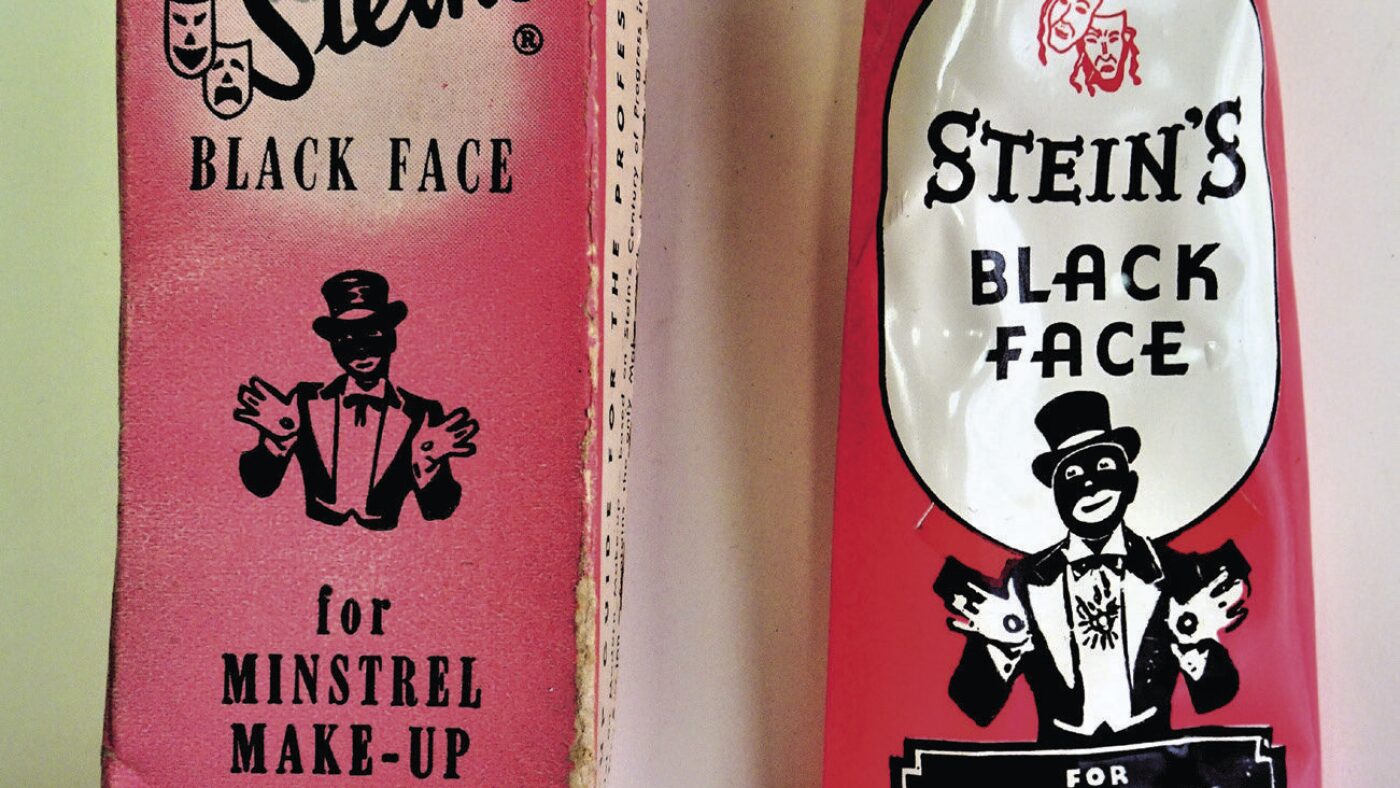
During the Great Depression, Barnes notes that President Franklin D. Roosevelt’s Works Progress Administration sought to “preserve American heritage” by promoting blackface. As part of the effort, she says, the government distributed lists of “top minstrel plays that they recommended to schools, to local charities, to colleges.” Roosevelt was such a fan of minstrel shows that he co-wrote a script, to be performed by children with polio.
Barnes credits the civil rights era and especially mothers with helping de-popularize blackface in the 1970s, first in schools and then in the larger culture. “They successfully get the shows out of school curriculum piece by piece. And by 1970, most of these publishing houses are going under because of the incredible work of Black and white mothers who worked with them,” she says.
Interview highlights
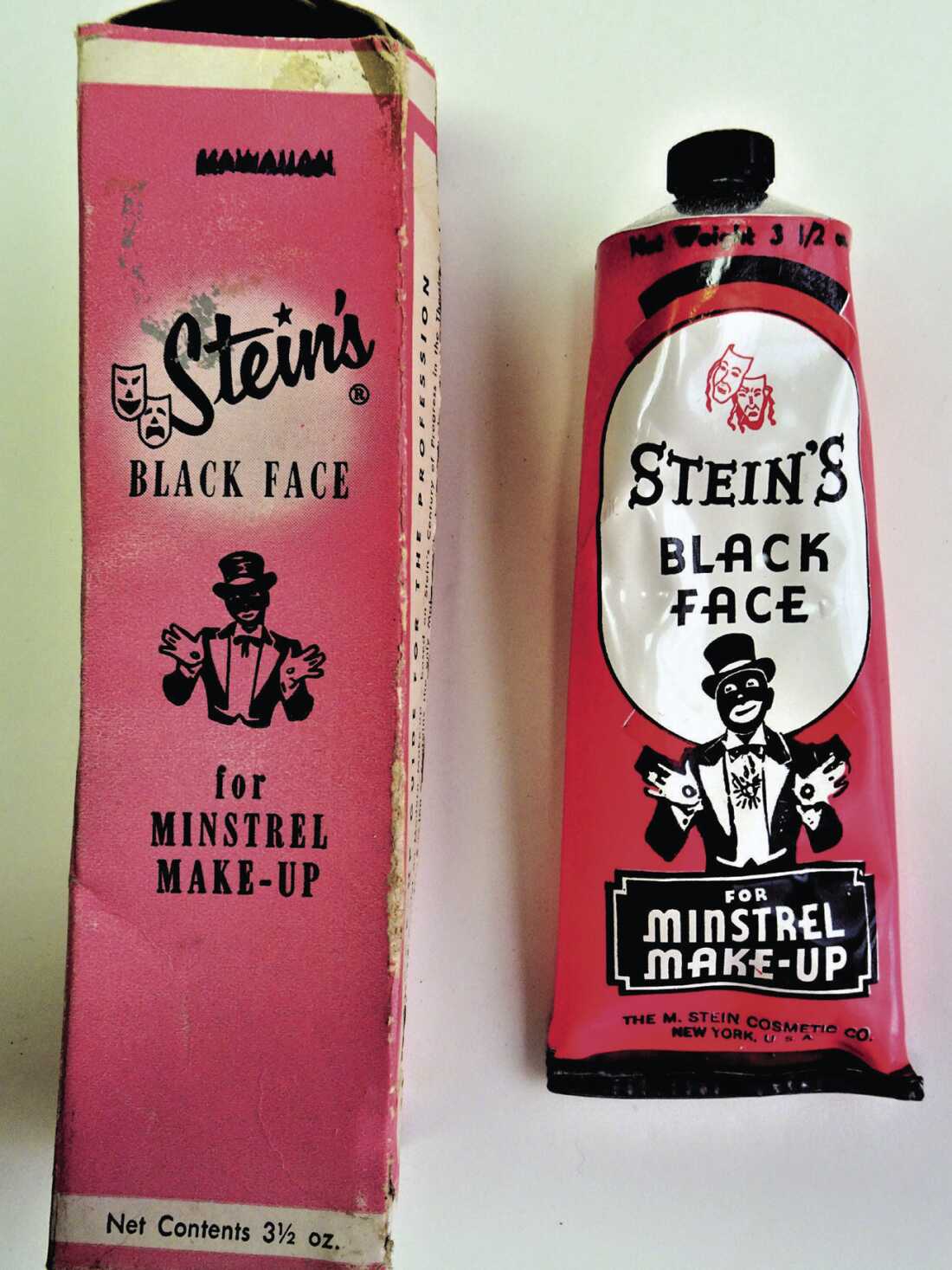
Stein’s makeup company created multiple shades of blackface for performers in amateur minstrel shows.
WW Norton
hide caption
toggle caption
WW Norton
On commercial blackface makeup that replaced shoe polish and burnt cork
It’s an entire commercial empire. So Stein’s makeup was one of the largest. They were a theatrical makeup company. And you’ll actually find today when you go into Halloween stores that a lot of these blackface makeup companies still exist today for Halloween costume makeup and also for clown makeup. …
Burnt cork was incredibly difficult to get off of your face. You’re essentially taking fire ash and then mixing it with shoe polish or some sort of shiny ingredients, and so it was incredibly hard to get it off. So when Stein and these other cosmetic companies begin to create the tubes … that did come in 29 colors and you could pick which bizarre racial calculus you wanted to represent, they would come off with cold cream or makeup remover and that was one of their selling points — now it’s easy to take off.
On Stephen Foster‘s songs for minstrel shows, like “Oh Susannah!”

What’s interesting about those songs is they are romanticizing the relationship between an enslaved person and their enslaver. And so when we have commentary, even from the president now, who recently said slavery wasn’t so bad, well, slavery was horrific, but if you were raised on a diet of Stephen Foster music, and going to minstrel shows, you can somewhat understand how somebody at the time could easily be led to believe that slavery was a grand old party because that’s what it was supposed to be telling you. It’s pro-slavery propaganda.
On the slogan “Make America Great Again” originating from early 20th-century minstrel shows
“Make America Great Again” or “This Is Our Country” or “Take Back Our Country” are all slogans and songs that were very common in minstrel shows. And so a lot of minstrel shows reinterpreted slavery in a fantastical way, that the Civil War ended and that in these minstrel shows there was Black rule and that everything America held dear was desecrated. And so this [blackface] “Zip” character … sometimes he’s named “Rastus” — he has different names that he goes by — runs for office, political office, becomes president, and he’s the first Black president and the first thing he does is he takes away America’s guns. Sound familiar? And so a lot of these terms that you could perhaps say [are] dog whistles in white of supremacy are taken line for line from these minstrel shows.
On not censoring this history
Historians right now are in somewhat of a culture war in that it is our patriotic duty as American citizens and as patriots to help make sure that the American public has access to our history in all of its complexity. And the truth is that you can’t understand the victories and the triumphs without understanding how far Americans had to push. And I think that’s especially true of blackface. When we didn’t adequately understand how long blackface was a mainstay in American culture. Because many historians believe that it had died out by 1900, when in fact it only accelerates and increases up through the 1970s. And so if you just say, “Oh, it just died out. It was no longer in fashion,” then what you’re losing is the incredible, dangerous, and brave work of thousands of Black and white mothers across the United States in the 1950s and the 1960s, of students who stood up during Jim Crow America and said, “This is not OK. We are humans. We deserve dignity. And we want you to understand our history.” …
I think these are the hard conversations Americans actually want to have. And I think America is completely ready for those hard conversations and moving forward.
Anna Bauman and Susan Nyakundi produced and edited this interview for broadcast. Bridget Bentz, Molly Seavy-Nesper and Meghan Sullivan adapted it for the web.

West Virginia Returns Home to Face Maryland in Midweek Clash

Wyoming Announces 2026 Football Schedule – SweetwaterNOW

Aon Says Stablecoins Speed Insurance Premium Payments | PYMNTS.com

Higher Fitness Levels Amplify Brain Benefits After Exercise, Study Finds

Dan Webster reviews “WTO/99”

Florida High School Football Rankings: Top 25 teams – Oct. 21

Cleary's 21 help Le Moyne down Central Connecticut State 69-64 in OT

How old is Bo Nix? What to know about Oregon quarterback ahead of 2024 NFL Draft

99th annual Pony Swim held in Virginia

Indiana Members Credit Union announced as new anchor tenant at Bottleworks District

Trump reveals top issues GOP should focus on to secure midterms victory: ‘I’ve never been more confident’

NATO intercepts another Iranian missile in Turkish airspace

Is Iran another Iraq? : Sources & Methods

Trump says Iran war will be “over pretty quickly” as oil price hits 6 year high | BBC News

China-linked birth tourism under scrutiny as GOP lawmakers press Trump admin for answers
-

 Wisconsin1 week ago
Setting sail on iceboats across a frozen lake in Wisconsin
-

 Massachusetts7 days ago
Massachusetts man awaits word from family in Iran after attacks
-

 Maryland1 week ago
AM showers Sunday in Maryland
-

 Florida1 week ago
Florida man rescued after being stuck in shoulder-deep mud for days
-

 Pennsylvania5 days ago
Pa. man found guilty of raping teen girl who he took to Mexico
-

 News1 week ago
2 Survivors Describe the Terror and Tragedy of the Tahoe Avalanche
-

 Sports5 days ago
Keith Olbermann under fire for calling Lou Holtz a ‘scumbag’ after legendary coach’s death
-

 Virginia6 days ago
Giants will hold 2026 training camp in West Virginia