Lifestyle
L.A. Affairs: I'm crying a lot lately and arguing with my husband. Is L.A. to blame?

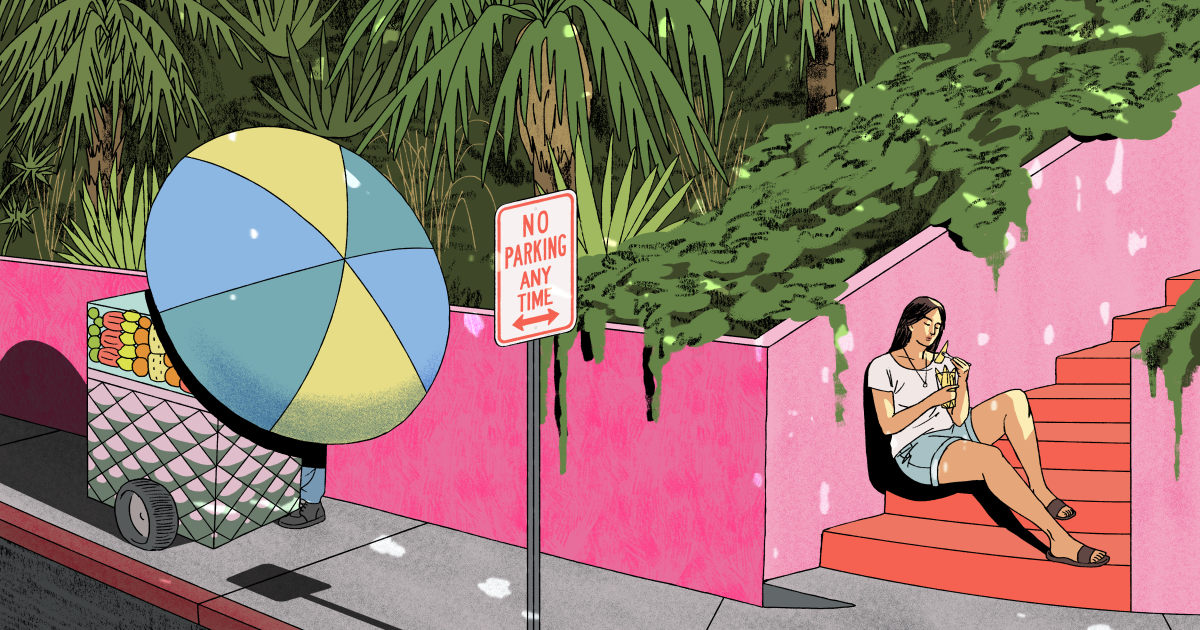
I’ve been crying a lot lately.
I find myself sitting on the couch in my living room, folding laundry between Zoom meetings, the U.S. Open on in the background, my aging hands in the foreground, and I break into tears. I’m not sobbing because Zverev won or because my hands remind me of my grandmother’s, though slightly less waxy, veiny and spotted. It’s something bigger, something deeper, something I can’t quite put my finger on.
I’m on the 405 on my way to pick up my daughter from school, stuck in bumper-to-bumper traffic, and again I begin to cry. I cry on my way to work and as I sit on the warm sand in Malibu looking out at the sea. I cry during yoga, as I hike Temescal Canyon, as I wait in line for a $22 smoothie at Erewhon. These episodes have been creeping up on me for months now. Little by little, they have invaded my head space and my nervous system. I’m at a loss for words — I cry.
It could be a number of things. My husband and I have been arguing nonstop about emotional labor and my ongoing attempts to decenter him in our marriage. It’s exhausting and fruitless. I’m no longer writing. I have a UTI, again. But these things are too easy, too obvious. I try to snap out of it. Meditation, sound baths, breathwork — nothing helps.
And then, out of the blue, I get a call from my landlord: She’s selling the duplex, and we may have to move. The potential of being forced to leave rent-controlled, under-market housing in Westwood, a safe neighborhood on the Westside in a good school district, should push me over the edge. Tears should be running down my face in torrents, but they aren’t. I find myself feeling happier than I’ve felt in months. We might have to move. We might have to move. We can leave. We’ll have to leave! I smile from ear to ear and start dreaming of another life in another place. And then it hits me. I’ve fallen out of love with L.A.
People hate L.A., so falling out of love with it might make sense to you. It’s not a true city, it’s too spread out, there are no seasons, the traffic is dreadful, they say with smug looks on their faces as they leave in flocks to colder places. But I don’t hate L.A. I love it; I always have. I’ve loved L.A. since I was a child growing up in Orange County, a brown kid in a sea of white kids who felt unseen and alone. L.A. is my city. It’s people who look like me in thrift stores on Melrose. It buzzes with energy. It’s dirt and grit shoved up against beauty and splendor. It’s real — it allows space for complicated things to exist side by side. It’s my dad’s family in East L.A., chicharrones, an ice cream truck and menudo after church on Sundays. It’s my mom’s family in Alhambra, strawberry jam on fried chicken, the Dodgers and a Boy George poster on the back of a bedroom door. L.A. is everything, was everything. L.A. was once my savior, my only hope.
So, what changed? A lot.
I’ve been married for 10 years now, I have a kid, I’ve lost people I love, my literary agent fired me, the wildfires are out of control and it’s getting hotter — all things that surely have affected my love affair with this city.
My identity has shifted, and I feel off-kilter. I’m no longer a hopeful young girl, dreaming of life in the City of Angels. I’m older. Wiser? Maybe. I’ve failed a bunch. I’m not who I thought I’d be. L.A. isn’t what I thought it’d be either. Can we survive these truths? I want to …
I want to fall back in love. But how?
I light a candle in front of Santa Barbara, the patron saint of my family, and ask her to guide me. I place pink gemstones on my heart chakra as I sleep. I begin spending time in the moonlight. I read “Nightbitch.” I drive through downtown Los Angeles at night with my windows down and the sunroof open as I did with my aunt and uncle when I was a child. The lights are magic; there is something in the air.
I eat a French dip sandwich and a pickled egg that stains my fingertips purple at Philippe’s and feel satiated. I take my daughter to the Self-Realization Fellowship Lake Shrine. We feed the ducks and the turtles. A swan nips at her outstretched hand. She laughs and runs around the lake. I watch her and see myself as a child. I write this short piece and actually enjoy the process. I make arroz con pollo and cry because it tastes like my childhood and reminds me of my grandma. But it’s a different cry than before. It feels different. Like I’m taking something back.
I decide to make the city mine again.
I begin to avoid the people, places and things that irk me. I go analog (for the most part). I stay firm in my boundaries. I am more present than I’ve ever been. I wake up a little bit earlier each morning to look at my daughter’s perfect face as she sleeps beside me. I listen to the birds chirping outside my window. I kiss my husband because he buys me cheese and figs. We argue slightly less but recover and repair faster. I start taking the streets and avoiding the freeways. I make a promise to find one thing about the city to be grateful for each day: shade, In-N-Out, free museums, sunshine, the ocean, kind neighbors (thank you, Mary and Paul), walkable neighborhoods, the public library, reproductive freedom.
In the midst of rebuilding my gratitude, I begin to remember who I am. The city abides. She becomes my ally, giving me cool breezes, green lights, a healthy dose of vitamin D. I’m lighter, freer, and then one day, many days since my crying began, I feel hope pulsing in the back of my brain, and I know I’m right where I’m supposed to be. I love L.A., and L.A. loves me.
So even though my joints ache and my body slips into perimenopause, even though my marriage is going through a rough patch and my creative practice has seemingly died, I know I’ll be OK. In the words of Anthony Kiedis of the Red Hot Chili Peppers, “At least I have her love, the city, she loves me. Lonely as I am. Together we cry.”
The author is a teacher and a writer. She lives in Westwood with her daughter and her husband.
L.A. Affairs chronicles the search for romantic love in all its glorious expressions in the L.A. area, and we want to hear your true story. We pay $400 for a published essay. Email LAAffairs@latimes.com. You can find submission guidelines here. You can find past columns here.



Bruce Campbell
I’m Battling Cancer
Published
Bruce Campbell has revealed he has cancer, but says it’s a type that’s treatable, though not curable.
“The Evil Dead” actor shared the news Monday in a message to fans, writing, “Hi folks, these days, when someone is having a health issue, it’s referred to as an ‘opportunity,’ so let’s go with that — I’m having one of those.” He continued, “It’s also called a type of cancer that’s ‘treatable’ not ‘curable.’ I apologize if that’s a shock — it was to me too.”

Campbell said he wouldn’t go into further detail about his diagnosis, but explained his work schedule will be changing. “Appearances and cons and work in general need to take back seat to treatment,” he wrote, adding he plans to focus on getting “as well as I possibly can over the summer.”
As a result, Campbell says he has to cancel several convention appearances this summer, noting, “Treatment needs and professional obligations don’t always go hand-in-hand.”
He says his plan is to tour this fall in support of his new film, “Ernie & Emma,” which he stars in and directs.
Ending on a determined note, Campbell told fans, “I am a tough old son-of-a-bitch … and I expect to be around a while.”

Neve Campbell in Scream 7.
Paramount Pictures
hide caption
toggle caption
Paramount Pictures
The OG Scream Queen Neve Campbell returns. Scream 7 re-centers the franchise back on Sidney Prescott. She has a new life, a family, and lots of baggage. You know the drill: Someone dressing up as the masked slasher Ghostface comes for her, her family and friends. There’s lots of stabbing and murder and so many red herrings it’s practically a smorgasbord.
Follow Pop Culture Happy Hour on Letterboxd at letterboxd.com/nprpopculture

Abriana Vicioso is the host of the Flower Hour, which takes place monthly.
(Jennifer McCord / For The Times)
Each flower carries a personal history. For Abriana Vicioso, the calla lily was her parents’ wedding flower — a symbol of her mother’s beauty. “She had this big, beautiful white calla lily in her hair,” Vicioso says. “I love my parents. They’re the reason I’m here. I’ll never forget where I came from.”
The Flower Hour begins with Vicioso announcing, with a warm smile: “Today is about touching grass.” The florist-by-trade gestures behind her to hundreds of flowers contained in buckets — blue thistles, ivory anemones and calla lilies painted silver — all twisted and unfurling into the air. “Tonight is going to be so sweet and intimate,” Vicioso says, eyeing the beautiful chaos at her feet. A grin buds across her face.
Moments before the workshop, participants sit at candlelit tables exchanging horoscopes and comparing their favorite flowers. A mention of the illustrious bird-of-paradise flower elicits coos and awe from the women. Izamar Vazquez, who is from Jalisco, Mexico, reveals her fondness for roses, which make her feel connected to her Mexican roots.
Vicioso hosts her flower-themed wellness workshop near the iconic Original Los Angeles Flower Market in downtown L.A. In January, the first Flower Hour event sold out, prompting her to make it a monthly series. Vicioso describes the event as a “three-part journey” where participants are invited to drink herbal tea, smoke rose-petal-rolled cannabis joints and create a floral arrangement. “The guide is to connect with the medicine of flowers,” Vicioso says.


Rose petal joints, tea and flower arranging are all part of The Flower Hour event’s offerings.
The event is hosted at the Art Club, a membership-based co-working space. “The Flower Hour is really beautiful. Everyone gets to explore their creativity while meeting new people,” says Lindsay Williams, the co-owner of the Art Club.
The idea for Flower Hour came to Vicioso during a conversation with her mother. “We joke all the time that flowers were destined to make their way into my life,” she says. She works as a florist and models on the side, even appearing in the pages of Vogue. Vicioso grew up in a Caribbean household, where flowers and offerings were part of daily life. “In my culture and religion, a lot of my family practices — an Afro-Caribbean religion — we build altars.”
Like many cultures, flowers carry sentimental value in her religion. “I’m Caribbean, so a lot of my family practices a Yoruba religion, which comes from Africa. In the Caribbean, it’s well known as Santería.”

-
Share via
After a difficult year and a breakup, Vicioso wanted to marry her love of flowers with community building. Because Vicioso uses cannabis medicinally, the workshop naturally includes a smoking component. “My family has smoked cannabis for a lot of reasons for a long time. It’s a really healing plant,” she explains.
In the workshop, even the cannabis gets the floral treatment. Vicioso presents her rose-petal-wrapped joints on a silver platter at each table. She rolled each by hand. “If you’ve never smoked a rose-petal-rolled joint, the difference with this is it’s going to have roses that have a slight tobacco effect,” she announces.
During the workshop, Vicioso stresses the importance of buying cannabis from local vendors. The cannabis provided was purchased from a Northern Californian vendor. The wellness workshop aims to reclaim the healing ritual of smoking cannabis. “This is a plant that has been commercialized,” Vicioso says. “There’s a lot of Black and Brown people who are in jail for this plant.”
The resulting workshop is what Vicioso describes as “an immersive wellness experience that is the intersection of wellness, creativity, community and an appreciation of flowers.” The workshop serves as a reminder to enjoy Earth’s innate beauty in the form of flowers — including cannabis. “It’s this gift that the universe gave us for free and that I have this deep connection with,” Vicioso says.


Conversation cards to generate discussion among participants (top, letf). The workshop serves as a “third space” for Angelenos to engage in tactile creativity and community building outside of traditional nightlife settings.
After enjoying lavender chamomile tea and smoking a joint, Vicioso introduces the flowers to the group before inviting them to pick their own. She emphasizes each flower’s personality traits, describing green dianthus as a “Dr. Seuss” plant. Then, there are calla lilies with their “main character moment.” It gets personal. “Start thinking of a flower in your life that you can discover,” she says. “If you’re feeling like you need inspiration, you can always remember that these flowers have stories.”
Vicioso infuses wisdom into her instruction on floral arrangements: There are no mistakes. Let the flowers tell you where they want to go, she urges. Intuition will be your guide — the wilder, the better.
“Hecho in Mexico” reads a sticker on a bunch of green stems. “Like me,” says Vazquez with a laugh. “They’re all doing their own thing. Like a family,” she says later, arranging stems.

The Flower Hour participants and Vicioso, center, chat as they build their own floral arrangements at the sold-out event.
Two participants — Vazquez and Rebeca Alvarado — are friends who run a floral design company together called Izza Rose. Like Vicioso, the friends have a connection to flowers through their Latin American culture. They met Vicioso in the floral industry and were overjoyed to discover her workshop.
“This is a great way to connect with other people,” says Vazquez.
Alvarado agrees, adding: “You’re getting to know people outside of going to bars. You can connect in different ways when there’s an activity.”
Vazquez uses flowers to stay connected to her Mexican heritage, adding that she prefers to support Mexican vendors. In recent months, the downtown L.A. flower market has struggled to recover from ongoing ICE raids. “Some are scared to come back,” says Vazquez.


Hand-rolled cannabis joints wrapped in rose petals are presented on a silver platter at The ArtClub (top, right). The Flower Hour aims to reclaim the healing rituals of cannabis and flowers.
Another participant, Barbara Rios, was attracted to the workshop for stress relief. “You can hang out with your friends, but it’s nice to do things with your hands,” she says. “I work a stressful job, and it’s nice to have that third space that we’re all craving.”
On this February night, the participants were predominantly women, save for one man. In the future, Vicioso hopes that more men learn to engage with flowers. “There’s a statistic about men receiving flowers for the first time at their funerals, and I think we have changed that,” she says.
To conclude the workshop, Vicioso encourages participants to build lasting friendships and incorporate flower arranging into their daily practice — even if it’s just with a small, inexpensive bouquet.
“Get some flowers together, go to the park, hang out with each other and hang out with me,” she says. Participants leave with flower arrangements in hand. In the darkness of the night air, it briefly looks as though the women carry silver calla lilies that are blooming from their palms.


Anthropic upgrades Claude’s memory to attract AI switchers

Iran nuclear talks ‘didn’t pass the smell test’ before Trump launched strikes, says Vance

Trump sends official notification to Congress on strikes against Iran

Punch the monkey, viral star, experiences dramatic breakthrough among zoo mates

NBA player calls for Hawks to cancel their ‘Magic City’ strip club promotional night out of respect for women

Florida High School Football Rankings: Top 25 teams – Oct. 21

Cleary's 21 help Le Moyne down Central Connecticut State 69-64 in OT

How old is Bo Nix? What to know about Oregon quarterback ahead of 2024 NFL Draft

99th annual Pony Swim held in Virginia

Indiana Members Credit Union announced as new anchor tenant at Bottleworks District
Trump sends official notification to Congress on strikes against Iran

Unexpected birth brings hope to near-extinct Amazon tribe

Supreme Court blocks redrawing of New York congressional map, dealing a win for GOP

Map: Earthquake Shakes Central California

Gas prices could jump as Middle East tensions threaten global oil supply
-

 World5 days ago
Exclusive: DeepSeek withholds latest AI model from US chipmakers including Nvidia, sources say
-

 Massachusetts5 days ago
Mother and daughter injured in Taunton house explosion
-

 Denver, CO5 days ago
10 acres charred, 5 injured in Thornton grass fire, evacuation orders lifted
-

 Louisiana1 week ago
Wildfire near Gum Swamp Road in Livingston Parish now under control; more than 200 acres burned
-

 Technology1 week ago
YouTube TV billing scam emails are hitting inboxes
-

 Politics1 week ago
OpenAI didn’t contact police despite employees flagging mass shooter’s concerning chatbot interactions: REPORT
-

 Technology1 week ago
Stellantis is in a crisis of its own making
-

 News1 week ago
World reacts as US top court limits Trump’s tariff powers