Lifestyle
L.A. Affairs: I was a recent widow. Could my daughter’s guitar teacher change my tune?

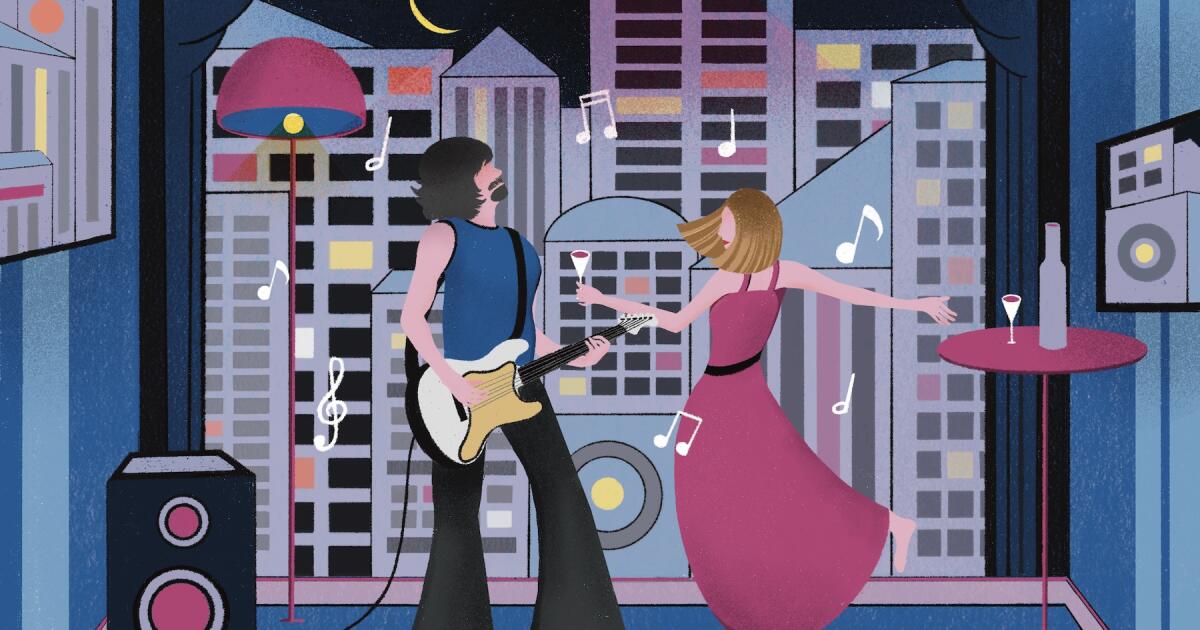
I was at dinner in Los Feliz recently trying to encourage a couple I’ve been friends with for more than 20 years to come see my boyfriend’s band play the following weekend. “It’s so fun,” I said. “It’s at a bar in the Valley, but Luis gives it the same energy as if he’s playing the Forum. Plus, it’s a Friday night. You can sleep in on Saturday.” They nodded their heads in consideration, and then the husband asked a perfectly reasonable question. “What time does he start?”
“Around 9,” I said. “Ish.”
Their faces lighted up and their eyes got wide as if I had just delivered the funniest punchline they’d ever heard. “Nine o’clock?!” the wife asked. “At night?”
“Well,” I admitted, “9:15. The latest 9:30.”
Her husband laughed and said, “We’re usually in bed by then.”
The wife added, “But if he ever plays a daytime gig, we’d love to come.”
I’ve had the same conversation with a variety of friends for years, and they usually end the same way. The truth is, I get it. Because on the nights that my blues-playing, guitar-slinging boyfriend doesn’t have a gig, we’re usually in bed by 9:30 too.
Luis and I met when we were in our 40s. He was my daughter’s guitar teacher, although taking her to her lessons fell under the jurisdiction of my late husband, Joel. Luis and I had met only a handful of times. Although I found him attractive, we were not on each other’s radars until I was nearly a year into my widowhood. A friend had invited me to one of his gigs, and I went. We got to talking and saw each other a few times over the next several weeks.
What we thought might be a fling turned into a bona fide relationship. It’s now been almost 10 years, and we haven’t just grown together as a couple, we’ve grown … old. Or maybe just older. We’re still youthful, but I haven’t been carded in ages, and oftentimes we text each other to see if one of us has the reading glasses the other can’t seem to find.
We used to look forward to getting couples massages together. Now, we’re excited when our colonoscopies are the same week. We used to frequent a neighborhood Italian restaurant and drink old-fashioneds and vodka martinis with our clams linguine and eggplant parm. Now, we frequent the pharmacy to make sure I keep an eye on my cholesterol and he has enough of his blood pressure medication.
Same thing with my friends, many of whom I’ve known since we were in our 20s. Back then, we’d talk obsessively about our fledgling careers and the people we would end up marrying, and we’d wonder if we really could have it all. Now, we talk constantly about our hormones (or lack thereof), how we’re handling our aging parents and how “kids today” — even our own — are plagued with anxiety and depression. Again, we’re not old, per se, but we’re not young either. Unless we live well past the age of 110, we’re not even middle-aged. So that segment of our lives is actually far behind us.
Joel, who died unexpectedly at age 50, was middle-aged in his 20s. Of course, at the time, we had no idea that that was the case. We weren’t a couple yet. When Joel and I met, we worked at a record label on the Sunset Strip. Part of our job was to see up-and-coming and established bands, sometimes several in one night. It wasn’t out of the ordinary to see the Rave-Ups play at the Palomino in North Hollywood at 9 p.m. and then rush over the hill to end the evening with an 11 p.m. set by the Red Hot Chili Peppers at the Hollywood Palladium. And that would be during the week. Neither of us would think twice about how late things got started or the distance we would travel. We loved seeing live music. It was fun. We were young.
It’s so cliché, but when I look at pictures of myself at that age, I think, “I was so cute. So open. So driven.” I had no idea what the future held: young widowhood, a major career change and love later in life with a man I’ll likely continue growing older with, a man who isn’t Joel.
Love with Luis has always been different. Maybe it’s because falling in love again, especially as a widow, was so unexpected. We had lived full lives by the time we got together. Although neither of us feels compelled to marry, we expect we’ll be grandparents together sometime in the future. That’s a thought that makes us smile.
All of this said, I’m convinced that playing music is what keeps Luis young. That, and his hair. He’s got a lot of it. Thick, wavy, even unruly at times. In our years together, it’s gotten more salt than pepper, but that hasn’t stopped anyone from asking if they could smell him. Yes, friends and strangers alike ask if they can get really close to him and take a whiff. We think this is strange. But he’s a charismatic and handsome musician, and this may just be par for the course.
When he’s onstage, singing with his band, jumping and kicking with his guitar strapped around his neck, it’s hard to believe he’s closer to 60 than 25. Maybe music is the fountain of youth. Or maybe it’s as simple as doing what you love. And I love being in the audience, watching him do what he loves. It’s something that makes me feel young too. Especially when it’s late on a Friday night, even if my friends have opted to stay home. They have no idea what they’re missing.
The author lives in Los Angeles and wrote the bestselling memoir “Widowish.” She is working on her second book, a middle-grade novel. She’s on Instagram: @melissagould_author
L.A. Affairs chronicles the search for romantic love in all its glorious expressions in the L.A. area, and we want to hear your true story. We pay $400 for a published essay. Email LAAffairs@latimes.com. You can find submission guidelines here. You can find past columns here.


People visit the Liberty Bell on the eve of Independence Day in Philadelphia on July 3, 2025. The crack in this symbol of U.S. freedom echoes the paradox between national pride and civic ignorance revealed in a new national poll.
Juan Mabromata/AFP/Getty Images
hide caption
toggle caption
Juan Mabromata/AFP/Getty Images
A new national poll reveals a striking paradox in public sentiment ahead of America’s 250th anniversary: a disconnect between Americans’ strong patriotic pride and their lack of civic knowledge.
According to a survey from the libertarian Cato Institute think tank of more than 2,000 U.S. adults conducted in late June, 86% of respondents said they are grateful to be American and 70% believe the nation’s founding principles remain relevant.
However, nearly half of Americans (46%) don’t know that America’s 250th anniversary commemorates the adoption of the Declaration of Independence.
This civic ignorance extends to basic governance: Nearly 60% do not know the main purpose of the U.S. Constitution is to limit government power, and do not know why the colonies declared independence from Great Britain.
Furthermore, the report highlights deep anxieties about the future of American liberty.
The majority of those surveyed believe the country has strayed from its founding principles, and more than half fear the U.S. could cease to be a free country within the next 50 years, citing corruption and the abuse of power as primary threats. The majority of both Republicans and Democrats share these fears.
The concerns are especially pronounced among Gen Z respondents, who exhibited both the lowest levels of civic knowledge and the least favorable views of the nation’s founders. The majority of Gen Z failed to cite the adoption of the Declaration of Independence as the source of the 250th anniversary.
“The lack of civic knowledge is a great disaster,” said Coe Professor of History and American Studies and Professor of Political Science Emeritus at Stanford University Jack Rakove. “Any democratic system of government to succeed requires having an informed electorate.”
The Pulitzer Prize-winning authority on the drafting of the Constitution and the Declaration of Independence blamed the problem on the fragmented media landscape and schools prioritizing STEM subjects over civics and history.
“Our educational system is highly decentralized. So the idea that you could have one clean, neat, sweeping educational reform that will cope with the problem is hard,” Rakove said. “And of course, and we do live in this disaggregated information environment where people pick the sources they like. If you assume that a Democratic society depends upon well-rounded deliberation of being exposed to the views of other people, the information environment itself is not conducive to the underlying foundation of Democratic debate.”

Unpacking my third suitcase in our new West Hollywood home, a sharp pain shot through my chest. I felt dizzy and short of breath before sprawling out on our mattress, which was still covered in plastic.
“What’s wrong?” David asked.
An hour later, on a gurney in the emergency room at Cedars-Sinai, I waited to be admitted overnight. What a great start to our new life — back in L.A. after seven years in New York City — David sleeping alone at our apartment while I was to keep close to the paddles and operating room in case what had just happened was a heart attack.
I was 33, practicing yoga and exercising almost daily. A few months earlier, my New York doctor noticed I had high blood pressure, and I was feeling terrible, so something clearly was going on. Was an artery blocked? Nope, the tests revealed; physically, I was fine. What had happened was a panic attack.
“Your health will be better in L.A.,” David had promised before returning to L.A.
Now I took no pleasure in his being wrong.
After growing up in Temple City (hardly L.A.), I went on a high school trip to the Big Apple and knew it was where I needed to be.
Exactly five years later, the time to escape California arrived after a miserable breakup from a three-year relationship with a guy that I hid entirely from my family. I was desperate and depressed, down 15 pounds from not eating much, my diet consisting largely of cigarettes and red wine. At the Archstone, my Studio City apartment, I did ecstasy alone on a Wednesday. One has to take a good look at himself when he’s in his bedroom, by himself, rolling, and so I decided it was time to start over in New York.
On the other side of the country, I thought it was normal to hook up with a new guy every third night. Which I suppose, for a gay man who’d spent the first 27 years of his life denying his sexuality to a family he feared wouldn’t understand, it was. My self-esteem was in the gutter, though you wouldn’t have known it from the outside.
After a three-digit number of hookups on Grindr, I met David, a guy who lived on the same Manhattan corner as I did. We did what people do on Grindr and hooked up a couple of times.
But one morning, we bumped into each other on 9th Avenue. I left our short chat feeling uplifted by how smiley and polite he was in daylight and while we were sober. That night, we went on our first date, and the rest is history. But I hid what I assumed wouldn’t be well-received.
“Let’s move back to L.A.,” he said after four years of life together in New York.
“I’m really not ready,” I said. I loved living in New York and never, ever expected to leave. He understood, but he wanted to return to “the coast.” I knew that in a healthy relationship, it couldn’t be just what I wanted. So eventually, we packed up and moved to an apartment on North Flores Street in West Hollywood.
And now, I was in the hospital.
After having to cancel the welcome home party our L.A. friends had planned for us, and being released from Cedars, my life fell apart. But being the one who kept everything together, I kept it together better than most would, at least in the presence of others.
I’m fine, I told myself, but I worried my heart was broken, and there was something medically wrong with it. To heal it, I’d need to accept truths that I didn’t want to.
Growing up was devastatingly hard for me. Being gay and misunderstood, with the unacknowledged pain of it kept inside, was quite literally eating me alive. Being back in L.A. meant being near my past. I told my mom I was gay before leaving for New York. She said she still loved and accepted me, but to this day, the struggle has never been discussed or acknowledged. I knew I was a disappointment to my family.
I went to Westwood what felt like 70 times, and after visiting a bunch of UCLA’s specialists, I found myself in the office of a neurosurgeon who took one look at me and said, “You don’t belong here. What you’re suffering from is plain old anxiety, and you’re going to have to work with your therapist on this.”
“I have been,” I said, “and it’s not helping.” But before I finished, he had walked out the door.
Before long, the panic attacks got so bad, I could hardly drive. David chauffeured me, under the palm trees and bright sun, around as much as his schedule allowed, and when he couldn’t, I made the best of it, lugging my laptop with me for the hour-long trek to yoga-teacher training at Equinox in the South Bay, using that extra time in the back of an Uber to write.
For almost my entire adult life, I’d been in therapy, but it was couples therapy with David where I felt supported enough to admit, first to myself, that I’d been terrified of being fully myself. I was afraid he’d leave me if he saw the real me. Secretly I had been keeping a lifetime of pain bottled up inside because of fear — I didn’t want to risk losing him by being too emotional or having too many feelings.
Three months after that therapy session, the pandemic arrived, and being together 100% of the time for the next year, I let him in fully. He didn’t run — instead, he proposed.
It’s been eight years since that neurologist, and six since I’ve been able to fully drive again. And here in L.A., in a city characterized by its distance, I have, with David, built a close chosen family that supports and fully understands me.
Now, I feel “at home” at our Spanish-style Hancock Park house, the one we bought because we wanted to start a family of our own, only after L.A. allowed me to heal and live peacefully, and now, anxiety free.
Had David not dragged me back, I wouldn’t have learned what I did about myself, my story of origin and living a life that’s so beautiful and that’s so true to me.
And certainly, we wouldn’t be bringing our baby daughter, Lucy, named after Lucille Ball (who’s more Hollywood?), home in mid-July by way of surrogacy.
The author is a writer and coach who helps established business owners build lives that feel as good as they look. He lives in Hancock Park. He’s on Instagram: @iammattgerlach.
L.A. Affairs chronicles the search for romantic love in all its glorious expressions in the L.A. area, and we want to hear your true story. We pay $400 for a published essay. Email LAAffairs@latimes.com. You can find submission guidelines here. You can find past columns here.

Could you see your life just as easily with children as without?
What if you’re not cut out for parenthood? What if you grow lonely in your old age? Or what if you have a loving partner, but you disagree on this choice? Deciding between parenthood and a child-free life requires clarity about your fears and deepest desires — no easy task. This episode, psychotherapist and author of the book, The Baby Decision, Merle Bombardieri, helps us get clear. She discusses minimizing regret, normalizing feeling ‘stuck’ and why waiting to have a baby at 38 may be best.
Want more about the decision to have kids?
Many women don’t want kids. And for good reason.
Why are people freaking out about the birth rate?
Support Public Media. Join NPR Plus.
Follow Brittany on Instagram: @bmluse
For handpicked podcast recommendations every week, subscribe to NPR’s Pod Club newsletter at npr.org/podclub.
Additional support for this episode came from Alexis Williams. It was edited by Neena Pathak. Our Supervising Producer is Cher Vincent. Our Executive Producer is Barton Girdwood. Our VP of Programming is Yolanda Sangweni.
-

 Austin, TX5 minutes ago
July 4th: Austin celebration preview, safety tips
-

 Alabama8 minutes ago
Alabama unveils the Alabama Catfish Trail
-

 Alaska13 minutes ago
Some of the best America has to offer can be seen at its national parks
-

 Arizona20 minutes ago
Milwaukee Brewers vs Arizona Diamondbacks score, lineups, live updates
-

 Arkansas23 minutes ago
Arkansas Game and Fish ramps up lake patrols for busy Fourth of July weekend
-

 California35 minutes ago
Mother, daughter found ‘alive and well’ after going missing on Southern California hiking trail
-

 Colorado38 minutes ago
Thousands forced to evacuate in Colorado as wildfire spreads
-

 Connecticut43 minutes ago
AGANORSA Leaf Aniversario Connecticut Tubo Ships

