Lifestyle
'I wanted to buy her time': A mother looks back on her daughter's terminal cancer


Sarah Wildman and Orli, photographed in early summer 2021. Orli was finishing a second round of chemotherapy after her liver cancer had metastasized when she was asked to participate in a project chronicling the beauty of baldness.
Abby Greenawalt/Sarah Wildman
hide caption
toggle caption
Abby Greenawalt/Sarah Wildman
In 2019, Sarah Wildman’s daughter, Orli, was just 10 when she was diagnosed with hepatoblastoma, a rare form a liver cancer. Over the next few years, Wildman chronicled Orli’s illness for The New York Times, where she is a staff writer and editor for the Opinion section.
Wildman’s articles detailed Orli’s bout with several rounds of chemo, a liver transplant, two brain surgeries and a tumor that pinched her spine, leaving her unable to walk. Orli died in March 2023, at the age of 14.
“I thought I understood pain, but she was facing a kind of pain I realized I really had never encountered,” Wildman says. “She would sometimes ask me, ‘What do you think I did to deserve this?’ And of course, that’s not an answerable question.”
Wildman also wrote about the expert medical care Orli received — and the unwillingness of some doctors and nurses to speak openly and realistically about what she was facing. Wildman believes the medical establishment tends to view the death of a child as a failure. As a result, she says, “there is a reluctance to face the idea that medicine has limits. … Children’s hospitals really are always advertising that they will cure children.”

Wildman says that Orli’s illness and death made her question her own Jewish faith: “I had to redefine what God meant to me. It couldn’t be waking up and saying a prayer in the morning or praying for something specific. … I had to really see it in the divinity of people who went out of their way to help us and that weren’t afraid of us.”
Orli would have turned 16 on Jan. 13. To mark the occasion, Wildman and her younger daughter, Hana, spent the weekend doing things that they thought Orli would have enjoyed doing.

“I think one of the really difficult things about facing a parent who has lost a child … is that you cannot make it better. There is no betterment of this,” she says. “What’s easier, though, is when people aren’t afraid of mentioning her name or reminding me of a story or telling me something I didn’t know that she’d told them or that she’d done for them.”
Interview highlights
On interviewing Orli on Instagram
I wanted people to see what it meant to be a kid in cancer care, a really articulate kid, a kid who was really grappling with it and thinking about it and considering it, especially at a time in the mid-pandemic where people were weary of lockdown, really feeling quite sorry for themselves. And what Orli does in that interview, in addition to sort of winning over everyone who watches it, is to sort of realign the way people are thinking about their own sadness, their own sense of isolation, and to show how she was so joyful even during extremely hard experiences.
On the questions Orli and her sister Hana asked that Wildman struggled to answer
At one point we had a very severe experience where Orli ended up in the ICU in Hawaii. We were on a Make-A-Wish trip. It was brutal and terrifying. And Hana said, “Do you think God doesn’t love us?” The kinds of questions that they asked during this really showed my hand, if you will. I was not able to really offer a concrete answer to any of these things. I would say I don’t think that there is a God that is that activist in this way — because there is so much pain around the world and we are experiencing this. But I don’t think it’s about God not loving us. You have to see divinity in the people who are helping us. I would try to turn it into thinking, “How can we see good in the situation?” But sometimes I was really stymied.
On parenting a child with a terminal illness
It really challenged parenting. … I didn’t know how to discipline in this space when all the rules seemed to have been thrown out the window. I didn’t know how to put limits on things. How do you put limits on phone use when you have so little outside interaction? How do you say you have to really focus on algebra when you don’t know actually if any of it will matter? It’s really difficult. And I once said to her, “Well, isn’t it good that we have so much time together, we really get to bond?” And she said, “This is the time I’m supposed to be breaking away from you.” She was hilarious and cynical and tenacious and would often really try to push the boundaries of permissibility when she could.

Orli (third from left) poses with her parents and sister Hana on her 13th birthday in 2022.
Miranda Chadwick/Sarah Wildman
hide caption
toggle caption
Miranda Chadwick/Sarah Wildman
On maintaining hope and optimism throughout Orli’s treatment
I think hope can be a form of denial. It can also be a motivating force. It can mean that you do seek out treatments that do give you days, months, maybe even years. I think that the hope is essential because cancer care is grueling. It can be demoralizing to face the consequences of cancer care. It can be the cancer care that itself comes with pain. It comes with nausea. It comes with hair loss. I can come with all sorts of indignities. …
It was brutal because she really tried to live each moment in such an enormous way. She really, really loved living and she would try to make life different in the hospital. I mean, she made every single nurse do TikTok dances with her. She would make the music therapists sing Lizzo and Olivia Rodrigo and Taylor Swift, and she would play Taylor Swift and Lizzo in every operating room. And she had many, many surgeries. She would force people again and again to see her not as a patient, but as a person.
I wanted to give her everything. I wanted to buy her time.
Monique Nazareth and Susan Nyakundi produced and edited this interview for broadcast. Bridget Bentz, Molly Seavy-Nesper and Beth Novey adapted it for the web.



Wyle, who spent 11 seasons on ER, returns to the hospital in The Pitt. Now in Season 2, the HBO series has earned praise for its depiction of the medical field. Originally broadcast April 21, 2025.
Hear The Original Interview
Television
After years of avoiding the ER, Noah Wyle feels ‘right at home’ in ‘The Pitt’

TMZ Live Stream
Come Into Our Office and Watch News Happen!!!
Published
We want you to be a part of TMZ, so every weekday, between 9:30 AM and 11:30 AM PT, we take you inside our newsroom via live stream.
You never know what you’re gonna get … a big story that breaks, an argument erupts in the room, or someone’s just joking around.
Your comments are a big part of the stream, and the staff spends a lot of time speaking directly to you. Every day is different!
We also use our live stream to produce our “TMZ Live” TV show.

From left: Noah Wyle plays Dr. Michael “Robby” Robinavitch, the senior attending physician, and Fiona Dourif plays Dr. Cassie McKay, a third-year resident, in a fictional Pittsburgh emergency department in the HBO Max series The Pitt.
Warrick Page/HBO Max
hide caption
toggle caption
Warrick Page/HBO Max
The first five minutes of the new season of The Pitt instantly capture the state of medicine in the mid-2020s: a hectic emergency department waiting room; a sign warning that aggressive behavior will not be tolerated; a memorial plaque for victims of a mass shooting; and a patient with large Ziploc bags filled to the brink with various supplements and homeopathic remedies.
Scenes from the new installment feel almost too recognizable to many doctors.
The return of the critically acclaimed medical drama streaming on HBO Max offers viewers a surprisingly realistic view of how doctors practice medicine in an age of political division, institutional mistrust and the corporatization of health care.
Each season covers one day in the kinetic, understaffed emergency department of a fictional Pittsburgh hospital, with each episode spanning a single hour of a 15-hour shift. That means there’s no time for romantic plots or far-fetched storylines that typically dominate medical dramas.
Instead, the fast-paced show takes viewers into the real world of the ER, complete with a firehose of medical jargon and the day-to-day struggles of those on the frontlines of the American health care system. It’s a microcosm of medicine — and of a fragmented United States.

Many doctors and health professionals praised season one of the series, and ER docs even invited the show’s star Noah Wyle to their annual conference in September.
So what do doctors think of the new season? As a medical student myself, I appreciated the dig at the “July effect” — the long-held belief that the quality of care decreases in July when newbie doctors start residency — rebranded “first week in July syndrome” by one of the characters.
That insider wink sets the tone for a season that Dr. Alok Patel, a pediatrician at Stanford Medicine Children’s Health, says is on point. Patel, who co-hosts the show’s companion podcast, watched the first nine episodes of the new installment and spoke to NPR about his first impressions.
To me, as a medical student, the first few scenes of the new season are pretty striking, and they resemble what modern-day emergency medicine looks and sounds like. From your point of view, how accurate is it?
I’ll say off the bat, when it comes to capturing the full essence of practicing health care — the highs, the lows and the frustrations — The Pitt is by far the most medically accurate show that I think has ever been created. And I’m not the only one to share that opinion. I hear that a lot from my colleagues.
OK, but is every shift really that chaotic?
I mean, obviously, it’s television. And I know a lot of ER doctors who watch the show and are like, “Hey, it’s really good, but not every shift is that crazy.” I’m like, “Come on, relax. It’s TV. You’ve got to take a little bit of liberties.”
As in its last season, The Pitt sheds light on the real — sometimes boring — bureaucratic burdens doctors deal with that often get in the way of good medicine. How does that resonate with real doctors?
There are so many topics that affect patient care that are not glorified. And so The Pitt did this really artful job of inserting these topics with the right characters and the right relatable scenarios. I don’t want to give anything away, but there’s a pretty relatable issue in season two with medical bills.
Right. Insurance seems to take center stage at times this season — almost as a character itself — which seems apt for this moment when many Americans are facing a sharp rise in costs. But these mundane — yet heartbreaking — moments don’t usually make their way into medical dramas, right?
I guarantee when people see this, they’re going to nod their head because they know someone who has been affected by a huge hospital bill.
If you’re going to tell a story about an emergency department that is being led by these compassionate health care workers doing everything they can for patients, you’ve got to make sure you insert all of health care into it.
As the characters juggle multiple patients each hour, a familiar motif returns: medical providers grappling with some heavy burdens outside of work.
Yeah, the reality is that if you’re working a busy shift and you have things happening in your personal life, the line between personal life and professional life gets blurred and people have moments.
The Pitt highlights that and it shows that doctors are real people. Nurses are actual human beings. And sometimes things happen, and it spills out into the workplace. It’s time we take a step back and not only recognize it, but also appreciate what people are dealing with.
2025 was another tough year for doctors. Many had to continue to battle misinformation while simultaneously practicing medicine. How does medical misinformation fit into season two?
I wouldn’t say it’s just mistrust of medicine. I mean that theme definitely shows up in The Pitt, but people are also just confused. They don’t know where to get their information from. They don’t know who to trust. They don’t know what the right decision is.
There’s one specific scene in season two that, again, no spoilers here, but involves somebody getting their information from social media. And that again is a very real theme.
In recent years, physical and verbal abuse of healthcare workers has risen, fueling mental health struggles among providers. The Pitt was praised for diving into this reality. Does it return this season?
The new season of The Pitt still has some of that tension between patients and health care professionals — and sometimes it’s completely projected or misdirected. People are frustrated, they get pissed off when they can’t see a doctor in time and they may act out.
The characters who get physically attacked in The Pitt just brush it off. That whole concept of having to suppress this aggression and then the frustration that there’s not enough protection for health care workers, that’s a very real issue.
A new attending physician, Dr. Baran Al-Hashimi, joins the cast this season. Sepideh Moafi plays her, and she works closely with the veteran attending physician, Dr. Michael “Robby” Robinavitch, played by Noah Wyle. What are your — and Robby’s — first impressions of her?
Right off the bat in the first episode, people get to meet this brilliant firecracker. Dr. Al-Hashimi, versus Dr. Robby, almost represents two generations of attending physicians. They’re almost on two sides of this coin, and there’s a little bit of clashing.
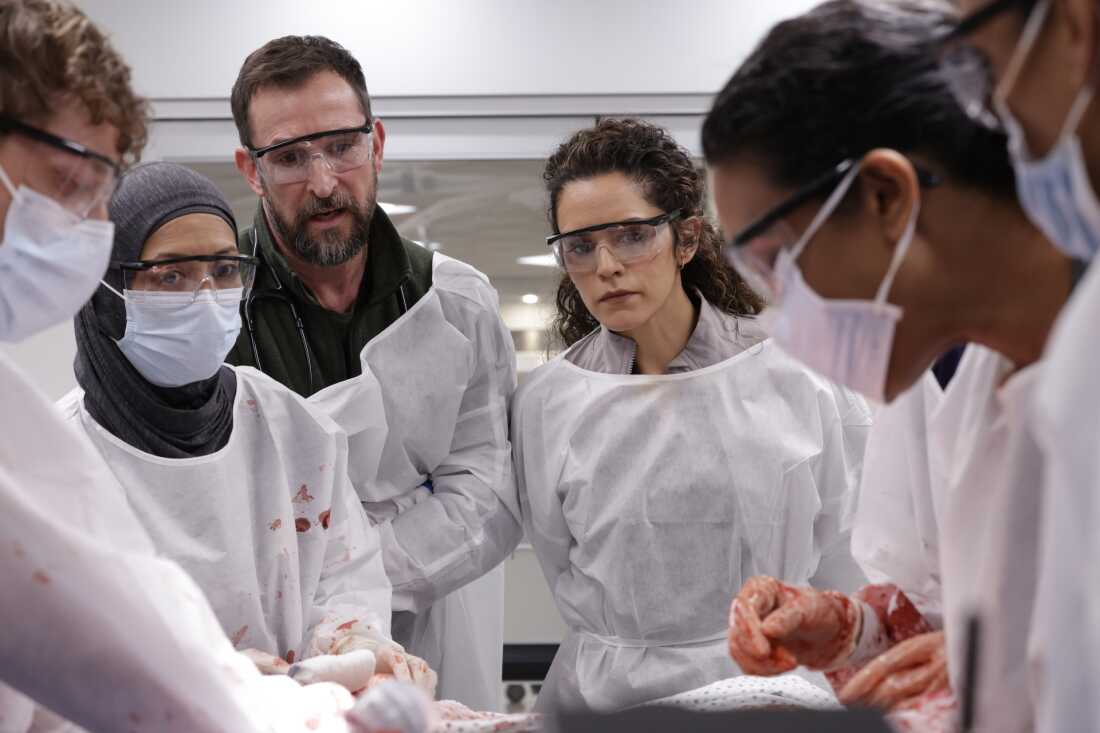
Sepideh Moafi, fourth from left, as Dr. Baran Al-Hashimi, the new attending physician, huddles with her team around a patient in a fictional Pittsburgh teaching hospital in the HBO Max series The Pitt.
Warrick Page/HBO Max
hide caption
toggle caption
Warrick Page/HBO Max
Part of that clash is her clear-eyed take on artificial intelligence and its role in medicine. And she thinks AI can help doctors document what’s happening with patients — also called charting — right?
Yep, Dr. Al-Hashimi is an advocate for AI tools in the ER because, I swear to God, they make health care workers’ lives more efficient. They make things such as charting faster, which is a theme that shows up in season two.
But then Dr. Robby gives a very interesting rebuttal to the widespread use of AI. The worry is that if we put AI tools everywhere, then all of a sudden, the financial arm of health care would say, “Cool, now you can double how many patients you see. We will not give you any more resources, but with these AI tools, you can generate more money for the system.”
The new installment also continues to touch on the growing corporatization of medicine. In season one we saw how Dr. Robby and his staff were being pushed to see more patients.
Yes, it really helps the audience understand the kind of stressors that people are dealing with while they’re just trying to take care of patients.
In the first season, when Dr. Robby kind of had that back and forth with the hospital administrator, doctors were immediately won over because that is such a big point of frustration — such a massive barrier.
There are so many more themes explored this season. What else should viewers look forward to?
I’m really excited for viewers to dive into the character development. It’s so reflective of how it really goes in residency. So much happens between your first year and second year of residency — not only in terms of your medical skill, but also in terms of your development as a person.
I think what’s also really fascinating is that The Pitt has life lessons buried in every episode. Sometimes you catch it immediately, sometimes it’s at the end, sometimes you catch it when you watch it again.
But it represents so much of humanity because humanity doesn’t get put on hold when you get sick — you just go to the hospital with your full self. And so every episode — every patient scenario — there is a lesson to learn.
Michal Ruprecht is a Stanford Global Health Media Fellow and a fourth-year medical student.

Chief marketing and communication officer named to Milwaukee Business Journal’s 40 Under 40 | Marquette Today

Flood watch expands into metro Atlanta ahead of severe storm threat

Prosecutors in DOJ’s Civil Rights Division will not investigate Minneapolis ICE shooting, sources say

Indianapolis Colts highest and lowest PFF grades on offense in 2025

O’Connor vows Pittsburgh won’t cooperate with ICE

Florida High School Football Rankings: Top 25 teams – Oct. 21

Cleary's 21 help Le Moyne down Central Connecticut State 69-64 in OT

How old is Bo Nix? What to know about Oregon quarterback ahead of 2024 NFL Draft

99th annual Pony Swim held in Virginia

Video: ‘It Didn’t Have to Happen This Way:’ U.Va. Faculty Call for Review of Police Response to Protests

AOC accuses Vance of believing ‘American people should be assassinated in the street’
Mercosur: How Macron’s domestic weakness undercut his Brussels clout

National Park Service will void passes with stickers over Trump’s face

Trump plans to meet with Venezuela opposition leader Maria Corina Machado next week

Trump says meeting Iran’s ‘Crown Prince’ Pahlavi would not be appropriate
-

 Detroit, MI6 days ago
2 hospitalized after shooting on Lodge Freeway in Detroit
-

 Technology3 days ago
Power bank feature creep is out of control
-

 Dallas, TX5 days ago
Defensive coordinator candidates who could improve Cowboys’ brutal secondary in 2026
-

 Health5 days ago
Viral New Year reset routine is helping people adopt healthier habits
-

 Iowa3 days ago
Pat McAfee praises Audi Crooks, plays hype song for Iowa State star
-

 Nebraska3 days ago
Oregon State LB transfer Dexter Foster commits to Nebraska
-
 Nebraska3 days ago
Nebraska-based pizza chain Godfather’s Pizza is set to open a new location in Queen Creek
-

 Missouri3 days ago
Damon Wilson II, Missouri DE in legal dispute with Georgia, to re-enter transfer portal: Source