Lifestyle
I spent the night in a lighthouse on a tiny California island. Here’s how you can too

You might be reluctant to stay at a $475-a-night inn that warns of flashing lights and foghorns throughout the night, or bans one-night guests from bathing, or requires that you be ready to climb a ladder above roiling seas.
But then you hear those four words:
Lighthouse on an island.
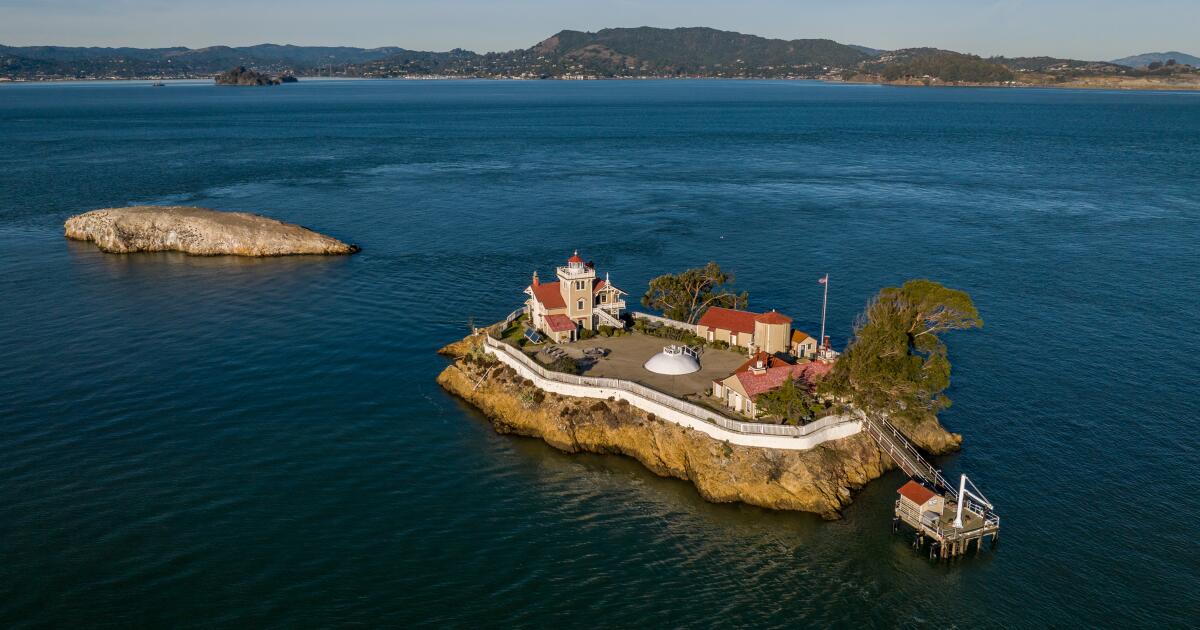
The East Brother Light Station is a compound of three buildings on a three-quarter-acre island near the eastern shore of San Francisco Bay. The main building is a four-bedroom 1873 Victorian home, topped by a beacon you can see from up to 13 miles off. And all of those bedrooms are rentable by the night, with a fancy dinner and breakfast included.
In December, I booked a night and made my way to Point San Pablo Harbor in Richmond, 20 miles north of San Francisco.
Point San Pablo Harbor, at the western edge of Richmond in East San Francisco Bay, is a bohemian community with one restaurant, one lighthouse bed-and-breakfast, a few dozen live-aboard boats in the marina and several leftover Burning Man sculptures along the shoreline.
(Christopher Reynolds / Los Angeles Times)
Point San Pablo Harbor, at the western edge of Richmond in East San Francisco Bay, is a bohemian community with one restaurant, one lighthouse bed-and-breakfast, a few dozen live-aboard boats in the marina and several leftover Burning Man sculptures along the shoreline.
(Christopher Reynolds / Los Angeles Times)
The first surprise was the crocodile. When you follow the two-lane approach road, you pass a few miles of mostly idle post-industrial waterfront, climb a hill, then descend to the harbor, where you are greeted by a 40-foot-long steel-and-ceramic crocodile, jaws open wide.
Nearby stands a Victrola-style trumpet tall enough to serenade Godzilla. Also a hippo-sized cat, a possible altar and several other large, mysterious sculptural objects, neighbored by a few yurts, a pen full of goats and a few dozen houseboats in the marina — rustic, artsy houseboats, boldly painted, with a pirate vibe.
At the base of the dock, a rustic patio restaurant called the Sailing Goat was serving lunch. In fact, I was gulping some of the Sailing Goat’s excellent clam chowder when my innkeepers’ 22-foot boat puttered up to the dock.
Innkeeper Dre Elmore prepares to captain the short boat trip from Point San Pablo Harbor to the bed and breakfast at East Brother Light Station.
(Loren Elliott / For The Times)
The 10-minute ride to the old lighthouse
Dre and Charity Elmore, both newcomers to California, started work in early 2023 as keepers of the East Brother Light Station Bed & Breakfast, a gig nearly as intriguing as the lighthouse itself.
Bundled in rain gear and eager to get back to their island before a downpour hit the launch, the two quickly embarked me and my overnight bag for the trip to the island.
Over the whine of the motor, Dre Elmore explained that many of the houseboat people seem to be live-aboard artists and musicians. As for the sculptures?
“From Burning Man,” he said.
On the quarter-mile ride to the island, the Elmores told me I’d be the only guest for the evening — others had canceled because of illness. Then they gave me the inn’s backstory.
The East Brother Light Station B&B stands on a tiny island in San Francisco Bay. Guests arrive by boat. (Christopher Reynolds / Los Angeles Times)
East Brother Island, neighbored by unbuilt West Brother Island, is in San Pablo Straight, where San Francisco Bay and San Pablo Bay meet. (Christopher Reynolds / Los Angeles Times)
From 1873 until the 1960s, East Brother Island was home to a manned lighthouse, using its beacon and horn to guide ships through the often-foggy strait that connects San Francisco Bay to San Pablo Bay.
Once automation arrived, the Coast Guard was ready to tear down the old keepers’ residence. That’s when Richmond’s preservationists rose up.
First they got the light station added to the National Register of Historic Places. Then they launched a campaign to restore the compound and run the keeper’s residence as a bed and breakfast. It would be a nonprofit operation, with proceeds paying for maintenance. The inn opened in 1980, renting two rooms.
There have been plenty of headwinds since then, including the pandemic, a damaged power cable and all the material woes that come with so much salty air and water. But the inn has grown to five rooms in the historic compound, open four nights a week.
Innkeeper Dre Elmore captains the short boat trip from Point San Pablo Harbor to the bed and breakfast at East Brother Light Station.
(Loren Elliott / For The Times)
Many guests are locals who have always wondered about this odd little island. Others are lighthouse aficionados who roam this country’s coasts, getting their U.S. Lighthouse Society passports stamped. (The last active lighthouse keeper in the U.S., Sally Snowman at Boston Light Beacon, retired in December, but those aficionados still have about 850 active and retired lighthouses to visit and admire.)
As our boat neared the light station’s pier, it became clear why this is not a destination for everyone. As the inn’s website warns, guests must be able to climb 4 to 12 feet up a ladder (depending on the tide) from bobbing boat to dock. Meanwhile, your innkeepers have to heave your luggage up from the boat.
It’s best to pack light. And once you’re on the island, expect a vibe that’s less Burning Man, more L.L. Bean.
The East Brother Light Station B&B, an 1873 building with four bedrooms, stands on a tiny island in San Francisco Bay. Guests arrive by boat.
(Christopher Reynolds / Los Angeles Times)
Visitors can roam. Or buy out the island.
The compound is surrounded by a white picket fence, as if this were just another slice of residential Americana. Charity Elmore leads guests on a tour that advances from the inn’s stately rooms — ready for an Agatha Christie mystery to break out at any moment — to the lighthouse tower and widow’s walk up top.
“This, right here, is the Lantern Room. That is the actual light that flashes on and off every five seconds,” Charity told me as the beacon blazed, darkened and blazed again. “It lets all the boats in the bay area know that we’re out here.”
The San Francisco and Marin rooms upstairs, which have commanding views, private bathrooms and cost $525, are the most popular among first-timers. I paid $475 to stay downstairs in the West Brother Room, which has a slightly less commanding view and shares a bathroom.
If you’re a boat person who savors the faint scent of diesel, however, you’ll want to book Walter’s Room, a small bedroom and sitting-room in the fog signal building. The bathroom is 25 feet away, but a barn-style door opens to a patio and spectacular view and there are no shared walls.
Then there’s the splurge option: You rent the whole inn for a $2,500 “house party” — room for 10-12 people, potentially including children, who are otherwise not allowed. That happen two or three times a month.
There are a few other lighthouse lodgings on the West Coast, including the hostel at Pigeon Point in Pescadero and the fancy B&B at Heceta Head near Yachats in Oregon. But where else on the West Coast can you buy out an island?
The East Brother Light Station B&B stands on a tiny island in San Francisco Bay.
(Christopher Reynolds / Los Angeles Times)
Whether you rent one room or all, Champagne and hors d’oeuvres are served in late afternoon — outdoors if the weather is mild. Then, in the spell before the bell rings for dinner in the dining room, you have time to roam.
You can head upstairs, where there’s a wood-burning stove and a room full of puzzles, board games and a guitar. There’s a horseshoe pitch on one side of the fog signal building. The cellphone coverage is fine, but there’s no WiFi, no land line, no hot tub.
So you do what they do in the L.L. Bean catalog: Stare meaningfully at the the swelling sea, the ferries and barges puttering past, the birds that perch on West Brother, the next island over. Farther away, you have the Richmond-San Rafael Bridge and the distant San Francisco skyline. In winter, clouds and fog permitting, you see the sun set behind Mt. Tamalpais.
The East Brother Light Station B&B stands on a tiny island in San Francisco Bay. (Christopher Reynolds / Los Angeles Times)
The East Brother Light Station B&B stands on a tiny island in San Francisco Bay. (Christopher Reynolds / Los Angeles Times)
The East Brother Light Station at dusk.
(Christopher Reynolds / Los Angeles Times)
After dark, I climbed the spiral staircase to the widow’s walk and stood by the pulsing beacon, which felt forbidden but isn’t. Then I dipped into a gift shop copy of “East Brother: History of an Island Light Station” by Frank Perry, and learned the following:
- To put a lighthouse on the domed stone island, 19th-century workers dynamited rock to flatten the top. Then they laid concrete sloping toward a spherical cistern in the middle of the island, to collect water. That’s still the water-storage system, and it’s why the innkeepers must hoard their freshwater.
- Beneath the main house’s stick-and-frame wooden exterior, it’s a brick building, which makes it more stable, warmer and quieter in the wind.
- The house was completed in 1873, but the lighthouse wasn’t illuminated until March 1874.
- In the old days, keepers rowed three miles across the bay to buy provisions at San Quentin, then rowed back, occasionally while drunk. In his January 1883 journal, keeper Charles F. Winsor complained that his assistant Mr. Page “took the mail over to San Quentin, returned drunk.” And then a month later: “Mr. Page went for mail and stores, drunk, no mail.” Soon after, Mr. Page departed the island.
A puzzle sits out in the game room of the bed and breakfast at East Brother Light Station.
(Loren Elliott / For The Times)
Now the keepers live in the smaller structure next door to the main building. They typically serve a two-year contract, then move on.
After dinner — a four-course event that on my night included tomato bisque, strawberry almond salad, salmon with remoulade, potatoes Dauphinois, roasted asparagus and New York cheesecake — the Elmores told tell me how they’d arrived.
Until early in 2023, they were living in Fairport, N.Y., along the Erie Canal outside Rochester. Charity Elmore, 56, was a project manager in high-tech. Dre Elmore, 57, had spent decades in publishing, then built a second career of maritime jobs, earning a Coast Guard master captain’s license for vessels up to 100 tons. He also liked cooking.
They were both ready for a big move, and and were chosen from more than 1,000 applicants for the East Brother gig. They started in March.
Charity: “You don’t find too many captains that are that good at cooking.”
Dre: “I’m the only 100-ton captain in the world that made three soups on Thursday.”
Charity: “Probably. There’s no data to back that up.”
Is it a dream job?
“It’s a lot of work,” Dre said, “but it’s definitely worth it to live out here.”
“It’s like a living museum,” Charity said.
Innkeeper Dre Elmore prepares to demonstrate the vintage foghorn at the East Brother Light Station B&B.
(Christopher Reynolds / Los Angeles Times)
What you see and hear overnight
That night it rained and the light station’s modern foghorn sounded every 30 seconds, as it routinely does from October to April. But it’s a mellow sound, like the call of an owl from across the street. Though the inn supplies ear plugs, I was never tempted to reach for them.
As for stray lighthouse beams, I saw none. After all, that rotating beacon up above is designed to scatter light far and wide, not straight down. I slept deeply.
In the morning, guests get a hearty breakfast. Before the 11 a.m. boat ride back to the mainland, Dre Elmore likes to show off the retired Fresnel lens and the array of still-working machinery in the fog signal building.
The machinery is fascinating. But the payoff for me came when he demonstrated the station’s rare 1934 diaphone fog signal, which sounds off with two descending blasts, basso profundo. When those bass notes sound, it won’t matter whether you’re in pirate mode, L.L. Bean mode or lighthouse geek mood. All your molecules will vibrate. In a good way.



Michelle Pfeiffer stars as Stacy Clyburn in The Madison.
Emerson Miller/Paramount+
hide caption
toggle caption
Emerson Miller/Paramount+
Since introducing his Yellowstone TV series, starring Kevin Costner, in 2018, Taylor Sheridan has made a very successful career of building dramas around veteran stars. Now Sheridan has a new official sequel series — Marshals, on CBS — and a seemingly unrelated series, The Madison, that I suspect will connect to the Yellowstone storyline before too long.
The Madison is a six-episode drama, starring Michelle Pfeiffer and Kurt Russell. It streamed half its episodes when it premiered March 14 on Paramount+ and has been renewed already for a second season. All six episodes were written by Sheridan and directed by Christina Alexandra Voros, who directed many episodes of both Yellowstone and its prequel, 1883.

The Madison is set up as a sort of dramatic Green Acres, and presents Pfeiffer and Russell as Stacy and Preston, wealthy New Yorkers who are close to approaching their 50th wedding anniversary. They have daughters, and granddaughters, and Preston also has a cabin and some land he shares with his brother Paul in Madison River Valley, Mont. He goes there when he can to relax; when he does, his wife Stacy stays behind in the city.
Before long, Stacy decides to take her daughters and granddaughters to see the Montana cabins for the first time. The whole family is there: One older divorced daughter with two girls — a teenager, and one in grade school — and the younger married daughter, who has just been mugged.

The Madison, like Yellowstone and all its prequel series, is all about legacy and responsibility and relationships — but focusing on the women instead of the men. Some scenes and concepts in The Madison are absurd in the extreme, like the idea that the streets of New York are more dangerous than any wild west. But there also are moments of true beauty and calm — and the valley setting itself, I suspect, eventually will link to previous series in the Yellowstone canon.
Fly-fishing figures prominently here, as it does in most other Yellowstone-connected series — but Sheridan and The Madison, with Russell fully enjoying the peace of the river, nails the emotion. The new CBS sequel, Marshals, which also has a male-bonding fly-fishing scene, does not.

Luke Grimes plays Kayce Dutton in Marshals.
Sonja Flemming/CBS Entertainment
hide caption
toggle caption
Sonja Flemming/CBS Entertainment
Marshals, which premiered March 1 on CBS, stars Luke Grimes as Kayce Dutton, one of the sons of Costner’s John Dutton from Yellowstone. Sheridan co-wrote the first episodes, but Marshals isn’t nearly as good a series as The Madison. It finds a way to get Kayce hired as a U.S. Marshal, but mostly to give the character a chance to run around with more advanced weaponry. And his relationship with his son Tate, played by Brecken Merrill from Yellowstone, is explored a lot less credibly, and dramatically, than the maternal dynamics on The Madison.
Marshals adds to the Yellowstone legacy, with its allusions to long-established storylines like a seventh-generation land surrender, and modern clashes that echo deadly standoffs of old. But it’s The Madison, like 1883 and 1923, that brings the best out of Sheridan. And bringing back veteran movie stars Pfeiffer and Russell? Even in a modern Western, that’s a real Bonanza.


Imagine waking up early, eager to peep dazzling carpets of brilliant orange flowers at the Antelope Valley California Poppy Reserve. Instagram posts promised a spectacle.
You drive to the reserve north of Los Angeles, but the rolling hills aren’t alive with color.
Bummer. The bloom is over.
Thanks to AI, and a local scientist, such disappointment may soon be a thing of the past.
This year, Steve Klosterman, a biologist who works on natural climate solutions, launched a “wildflower forecast,” powered by a deep-learning model, satellite imagery and weather data.
In a sense, Klosterman, of Santa Monica, developed the tool to meet his own need.
Last spring, the Midwest transplant was hankering to see some wildflowers. He assumed there was some online resource that offered predictions or leveraged satellite images.
“Surely, there must be something,” he recalled thinking. “But there was nothing.”
There are tools. The state reserve operates a live cam trained on one swath of land. Theodore Payne, a California native plant nursery and education center, runs a wildflower hotline, where people can call in and hear weekly recorded reports on hot spots.
“These are all essential resources,” Klosterman said. “At the same time, they’re limited.”
Klosterman isn’t green when it comes to plants. His PhD, at Harvard, focused on the timing of new leaves on trees in the spring and color change in the fall.
For a class project, a team he was part of built a website that predicted those leaf changes in the Boston area. It was a hit.
California poppies bloom in Lancaster, near the state natural reserve, in mid-March.
(Kayla Bartkowski / Los Angeles Times)
To create the poppy bloom predictor, Klosterman turned to AI initially developed for medical imaging. He has harnessed it to instead analyze satellite images of the Antelope Valley.
The model scans 10-by-10-meter squares of land to determine whether poppies are present by their telltale orange color. (It also identifies tiny yellow flowers called goldfields.)
The model is trained on satellite images — which go back nine years — along with past weather data.
It then uses the current forecast, and recent flower status, to peer into the future.
If the mercury is going to hit 100 degrees and wind is picking up — and in previous years that led to withering flowers — that will guide the prediction.
Right now, the model can forecast five days out and is, as Klosterman puts it, “very much a work in progress.” It would be better, more powerful, if it had 100 years to learn from.
As more data are collected, it might someday be able to forecast a week or two out.
Right now, poppies are popping at the reserve in the western Mojave Desert.
It rained throughout the fall and into winter, and poppies need at least seven inches of rain to make a good showing, said Lori Wear, an interpreter at the reserve.
Snowfall in January seems to push them to another level, but that didn’t happen this season. So it’s a good bloom, but not extraordinary, she said.
Still, poppies — California’s state flower — blanket swaths of the protected land.
“It almost looks like Cheeto dust,” she said, “like somebody had Cheetos on their fingers and just smeared it on the landscape.”
Poppies here have typically peaked around mid-April, but variable weather in recent years has made it hard to predict, she said. Klosterman believes right now is likely the zenith.
Also blooming now: goldfields, purple grape soda lupine and owl’s clover. Wear described the latter, also purple, as looking like a “short owl with little eyes looking at you and a little beak.”

An SUV drives through blooms near the reserve. “It almost looks like … somebody had Cheetos on their fingers and just smeared it on the landscape,” said Lori Wear, an interpreter at the reserve.
(Kayla Bartkowski / Los Angeles Times)
On Sunday, Klosterman experienced the blooms for himself, using his technology as a guide.
It offers predictions in two forms. The first is the amount of the valley — shown in a satellite image — covered in poppies and goldfields, expressed as a percentage. The other is an overlay of orange and yellow splotches on the land.
The map showed a fairly high concentration of poppies near a stretch of Highway 138. He went there and, lo and behold, vibrant flowers awaited him. He sent proof: a smiling selfie in front of a sea of blossoms.
Klosterman’s tool may help answer arguably more complex questions than poppy or no poppy, such as a more precise understanding of the conditions the flowers need to thrive.
Experts know rain is key, but it’s more complicated than that.

Steve Klosterman takes a selfie in a field of California poppies.
(Steve Klosterman)
Heavy rain can supercharge invasive grasses, crowding out the blooms. Natives actually tend to do better after several years of drought, once invasives not adapted to the arid climate die out. That’s what led to an epic superbloom in 2017, Joan Dudney, an assistant professor of forest ecology at UC Santa Barbara, told The Times in 2024.
Klosterman wondered if the recent heatwave would desiccate them. But his model didn’t show that, and neither did his trip. So it’s possible other factors play a significant role in their persistence, such as length of day.
The model could also shed light on what could happen to the flowers as the climate warms. Will they migrate to the north? Will there be fewer blooms?
To game that out, Klosterman said you could invent and plug in a weather forecast with higher temperatures.
For now, Klosterman’s forecast is limited to the Antelope Valley. But if it expands to other areas, and other flower types, it could help people like Karina Silva.
Silva woke up at 5 a.m. last Wednesday to travel from her Las Vegas home to Death Valley National Park, hoping to beat the heat and the crowds to the superbloom.
But several hours later, she and her husband, David, were still trying to find it.
The hillside behind her was sprinkled with desert golds, but the display fell short of the riotous eruption of flowers posted on social media. The superbloom ended in early March, according to park officials.
“I was just thinking it was going to be this explosion of different colors,” Silva said by the side of the road overlooking Badwater Basin.

Toxic
Confidence
Make way for a new attitude
Everywhere you look these days, the landscape is clogged with confidence men: People with limited experience landing high-ranking government roles. Networks helmed by leaders with scant broadcasting experience. Wellness empires built by entrepreneurs without medical training. An arrogant acquaintance whose presence you find thrilling, maybe.
Perhaps you, too, have noticed the decline in humble brags and performative apologies on social media? A concurrent rise in unshakable self-assurance, unsolicited advice and provocative hot takes? The overqualified don’t hesitate to remind you of their résumé; the underqualified declare themselves authorities; the appropriately qualified claim that their email job is “saving lives.”
If ChatGPT can replace us while insisting that there are only two Rs in the word “strawberry,” it’s no wonder some see the time for a spiky new affect.
“Everyone’s trying influencing; everyone’s paywalling their Substacks,” said Gutes Guterman, 29, a founder of the magazine Byline. “You have to seem like an expert for people to believe in you.”
Amelia Dimoldenberg, a comedian who has made a career out of charming celebrities in her YouTube video series “Chicken Shop Date,” was an early adopter. Deploying the attitude — perhaps the natural register of flirtation — to great effect, she reliably convinces her A-list guests that they are probably a little bit in love with her.
And it has a natural progenitor in drag and hip-hop culture, where reads, diss tracks and storied beefs are founded on inflated egos. It’s the inner voice that drives someone to put out a song titled “I Am a God” and set out to conquer other industries.
Still, it used to be that “impostor syndrome” dominated conversations, the anxious stance of millennials with adult responsibilities and women leading corporate workplaces trying not to rankle. Even if you felt deserving of accolades, the social graces of the time required the expression of modesty.
Now, in an era of aggressively handsome incels and macho political posturing, cultivated humility feels trite. A younger generation, coming out of high school and college in Covid lockdown, feels less beholden to dampening their light. Who has time for affected meekness when playing the braggart not only tickles the soul, but has the potential to convince others of one’s own greatness?
“You’re standing on the ledge, wondering, ‘Should I dive in?’” said the actor and comedian Ivy Wolk on an episode of the popular TikTok show “Subway Takes,” summing up the potential pitfalls of self-doubt. At the same time, she added, other people are coming up behind you “ready to jump.”
Maybe It’s Fun?
It’s partly a product of a new media environment. On platforms like Substack and TikTok, where success relies on convincing others to invest in your singular personality, showing vulnerability or doubt can be risky. Whether it’s posting about a reading series at your local bar or achieving internet notoriety by instructing young men on how to become “gigachads,” these ventures require being bullish on one’s own value.
At its least offensive, toxic confidence is low stakes and entertaining. It’s newsletter writers filling your inbox with unsolicited gift guides and dishy, unedited diary entries. It’s that mediocre actor you barely dated starting a podcast with a paywall and calling herself a political pundit. It is the author Lisa Taddeo directing a post on Instagram to the winners of a fellowship she had been not been granted: “I’ll be watching what you do. I hope it’s better than what I do. But I don’t think it will be. Because what I’m doing is going to be EXCEPTIONAL.”
It’s whatever drives the chaos agents in your orbit to become life coaches.
Perhaps a simple truth is that toxic confidence is charming if you like the person and intolerable if you don’t.
Consider Amanda Frances, a new cast member of “The Real Housewives of Beverly Hills” who has embraced the moniker of “Money Queen” and says she made her fortune selling money manifestation courses.
“I had no formal business experience,” she told her castmate Bozoma Saint John, the first Black C-suite executive at Netflix, over lunch. “I found out I had a gift around, like, the energetic part of money.”
Later, Ms. Saint John gossiped to another castmate, Rachel Zoe, about the interaction: “You’ve never had a job before, so how are you telling people how to get money?”
All of this bravado probably owes something to President Trump, who is known for — among other swaggering displays — using superlatives to boast of his intelligence.
“Nobody knows more about taxes than me, maybe in the history of the world,” he once claimed, for example.
Rarely does Mr. Trump shy from holding forth in speeches and free-associative monologues beyond those typical of presidents. It has become a modus operandi for his administration. Last September, for example, Secretary of Defense Pete Hegseth summoned hundreds of the U.S. military’s top officials to the Marine Corps base in Quantico, Va., for a widely broadcast, in-person meeting.
Highly decorated admirals and generals sat stone-faced as Mr. Hegseth delivered a nearly hourlong speech. He concluded the address by warning enemies abroad with the acronym “FAFO” — language more commonly found in online circles than in formal military settings, roughly translating to “mess around and find out.”
The proclamation was met with minimal audience response — a lonely woo from the crowd — and the assembly was later described as a “waste of time” by former Secretary of Defense Leon Panetta. Senate Democrats estimated the event’s cost at roughly $6 million in taxpayer funds.
Borrowed Ego
If we occasionally find ourselves in the thrall to confidence men, it may be because we desire a bit of what they have.
Looking up to someone bold and brash can give one “that feeling of borrowing ego strength,” said Rachel Easterly, a psychotherapist based in Brooklyn. She referred to narcissism in children, an otherwise normal phase of childhood development.
“It’s very frightening to be a small, helpless person — you’re in a world where you don’t have a lot of power, so you compensate with this defense,” Ms. Easterly said. “It can happen on a societal level.” When Freud, Donald Winnicott and others were developing their theories on why people were drawn to cults of personality, she said, it was “in the context of societal collapse and war.”
“We are feeling similar sorts of existential dread as adults now,” she added, “in terms of nihilism in our culture, climate change, income inequality.”
That may be why so many were drawn to “Marty Supreme,” last year’s blockbuster about a striving table tennis wunderkind, and captivated by Timothée Chalamet’s brashness in promoting it.
“This is probably my best performance, you know, and it’s been like seven, eight years that I feel like I’ve been handing in really, really committed, top-of-the-line performances,” Mr. Chalamet, the film’s lead, said in an interview last year.
“This is really some top-level stuff,” he added, using an expletive.
Mr. Chalamet collected a Golden Globe and a Critics Choice Award for his portrayal of Marty. But by the time the Academy Awards rolled around, he had gotten a bit too comfortable in the culture’s embrace of his toxic confidence, and it quickly turned Icarian.
In a sit-down with the actor Matthew McConaughey, Mr. Chalamet claimed that “no one cares about” opera and ballet. It didn’t seem to occur to him to backtrack or to try to reassure members of those communities of his admiration. Instead, he doubled down, taking aim at artists’ lack of income: “I just lost 14 cents in viewership.”
Punching down is one way to make these high levels of confidence less charming. Those who manage to pull it off tend to be those who are not enjoying their success at another’s expense. Light ribbing is passable.
At the Winter Olympics in Milan, the Chinese freestyle skier Eileen Gu exhibited a bubblier version of toxic confidence as she described what it was like to be inside her own head (“not a bad place to be”) and what she would tell her younger self (“I would love me, and that’s the biggest flex of all time”). She was also honest about the intensive routines she maintains so that she can compete in the Olympics, study quantum physics at Stanford and model with IMG — and the enormous pressure she puts on herself to keep it all up.
That makes it difficult to argue that moments like this are unearned: After winning gold in the women’s halfpipe and two additional silver medals this winter, a reporter asked if she considered her achievements “two silvers gained” or “two golds lost.”
She broke into laughter: “I am the most decorated female free skier in history.”
Don’t Be Coy
For those who aren’t multihyphenate Olympians, it’s possible that beneath the slick veneer of seemingly absolute assurance remains the same anxious, uncertain person merely following the new social dictates of the moment.
“I genuinely don’t know if everyone believes in themselves as much as they say they do, but I think it’s sort of the only option,” said Ms. Guterman, the magazine founder, who described herself as “appropriately” confident. “Because if you don’t really believe in yourself right now, you don’t really have anything going for you.”
The mentality seems to have helped Ms. Wolk. After being forced to delete her social media by a cable network as a teenager, she kept posting anyway, quickly gaining half a million followers. Last year, after a turn in the film “Anora,” Ms. Wolk, now 21, portrayed a brutally assertive, pigtailed motel clerk in the A24 mommy-horror flick “If I Had Legs I’d Kick You,” working alongside ASAP Rocky and Rose Byrne.
If you have a goal, it doesn’t serve you to be coy about it, Ms. Wolk said over the phone. “You can’t lie down and hope that opportunities just come up,” she said. “You have to go out and grab it and say yes.” •
Share this with someone who needs more toxic confidence.

Toxic
Confidence

Hundreds of thousands march through London in stand against the far right

2 students killed, 7 other people injured in Tennessee bus crash during school field trip

Three Detroit Pistons Players That Have Impressed Most Without Cade Cunningham

People We Meet: Ranjit Brar’s ‘horrible’ road led him back to San Francisco

Cowboys Showing Significant Interest in Son of Philadelphia Eagles Legend

Florida High School Football Rankings: Top 25 teams – Oct. 21

How old is Bo Nix? What to know about Oregon quarterback ahead of 2024 NFL Draft

Cleary's 21 help Le Moyne down Central Connecticut State 69-64 in OT

99th annual Pony Swim held in Virginia

Indiana Members Credit Union announced as new anchor tenant at Bottleworks District
Hundreds of thousands march through London in stand against the far right
2 students killed, 7 other people injured in Tennessee bus crash during school field trip

Dem senators dodge crucial question on illegal alien accused of killing Chicago college student

EU Parliament unblocks key political hurdle in digital euro talks

Man arrested in plot to firebomb Palestinian activist’s home after undercover op
-

 Detroit, MI1 week ago
Drummer Brian Pastoria, longtime Detroit music advocate, dies at 68
-

 Movie Reviews1 week ago
‘Youth’ Twitter review: Ken Karunaas impresses audiences; Suraj Venjaramoodu adds charm; music wins praise | – The Times of India
-

 Sports1 week ago
IOC addresses execution of 19-year-old Iranian wrestler Saleh Mohammadi
-

 New Mexico6 days ago
Clovis shooting leaves one dead, four injured
-
 Business1 week ago
Disney’s new CEO says his focus is on storytelling and creativity
-

 Tennessee5 days ago
Tennessee Police Investigating Alleged Assault Involving ‘Reacher’ Star Alan Ritchson
-

 Technology6 days ago
YouTube job scam text: How to spot it fast
-

 Texas1 week ago
How to buy Houston vs. Texas A&M 2026 March Madness tickets