Lifestyle
I asked about race on reality shows at the TV critics press tour. It didn't go well


The Bachelor producers Jason Ehrlich, Claire Freeland and Bennett Graebner answered questions at the TV Critics Association’s winter press tour.
PictureGroup/Disney
hide caption
toggle caption
PictureGroup/Disney

The Bachelor producers Jason Ehrlich, Claire Freeland and Bennett Graebner answered questions at the TV Critics Association’s winter press tour.
PictureGroup/Disney
Just when you think the TV industry has learned an important lesson, something can happen to remind you that – in some corners of the business – progress is fleeting as chalk marks in a rainstorm.
Consider my recent experience quizzing producers from ABC’s franchise The Bachelor/The Bachelorette during a press conference at the TV Critics Association’s winter press tour.
I saw a rare opportunity to spark a meaningful conversation about race, with one question: Why does the show find it so difficult to handle race issues?
For years, I’ve covered how the dating competition has had few Black leads. Alumni Rachel Lindsay and Matt James have criticized how the show handled race during their seasons and a race-based controversy during James’ season in 2021 led to the departure of longtime host Chris Harrison.
Producer Claire Freeland, who hadn’t worked on those earlier editions of the show, spoke about what the program was trying to do now. But that wasn’t answering the question, I insisted. Why has the show struggled on these issues in the past — particularly when Black people are the stars — and what might they have learned moving forward?
Neither Freeland nor fellow Bachelor producers Jason Ehrlich or Bennett Graebner said anything for about eight seconds. “I guess we have our answer,” I noted; as the questioning moved on, some critics marveled at a silence that seemed to speak volumes.
Trade publications like Variety and The Hollywood Reporter did stories on their reaction and the producers tried to clean up the situation by talking to some reporters after the press conference. But that exchange reinforced my hunch that the show’s producers have never found a way to grapple with how white-centered the show is, how difficult that centering makes it for people of color who appear on the program and how that failure leaves them unable to respond well when problems involving racial issues arise.
John Landgraf, chairman of FX Content & FX Productions, speaks at the 2024 Winter TCA press tour.
Frank Micelotta/PictureGroup/FX
hide caption
toggle caption
Frank Micelotta/PictureGroup/FX
John Landgraf, chairman of FX Content & FX Productions, speaks at the 2024 Winter TCA press tour.
Frank Micelotta/PictureGroup/FX
Or even when someone just asks about race.
For me, it’s also part of a larger issue, where TV programmers have a tough time acknowledging problematic messages in their product – let alone eliminating them. It’s a flashback to the bad old days many years ago, when TV casts and production staffs were even less diverse, and obvious questions about race brought the same, stunned silences.
And that’s not all I learned during the press tour. Here are a few takeaways about TV that surfaced over my time in Los Angeles.
The apex of Peak TV may have passed, but there are still too many series on television
FX chairman John Landgraf’s executive sessions at the press tour have emerged as a sort of State of Union for the TV industry, where the famously data-driven executive rolls out facts and figures to assess the trends ahead.
The good news for an industry drowning in content: Last year, the number of original series fell by 14% to 516 shows.
The bad news is that it still feels like too many series for most consumers to keep track of or for the industry to keep financing.
Speaking at a TCA session back in 2015, Landgraf described a phenomenon that became known as “Peak TV” to describe a situation where viewers were overwhelmed by the massive numbers of shows available – then at a measly 400 or so. His fear was that the industry was building a bubble that would burst in a rush, as programmers were forced to cancel masses of series unable to find audiences.
Instead, TV platforms have eased back their portfolios after reaching a historic high of 600 series in 2022. They’ve slowed production, canceled some shows, and even pulled completed programs off streaming services completely for tax benefits – as Wall Street investors demand online platforms show practical plans to turn a profit and the impact of last year’s strikes in Hollywood plays out.
Still, as Landgraf admitted to me after his press conference, 516 shows are probably too many. Ensuring that great shows still find an audience – and the overall field remains diverse and open to creative voices of all types – is the tension that will continue to challenge executives like him for quite a while.
Even the people who make TV aren’t sure where the industry is headed
If anything else jumped out during my discussions with TV executives, it’s how unsettled people are by an unpredictable post-strike environment, tightening economic conditions (including layoffs at many media companies), and continuing uncertainty about what makes a series a hit.
Midlevel streaming services like Peacock and Paramount+ are feeling the squeeze, as big players like Disney+ and Netflix get bigger and smaller, boutique competitors focus tightly on their target audiences (small wonder, then, that the Wall Street Journal recently reported the two streamers have talked about joining forces or even a merger, days after Disney, Fox and Warner Bros. Discovery announced plans to team up on a sports streaming platform).
Meanwhile, the same media companies that yanked their prime library series from Netflix to keep it from dominating the future of TV have now begun licensing shows back to them – allowing programs like NBC’s This Is Us, HBO’s Six Feet Under and ABC’s Lost. It feels like everyone is heading back to the future, repeating some of the same mistakes they made the first time.
Does this lead Landgraf, who warned years ago about the danger of ceding too much space to Netflix, to feel like the gigantic service won the streaming wars?
“I have always worried about Netflix’s appetite [but] I wouldn’t say that … the streaming wars are over,” he told critics, touting the online success of the company that owns FX, Disney. “I think every market functions better when it’s not dominated by a single entity that then dictates the terms.”
This means consumers can expect the fragmentation and uncertainty to remain – which might not be bad.


In central London’s Waterloo Place, a life-size statue that emerged overnight in late April has been creating a stir. When I visited a few weeks after it was erected, local authorities had already set up protective barriers around it.
The installation — signed by the famed street artist Banksy — depicts a man in a suit hoisting a flag as he strides over a precipice. As he marches on, the flag blows backward to cover his face, leaving him unaware he’s only a step away from a perilous fall.
Set among grand monuments celebrating Britain’s past, the “flag man” takes on a particular visual irony at a time when the country — and much of the world — is debating its path forward.
Like many viewers there, I found myself wondering whether this statue is Banksy’s warning about the consequences of uncritical nationalism, or simply a reflection on human shortsightedness. Or, perhaps, it is just prompting us to ponder a broader question: What happens when devotion to a symbol prevents us from seeing what lies ahead?
Whatever the message, the work feels remarkably attuned to the current moment.
For more Far-Flung Postcards, click here.
Lifestyle
Wait, it’s a candle? Her beeswax fruit and veggie ones look so real, you’ll want to take a bite
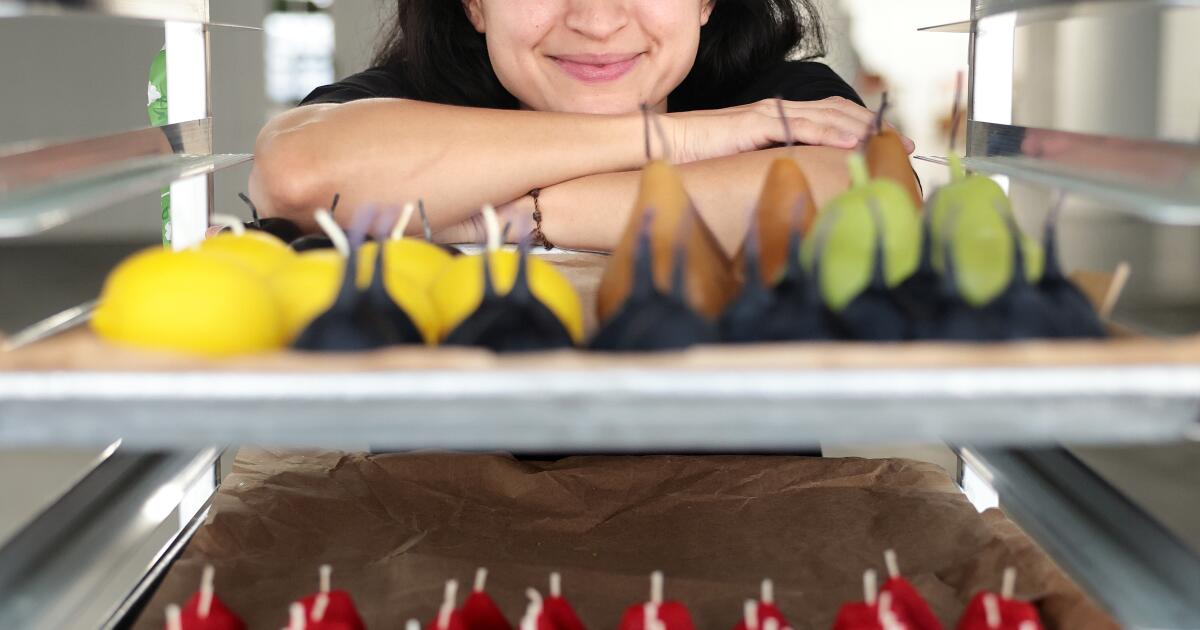
Jessica Gonzalez hustles behind her booth at the recent Renegade Craft Fair, frantically ringing up sales, answering questions and packaging her beeswax candles.
It’s hot on the grounds of the Los Angeles State Historic Park in April, but 35-year-old Gonzalez and her fiancé, Jordan Colindres, keep their cool as a crowd gathers to admire her Happy Organics candle collection, a homage to her family’s produce company in the Central Valley that looks like real fruits and vegetables.
“I love doing in-person events because it’s so fun to see people’s reactions,” she said a few months later. “It makes me feel good to see other people finding joy in my candles. They often say, ‘Oh, that’s really funny.’ And it is funny to have a cherry candle on top of your birthday cake.”

3

1. A staff member pulls a beeswax corn candle, $26, out of its mold at Happy Organics’ studio in downtown Los Angeles. 2. Each Beeswax Mixed Berry Birthday Candles set is cast from real mixed berries — strawberries, raspberries, blackberries, blueberries and cherries. A set of 10 is $30. 3. Bartlett green pears and heirloom tomatoes, $24 to $40.
Judging by the smiles and charmed looks on shoppers’ faces, her produce-inspired candles are less about illuminating rooms and more about sharing the joy she sought when she first started the company in 2018.
In this series, we highlight independent makers and artists, from glassblowers to fiber artists, who are creating original products in and around Los Angeles.
But then, it’s hard not to smile at the playfully elegant Bosc pears, puckered mandarins and green-and-purple asparagus taper candles which range in price from $12 to $40. Some are molded into corn on the cob, celery and rhubarb shapes. Others are made to look like mushrooms, figs, tomatoes and snap peas. The most popular are the small birthday candles shaped like raspberries, cherries and blackberries, packed in molded-pulp baskets just like you’d find at the grocery store or farmers market.

-
Share via
Gonzalez didn’t start out as a designer. The youngest of nine children, she was born in 1991 in Salinas and later moved to Merced, where she grew up on a 10-acre farm. She studied computer science at Mills College, then worked in tech consulting in the Bay Area and eventually became the CTO of an ag-tech company. When her mother, Angela, became ill in 2016, she returned to Merced to be with her family.
When her mom died suddenly soon after she moved home, Gonzalez left the tech industry. “I wasn’t connected with what I was doing,” she said. “I wanted to find something more meaningful; something I loved. I didn’t want my ego to keep me stuck in what I studied in college. I decided to let myself try new hobbies and passions and look for joy again.”
After her mother’s death, she began working with her father, Salvador, and her uncles at the family’s apiary, where they managed more than 30 hives. (Her grandfather was also a beekeeper in Michoacán, Mexico.) Soon, she began selling their raw honey at local farmers markets. In a heartbreaking turn, her father was diagnosed with cancer a year later, so she started making cannabis-infused honey, balms and chocolates to help ease his pain.
When she saw that the beeswax candles, which last significantly longer than paraffin candles, were selling faster than the honey, she decided to focus on making candles from the leftovers from her uncles’ hives.
She was only 25, but it was a turning point. “It was one of those moments where I felt like I needed to change my path,” she said. “I needed to change everything in my life.”

Jessica Gonzalez and her father Salvador on their family farm in Merced. (Gonzalez family)

Gonzalez at Happy Organics’ studio in downtown Los Angeles. (Christina House / Los Angeles Times)
When her father died in 2018, she inherited his bees and started Happy Organics, although she hadn’t planned on starting a business. After experiencing so much loss, making candles became a kind of therapy. “It felt great to work with my hands again, something I thought I’d never have time for,” she said.
Her oldest sister, Sonia Gonzalez, said Gonzalez reminds her a lot of their father, who reinvented himself many times over the years.


The nopal cactus is cast from a real nopal and hand-poured in 100% pure beeswax in the Los Angeles studio.
“He grew up as a village boy in the rural mountains of Michoacán, Mexico, and went on to work in restaurants, cut down Christmas trees and pick strawberries and broccoli in the fields of Salinas,” she wrote in an email. “From there, he started selling produce door-to-door, then at flea markets and eventually built his own produce distribution business from the ground up. As the youngest of nine kids from a working-class family, Jessica’s always been incredibly resourceful, responsible, and amazing at reinventing herself.”
Like a lot of millennials, Gonzalez taught herself how to make candles by watching YouTube videos. She started with hand-dipped tapers, working in the garage on the farm that helped her feel safe and connected to her parents. “It was a really nice environment to try something new and creative,” she said.
Inspired by her family’s produce, she cast real corn, strawberries and cherries in plaster, then made a silicone mold to create copies. Even when using the same mold, color can vary from batch to batch, and how it cools also affects the result. “That’s just how handmade things are,” she said. “There’s always some variation.”

Cherry molds make cherry candles at Happy Organics’ studio in downtown Los Angeles.

A variety of fruit and veggie candles.
When she moved to Los Angeles in 2023 to be with Colindres, her business took off. “L.A. is a great place to grow,” she said. “There’s so much opportunity here. When I go to a farmers market, I never know who I’ll meet.”
She sold her candles in person at craft shows, the Hollywood Farmers’ Market and most recently, during a residency at the P.F. Candle Co. showroom in Echo Park.

2

3

1. A staff member trims the wicks on a pair of carrot birthday candles, $22. 2. Gonzalez passes by shelves of candles at Happy Organics’ studio in downtown Los Angeles. 3. Asparagus taper candles, $30.
“I have a lot of respect for her as a fellow candle maker (making molds is not easy), but getting to know her story more and how her choice of foods and wax is reflective of her family’s history gave it so much meaning,” P.F. Candle Co. founder and creative director Kristen Pumphrey said in an email. “It’s been a tough couple of years for L.A. businesses, so we gotta stick together — there’s this wonderful sense of community hosting a local brand that’s so passionate about their work.”
As her business has expanded, her products are now available at Terrain, Joan’s on Third and the MoMA Design Store in addition to her website. She has also had to source beeswax from other vendors across the country to keep up with demand.
Kimberly Curtis, owner of Hide & Seek Vintage in Studio City, said Gonzalez’s strawberry and cherry birthday candles “flew off the shelves last year” during the holidays. “Our customers love them,” she added.

Gonzalez holds a cabbage candle.
Still, Gonzalez stays connected to her Central Valley roots. Everything she and her small team make in downtown Los Angeles is handmade and “takes time,” she said, describing the steps involved in crafting quality candles. Right now, her favorite is the Nopal Cactus candle, which she made using a clipping from an employee’s yard. While others help her with production, wholesale management and packaging, she focuses on sales, content and all-new product development.
When asked if she has advice for others who want to start their own business, Gonzalez admits she sometimes feels overwhelmed.

In 2013, Gonzalez and her family gathered at their Merced ranch to celebrate her parents’ anniversary.
(Gonzalez family)
“The biggest thing that has gotten me through the toughest spots is my why or my reason for starting,” she said. “I think that has to be really strong. That’s what brought me a lot of comfort when I felt like quitting: going back to the beginning and remembering why I started this.”
For Gonzalez, her reason is always close to her heart. “I wanted to feel connected to my parents in some way,” she said. “This was a good representation of my upbringing.”

The Kennedy Center, the facade of which remains covered with a tarp, is seen in Washington, DC, on June 28, 2026. A US federal judge asked on June 24 for an explanation for why a tarpaulin continues to cover the facade of the Kennedy Center where President Donald Trump’s name was recently removed. District Judge Christopher Cooper gave the board of trustees of the performing arts venue until the end of July to explain “the purpose for and status of the tarp and scaffolding that Defendants have erected on the front portico of the Center.”
ALEX WROBLEWSKI/AFP via Getty Images
hide caption
toggle caption
ALEX WROBLEWSKI/AFP via Getty Images
More than two weeks ago, President Trump’s name was removed from the Kennedy Center facade though it is still covered by a tarp and the legal battle continues.
On Monday, a U.S. Department of Justice filing on behalf of the Kennedy Center included some surprises. The document was submitted in response to issues raised by lawyers for ex-officio board member Rep. Joyce Beatty of Ohio who is suing to remove President Trump’s name from the center and stop its closure for renovations.
Among the revelations, the Kennedy Center admitted that, during a board meeting on December 18, 2025, Beatty had been “muted and prevented from speaking.” It was at that meeting that the board voted to add President Trump’s name to the center. The filing later acknowledges the congresswoman was “prevented from voicing her opposition.”
The John F. Kennedy Center for the Performing Arts is a living memorial to its namesake. The guidelines for how the theatre complex spends federal dollars are very specific. Among other rules, it states that “no additional memorials or plaques shall be designated or installed.” Beatty argues adding Trump’s name runs afoul of those rules and that any change requires approval from Congress.
According to one of Beatty’s filings, “There was no advance notice in the agenda that the Board would be considering a name change,” a statement the Kennedy Center now does not deny. The center admits that, prior to voting, there was “no discussion about potential risks or downsides of the vote to adopt a secondary name for the Center.” Nor was there a board discussion “about any potential conflict of interest that might result from the vote.”
The center’s lawyers previously contended that if Trump’s name were to be removed, it would “lose money from donors who support” him and “impede the Center’s fundraising efforts.”
Closing for renovations
Earlier this year, Trump announced on social media that the Kennedy Center would close for two years for renovations. He wrote that he made the decision after “a one year review” with “Contractors, Musical Experts, Art Institutions, and other Advisors and Consultants.”
But, according to the center’s lawyers, Trump’s announcement “was made without presenting any plans, analyses, timelines, or funding information to his cotrustees and without any Board vote.”
The Kennedy Center has long denied reporting by The Washington Post that ticket sales plummeted after President Trump became the Center’s board chair. In Monday’s legal filing, the Center admits that, by October 2025, “nearly half of the Center’s tickets were going unsold.”
-

 Illinois2 minutes ago
Illinois Product Farmers Market Highlights Local Flavors and Family Traditions
-

 Indiana9 minutes ago
2 Indiana men plead guilty in Montana oxycodone conspiracy case
-

 Iowa12 minutes ago
Iowa’s governor and her family on weeklong tour of Iowa tourist sites – Radio Iowa
-

 Kansas17 minutes ago
New mural to be unveiled Thursday afternoon in North Topeka
-

 Kentucky24 minutes ago
Former Northern Kentucky school bus driver sentenced in child pornography case
-

 Louisiana26 minutes ago
Audit finds barriers hinder Louisiana WIC enrollment – American Press
-

 Maine32 minutes ago
How to safely enjoy the water in Maine as temperatures rise
-

 Maryland39 minutes ago
Rep. Glenn Ivey, Community Members Discuss Gun Violence Solutions

