Lifestyle
How Covid Changed the Lives of These 29 Americans


Five years ago, Covid took hold and the world transformed almost overnight. As routines and rituals evaporated, often replaced by grief, fear and isolation, many of us wondered: When will things go back to normal? Could they ever?
Today, for many, the coronavirus pandemic seems far away and foggy, while for others it’s as visceral as yesterday. We asked Americans what changes forged in that upheaval have lasted, and hundreds of you detailed the ways your lives assumed a different shape — for better and for worse.
Here are some stories of those enduring changes. Interviews have been edited and condensed for clarity.
Donna Sintic,
72, Santa Monica, Calif.
It totally changed my perspective on holidays which I had controlled for too many years. Suddenly it was okay to eat pizza on the patio — spaced six feet apart — on Thanksgiving. My new resolution was to relinquish control and just let holidays be about gathering family and counting blessings.
Asher Steinberg,
33, New York City
Life is mostly back to normal for me, but my partner and I still test if we have respiratory symptoms, and generally ask our family to as well. I still feel some uncertainty about what the right decisions are — Should I put on a mask on this crowded subway car? Is that person just coughing because of allergies or should I move a couple seats over?
Antoine Carter,
39, Milwaukee He lost his stepdad and an aunt to Covid in 2020.
It restructured our family dynamic, and I needed to step up and fill new roles. Then George Floyd happened, and it gave me courage to stand up for myself, and ask for what I deserved at my job. I went back to school in 2021 and finished my bachelor’s degree online. It forced me to think, and figure out what was next, and who the next me was.
Carolina Acosta-Alzuru,
66, Athens, Ga.
Before the pandemic I had only one houseplant. Today I have more than 30. I still work a lot. I still wake up at 5 a.m. But now I meditate and take care of my plants before I do anything else.
Sarah Kelly,
35, Winston-Salem, N.C. She was finishing graduate school at the time.
My fellowship ended with no direction forward, I lost my temporary housing and didn’t qualify for unemployment as a student. With little savings, I moved back to my hometown for family and community support. I live a much smaller life now, in a town with no opportunities in my field. The upside to it all? I have a beautiful 5-month-old baby girl, who has brought me more joy than I knew was possible.
Miguel Guzman,
56, San Antonio He nearly died after getting Covid in late 2020.
The most important thing is being grateful to be alive, just being able to do the things that we love to do, to play mariachi music. Being in that dire situation, that’s the only thing that I wanted. I was thinking about my family — how they were going to manage if I didn’t live. But I’m still here.
Michelle Jaggi,
43, Erie, Pa.
Masks became so divisive, and I didn’t expect that. A lot of the concrete connections with people are eroded when you’re not participating in the typical activities, when going out to lunch is replaced by texts and calls. It leads to hurt feelings on both sides. I have friends who have said, “Things don’t have to be this way,” but my family feels, for our safety, that it does need to be this way. Those friendships have changed.
Lynn Truong,
36, Las Vegas
My favorite thing I learned was how to love and appreciate my face with no makeup on. Pre-pandemic, I would put on makeup just to check the mail.
Kesha Coward,
47, Richmond, Va. She has multiple sclerosis, and lost her job in April 2022.
I had never been unemployed and I had to lean on my savings. I have M.S., and I didn’t have health insurance for about a year, so I didn’t have my medication. I was able to find a new job, with insurance, but I could not work remotely. I did get Covid, and it impacted my health — I have had a heart monitor installed. I was really going through it, and I had to push myself. I told myself, this can’t be the end of everything.

James P. Burns,
72, New York City
My wife and I had always wanted a dog, but had hesitated because of time constraints. But with the uncertain future, a dog made perfect sense. Kiki will be 5 in April.
Constance Kreemer,
75, Santa Cruz, Calif. She is a professional dancer and has taught yoga for decades.
I believe my body is my temple. I became a pariah during the pandemic because I wasn’t willing to be vaccinated. I had friends who wouldn’t hug me or get in a car with me. I had people tell me I must be a Republican, when I am very, very liberal. There was so much fear instilled in everyone. The lasting change for me was to know who my people were.
Rosanne Zoccoli,
72, New York City
I do wish that more investment be made into this type of long Covid. It is, incorrectly, not considered dangerous. But I can’t smell gas or smoke.
Paige Woodard,
21, Northampton, Mass.
It was the most drastic weight gain I had ever had in my life. And I think I didn’t notice it for a while, in part because I was living in, like, sweatpants and pajama pants, and I didn’t really have to go anywhere. And that weight has stayed on.
Jacqueline Child,
30, Denver She started a dating app with her sister for disabled and chronically ill people.
I was not outspoken about my disability, and now, interacting with this community every day, I have really normalized it for myself. I think for many non-disabled people, there’s a view that disability and intimacy don’t go together. That is something we want to change.
Sydney Drell Reiner,
67, Hermosa Beach, Calif. She was married for 27 years.
“You look so much happier,” friends tell me now that we’re separated and finalizing the divorce. But what I think they’re really seeing is me — the person I used to be before this marriage. The person who made choices based on what I wanted, rather than what I believed was required of me. Covid stripped away the distractions and revealed a truth I’d been avoiding. And for that, strangely enough, I am endlessly grateful.
Tarit Tanjasiri,
61, Irvine, Calif. His cafe and bakery had 70 employees in 2020.
We were able to leverage our relationship with our vendors and at least keep our employees fed. I know that they were there at the hardest times volunteering to come and clean the bakery for free. We’re able to now really make more investments to offer everyone health insurance, retirement plans.
Michele Rabkin,
61, Oakland, Calif.
Trying to keep our spirits up, me, my husband and a few friends decided we would get together on Zoom to chat, then go watch a movie and come back on Zoom afterwards to talk about it. We’ve watched 175 movies together so far.
Shawn’te C.R. Harvell,
42, Elizabeth, N.J. He is a funeral home manager.
I wasn’t getting much sleep because we were so busy, and that was the first time I questioned my career choice. Everything changed with how we culturally referenced and dealt with our dead, to the point where we were going to the cemetery and it was just the funeral director and the deceased. You had to FaceTime the family. I did not get into this to just be picking up a body to dispose of it. It changed the way we do funerals now.
Charles Huang,
22, Rosemount, Minn. He has not gotten Covid and continues to mask.
The isolation I still feel is painful. When I’m in a crowded elevator or on a fully booked flight, I try to act calm, but my mind frantically fixates on the possibility of contracting Covid, and puzzles over why post-pandemic life never came for me the same way it came for what looks like nearly everyone else.
Cindy Way,
67, State College, Pa.
When my evangelical church closed, I felt a spiritual urge to explore other traditions. I began to question everything I had been told, and went into a spiritual freefall from which I haven’t fully recovered. I saw my lifelong Republican views flip as well. I no longer felt threatened by those outside my bubble and began to attend an affirming church and support the rights of all the disenfranchised. It’s still very painful to acknowledge the pain and damage I may have caused others.
Carolyn Thomas,
60, Strasburg, Va.
My employer insisted that we get Covid shots or file for exemptions that, if approved, would lead to regular testing. I wouldn’t get the shots or tests, and so I had to retire early and give up my high salary for a lower pension than I’d expected. I’d voted for Democrats my entire life, and in 2024 I voted for Trump.
Malik Shelton,
33, Augusta, Ga.
A lot of nurses would tell you, in some ways, we miss Covid — the way people treated you then. The country was going through a hard time, and everyone was being hit, so you didn’t have so many situations with nurses being called names, or patients saying they don’t want anyone with an accent. Those things, now? They happen every day.
Kevin Nincehelser,
37, Topeka, Kan. He and his wife had two more children during the pandemic.
I have been close to them their whole lives because Covid allowed me to work from home and better assist with childcare. My wife and I converted our kids from public school to home-school. We now have all our groceries delivered. I am also a business owner and converted our business from 100 percent in the office to 100 percent work from home.
Dr. Mark Hamed,
45, Sandusky, Mich. He is a local public health official.
It taught me to get out of my silo and listen to people with different opinions, different politics and let them educate me. I met with these little old ladies, as they explained their fears about vaccines and autism. They were so scared for their grandchildren. And after that conversation, they were hugging me, texting me. This community is all about family, so now I tell them, “We should probably get the flu vaccine, because we care about our older folks.” They all mean well, there is just so much misinformation.
Talia Falkenberg,
22, Atlanta Her high school was still remote when she returned for her senior year in the fall of 2020.
There were a lot of firsts I was missing out on. My peers and I were so focused on our own futures, and it made us zoom out and focus on the big picture. I don’t sweat the small stuff anymore, and I don’t feel as angry. I give a little more grace, now, to the administrators who made that decision.
Judith Liskin-Gasparro,
78, Iowa City
An informal Yiddish study group started up over Zoom. Although Yiddish was the native language of all of my (immigrant) grandparents, I had learned no Yiddish as a child. I thought the group might be a nice distraction. To my surprise, I fell in love with Yiddish.
Stephanie Woerfel,
72, Everett, Wash.
My sister and I were avid pool swimmers. We live 10 minutes away from Puget Sound. One day we saw a woman in a bikini coming out of the water onto the beach. The next week my sister and I took the plunge. We swim twice a week in the Sound rain or shine, snow or wind.
Asia Santos,
39, San Diego She volunteered to travel as a nurse to New York City in April 2020.
You were faced with these huge questions every day: What is a good death? What is a bad death? My thing was, no one is allowed to die alone. It was the only way I could get up the next day. You can make trauma work negatively for you, or positively.
Mei Davis,
60, Pensacola, Fla. She has not fully regained her sense of taste and smell after getting Covid in 2021.
Life almost becomes muted. I lived to travel, and the first thing I always did was look up the best restaurant wherever I was. I still do that, because you don’t want to give up on these things, and you hope someday they might come sliding back.



The Kennedy Center on June 28, with its facade signage still covered by a tarp and scaffolding.
Alex Wroblewski/AFP via Getty Images
hide caption
toggle caption
Alex Wroblewski/AFP via Getty Images
On Wednesday, a federal appeals court denied President Trump’s request to stop the removal of his name from Washington, D.C.’s Kennedy Center. The signage on the building has been covered with tarp and scaffolding since June 13, but in a court filing last month, the center’s current executive director said that Trump’s name has been removed.
In their decision, three judges from the U.S. District Court of Appeals for the District of Columbia Circuit said that the president had failed to prove that the arts center would be “irreparably injured” without Trump’s name attached to it.

NPR requested comment from the Kennedy Center, but did not receive an immediate reply.
This latest round of court decisions is part of the ongoing litigation filed by Rep. Joyce Beatty, D-Ohio, against President Trump and the board of the Kennedy Center. In a statement emailed Wednesday to NPR, Beatty said: “Today’s ruling again affirms that this administration’s efforts to rename the Kennedy Center were unlawful. His name no longer desecrates this sacred memorial, which belongs to the American people. Now it is time for the Trump administration to accept this, comply with the law, and take the tarps down.”
In previous court filings, Trump’s legal team had asserted that removing the president’s name from the arts complex, both on the physical building and in its digital materials, would inflict irreparable harm in both time and money already spent. In the denial, the three judges — Patricia Millett, Robert Wilkins and Gregory Katsas — wrote that since Trump’s name has already been removed, “a stay would not avert those harms.”
Furthermore, Trump had claimed that without his name attached, future fundraising would be threatened “and [will] contribute to the financial decline of the Center.” In response, the appeals judges wrote: “Appellants, however, have failed to support this assertion with any specific facts or evidence. They offer only the conclusory assertions of the Kennedy Center’s Executive Director that were made in a factually unsupported declaration.” The center’s current executive director, Matt Floca, specializes in physical plant management.

The presiding judge in the case, Christopher R. Cooper, has ordered that the center provide him a status report on the center’s operation and programming before the end of this month. As of Wednesday, the center’s calendar lists a small roster of programs, including outdoor free movie screenings, workshops for children, and five free live performances in July on its Millennium Stage. In the past, the Kennedy Center presented over 2,000 arts and education events each year, including free daily Millennium Stage performances.

Lifestyle
A meal with an animated Mona Lisa? Immersive dining goes high tech — but will L.A. eat it up?
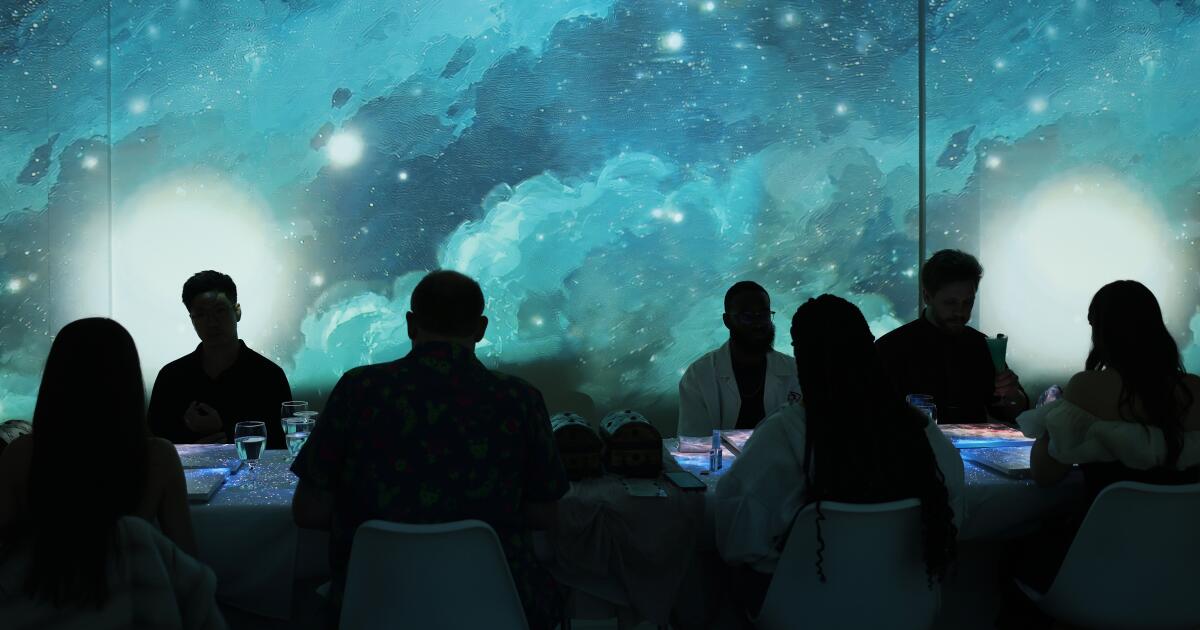
My dinner course is served. It is a Campbell’s-inspired soup can, lightly angled so strands of broccoli are peeking out. I lift the can to uncover a slow-braised short rib and mashed potatoes. An American dish to represent an American artist, here Andy Warhol.
The room is overtaken with projections, scenes of bustling New York traffic paired with bachelor-pad-like guitar riffs. Shown on a wall above a dinner table is a selection of Warhol silkscreens. It’s a Friday night in West Hollywood, and I’m surrounded by a mix of out-of-towners and those celebrating an anniversary. And while this is a special occasion, we’re urged to get a little messy with our food — to use our hands, to paint with a salad, to draw on a cookie.
The main course: A tomato soup can? “7 Paintings” is an immersive event that occasionally hides dishes in artist-inspired presentations.
(Christina House / Los Angeles Times)
Play is the primary side dish at “7 Paintings,” a tech-infused dinner theater that aims to be a crash course in fine art. That selection of veggies paired with multiple mini cups of colorful dressings? Guests are encouraged to mix and match the vinaigrettes into a mess of hues, a nod to abstractionist Jackson Pollock. And yellowfin tuna with dashes of avocado and taro chips? That’s an edible tribute to Banksy, of course. What does raw fish have to do with stenciled street art? It’s bold, heavily angled and has a short shelf life? Maybe? Perhaps don’t overthink it.

Even the paper is edible.
(Christina House / Los Angeles Times)
“Have you ever eaten a painting before?” says Nadine Beshir, the Dubai-based creator of “7 Paintings.” “We try to get people out of their comfort zones and eating paper. I want to bring out the child in them.”
“7 Paintings,” held at Sunset House L.A. through the end of August, is the latest example of immersive dining to arrive in this city. These experiences often involve guest participation and are accentuated with advanced multimedia technology and sometimes theatrical elements.
Worldwide, there have been standouts. For instance, Eatrenalin at Germany’s Europa-Park, a dining room-meets-ride where participants are whisked around the space on trackless “floating chairs,” has just received a coveted Michelin star. Ibiza’s Sublimotion has similar haute ambitions, pairing 12 diners together in a room that will come alive with otherworldly projections and performers. At times, diners will win don virtual reality headgear.
But tech-driven immersive dining experiences have never quite taken off in Los Angeles as a trend. Last year, the Gallery, where fantastical cityscapes and projections surrounded downtown L.A. diners, stood just a couple months before the concept was abandoned.

“7 Paintings” pairs food with art and music. It’s “fun dining, not fine dining,” says its founder.
(Christina House / Los Angeles Times)

Bartender Luca Famulari shakes a cocktail at the immersive dining event.
(Christina House / Los Angeles Times)
“The economics of a restaurant are not the same as the economics of theater and the challenge of combining the two lies in thinking outside the box with respect to pricing and cost structure, such that the customer perceives high value from both the food and the experience,” says the Gallery co-founder Daren Ulmer.
Entrepreneurs keep aiming for that careful balance. “Le Petit Chef and Friends” is currently running at Tangier at downtown’s Hotel Figueroa, an event in which a fully animated film is projected on our plates and tables. Long-running pop-up event Fork N’ Film leans more dinner and movie, pairing dishes directly inspired by what is happening on screen. Upcoming films include “Ratatouille” and “Lilo and Stitch.”
The field comes with challenges. “The costs are very high,” says Joanna Garner, an immersive designer and former creative director with experiential art firm Meow Wolf. Garner has been experimenting herself with communal, immersive dinner events, and her next, the flirtatious “Please Open Your Mouth,” is set for July 11. (No tech there, as Garner is after a more sensual, adult-focused gathering.) Tickets for her event are $150 and a spot in the “7 Paintings” dining room runs $175, priced on par with a number of city’s most acclaimed restaurants.
There is also the reality that all public dining is in some fashion immersive, usually requiring varying combinations of engagement, communication and presentation. And then, are all these added elements distracting?

An animated Mona Lisa sits on the wall as guests enjoy their meals. Throughout the dinner, the painting provides factoids on various artists.
(Christina House / Los Angeles Times)
Throughout “7 Paintings,” for instance, an animated Mona Lisa, situated on the wall next to the main dinner table, will provide brief biographical details of each artist represented.
“Being able to nail the food, and nail the story, those are two very difficult threads to weave,” Garner says. “I do think, ultimately, people come to a dinner table to talk to the people at the table and to have intimate experiences. To have an experience where you’re constantly being taken away from the food, I’m not so sure if that’s what people are looking for.”
Food is framed as a star of “7 Paintings” but tasting it is just one component. At one point, we must uncover a cheese course in a tiny treasure chest, the code for the lock hidden in the projections (don’t stress, it’s not a hard puzzle). Beshir highlights the Pollock-inspired salad course, which is accentuated with a jazz soundtrack, as the thesis of the evening.
1

2

1. A guest uses a silicon brush to apply sauces onto an entree, a nod to abstractionist Jackson Pollock. 2. Projections fill up the dining table during meals.
“This course is really about getting people to free their minds from preconceived ideas,” Beshir says. “Like, you have to eat with a fork and knife, or the salad comes and then the dressing. No, the dressing comes and then the salad, and it’s trying with big brushes to paint the way he did. A lot of people do not understand Abstract Expressionism, and they think it’s people just splashing colors around. But when you understand the link between the rhythm of the music and painting, you live it. We give you time to paint with your salad dressing.”
In L.A., Beshir has partnered with nightlife impresario Kim Kelly, who is plotting a “Sleep No More”-inspired walk-around theatrical show for the Sunset House venue later this year. “7 Paintings,” however, is fully seated, and purposefully a little silly. Beshir and Kelly have been evolving it during its L.A. run, recently adding a stronger painting component by giving guests their own canvas to work on throughout the evening. Each night crowns a winner.
“Everyone comes over to look at their art,” Kelly says. “It just kind of changed the whole thing, to be honest. People are now being creative throughout the entire evening. Instead of just watching and occasionally painting, you’re now painting the whole time.”
As for what, perhaps, soba noodles with edamame and mushrooms have to do with Pablo Picasso, or why Salvador Dali gets an unexpected dessert course of a white chocolate potato souffle, Beshir clarifies the goal of the evening. While the animated Mona Lisa will provide backstories on each painter, this isn’t an educational night. “It’s fun dining, not fine dining,” Beshir says.
And by the end of my night, strangers were socializing, showing off their painted cookie creations, sharing Banksy tidbits and asking for recommendations on various vinaigrette combinations. Ultimately, it’s an evening of discovery, packed with surprises like finding an entire course hidden under a canvas.

Darryl Mayes of Charlotte, N.C., left, and Taylor Smith of North Hollywood, right, uncover their course.
(Christina House / Los Angeles Times)
“We try not to have too much sophistication, like fried ants or something. I’m personally very adventurous in how I eat, but if I want to have this in 100 cities around the world, I cannot be too meticulous.”
And Beshir has big goals.
“I want this be your movie and dinner thing,” Beshir says. “I want people to be waiting for our next show, and to be able to afford to come every couple months.”
And to come home not with leftovers, but perhaps a painting of their own.
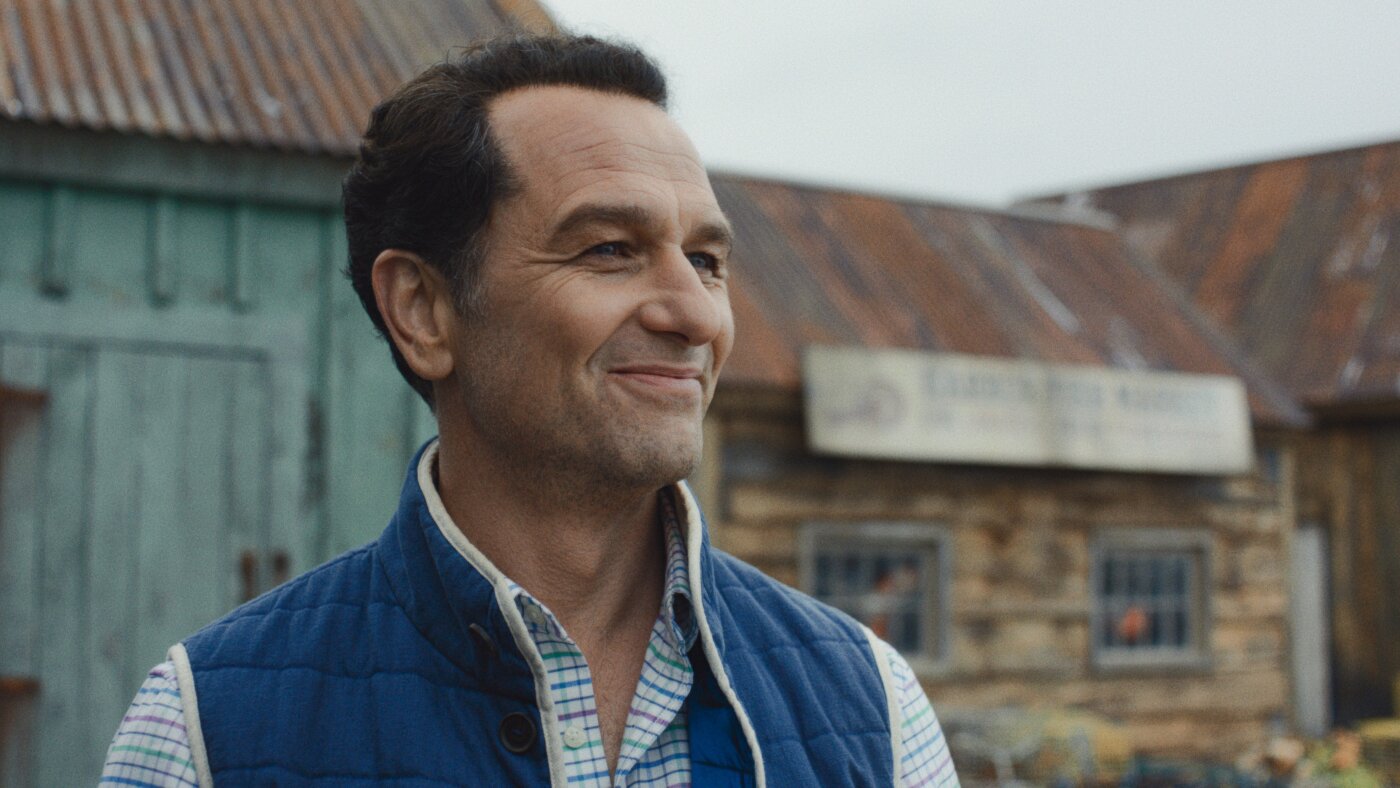
Matthew Rhys was nominated for his role in Widow’s Bay.
Apple TV
hide caption
toggle caption
Apple TV
The 2026 Emmy nominations are here. We’re unpacking the record-breaking nominations for Hacks, plus a big day for Widow’s Bay, The Pitt, and The Bear. We’ll also talk about the snubs and make some early predictions of who will win.
Connect with Pop Culture Happy Hour:
Letterboxd / Facebook
Our weekly newsletter
Support Pop Culture Happy Hour+
-

 Wisconsin1 minute ago
New Wisconsin AD Shawn Eichorst: Badgers Need ‘Texas Swagger’ And Less Humility
-

 West Virginia6 minutes ago
West Virginia retailers told to allow people to purchase soda with SNAP benefits
-
 Wyoming13 minutes ago
Wyoming women escape black bear attack on their tents in the Big Horn Mountains
-

 Crypto16 minutes ago
Binance maintains commitment to EU, seeking more licences in Asia
-

 Finance21 minutes ago
How Banreservas mobilised diaspora capital
-

 Fitness28 minutes ago
I’d Fallen Into an Exercise Rut—Until Trail Running Reminded Me How Joyful Movement Could Be
-

 Movie Reviews36 minutes ago
Movie review: Supergirl is a blast
-

 World41 minutes ago
Trump Says He Thinks He Will Remove Syria From US Terrorism Sponsor List

