Lifestyle
His playful wood furniture is more like functional art

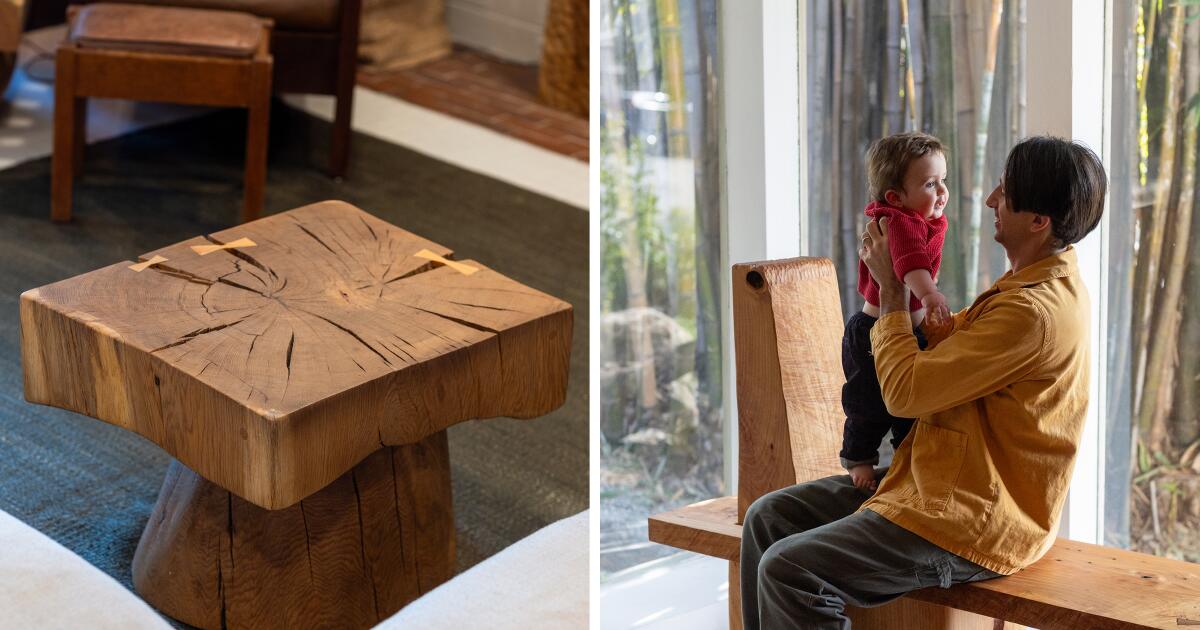
Walking through the garden of designer and sculptor Vince Skelly’s Claremont home is a distinct local sensory experience. Following a decade living in Portland, Ore., “I just want it to feel like Southern California,” he says as he grazes a palm over a salvia plant, releasing its aroma. Since returning in 2021, the self-taught artist has been expanding his practice and nurturing a connection to his hometown, colloquially dubbed “the City of Trees and PhDs.”
Skelly’s foray into wood sculpting began in 2017, when after spending his days tied to a screen as a graphic designer he’d fire up power tools in his Portland garage. He began by exploring “the limitations of what I can lift into my car, and [using] one chainsaw and tools. Those led to the vocabulary of forms I’m known for.”
Learning about legendary woodworkers such as George Nakashima and JB Blunk in particular, featured in the 2010 book “Handcrafted Modern,” was revelatory. “I was surprised he did all that with a chainsaw because his sculptures felt so refined — these abstract forms out of redwood and cypress,” Skelly says of Blunk. “A chainsaw is such an aggressive tool, and using it in a thoughtful, considered way to create form and shape intrigued me.” Then scaling down to using other analog devices yields nuance and detail.
Furniture made by Vince Skelly, with clay paintings by Dino Matt above.
Artwork made by Vince Skelly.
Vince Skelly holds his 10-month-old son, James Barron Skelly, in the backyard of the family home.
Within a few short years, he was brainstorming ideas and taking commissions from Off-White brand founder and LVMH menswear artistic director Virgil Abloh via DM. The largest prototype project wasn’t fully realized as planned before Abloh’s death in November 2021, but these exchanges “made me realize it’s great to dream big and take chances.” Skelly’s goods being recently installed in the Burberry store on Rodeo Drive is another sign the fashion world appreciates his point of view.
Some details shift, but the core challenge remains: namely, how to take raw timber and apply “the least amount of modification to turn it into a finished piece.”
Benches, chairs, stools, tables and sculptures straddle functional and decorative purposes. Unstained and waxed logs retain their intrinsic qualities yet are transformed in ways that honor their origins. Smooth bench surfaces sit atop hulky rounded bases, and smaller tactile sculptures result from Skelly’s reductive process. Human intervention is evident yet humbled by a certain primal resonance.
Like his heroes’ output, no two pieces are identical. What he describes as “an index,” however, has evolved for clients who want sculptural furniture that retains nature’s imperfections and quirks — but not flop-on-the-sofa comfort. For much of his work Skelly sources specific lumber with the end product in mind, knowing that each undertaking will still take on its own character.
Minimizing waste is a key precept. “I have a hard time throwing away scraps,” he says with a laugh about the shards and wedges that litter the edges of his backyard and the floor of his nearby studio in La Verne. He repurposes offcuts into smaller experiments, including rhythmic, polychromatic wall-mounted pieces hanging in his own home; one is above the white oak fireplace mantle he hand-chiseled.
“Using found wood to dictate new forms” remains a generative exercise, especially when preparing for shows with curator and gallerist Alex Tieghi-Walker of Tiwa Select, who organized “After the Storm” in L.A. in 2022, which showcased pieces made from salvageable debris in the wake of that year’s windstorm. What Skelly will present with Tiwa Select later this year in New York City doesn’t have an “end client, so I can just do whatever I want,” he explains.
Detail of a fireplace mantel made by Vince Skelly.
Vince Skelly gets a record from his collection while his wife, Jessica Barron Skelly, plays with the couple’s 10-month-old son, James Barron Skelly, on the floor of their home in Claremont.
The sensitively updated home where he lives with his wife, Jessica, and their infant son is a laboratory for living with these objects. So far, the presence of a crawling baby has led to only minimal adjustments and aesthetic intrusions.
Rather than function as austere showpieces, Skelly’s creations blend into this welcoming home environment full of earthy colors and personal treasures, which include a beloved rocking chair inspired by Claremont-adjacent master craftsman Sam Maloof that Jessica’s father crafted in the 1970s. It’s an ideal companion piece to the site-specific daybed Skelly made to best enjoy the view from the sunroom’s expansive windows, where dappled light filters through an outdoor screen of towering bamboo.
The Skellys are proud stewards of the midcentury property that holds a convergence of Claremont heritage. While waiting for the right house to come around to plot their move back, they were thrilled to hear about the modest two-bedroom home of former California Botanic Garden director, author and professor Lee Lenz. In the late 1950s, the accomplished botanist and conservationist became the second owner of a spec house for an unrealized cul-de-sac development of concrete masonry residences.
Lenz lived in the property situated within view of his workplace until his death in 2019 at the age of 104. Over the decades, this corner lot became a site for the scientist to apply his expertise, establishing a fantastical, idiosyncratic sanctuary populated with extensive plantings. It’s also a stone’s throw from the studio of seminal mosaic artist and architectural designer Millard Sheets (now home to Claremont Eye Associates).
Given Claremont’s tightknit community, Skelly surmises Lenz and Sheets knew each other. The turquoise mosaic tiles that clad concrete pads in the yard, for instance, perhaps came as surplus from Sheets’ workshop. The inspiration felt immediate.
“It’s a visual city [with] a lot of art. We left our back door and we were in the campuses, climbing on sculptures and seeing Millard Sheets’ mosaics,” Skelly recalls. “I grew up going to the [California Botanic] Garden — then fast-forward to this house.”
Detail of a wood mosaic outdoor shower made by Vince Skelly.
Detail of backyard native plants and outdoor artwork made by Vince Skelly.
Vince Skelly and his family sit outside in the backyard, where handmade artwork and native plants decorate the space landscaped by design studio Terremoto.
Reimagining the backyard in collaboration with David Godshall of noted landscape design firm Terremoto simultaneously pays homage to Lenz and reflects a vision for this young family. California native plants, hardscape additions and meandering paths provide a perfect backdrop for Skelly’s exterior works.
Skelly disassembled Lenz’s old-growth redwood bird cages and repurposed them into a deck. He also installed an original “wood mosaic”-adorned outdoor shower — a sly reference to Sheets. Plenty more remnants remain for potential future use.
His personal and professional life are inexorably tied to the town where Skelly’s artist parents originally moved to attend school at Claremont Graduate University. He’s eager to make his mark through a public art commission that involves producing a bench from another casualty of the 2022 windstorm, and to develop more found-material carved sculptural seating with students as part of a pilot program at Pomona College.
“We know how special it is because of people like Millard Sheets and Sam Maloof who left their fingerprints on the public art scene and the architecture,” he reflects of Claremont. Being outside of L.A. proper has other advantages too. “It’s more accessible to do the things you want to do in a small town.”


Sunday Puzzle
NPR
hide caption
toggle caption
NPR

On-air challenge
I’m going to give you two five-letter words. Add the same two letters at the end of the first one and the start of the second one, in each case to complete a familiar seven-letter word.
Ex. Later Ready –> LATERAL/ALREADY
1. Habit Tempt
2. Laten Press
3. Blank Ching
4. Since Venue
5. Shack Groom
6. Surge Stage
Last week’s challenge
Last week’s challenge came from Rawson Sheinberg. of Plymouth, Mich. Think of a U.S. city with a two-word name. Add a letter to the first word, without rearranging letters, to name a country. Then, without adding a letter, rearrange the letters of the second word to name another country. What places are these?
Answer: Los Angeles –> Laos, Senegal
Winner
Elaine Neel of Derby, Kansas.
This week’s challenge
Next weekend will be the 186th convention of the National Puzzler League, in Bloomington, Ind., which I’ll be attending as always. Two other people who will be there are Henri Picciotto and Joshua Kosman, who created this week’s challenge. Name two words that are opposites. They share a single letter. Remove that shared letter from each word, put a hyphen between the two starting words, and you’ll get a term you sometimes see in food ads. What are the two words?
If you know the answer to the challenge, submit it here by Thursday, July 9 at 3 p.m. ET. Listeners whose answers are selected win a chance to play the on-air puzzle. Important: include a phone number where we can reach you.
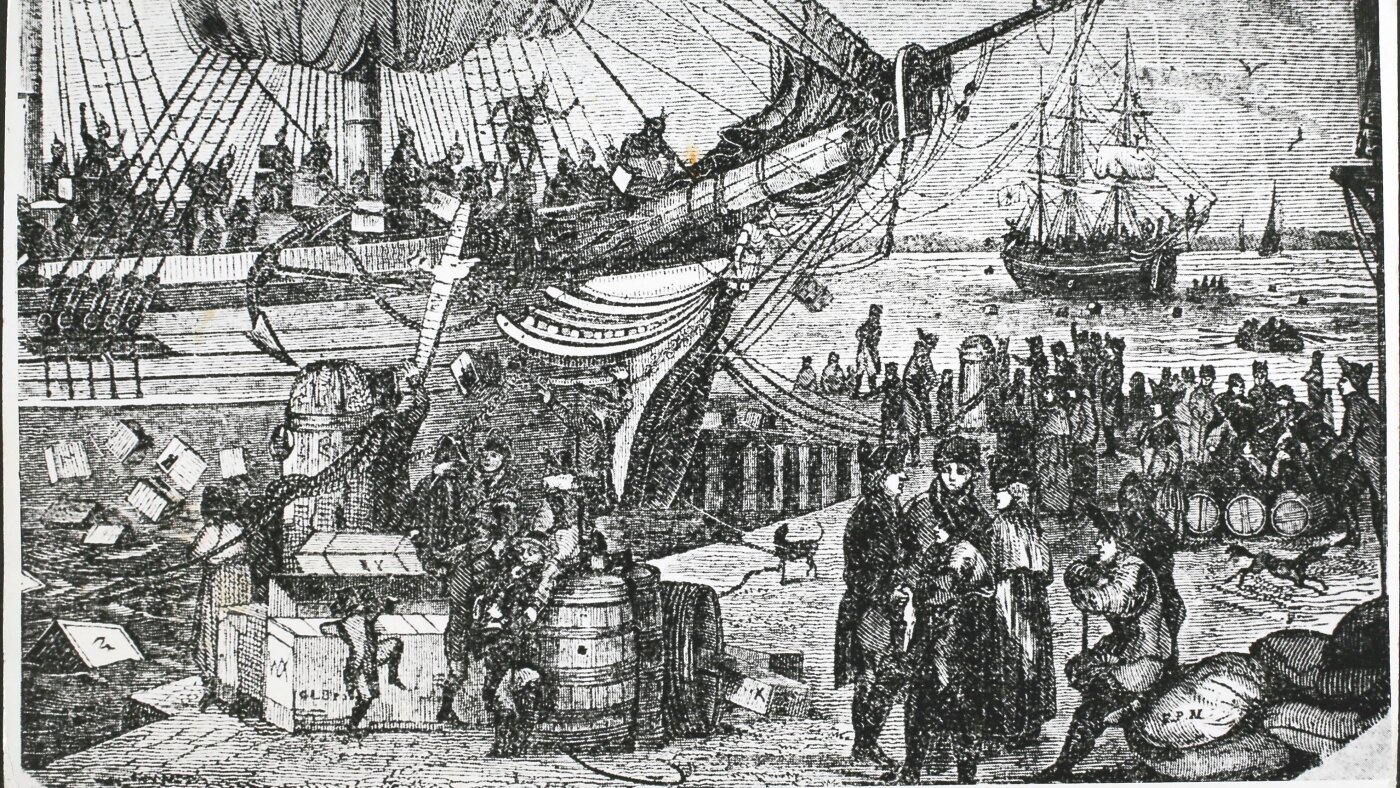
An illustration of the Boston Tea Party, when colonists dumped British East India Company tea into the harbor on Dec. 16, 1773. Some accounts say this marked a pivotal moment when Americans started loving coffee. But one historian says Americans were drinking lots of coffee before then.
Hulton Archive/Getty Images
hide caption
toggle caption
Hulton Archive/Getty Images
A consequential act of defiance secured tea’s place as perhaps the most iconic beverage of America’s colonial era.
The Boston Tea Party became an essential ingredient in the recipe for revolution in the following years.
But tea wasn’t the only hot beverage with a prominent role in America’s fight for independence.
Coffee was an important part of American culture from the start. And coffeehouses were essential, too — serving as hubs for brewing ideas of independence.
As the United States celebrates 250 years, here’s what to know about America’s early history of coffee.
Colonists were drinking coffee long before the United States existed
Europeans brought coffee with them when they came to America.
“The first documented example of a mortar and pestle used to grind coffee beans was on the Mayflower” in 1620, says historian Michelle Craig McDonald, the author of Coffee Nation: How One Commodity Transformed the Early United States.
“The fact that coffee was present so early is not surprising if you think about it,” McDonald says. “A number of those who were on the Mayflower came to North America from Amsterdam, which was a major coffee trading center in Western Europe by the 17th century.”
The first coffeehouse in the colonies opened in 1676 in Boston, a century before the U.S. declared independence, she says. Some taverns sold coffee even earlier.
The Boston Tea Party probably wasn’t the dramatic turning point toward coffee that some claim
On the night of Dec. 16, 1773, disgruntled colonists boarded three ships moored in Boston Harbor and threw overboard more than 92,000 pounds of tea owned by the British East India Company.
Tensions had been building between the Crown and the colonies over the previous decade, as Britain tried to levy taxes on its colonies to recoup war debts.
The Boston Tea Party protest was targeted at the British government’s passing of the Tea Act in 1773, which granted the East India Company a monopoly over tea sales in the colonies. While the British had removed some unpopular taxes in the preceding years, they left tea taxes in place. Colonial merchants were especially upset that the act allowed the East India Company to undercut their tea business.
To build solidarity for their cause of sovereignty, some patriots called on colonialists to swear off tea in favor of coffee. It’s why many histories point to the Boston Tea Party as a turning point when Americans switched from mostly drinking tea to mostly coffee. The anti-tea sentiment was immortalized in a founding father’s now-famous letter.
In July 1774, John Adams (before he became the second U.S. president) wrote to his wife Abigail, recounting an incident during his travels. After a long day, he asked the proprietor of the house where he was lodging for a cup of tea, provided it was smuggled and free of British taxes.
” ‘No sir, said she, we have renounced all Tea in this Place. I cant make Tea, but I’le make you Coffee.’ Accordingly I have drank Coffee every Afternoon since, and have borne it very well. Tea must be universally renounced. I must be weaned, and the sooner, the better,” Adams wrote.
Despite John Adams claiming a newfound patriotic duty to appreciate coffee, McDonald says colonists had been drinking lots of coffee all along.
She studied advertisements from the 1760s and ’70s to estimate how many shops sold coffee versus tea. Even before the Boston Tea Party, she says, “coffee is definitely more broadly available than tea is.”
A big reason? It was cheaper. “Its price again per pound is significantly less, which tells you about its availability, its accessibility to drinkers.”
Historians say it’s hard to definitively compare tea with coffee consumption, though, as official records from before America gained independence were inconsistent.
And smuggling was rampant, making official records even less reliable.
“There is a vast amount of smuggling,” says Joyce Chaplin, a professor of early American history at Harvard University. “So they’re not paying formal duties on tea that they get from the Dutch. They’re probably not paying formal duties on coffee from the French Caribbean.”
And Chaplin notes that people who loudly proclaimed a new appreciation for coffee over tea weren’t always doing what they said. It could have been political pandering. “I do not drink tea that comes via the East India Company,” she posits someone of the era saying. “But, you know, other sources are fine. Ditto for the coffee.”
Coffeehouses were a hub for revolutionary ideas
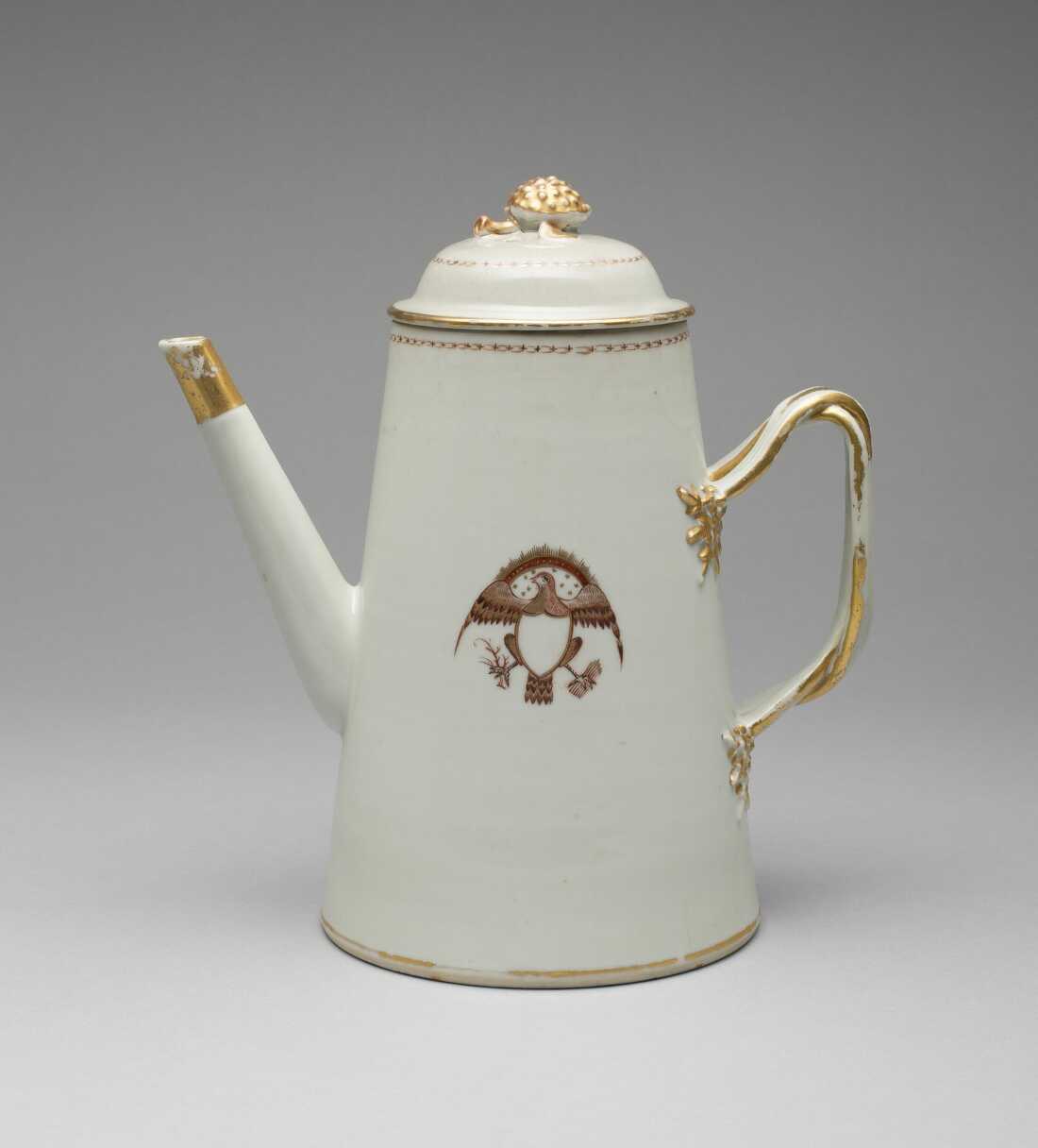
A coffeepot with cover, circa 1795. It has an American eagle motif, made in China for the American market. Coffee was part of a growing trend of globalization in the colonial era.
Heritage Art/Heritage Images via Getty Images
hide caption
toggle caption
Heritage Art/Heritage Images via Getty Images
In the colonial era, coffeehouses were hotbeds for seditious thought — where people planned acts of revolution.
“Coffeehouses are kind of famous for being places where people think and plot things,” says Mark Pendergrast, author of Uncommon Grounds: The History of Coffee and How It Transformed Our World.
A coffeehouse called the Green Dragon served as one of the locations for planning the Boston Tea Party. Years earlier, the Old London Coffeehouse in Philadelphia was a meeting place for strategizing responses to another British tax, the Stamp Act of 1765.
In Britain, coffeehouses were nicknamed “penny universities,” Pendergrast says: “because for a penny you could go and learn a whole lot by sitting around in a coffeehouse and discussing everything.” The same attitude traveled across the Atlantic.
Early American coffeehouses would commonly have city business directories, libraries of newspapers and currency exchange information. People could get maritime insurance there or buy things at auction.

“There’s a reason why coffeehouses become places of colonial protest … in the 1760s, in the 1770s, and it’s because it is the place where traders and merchants tended to gather,” historian McDonald says. “That’s where they heard about the economics of the day.”
Taverns were more likely than coffeehouses to have rooms for rent and stables for travelers’ horses. They were also more likely to have food.
Interestingly enough, coffeehouses could serve alcohol and taverns could serve coffee.
But the vibes at each were different. While women and men could “riotously drink together” in taverns, coffeehouses often didn’t allow women, according to Chaplin of Harvard.
“The sense was the coffeehouse was the place where you had a clear head — to argue about politics, to find out what was going on in the business world, to cut a business deal,” she says. “Whereas taverns were places where, in a sense, you refueled.”
Still, she says, the lines between the two “weren’t completely clear.”
The cost of America’s revolutionary drink
Coffee (and tea for that matter) was part of a growing globalization of trade around this time.
Much of the coffee in the colonies was grown in the Caribbean, while tea came from China.

Supply was up and coffee was easier than ever to drink. “Trade and frankly, imperialism, are making it possible for … colonial products to be produced and transferred to other parts of the world in greater and greater quantities,” says Chaplin.
As a result, by the time of the American Revolution, both coffee and tea were in reach for many common people. “They’re both becoming affordable luxuries,” Chaplin says.
Fancy coffee and tea paraphernalia were also part of this increasingly global market. Middle and upper-class people would have wanted special implements for drinking these beverages and a place to drink it. That meant they needed wood for coffee tables, silver for coffeepots, and porcelain for teapots.
“These two beverages are encouraging people to consume all kinds of new stuff,” says Chaplin. “The mahogany that comes out of the Caribbean, the china coming out of China, silver that is mined principally in South and Central America and processed in a lot of the parts of the world.”
There’s a dark side to coffee’s history, too. The plantations that supplied the crop ran on the labor of enslaved people. By 1790, half of the world’s coffee was being grown in the French colony of Saint-Domingue, in what is today Haiti, Pendergrast says, where slaves were routinely mistreated, raped and murdered.

The Declaration of Independence, signed in 1776, is infamous for a contradiction. It proclaimed that “all men are created equal,” but failed to acknowledge the hundreds of thousands of enslaved people living in America at the time.
Coffee carried a similar contradiction. The beverage that fueled conversations that inspired America’s fight for independence — centered on the ideals of life, liberty and the pursuit of happiness — depended on enslavement.
“Coffee had this paradoxical effect, that it did promote revolutionary thought,” Pendergrast says. “But it was also grown by slaves.”
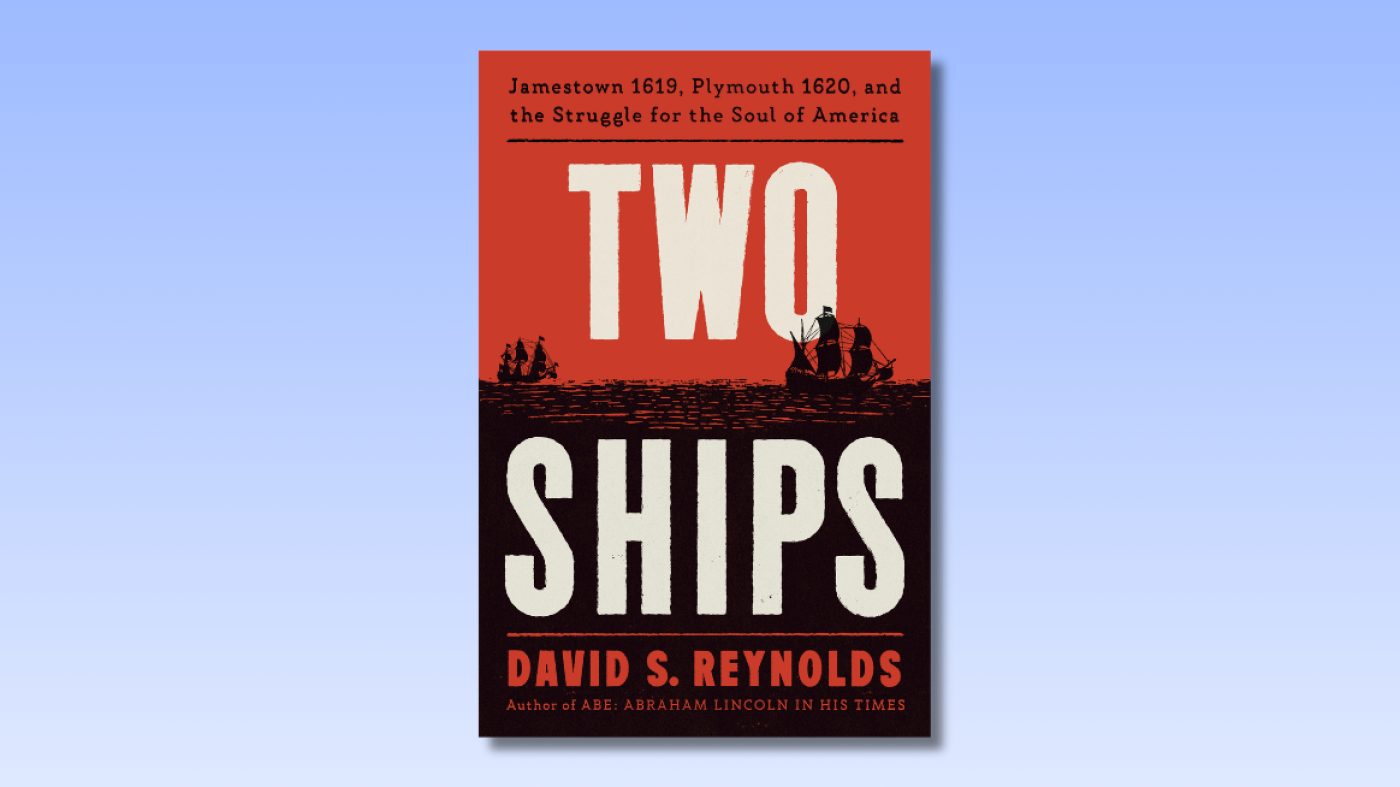
Just in time for a contentious 250th anniversary of the United States of America, historian David S. Reynolds’ latest book, Two Ships, helps us realize that any country that couldn’t agree on its own origin story is destined for divisive times.
Two Ships is about the complicated, conjoined legacy of the landings of the Mayflower, which carried the Pilgrims to Plymouth, Mass., in 1620, and the White Lion, which arrived in Jamestown a year earlier, bringing the first enslaved Africans to Virginia.
As Reynolds demonstrates, it’s not so much the facts of these two voyages, as it is the meanings ascribed to them, that made them such a powerful metaphor for two conflicting visions of American identity.
To simplify, the Mayflower’s passengers were separatist Puritans, dissenters to the reign of the English king, James I. As the United States developed, the Mayflower was credited with carrying the seeds of a radical democracy to the New World, one in which all men (in theory, at least) were equal before God.
In contrast, the European settlers of Jamestown were Royalists, also known as Cavaliers. Loyal to the monarchy, they believed in a strict hierarchy.
But the meaning of the images of the two ships shifted depended on who was invoking them and when. Not surprisingly, the metaphor was deployed most vigorously during the Civil War. In abolitionist speeches and writings, the White Lion or the “Slave-Ship,” as it was commonly called, was condemned for infecting America with the “plague-spot” of slavery.
Reynolds says that Frederick Douglass resorted to the “two ships” metaphor frequently, while Lincoln avoided it, hoping to preserve a unified ship of state. Meanwhile, Southern descendants of Cavaliers invoked the Mayflower to emphasize the intolerance and “cruel, persecuting” character of the Puritans. In a comment that resonates for our own times, Reynolds says:
It didn’t matter to the South that … by the mid-nineteenth century, the North had become a kaleidoscope of religious denominations, …, few of which resembled the faith of the Plymouth colonists. Distortion is intrinsic to cultural memory, especially when amplified by sectional or political bias. For Southerners, the Mayflower had brought Puritanism, which had yielded fanatical movements like abolitionism, now a dire threat to the Union.
In a brief-but-fascinating digression into the unpredictable power of literary fiction, Reynolds observes that the South’s fondness for Nathaniel Hawthorne’s anti-Puritan novel, The Scarlet Letter, and, even more, for the medieval historical romances of Sir Walter Scott, bolstered its nostalgia for a largely-imagined feudal society.

Reynolds quotes the always-quotable Mark Twain, no fan of Scott’s, as saying that Scott “did measureless harm; more real and lasting harm, perhaps, than any other individual that ever wrote …”
Two Ships is a dazzling survey of some three centuries of American history through a close reading of a metaphor. By the 1890s, Reynolds says, the interpretive tide had turned again: “Southern and Northern whites, feeling threatened by people of color and by an array of European immigrants, were retreating to a cocoon of racial solidarity that Mayflower celebrations helped reinforce.”
By the later-20th century, the image of the Mayflower was depoliticized and commercialized into Pilgrim hats and Black Friday sales. The powerful metaphor of the two ships receded into the mist.
Seven years ago, however, the 1619 Project piloted the White Lion — “The Slave-Ship” — back into view and anchored it at the center of debates about slavery’s place in the national story. The 1619 Project has been faulted for its historiography, and it does lie outside of the chronological boundaries of Reynolds’ book; still, it seems too momentous a reappearance of the White Lion not to at least acknowledge in this book.
That criticism noted, I think reading Two Ships would be an excellent way to observe this particular Fourth of July. It’s wise for all of us to have a more informed awareness of how Americans have understood, misunderstood and, often, flattened each other into stereotypes. Or, as Ernest Hemingway, one of the Mayflower Pilgrims’ more cynical descendants, might say in response to that sentiment: “Isn’t it pretty to think so?”

-

 Arizona5 minutes ago
3 Arizona Cardinals Now on the Chopping Block Entering Training Camp
-

 Arkansas12 minutes ago
A WORD | July 5: Arkansas’ own little game likes to play with your brain | Arkansas Democrat Gazette
-

 California15 minutes ago
A Dividend Portfolio That Out-Earns the Average California Family
-

 Colorado20 minutes ago
WATCH LIVE: Memorial service to honor firefighters killed on Colorado-Utah border – East Idaho News
-

 Connecticut27 minutes ago
Torrington declares local state of emergency after storms leave thousands without power
-

 Delaware30 minutes ago
Jersey Mike’s is nation’s top food chain, but score a local sandwich
-

 Florida35 minutes ago
This Week in South Florida: Maria Elvira Salazar
-

 Georgia42 minutes ago
Georgia Agriculture Commissioner Tyler Harper calls on public to report yellow-legged hornet secondary nests

