Lifestyle
Grammys 2024: 10 takeaways from music's biggest night (Taylor's version)


Taylor Swift poses with Julien Baker, Phoebe Bridgers and Lucy Dacus of boygenius after the 66th annual Grammy Awards.
Frederic J. Brown/AFP via Getty Images
hide caption
toggle caption
Frederic J. Brown/AFP via Getty Images

Taylor Swift poses with Julien Baker, Phoebe Bridgers and Lucy Dacus of boygenius after the 66th annual Grammy Awards.
Frederic J. Brown/AFP via Getty Images
The Grammys are nothing if not a three-and-a-half-hour infomercial for the music industry: The telecast foregrounds music’s biggest stars, programs performances that span many genres and generations, and otherwise assembles a digestible package of major milestones and musical moments. Sunday night’s festivities were no different, so here are this year’s major storylines and other takeaways, starting with… no, you’ll never guess. Wait for it…
1. Somewhere along the way, we have left a world in which Taylor Swift dominates the cultural conversation and entered a world in which Taylor Swift is the world and we are just tiny specks of flotsam, floating listlessly in a sea consisting of her disembodied essence.
Okay, so we kinda knew, going in, that Swift would be a significant player in Sunday night’s Grammys, given that she was nominated for six awards and that, when it comes to music news in 2024, all roads lead back to her red-lipsticked visage. But few could have seen Sunday’s onslaught coming. Swift’s Midnights won album of the year — her record-breaking fourth win in that category alone — as well as best pop vocal album. And, of course, the singer made a splashy entrance and danced and sang along during performances even when seemingly everyone else was seated. But Swift set aside her headline-grabbingest moment for her first victory speech, in which she announced the imminent arrival of a new album titled The Tortured Poets Department, out April 19. Which means the conversation around Swift is only going to get busier and louder and more all-consuming, with next Sunday’s Super Bowl just six Swift-packed days away.
Miley Cyrus accepts the best pop solo performance award for “Flowers” from Mariah Carey on stage during the 66th Annual Grammy Awards.
Valerie Macon/AFP via Getty Images
hide caption
toggle caption
Valerie Macon/AFP via Getty Images
Miley Cyrus accepts the best pop solo performance award for “Flowers” from Mariah Carey on stage during the 66th Annual Grammy Awards.
Valerie Macon/AFP via Getty Images
2. Saying “women did well” is underselling the degree to which women dominated the night.
Remember the 2018 Grammys, in which men dominated the major categories and the then-head of the Recording Academy later made a boneheaded comment about how women need to “step up”? Six years later, up has been stepped. All nine of the categories represented in Sunday night’s telecast were won by women artists, spread across seven different names: Swift (album of the year, best pop vocal album), Miley Cyrus (record of the year, best pop solo performance), Victoria Monét (best new artist), Billie Eilish (song of the year), SZA (best R&B song), Lainey Wilson (best country album) and Karol G (best música urbana album). Elsewhere, bands like boygenius and Paramore won big in categories representing rock and alternative music, while the performances in the telecast’s first half were dominated by big names such as Dua Lipa, Olivia Rodrigo, Eilish, Cyrus and SZA.
Tracy Chapman performs on stage during the 66th Annual Grammy Awards.
Valerie Macon/AFP via Getty Images
hide caption
toggle caption
Valerie Macon/AFP via Getty Images
Tracy Chapman performs on stage during the 66th Annual Grammy Awards.
Valerie Macon/AFP via Getty Images
3. Two tear-jerking performances ruled them all. Early on, country star Luke Combs participated in a segment about his hit cover of the 1988 Tracy Chapman classic “Fast Car.” Then the song’s familiar guitar part kicked in, at which point the camera pulled back slowly to reveal that the instrument was being played by… Chapman herself. The two stars then turned the song into a true duet, trading verses and smiles, and it cannot be overstated just how thrilled Combs looked from start to finish. It was a gorgeous moment all around, not to mention a chance for Chapman to take a well-earned victory lap for what is, no exaggeration, one of the best songs ever written by anyone, ever. And, speaking of the best songs ever written, Joni Mitchell performed at the Grammys for the first time (!!!), leading a lovely rendition of “Both Sides Now” with the aid of Brandi Carlile, Lucius, SistaStrings, Allison Russell, Blake Mills and Jacob Collier. There aren’t enough flowers to fling in the direction of either performance.
SZA accepts the best R&B song award for “Snooze” on stage during the 66th Annual Grammy Awards.
Valerie Macon/AFP via Getty Images
hide caption
toggle caption
Valerie Macon/AFP via Getty Images
SZA accepts the best R&B song award for “Snooze” on stage during the 66th Annual Grammy Awards.
Valerie Macon/AFP via Getty Images
4. Speaking of tear-jerking, the best speeches showed how much the Grammys can mean to the artists who win them. SZA was nominated nine times and won three awards Sunday, and when she took home best R&B song, her emotions flooded out of her; it was clear that the moment represented the culmination of years of hard work. Ditto Victoria Monét, whose long career made a minor mockery of the category “best new artist.” (The Grammys would do themselves a huge favor by changing that category’s name to something like “breakthrough artist,” given how long artists toil en route to newness.) Both speeches presented a firm rebuttal to the idea that these awards mean nothing to the folks who win them.
Honoree Jay-Z accepts the Dr. Dre Global Impact Award with Blue Ivy Carter onstage during the 66th Grammy Awards.
Kevin Winter/Getty Images for The RIAA
hide caption
toggle caption
Kevin Winter/Getty Images for The RIAA
Honoree Jay-Z accepts the Dr. Dre Global Impact Award with Blue Ivy Carter onstage during the 66th Grammy Awards.
Kevin Winter/Getty Images for The RIAA
5. Jay-Z didn’t spare the Recording Academy. The rap superstar won the Dr. Dre Global Impact Award, and in his victory speech — for which he brought daughter Blue Ivy onstage — he lightly blistered the Academy for its glass ceilings and other missteps. After chiding voters for never awarding album of the year to his wife Beyoncé, Jay-Z added a burn that had the crowd tittering nervously (“Some of y’all don’t belong in the category”) and doubled down with a line that’ll get quoted for years to come: “When I get nervous, I tell the truth.” (Those words are in competition with SZA’s “I’m not a very attractive cryer” for the title of “Grammy quote most likely to get stitched onto throw pillows and sold on Etsy.” In third place: Billie Eilish, whose surprise at winning song of the year was expressed via the words, “I’m shocked outta my balls.”)
Stevie Wonder performs on stage honoring Tony Bennett during the 66th annual Grammy Awards.
Valerie Macon/AFP via Getty Images
hide caption
toggle caption
Valerie Macon/AFP via Getty Images
Stevie Wonder performs on stage honoring Tony Bennett during the 66th annual Grammy Awards.
Valerie Macon/AFP via Getty Images
6. The In Memoriam segment went long, but it worked. Twenty minutes is a generous dollop of time to pay tribute to the performers and other music-adjacent figures who’d died in the preceding year. But, wow, we’ve lost a lot of powerhouses lately. Stevie Wonder gave a warm tribute to Tony Bennett, Annie Lennox performed “Nothing Compares 2 U” for Sinéad O’Connor (and closed the performance by calling for a ceasefire, a moment that felt true to O’Connor’s own activism), Jon Batiste and Ann Nesby played a medley for the music-industry executive Clarence Avant, and Fantasia Barrino and Adam Blackstone served up a rollicking cover of “Proud Mary” for Tina Turner. What made it work, besides the emotion involved, was the way the performances echoed the energy and spirit of the figures who’d died; Barrino, for example, understood that the best way to honor Turner was to embrace and echo her indefatigable showmanship, rather than merely mourn.
Killer Mike poses in the press room with the Grammys for best rap performance, best rap album and best rap song during the 66th annual Grammy Awards.
Frederic J. Brown/AFP via Getty Images
hide caption
toggle caption
Frederic J. Brown/AFP via Getty Images
Killer Mike poses in the press room with the Grammys for best rap performance, best rap album and best rap song during the 66th annual Grammy Awards.
Frederic J. Brown/AFP via Getty Images
7. Killer Mike won three Grammys… and then got arrested. The powerhouse rapper Killer Mike — perhaps still best known as one-half of Run the Jewels — absolutely cleaned up in the rap categories (best rap album, best rap song, best rap performance) prior to the telecast. Then, he got into an altercation that ended with him being led away in handcuffs. The story is still developing (Mike didn’t address it in a tweet this morning), but it’s hard to believe we’ve heard the last of it.
Billy Joel and Trevor Noah speak onstage during the 66th Grammy Awards.
John Shearer/Getty Images for The RIAA
hide caption
toggle caption
John Shearer/Getty Images for The RIAA
Billy Joel and Trevor Noah speak onstage during the 66th Grammy Awards.
John Shearer/Getty Images for The RIAA
8. Billy Joel performed his first new song in 17 years, then came back for an encore. Just a few days ago, Joel’s “Turn the Lights Back On” shocked the world — both because it was his first new song in 17 years and because the song itself was actually worth the interminable wait. The singer-songwriter performed the new track late in the Grammys telecast, then returned at the end to play one of his best-known bangers, 1989’s “The Downeaster ‘Alexa,’” which… [taps earpiece] okay, I’m being told the telecast-closing song was actually “You May Be Right,” which is considerably more rousing and thus appropriate for the occasion. Three and a half hours into an awards telecast, Billy Joel performing “The Downeaster ‘Alexa’” would have been absolute performance art, and I kinda wish he’d done it just to be a rascal.
9. U2 offered us a look inside Las Vegas’ famed Sphere, and the world is still heaving from motion sickness. Actuarially speaking, it’s unlikely that you’ve seen the new movie Argylle, which is somehow both expensive-looking and cheap-looking, not to mention garish and loud and exhausting, with lots of long and exceedingly silly action set pieces. U2’s performance was kinda like Argylle, yet somehow even more abrasive and 20 times as disorienting, with endless swooping drone shots and… I don’t know, holograms and floating CGI heads and whatnot? I’m not even entirely sure, because I had to look away after a while. U2 is nothing if not maximalist, and maximalism can be fun, but the visuals made this a truly punishing ordeal.
Coco Jones poses in the press room with the Grammy for best R&B performance for “ICU” during the 66th annual Grammy Awards.
Frederic J. Brown/AFP via Getty Images
hide caption
toggle caption
Frederic J. Brown/AFP via Getty Images
Coco Jones poses in the press room with the Grammy for best R&B performance for “ICU” during the 66th annual Grammy Awards.
Frederic J. Brown/AFP via Getty Images
10. The Grammys mostly resisted the urge to humiliate themselves. In many if not most years, the Recording Academy will locate some far-flung opportunity to step on a rake in the most embarrassing possible way. Perhaps the head of the Academy will say something so catastrophically stupid we’re still writing about it six years later (see No. 2), or maybe they’ll give best new artist to an act later determined to have been lip-syncing, or maybe they’ll give the first-ever Grammy for heavy metal to Jethro Tull at the expense of Metallica, or maybe Macklemore will sweep the rap categories at the expense of Kendrick Lamar… you know the drill by now. But this year, thanks in large part to a pop-heavy but otherwise solid slate of nominees, Sunday was a night mostly free of embarrassment. Did host Trevor Noah address Ed Sheeran as “one of the greatest live performers of all time”? He did. But no one would be cruel enough to close out a summary of this year’s Grammys by pointing out the time Trevor Noah did, in fact, address Ed Sheeran as “one of the greatest live performers of all time.”



Neve Campbell in Scream 7.
Paramount Pictures
hide caption
toggle caption
Paramount Pictures
The OG Scream Queen Neve Campbell returns. Scream 7 re-centers the franchise back on Sidney Prescott. She has a new life, a family, and lots of baggage. You know the drill: Someone dressing up as the masked slasher Ghostface comes for her, her family and friends. There’s lots of stabbing and murder and so many red herrings it’s practically a smorgasbord.
Follow Pop Culture Happy Hour on Letterboxd at letterboxd.com/nprpopculture

Abriana Vicioso is the host of the Flower Hour, which takes place monthly.
(Jennifer McCord / For The Times)
Each flower carries a personal history. For Abriana Vicioso, the calla lily was her parents’ wedding flower — a symbol of her mother’s beauty. “She had this big, beautiful white calla lily in her hair,” Vicioso says. “I love my parents. They’re the reason I’m here. I’ll never forget where I came from.”
The Flower Hour begins with Vicioso announcing, with a warm smile: “Today is about touching grass.” The florist-by-trade gestures behind her to hundreds of flowers contained in buckets — blue thistles, ivory anemones and calla lilies painted silver — all twisted and unfurling into the air. “Tonight is going to be so sweet and intimate,” Vicioso says, eyeing the beautiful chaos at her feet. A grin buds across her face.
Moments before the workshop, participants sit at candlelit tables exchanging horoscopes and comparing their favorite flowers. A mention of the illustrious bird-of-paradise flower elicits coos and awe from the women. Izamar Vazquez, who is from Jalisco, Mexico, reveals her fondness for roses, which make her feel connected to her Mexican roots.
Vicioso hosts her flower-themed wellness workshop near the iconic Original Los Angeles Flower Market in downtown L.A. In January, the first Flower Hour event sold out, prompting her to make it a monthly series. Vicioso describes the event as a “three-part journey” where participants are invited to drink herbal tea, smoke rose-petal-rolled cannabis joints and create a floral arrangement. “The guide is to connect with the medicine of flowers,” Vicioso says.


Rose petal joints, tea and flower arranging are all part of The Flower Hour event’s offerings.
The event is hosted at the Art Club, a membership-based co-working space. “The Flower Hour is really beautiful. Everyone gets to explore their creativity while meeting new people,” says Lindsay Williams, the co-owner of the Art Club.
The idea for Flower Hour came to Vicioso during a conversation with her mother. “We joke all the time that flowers were destined to make their way into my life,” she says. She works as a florist and models on the side, even appearing in the pages of Vogue. Vicioso grew up in a Caribbean household, where flowers and offerings were part of daily life. “In my culture and religion, a lot of my family practices — an Afro-Caribbean religion — we build altars.”
Like many cultures, flowers carry sentimental value in her religion. “I’m Caribbean, so a lot of my family practices a Yoruba religion, which comes from Africa. In the Caribbean, it’s well known as Santería.”

-
Share via
After a difficult year and a breakup, Vicioso wanted to marry her love of flowers with community building. Because Vicioso uses cannabis medicinally, the workshop naturally includes a smoking component. “My family has smoked cannabis for a lot of reasons for a long time. It’s a really healing plant,” she explains.
In the workshop, even the cannabis gets the floral treatment. Vicioso presents her rose-petal-wrapped joints on a silver platter at each table. She rolled each by hand. “If you’ve never smoked a rose-petal-rolled joint, the difference with this is it’s going to have roses that have a slight tobacco effect,” she announces.
During the workshop, Vicioso stresses the importance of buying cannabis from local vendors. The cannabis provided was purchased from a Northern Californian vendor. The wellness workshop aims to reclaim the healing ritual of smoking cannabis. “This is a plant that has been commercialized,” Vicioso says. “There’s a lot of Black and Brown people who are in jail for this plant.”
The resulting workshop is what Vicioso describes as “an immersive wellness experience that is the intersection of wellness, creativity, community and an appreciation of flowers.” The workshop serves as a reminder to enjoy Earth’s innate beauty in the form of flowers — including cannabis. “It’s this gift that the universe gave us for free and that I have this deep connection with,” Vicioso says.


Conversation cards to generate discussion among participants (top, letf). The workshop serves as a “third space” for Angelenos to engage in tactile creativity and community building outside of traditional nightlife settings.
After enjoying lavender chamomile tea and smoking a joint, Vicioso introduces the flowers to the group before inviting them to pick their own. She emphasizes each flower’s personality traits, describing green dianthus as a “Dr. Seuss” plant. Then, there are calla lilies with their “main character moment.” It gets personal. “Start thinking of a flower in your life that you can discover,” she says. “If you’re feeling like you need inspiration, you can always remember that these flowers have stories.”
Vicioso infuses wisdom into her instruction on floral arrangements: There are no mistakes. Let the flowers tell you where they want to go, she urges. Intuition will be your guide — the wilder, the better.
“Hecho in Mexico” reads a sticker on a bunch of green stems. “Like me,” says Vazquez with a laugh. “They’re all doing their own thing. Like a family,” she says later, arranging stems.

The Flower Hour participants and Vicioso, center, chat as they build their own floral arrangements at the sold-out event.
Two participants — Vazquez and Rebeca Alvarado — are friends who run a floral design company together called Izza Rose. Like Vicioso, the friends have a connection to flowers through their Latin American culture. They met Vicioso in the floral industry and were overjoyed to discover her workshop.
“This is a great way to connect with other people,” says Vazquez.
Alvarado agrees, adding: “You’re getting to know people outside of going to bars. You can connect in different ways when there’s an activity.”
Vazquez uses flowers to stay connected to her Mexican heritage, adding that she prefers to support Mexican vendors. In recent months, the downtown L.A. flower market has struggled to recover from ongoing ICE raids. “Some are scared to come back,” says Vazquez.


Hand-rolled cannabis joints wrapped in rose petals are presented on a silver platter at The ArtClub (top, right). The Flower Hour aims to reclaim the healing rituals of cannabis and flowers.
Another participant, Barbara Rios, was attracted to the workshop for stress relief. “You can hang out with your friends, but it’s nice to do things with your hands,” she says. “I work a stressful job, and it’s nice to have that third space that we’re all craving.”
On this February night, the participants were predominantly women, save for one man. In the future, Vicioso hopes that more men learn to engage with flowers. “There’s a statistic about men receiving flowers for the first time at their funerals, and I think we have changed that,” she says.
To conclude the workshop, Vicioso encourages participants to build lasting friendships and incorporate flower arranging into their daily practice — even if it’s just with a small, inexpensive bouquet.
“Get some flowers together, go to the park, hang out with each other and hang out with me,” she says. Participants leave with flower arrangements in hand. In the darkness of the night air, it briefly looks as though the women carry silver calla lilies that are blooming from their palms.

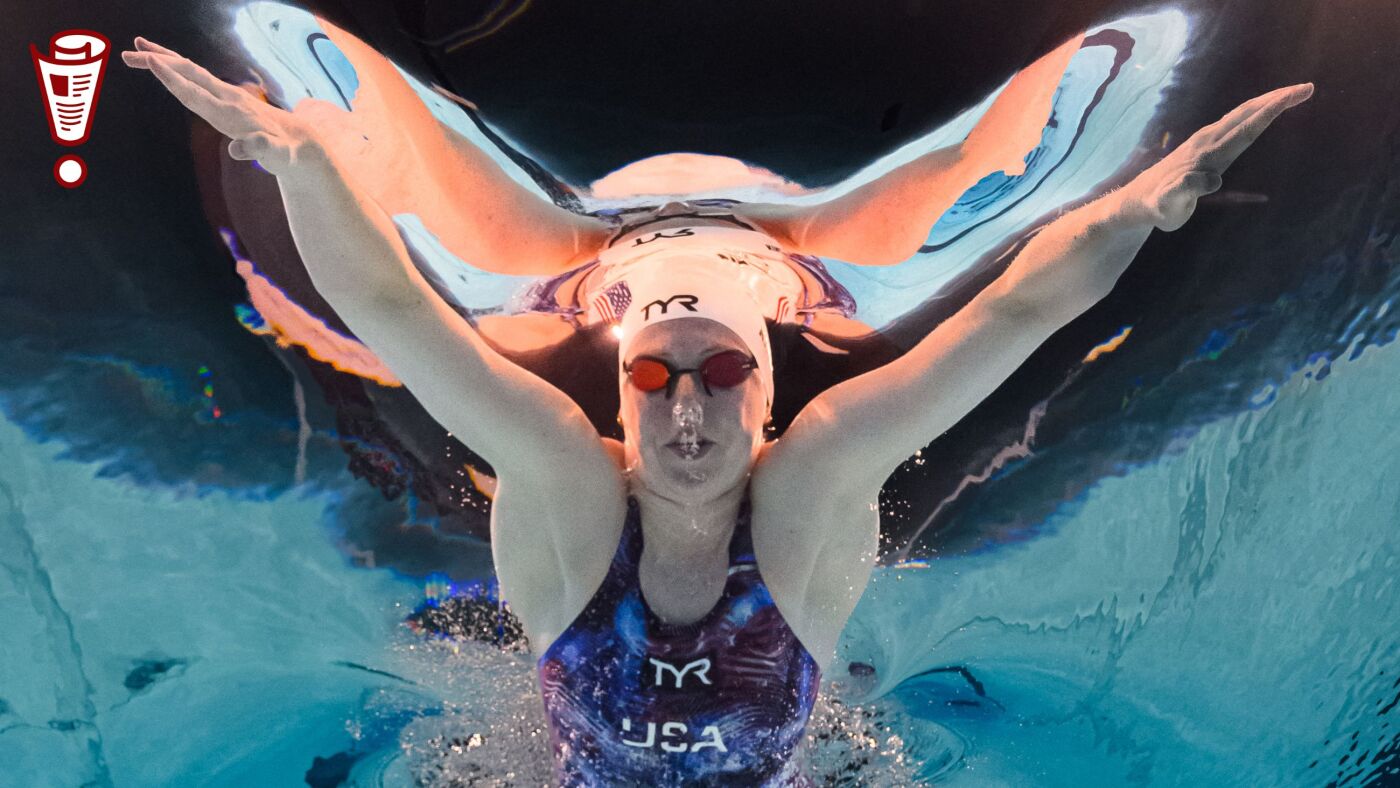
An underwater view shows US’ Lilly King competing in a heat of the women’s 200m breaststroke swimming event during the Paris 2024 Olympic Games at the Paris La Defense Arena in Nanterre, west of Paris, on July 31, 2024. (Photo by François-Xavier MARIT / AFP) (Photo by FRANCOIS-XAVIER MARIT/AFP via Getty Images)
François-Xavier Marit/Getty Images
hide caption
toggle caption
François-Xavier Marit/Getty Images
This week’s show was recorded in Bloomington, Indiana with host Peter Sagal, judge and scorekeeper Bill Kurtis, Not My Job guest Lilly King and panelists Alonzo Bodden, Josh Gondelman, and Faith Salie. Click the audio link above to hear the whole show.
Who’s Bill This Time
State of the Union is Hot; The Tribal Council Convenes Again; A Glow Up In the Doll Aisle
Panel Questions
The Toot Tracker
Bluff The Listener
Our panelists tell three stories about a travel hack in the news, only one of which is true.
Not My Job: Olympic Swimmer Lilly King answers our questions about Lil’ Kings
Olympic Swimmer Lilly King plays our game called, “Lilly King meet these Lil’ Kings” Three questions about short kings.
Panel Questions
Cleaning Out The Cabinet; Bedtime Stacking
Limericks
Bill Kurtis reads three news-related limericks: Getting Cozy With Cross Country Skiing; Pickleball’s New Competition; Bees Get Freaky
Lightning Fill In The Blank
All the news we couldn’t fit anywhere else
Predictions
Our panelists predict, after American Girls, what’ll be the next toy to get an update.

How South Dakota officials have reacted to ‘massive’ US attack on Iran
Volunteers needed for community-wide cleanup day with Hands On Nashville

Texas Tech student identified as victim in Austin bar shooting

Immigration agents bolster action at Utah courthouses, prompting criticism from some

Vermont high school playoff scores, results, stats for Monday, March 2

Florida High School Football Rankings: Top 25 teams – Oct. 21

Cleary's 21 help Le Moyne down Central Connecticut State 69-64 in OT

How old is Bo Nix? What to know about Oregon quarterback ahead of 2024 NFL Draft

99th annual Pony Swim held in Virginia

Indiana Members Credit Union announced as new anchor tenant at Bottleworks District

Map: Earthquake Shakes Central California

Gas prices could jump as Middle East tensions threaten global oil supply

Pakistan calls troops, orders 3-day curfew as 24 killed in pro-Iran rallies

US says Kuwait accidentally shot down 3 American jets

House Republicans push Johnson to go to war with Senate over SAVE Act
-

 World5 days ago
Exclusive: DeepSeek withholds latest AI model from US chipmakers including Nvidia, sources say
-

 Massachusetts5 days ago
Mother and daughter injured in Taunton house explosion
-

 Denver, CO5 days ago
10 acres charred, 5 injured in Thornton grass fire, evacuation orders lifted
-

 Louisiana1 week ago
Wildfire near Gum Swamp Road in Livingston Parish now under control; more than 200 acres burned
-

 Technology1 week ago
YouTube TV billing scam emails are hitting inboxes
-

 Politics1 week ago
OpenAI didn’t contact police despite employees flagging mass shooter’s concerning chatbot interactions: REPORT
-

 Technology1 week ago
Stellantis is in a crisis of its own making
-

 News1 week ago
World reacts as US top court limits Trump’s tariff powers