Lifestyle
Get your back scratched and hair brushed at this cozy ASMR massage studio in L.A.


I’ve never felt weird about paying strangers to touch me. Massages, facials, martial arts — it’s all just bodywork to me. That is, until I booked my first professional back scratch with Julie Luther, the founder of Soft Touch ASMR Spa in Pasadena.
Something about being touched softly made me nervous. In part, because that’s the kind of physical interaction you expect from your closest companions. I have childhood memories of loved ones tracing patterns on my skin and playing with my hair. Between meetings and mindless scrolling, that kind of touch feels increasingly scarce, almost indulgent, as we grow up in the modern world.
Luther understands this tension well. She’s built a business around re-creating those cozy childhood moments that many find both deeply soothing and surprisingly rare in adult life. Her treatments bring ASMR, short for autonomous sensory meridian response, into the physical world through intentionally gentle touch: back scratches with metal finger extensions, face tracing with feather-tipped wands, and subtle, soothing sounds that come from these careful movements across skin and through hair.
Masseuse Julie Luther at work in Pasadena. She was drawn to ASMR-like rituals while working in New York’s cutthroat fashion industry.
Back in 2007, Luther was stressed out in New York’s cutthroat fashion industry, running on four hours of sleep between a full-time job and internship after graduating college — she found herself craving those same soothing rituals that her mother and grandmother used to help her fall asleep as a child: playing with her hair and scratching her back.
“Nothing has been as relaxing,” she said.
Luther returned to her fashion industry grind. But as she watched ASMR’s popularity grow, she saw potential for the kind of content she’d always wanted to see. When the pandemic hit in 2020, she finally had the time to act, launching Friends with ASMR. She grabbed some friends from her quarantine pod and started filming the gentle back-scratching and hair-brushing videos she always wanted to watch.
Eventually viewers started clamoring for in-person sessions, Luther, whose YouTube channel now has more than 72,000 subscribers, realized she’d scratched her way into an unexpected business opportunity.

“Research suggests that the brains of people experiencing ASMR see spikes in neural activity in the regions of the brain associated with emotion, reward, empathy and social cognition,” says Dr. Elizabeth Ko, medical director of the UCLA Health Integrative Medicine Collaborative.
The tingling sensation that gives ASMR its reputation — a pleasant, cascading feeling that flows from head to shoulders — only affects about 20% of people, according to Dr. Elizabeth Ko, medical director of the UCLA Health Integrative Medicine Collaborative. But that hasn’t stopped researchers from investigating what happens in the brain during these experiences.
“Research suggests that the brains of people experiencing ASMR see spikes in neural activity in the regions of the brain associated with emotion, reward, empathy and social cognition,” Ko said.
Scientific interest in the practice has grown substantially, with studies suggesting ASMR activities may offer temporary relief for depression and chronic pain in some individuals, according to Ko. When combined with gentle touch like back scratches or hair braiding, Ko said ASMR practices may provide additional benefits through the release of oxytocin, a hormone associated with relaxation and social bonding.
Though researchers are still exploring whether non-ASMR-sensitive individuals can benefit from these practices, Ko notes that “whether ASMR is a physiological oddity or may be a potential therapeutic tool remains to be seen.”

Julie Luther in her Pasadena massage studio.
Luther sees this play out in her practice, where she says clients broadly fall into two camps. Most come seeking to re-create comforting childhood experiences of having their hair played with or backs scratched by family members. Some turn to her because they typically find traditional massages painful — something Luther relates to from personal experience. But she also sees clients who have never experienced nurturing touch, including some who are working to rebuild their relationship with physical contact after traumatic experiences.
“They’re trying to relearn what safe touch or nurturing touch is,” Luther said.
Luther’s practice is exclusively for women and nonbinary clients, a boundary she set after a male client ignored her consent forms and asked her to tickle his feet during a session. She has enough clients that it hasn’t hurt business.
Luther works from a serene room she rents from an acupuncturist in downtown Pasadena, with views of the nearby mountains. Luther offers three tiers of service, each named for different amounts of familial comfort: The Best Friend ($75 for 20 minutes), The Sister ($150 for 50 minutes), and The Grandma ($210 for 80 minutes of “Grandma level spoiling”).
I opted for The Best Friend, partly out of journalistic efficiency but mostly from a touch of nerves. All packages include the same elements: back scratching, tracing patterns on arms and face, hair brushing and finger combing, just in different durations. The shorter session felt like a safe way to dip my toe in these nurturing waters.
I stripped down to my underwear and got on a massage table and under the blanket, face down. Luther came in and spoke in a whisper to help set my intention for the session, which was just to relax.

Luther offers three tiers of service, each named for different amounts of familial comfort: The Best Friend ($75 for 20 minutes), The Sister ($150 for 50 minutes), and The Grandma ($210 for 80 minutes of “Grandma level spoiling”).

A table of tools that ASMR masseuse and content creator Julie Luther uses during her sessions.
While her YouTube channel features this kind of ASMR whispering throughout most videos, her in-person sessions are different. After the initial whispered guidance, she usually stays silent to let clients focus on their physical sensations. She started with my back using just her regular nails, which was still enough for my muscles to leap under her touch, slightly tickled, almost surprised at the sensation.
Next, Luther’s most popular tools came out: metal rings with pointy tips that extend her fingers into claws. Though my back initially kept tensing at the sharper touch, it soon relaxed into the sensation, as if my body were recalling those childhood back scratches. Next came hair brushing, the spikes of the brush echoing the earlier scratching.
I found myself wondering why I no longer maintain a ritual around brushing my hair. When I do it, it feels like a chore that I rush through, but when Luther did it, it felt like an easy moment of self-care. Finally, she had me flip over for face tracing, which she performed with feathers attached to delicate wands.
Unlike other bodywork treatments I get, there was no so-called “work” involved. No pore extractions or deep tissue pressure that left me breathing through pain. This was just nice, in the purest sense of the word. Pure pleasure, like eating ice cream or sinking into a warm bath. It scratched an itch I didn’t even know I had (pun intended).
When Luther whispered that we were done, I realized my choice of a 20 minute session was a mistake. I was zenned out on that childhood feeling of being cared for, not yet ready to surface and drive myself home.

Julie Luther uses a variety of props to perform her light-touch massages. Her most popular are metal rings with pointy tips that extend her fingers into claws.
Speaking to Luther afterward, she laughed knowingly when I admitted my initial hesitancy. The 20-minute session, it turns out, was designed precisely for nervous first-timers like me. More often than not, clients come back for longer the next time or even end up asking to extend their time right from the table.
“A lot of times they’re like, ‘Do you have room to extend the session?’ ” Luther said. “Sometimes I do.”
Next time, I’ll book the Grandma and get 80 minutes worth of niceness. For all the physical improvements that come with a good facial or a massage, sometimes touch for the sake of touch is enough. Our bodies don’t always need work to feel better, they just want to be reminded what it feels like to be cared for.


Lifestyle
L.A. Affairs: It’s hot when a man drives to me. But would this new guy make the trek from the Valley?
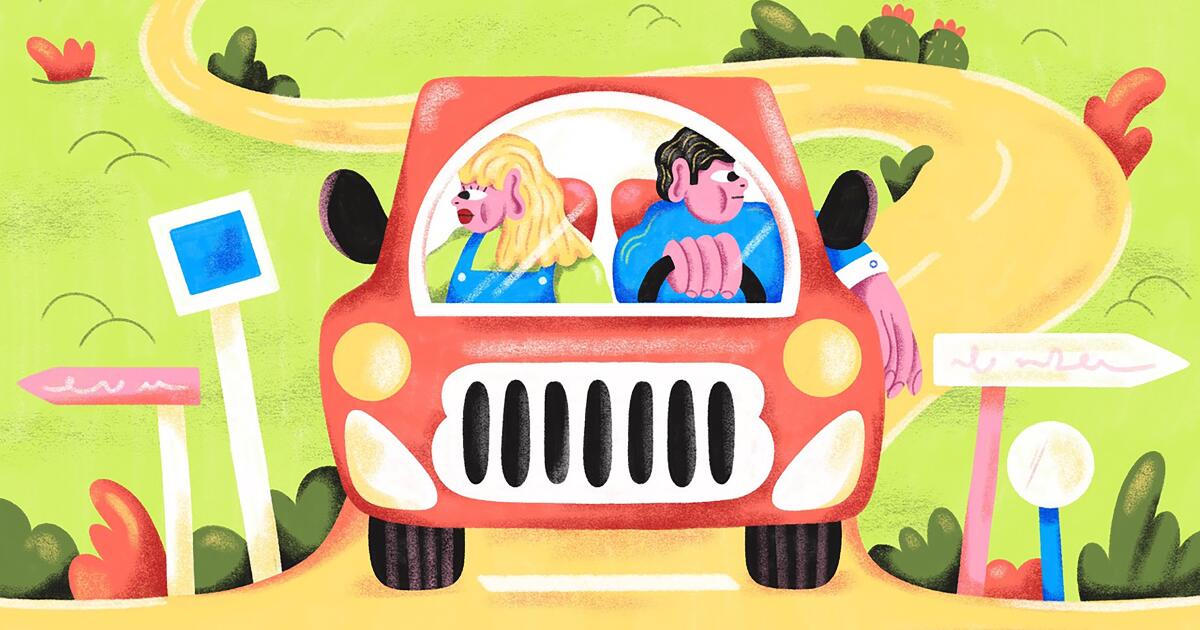
I met Dan on Hinge.
He lives in Woodland Hills, and I live in Venice. In Los Angeles, this is considered a long-distance relationship. In another city it might be nothing. Here, it’s a factor.
But I believe that with the right person, you can make anything work, so I stay open. I’m a native New Yorker, and if I were living in Brooklyn and a guy lived on the Upper West Side, that would be a 45-minute subway ride, which is truly nothing in New York. So with that same logic, I try to have flexibility with men in L.A.
When we started planning our first date, Dan suggested three options: a hike on mushrooms, a wine tasting or a walk on the beach.
A hike on mushrooms is something I’d only do with someone I already trust, not someone I just met online. I don’t do first-date hikes because I don’t like feeling trapped if the guy’s a dud. So I chose the wine tasting.
Then I learned the wine tasting was in West Hills.
On a Friday night, driving there from Venice would be insane. So I said I didn’t want to meet there because of the traffic. He suggested Malibu. That was also not ideal on a Friday.
I was getting annoyed — this was a pink flag because in my dating world, the guy is supposed to come to the woman’s neighborhood in the early days. I’ve gone out with plenty of men from the Valley who effortlessly suggested they come to me. It’s not rare or impossible.
I suggested he come to the Westside. I didn’t specifically say Venice, and in hindsight, I probably should have. He landed on Brentwood, which was manageable for both of us. On our first date, we met at an Irish pub on Wilshire Boulevard. He was cuter and more interesting than I had expected, and with the Guinness flowing, we had fun.
When I got home, he texted me: “Well, I like you 🙂 Less the tik tok and the lack of rock music in your life, but it’s not a deal breaker — there are other qualities 🙂 What are your thoughts?”
I noticed the slight negativity but was mostly dazzled that a man texted immediately after the date to say he liked me. In the modern dating economy, this felt rare.
The next day, both of our evening plans fell through, so we made a last-minute date. The wine tasting he originally suggested still sounded like fun, and although it meant me driving to the Valley, I was up for it now that we’d met.
We sipped flights at Malibu Wines & Beer Garden in its airy, romantic courtyard and played a flirty version of Truth or Dare. Halfway through, he dared me to kiss him.
We ended with sushi on Ventura Boulevard and a short make-out session in his car. He invited me to Thanksgiving at his uncle’s, which felt too soon, but also sweet.
After the second date, he texted and said he had his kids that week and was also hosting an event on Thursday, so his only day to meet was Wednesday. I said great.
On Tuesday night, he checked if we were still on, and I said yes.
Then he texted: “I’m flexible on time but not on location. I have a big event on Thursday, hopefully you can come to me again.”
My stomach tightened. This again?
So I texted back: “I drove to you last time, which was a bit of an exception for me especially in the early days, but the wine tasting location sounded special. Usually guys come to my area. How about we switch it up this time?”
He replied: “I appreciate the effort! Because of my event, I’d rather be close to a computer just if needed … Here is what i offer:
— I’ll come to your area anytime next week/end
— Lunch/dinner on me
I want to continue where we stopped last time 😉 No pressure of course, but let’s snuggle”
I responded: “Ok let’s meet next week. Snuggles sound nice … let’s see what happens …”
Then he wrote: “So I won’t see you tomorrow?”
I replied: “Unless you wanna come to me and bring your laptop along, let’s rain check until you have more flexibility.”
He said: “Dang, you are hard. I’ll let you know tomorrow around midday if it’s ok.”
And then — surprise — he decided to come.
He drove to Venice for a 5 p.m. date. He said his ETA was 5 p.m., and it ended up being 5:25 p.m., typical 405 Freeway.
When he showed up, he was in a cranky mood. On our way to KazuNori in Marina del Rey, I thanked him for picking me up and told him I think it’s hot when the guy comes to the girl.
“You’re just saying that because you want me to come to you more,” he said, not playfully, but aggressively.
That was basically the end for me. But there I was, in his car, heading to dinner. So I stayed pleasant and tried to make the best of it.
I shared that in the early stages of dating, I find it’s good etiquette for the guy to come to the woman’s neighborhood. He immediately disagreed and started ranting about how dating rules are ridiculous and how they swing in women’s favor. He resented paying for dates and declared he wasn’t looking to “sponsor a woman’s life.”
“If women want equality and equal rights,” he said, “then it should apply all across the board, including dating, and the man shouldn’t have to pay.”
I said women don’t actually have equal rights because we get paid less than men and often receive lower salaries than men in the same position.
I tried to change the subject and reset the mood, but he insisted we keep hashing it out.
I tried to explain masculine/feminine dynamics: providing and protecting, giving and receiving.
“What does the man get out of this arrangement?” he asked.
It was like watching someone’s personality warp into Mr. Hyde. Then he brought up another point: He’s a single dad of two kids, so he gets tired; and because I don’t have kids, that should factor into who drives where.
At this point, I was barely engaging and focused on eating my hand rolls, and I couldn’t wait to get home.
The check came, and I happily split it, wanting nothing further from him.
In the car back to my place, he remarked: “It’s obvious we’re never gonna see each other again.”
Obvious, but did it need to be stated?
Then he showed me a Spotify playlist he’d made for me of his favorite electronic music, because he knows I like EDM.
“Oh, that’s sweet,” I said.
“Yeah, that’s how I show interest. Through things like this, not who drives to who,” he replied.
When I got out of the car, we wished each other luck, and I headed inside and shut the door.
Two hours later, he sent me the playlist. I’ve yet to listen to it.
It wasn’t the distance that ruined it. It was the resentment. I’m not looking for a man who feels burdened by the effort. I’m looking for a man who sees the value of courting a woman in the first place.
The author is a writer, comedian and former psychologist who lives in Venice. She is the creator of the new vertical series “Manfari.” She’s on Instagram: @solange_neue and @manfari.show.
L.A. Affairs chronicles the search for romantic love in all its glorious expressions in the L.A. area, and we want to hear your true story. We pay $400 for a published essay. Email LAAffairs@latimes.com. You can find submission guidelines here. You can find past columns here.

Lonnie Bunch III is the 14th Secretary of the Smithsonian. He’s pictured above in September 2017.
J. Scott Applewhite/AP
hide caption
toggle caption
J. Scott Applewhite/AP
In a memo addressed to staffers sent Tuesday, the secretary of the Smithsonian, Lonnie G. Bunch III, defended the institution after the White House issued a 162-page report that characterizes the National Museum of American History as a place which has become “subject to institutional capture by a radical, activist ideology that is fundamentally opposed to telling the noble, honest story of the great country we know and love.”
In his email, which NPR has obtained, Bunch wrote in part: “While there will always be room for improvement, this report is not a fair characterization of the work and totality of the National Museum of American History. At the Smithsonian, our work is driven by scholarship, accuracy and an uncompromising commitment to tell the fullness of America’s story. As public servants and the keepers of this institution, we are charged with helping a nation find understanding, hope and clarity and as part of that duty, we are dedicated to excellence, reflection and growth.”

He continued: “We remain focused on what grounds us: a steadfast commitment to scholarship, nonpartisanship, independence, accuracy and integrity. For nearly 180 years, the Smithsonian has worked alongside partners across government — from the White House to Congress to our governing Board of Regents — guided by our enduring mission to increase and diffuse knowledge. That purpose remains: to pursue knowledge with rigor and to serve the American public with clarity and care.”
The White House report was issued on July 4 by the Domestic Policy Council under the title “Saving America’s Story: How Ideological Capture at the Smithsonian Institution’s National Museum of American History Erases Our Heritage.”

The council faults the National Museum of American History on a multitude of fronts, saying it underemphasized the Founding Fathers and early colonial and Revolutionary history; was not sufficiently celebratory of the country’s 250th anniversary; and that it engaged in “anti-white,” “illegal alien” and transgender activism.
It also accuses the museum of trying to “indoctrinate” teachers and students through its exhibitions, programming and teaching resources.
In the report, the council also specifically criticizes museum director Anthea Hartig, who has led the National Museum of American History since 2019 and is concurrently the president of the Organization of American Historians, calling her “an activist advancing an ideological agenda contradictory to the museum’s founding purpose of fostering patriotism.”

The Trump administration has made the Smithsonian museums one of its primary targets in its efforts to reshape cultural narratives to align with its viewpoints. In August 2025, the White House requested a “comprehensive internal review” of eight Smithsonian museums, including the National Museum of American History, following an executive order issued by President Trump in March 2025 in which he called for the removal of “improper ideology” from the Smithsonian’s offerings.
According to the Smithsonian’s charter, all of its 21 museums, 14 education and research centers, and the National Zoo are meant to be run independently of the federal government. The Smithsonian is overseen by Bunch and a board of regents, which includes Vice President Vance, Supreme Court Chief Justice John Roberts and other members appointed by Congress.
In an interview with NBC’s Meet the Press on Sunday, Bunch spoke about the Smithsonian’s 250th anniversary special exhibition at the Smithsonian Castle, which is called “American Aspirations.”
He told NBC: “It’s really important for people to understand that America is much an ideal as it is a place, that it’s a series of aspirations that have really shaped who this country is. And so for me, what is so powerful is to say, ‘Let us honor the words of Thomas Jefferson and the founders, but let us use those to challenge us to be better.’”
Jennifer Vanasco edited this story.

-

 Austin, TX3 minutes ago
Texas Has One Trait Almost Every National Champion Shares
-

 Alabama10 minutes ago
Final 2026 MLB mock draft projections for Alabama’s Justin Lebron
-
 Alaska13 minutes ago
Watch My Buddy Matt Not Get Eaten by Bears in Alaska
-

 Arizona18 minutes ago
Roller derby still has a home in Arizona despite myriad obstacles
-

 Arkansas25 minutes ago
Freshman OL Tucker Young never wavered through Arkansas football coaching changes | Whole Hog Sports
-

 California28 minutes ago
Northern California high school graduation shooting suspect arrested in Texas
-

 Colorado33 minutes ago
Colorado to weigh daily hunting limits, ban on fur sales for wildlife hunted for fur
-

 Connecticut40 minutes ago
Woman arrested, accused of murdering man in Farmington in March

