Lifestyle
Chris Pratt, Katherine Schwarzenegger could've given Craig Ellwood teardown ‘some honor,’ architect's daughter says


Chris Pratt and Katherine Schwarzenegger demolished a famed midcentury home designed by late architect Craig Ellwood to make room for a new, modern mansion.
That’s not how Erin Ellwood, Craig Ellwood’s daughter, said she would have gone about it.
“I think it would have been really cool to keep it and do something … add to it in a really interesting, innovative way,” Ellwood told The Times on Monday. “But you know, maybe this just isn’t their style. I mean, it clearly isn’t if they’re building a farmhouse.”
Ellwood, an Ojai-based interior designer, spoke to The Times about her father’s late ‘40s Brentwood commission, known among locals as the Zimmerman House after original owners Martin and Eva Zimmerman. The property, which she described as a “time capsule” because of its Midcentury Modern aesthetic, was purchased last year and set for demolition seemingly without reason. In recent weeks, several reports revealed that the Marvel star and Schwarzenegger purchased the lot for $12.5 million and that their new mansion — to be designed by Ken Ungar — was the reason for the teardown.
On X (formerly Twitter), the celebrity couple quickly faced ire from architecture enthusiasts and other critics. “Wow,” wrote one user who shared an Architectural Digest article. “Wow as in, this is really bad.”
“Chris Pratt bought a BEAUTIFUL 1950s mid century modern house designed by THE Craig Ellwood and demolished it to build a s— McMansion,” one X user wrote on Friday. “My mid century modernist heart is shattered.”
“Imagine tearing this historic house down to build a ‘modern farmhouse’ McMansion,” a second user wrote on Saturday.
As more reports about the Ellwood razing surfaced, handfuls of social media users also revived “Worst Chris,” a dig that stemmed from a viral tweet about the Hollywood Chrises (Chris Hemsworth, Pratt, Chris Pine and Chris Evans).
Representatives for Pratt and Schwarzenegger did not immediately respond to The Times’ request for comment on Monday.
Like Pratt’s online critics, Erin Ellwood said she only learned about the reason for the demolition earlier this month. But she told The Times that she understands “it comes with the territory.”
Throughout his decades-long career, Craig Ellwood brought his indoor-outdoor living approach to several properties across Southern California, including his beachfront Hunt House in Malibu. The Zimmerman house, with its floor-to-ceiling glass windows and open floor plans, was designed early in her father’s career and wasn’t the best representation of his work, Ellwood said.
“It doesn’t break my heart,” she added of the raze.
Still, the home, sold to “The Man from U.N.C.L.E” creator Sam Rolfe and wife Hilda Rolfe in 1975— stands for a timeless architectural movement. Erin likens her father’s lasting Midcentury designs to “the Chanel of architecture.”
“There’s certain fashions that will never go away. They’ll always stay strong,” she said.
The couple’s modern farmhouse aesthetic may not be Erin’s preferred style, but she said she understands why Pratt and Schwarzenegger would want the Zimmerman House plot: proximity to Schwarzenegger’s mother, Maria Shriver. The former first lady of California reportedly lives across the street from the property.
“I don’t feel bitter. I understand the love of family, I understand wanting to be close to my mother or my mother in-law,” said Ellwood, whose late actor mother Gloria Henry also lived by Shriver. “I understand being a multimillionaire and wanting to build exactly what I want and keep my family close. I get all that. Unfortunately, it involved tearing something down.”
Razing the Zimmerman House is not just “so brutal,” but wasteful in a variety of ways, Ellwood added. She lamented that the home did not have some kind of ceremonious sendoff — final tours for architecture students, a celebratory cocktail hour, donation of materials for architectural studies — before it was torn down.
“Is there something more creative that could’ve been done in the process of taking it away that could’ve given it some honor?” Ellwood asks.
She was speaking to The Times on what would have been her father’s 102nd birthday. She says Craig Ellwood “stood for innovation and a new way of California living.”
“I think what people are responding to is [the home] is like this time capsule,” she said. “I think that’s what hurts people so much — is that there aren’t that many great ones.”
With the Zimmerman House now a pile of rubble and Pratt and Schwarzenegger’s new mansion reportedly still in early construction, Ellwood said she hopes the couple considers giving back to the architecture community amid the backlash.
“They’ve got money,” she said. “It would behoove them to do something kind to the world of architecture.”



Wyle, who spent 11 seasons on ER, returns to the hospital in The Pitt. Now in Season 2, the HBO series has earned praise for its depiction of the medical field. Originally broadcast April 21, 2025.
Hear The Original Interview
Television
After years of avoiding the ER, Noah Wyle feels ‘right at home’ in ‘The Pitt’

TMZ Live Stream
Come Into Our Office and Watch News Happen!!!
Published
We want you to be a part of TMZ, so every weekday, between 9:30 AM and 11:30 AM PT, we take you inside our newsroom via live stream.
You never know what you’re gonna get … a big story that breaks, an argument erupts in the room, or someone’s just joking around.
Your comments are a big part of the stream, and the staff spends a lot of time speaking directly to you. Every day is different!
We also use our live stream to produce our “TMZ Live” TV show.

From left: Noah Wyle plays Dr. Michael “Robby” Robinavitch, the senior attending physician, and Fiona Dourif plays Dr. Cassie McKay, a third-year resident, in a fictional Pittsburgh emergency department in the HBO Max series The Pitt.
Warrick Page/HBO Max
hide caption
toggle caption
Warrick Page/HBO Max
The first five minutes of the new season of The Pitt instantly capture the state of medicine in the mid-2020s: a hectic emergency department waiting room; a sign warning that aggressive behavior will not be tolerated; a memorial plaque for victims of a mass shooting; and a patient with large Ziploc bags filled to the brink with various supplements and homeopathic remedies.
Scenes from the new installment feel almost too recognizable to many doctors.
The return of the critically acclaimed medical drama streaming on HBO Max offers viewers a surprisingly realistic view of how doctors practice medicine in an age of political division, institutional mistrust and the corporatization of health care.
Each season covers one day in the kinetic, understaffed emergency department of a fictional Pittsburgh hospital, with each episode spanning a single hour of a 15-hour shift. That means there’s no time for romantic plots or far-fetched storylines that typically dominate medical dramas.
Instead, the fast-paced show takes viewers into the real world of the ER, complete with a firehose of medical jargon and the day-to-day struggles of those on the frontlines of the American health care system. It’s a microcosm of medicine — and of a fragmented United States.

Many doctors and health professionals praised season one of the series, and ER docs even invited the show’s star Noah Wyle to their annual conference in September.
So what do doctors think of the new season? As a medical student myself, I appreciated the dig at the “July effect” — the long-held belief that the quality of care decreases in July when newbie doctors start residency — rebranded “first week in July syndrome” by one of the characters.
That insider wink sets the tone for a season that Dr. Alok Patel, a pediatrician at Stanford Medicine Children’s Health, says is on point. Patel, who co-hosts the show’s companion podcast, watched the first nine episodes of the new installment and spoke to NPR about his first impressions.
To me, as a medical student, the first few scenes of the new season are pretty striking, and they resemble what modern-day emergency medicine looks and sounds like. From your point of view, how accurate is it?
I’ll say off the bat, when it comes to capturing the full essence of practicing health care — the highs, the lows and the frustrations — The Pitt is by far the most medically accurate show that I think has ever been created. And I’m not the only one to share that opinion. I hear that a lot from my colleagues.
OK, but is every shift really that chaotic?
I mean, obviously, it’s television. And I know a lot of ER doctors who watch the show and are like, “Hey, it’s really good, but not every shift is that crazy.” I’m like, “Come on, relax. It’s TV. You’ve got to take a little bit of liberties.”
As in its last season, The Pitt sheds light on the real — sometimes boring — bureaucratic burdens doctors deal with that often get in the way of good medicine. How does that resonate with real doctors?
There are so many topics that affect patient care that are not glorified. And so The Pitt did this really artful job of inserting these topics with the right characters and the right relatable scenarios. I don’t want to give anything away, but there’s a pretty relatable issue in season two with medical bills.
Right. Insurance seems to take center stage at times this season — almost as a character itself — which seems apt for this moment when many Americans are facing a sharp rise in costs. But these mundane — yet heartbreaking — moments don’t usually make their way into medical dramas, right?
I guarantee when people see this, they’re going to nod their head because they know someone who has been affected by a huge hospital bill.
If you’re going to tell a story about an emergency department that is being led by these compassionate health care workers doing everything they can for patients, you’ve got to make sure you insert all of health care into it.
As the characters juggle multiple patients each hour, a familiar motif returns: medical providers grappling with some heavy burdens outside of work.
Yeah, the reality is that if you’re working a busy shift and you have things happening in your personal life, the line between personal life and professional life gets blurred and people have moments.
The Pitt highlights that and it shows that doctors are real people. Nurses are actual human beings. And sometimes things happen, and it spills out into the workplace. It’s time we take a step back and not only recognize it, but also appreciate what people are dealing with.
2025 was another tough year for doctors. Many had to continue to battle misinformation while simultaneously practicing medicine. How does medical misinformation fit into season two?
I wouldn’t say it’s just mistrust of medicine. I mean that theme definitely shows up in The Pitt, but people are also just confused. They don’t know where to get their information from. They don’t know who to trust. They don’t know what the right decision is.
There’s one specific scene in season two that, again, no spoilers here, but involves somebody getting their information from social media. And that again is a very real theme.
In recent years, physical and verbal abuse of healthcare workers has risen, fueling mental health struggles among providers. The Pitt was praised for diving into this reality. Does it return this season?
The new season of The Pitt still has some of that tension between patients and health care professionals — and sometimes it’s completely projected or misdirected. People are frustrated, they get pissed off when they can’t see a doctor in time and they may act out.
The characters who get physically attacked in The Pitt just brush it off. That whole concept of having to suppress this aggression and then the frustration that there’s not enough protection for health care workers, that’s a very real issue.
A new attending physician, Dr. Baran Al-Hashimi, joins the cast this season. Sepideh Moafi plays her, and she works closely with the veteran attending physician, Dr. Michael “Robby” Robinavitch, played by Noah Wyle. What are your — and Robby’s — first impressions of her?
Right off the bat in the first episode, people get to meet this brilliant firecracker. Dr. Al-Hashimi, versus Dr. Robby, almost represents two generations of attending physicians. They’re almost on two sides of this coin, and there’s a little bit of clashing.
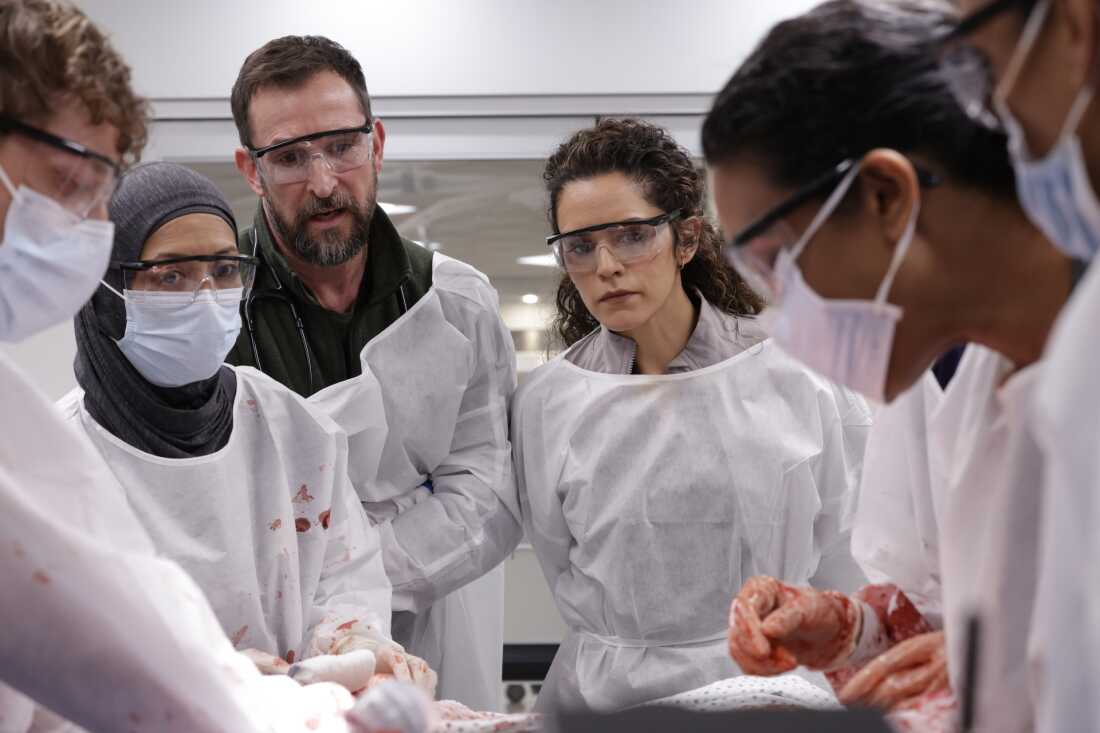
Sepideh Moafi, fourth from left, as Dr. Baran Al-Hashimi, the new attending physician, huddles with her team around a patient in a fictional Pittsburgh teaching hospital in the HBO Max series The Pitt.
Warrick Page/HBO Max
hide caption
toggle caption
Warrick Page/HBO Max
Part of that clash is her clear-eyed take on artificial intelligence and its role in medicine. And she thinks AI can help doctors document what’s happening with patients — also called charting — right?
Yep, Dr. Al-Hashimi is an advocate for AI tools in the ER because, I swear to God, they make health care workers’ lives more efficient. They make things such as charting faster, which is a theme that shows up in season two.
But then Dr. Robby gives a very interesting rebuttal to the widespread use of AI. The worry is that if we put AI tools everywhere, then all of a sudden, the financial arm of health care would say, “Cool, now you can double how many patients you see. We will not give you any more resources, but with these AI tools, you can generate more money for the system.”
The new installment also continues to touch on the growing corporatization of medicine. In season one we saw how Dr. Robby and his staff were being pushed to see more patients.
Yes, it really helps the audience understand the kind of stressors that people are dealing with while they’re just trying to take care of patients.
In the first season, when Dr. Robby kind of had that back and forth with the hospital administrator, doctors were immediately won over because that is such a big point of frustration — such a massive barrier.
There are so many more themes explored this season. What else should viewers look forward to?
I’m really excited for viewers to dive into the character development. It’s so reflective of how it really goes in residency. So much happens between your first year and second year of residency — not only in terms of your medical skill, but also in terms of your development as a person.
I think what’s also really fascinating is that The Pitt has life lessons buried in every episode. Sometimes you catch it immediately, sometimes it’s at the end, sometimes you catch it when you watch it again.
But it represents so much of humanity because humanity doesn’t get put on hold when you get sick — you just go to the hospital with your full self. And so every episode — every patient scenario — there is a lesson to learn.
Michal Ruprecht is a Stanford Global Health Media Fellow and a fourth-year medical student.

How Nebraska men’s basketball’s historic start to the season could end its NCAA tournament drought

Man struck, killed by work truck on I-15 ramp near Las Vegas Strip, police say

Man killed in NH snowmobile crash

Police investigate fatal stabbing in Mercer County

New Mexico Public Education Department faces $35 million shortfall

Florida High School Football Rankings: Top 25 teams – Oct. 21

Cleary's 21 help Le Moyne down Central Connecticut State 69-64 in OT

How old is Bo Nix? What to know about Oregon quarterback ahead of 2024 NFL Draft

99th annual Pony Swim held in Virginia

Video: ‘It Didn’t Have to Happen This Way:’ U.Va. Faculty Call for Review of Police Response to Protests

AOC accuses Vance of believing ‘American people should be assassinated in the street’
Mercosur: How Macron’s domestic weakness undercut his Brussels clout

National Park Service will void passes with stickers over Trump’s face

Trump plans to meet with Venezuela opposition leader Maria Corina Machado next week

Trump says meeting Iran’s ‘Crown Prince’ Pahlavi would not be appropriate
-

 Detroit, MI6 days ago
2 hospitalized after shooting on Lodge Freeway in Detroit
-

 Technology3 days ago
Power bank feature creep is out of control
-

 Dallas, TX4 days ago
Defensive coordinator candidates who could improve Cowboys’ brutal secondary in 2026
-

 Health5 days ago
Viral New Year reset routine is helping people adopt healthier habits
-

 Iowa3 days ago
Pat McAfee praises Audi Crooks, plays hype song for Iowa State star
-

 Nebraska3 days ago
Oregon State LB transfer Dexter Foster commits to Nebraska
-
 Nebraska3 days ago
Nebraska-based pizza chain Godfather’s Pizza is set to open a new location in Queen Creek
-

 Oklahoma1 day ago
Neighbors sift debris, help each other after suspected Purcell tornado