Lifestyle
Check out this under-the-radar wildflower spot while you still can


If you thought the wildflower season was over in Southern California, think again.
The easily accessible Highway 39, also known as San Gabriel Canyon Road, from Azusa north to Crystal Lake Recreation Area is one of the best hidden gems where you can still peep wildflowers — at least for a while longer.
While we haven’t had a superbloom this year — where flowers carpet entire hillsides and canyons all over — there was in abundance of wildflowers last week along Highway 39. Visiting reminded me of my trip to Anza Borrego Desert State Park in March to see desert wildflowers and bighorn sheep. In both spots, fantastic colors swirled in seemingly unexpected places. (However, Anza Borrego’s wildflower season ended in April.)
1
2

1. California bluebells (Phacelia minor) grow on the hillsides around Highway 39 on May 8 in the Angeles National Forest north of Azusa. 2. As do red bush monkeyflowers (Diplacus aurantiacus var. puniceus), as seen on May 9. (Raul Roa / Los Angeles Times)
Thousands of people flock to the windy two-lane Highway 39 past the Morris and San Gabriel dams on their way to the east, west or north forks of the San Gabriel River for camping, hiking, picnics and recreation in the cool snowmelt. If you time your trip right, you may see what I saw: a localized explosion of wildflowers right next to the road and in the gullies and trails throughout the San Gabriel Mountains. As you drive north on Highway 39, you’ll notice a variety colors. Yellows, pinks and reds line the hillsides. Meanwhile, when a colleague visited Carrizo Plain National Monument, one of California’s most iconic wildflower viewing areas, in April, the wildflower display wasn’t as striking as years past. There were swaths of goldfields and pockets of other wildflowers there, but the tall, thick grass fueled by rainstorms crowded the views. The Carrizo display is “largely over this year,” according to Theodore Payne’s wildflower hotline.
Along Highway 39, there are many turnouts and parking lots to safely stop to get a closer look at the variety of native flowers on foot. (You’ll need a National Forest Adventure Pass to park, which is $5 for the day or $30 annually.) One of the best spots is the overflow parking lot for the Devil’s Canyon Dam Truck Trail right off the road up to the Coldbrook Campground.
1
2
3
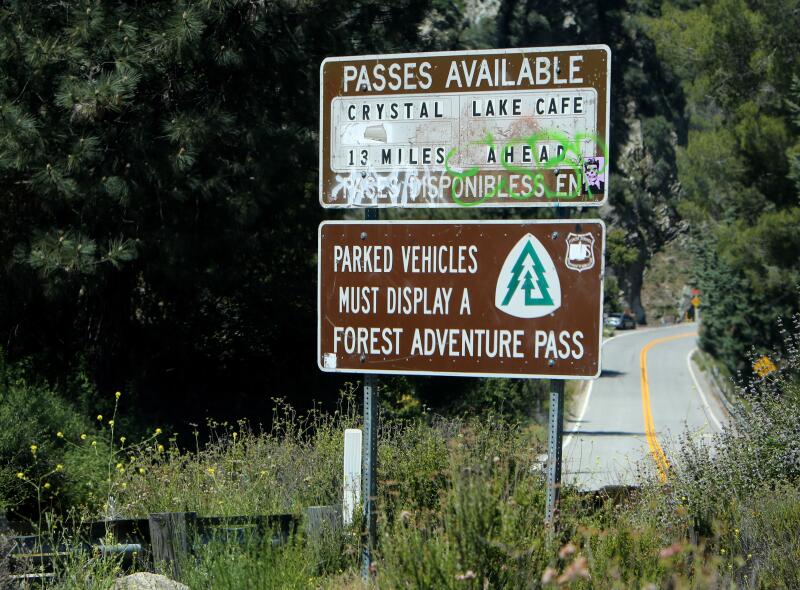
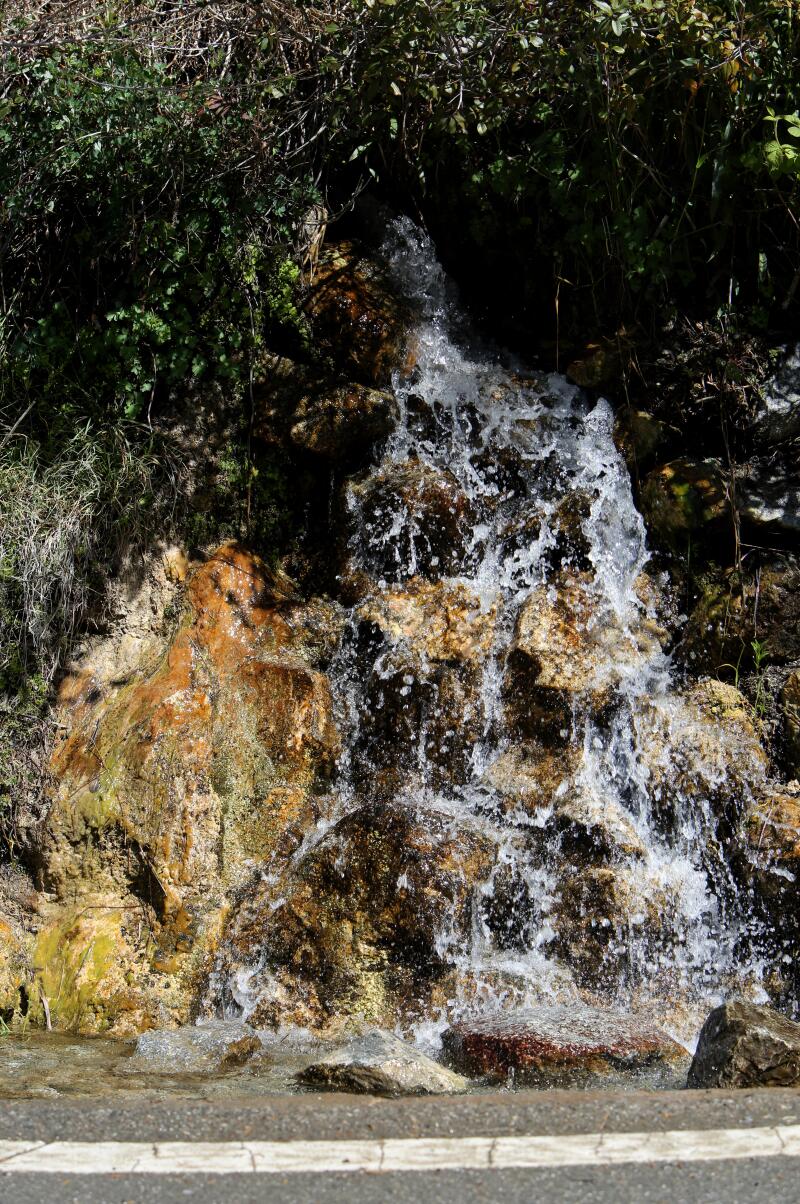
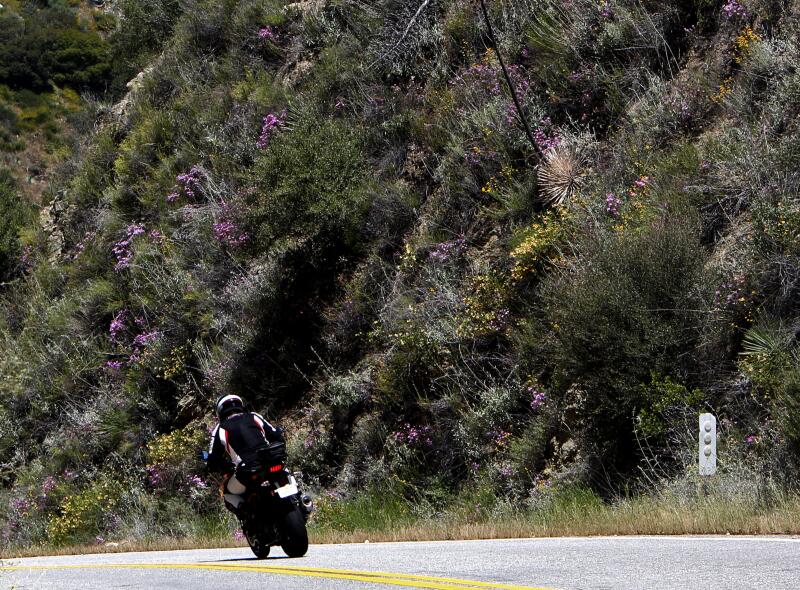
1. Elizabeth’s Spring bubbles right out of the side of the hill May 7 on Highway 39. 2. A motorcyclist rides past wildflowers growing on the hillsides around Highway 39. 3. Remember that you will need a National Forest Adventure Pass when parking in the Angeles National Forest. (Raul Roa / Los Angeles Times)
If you continue north, you can take a short hike to Lewis Falls in the Angeles National Forest and see Elizabeth’s Spring, a natural spring bubbling on the mountainside next to Highway 39. At the top of the road you’ll find Crystal Lake Recreation Area, where the Crystal Lake Cafe serves a simple menu including hamburgers, hot dogs, sandwiches, chili and brownies, and there are first-come, first-served camping sites.
1

2

1. A bee makes a pitstop on a sunflower along Highway 39 in the Angeles National Forest north of Azusa. 2. Wide throated yellow monkeyflower (Mimulus brevipes) frame the side of Highway 39. (Raul Roa / Los Angeles Times)
1

2
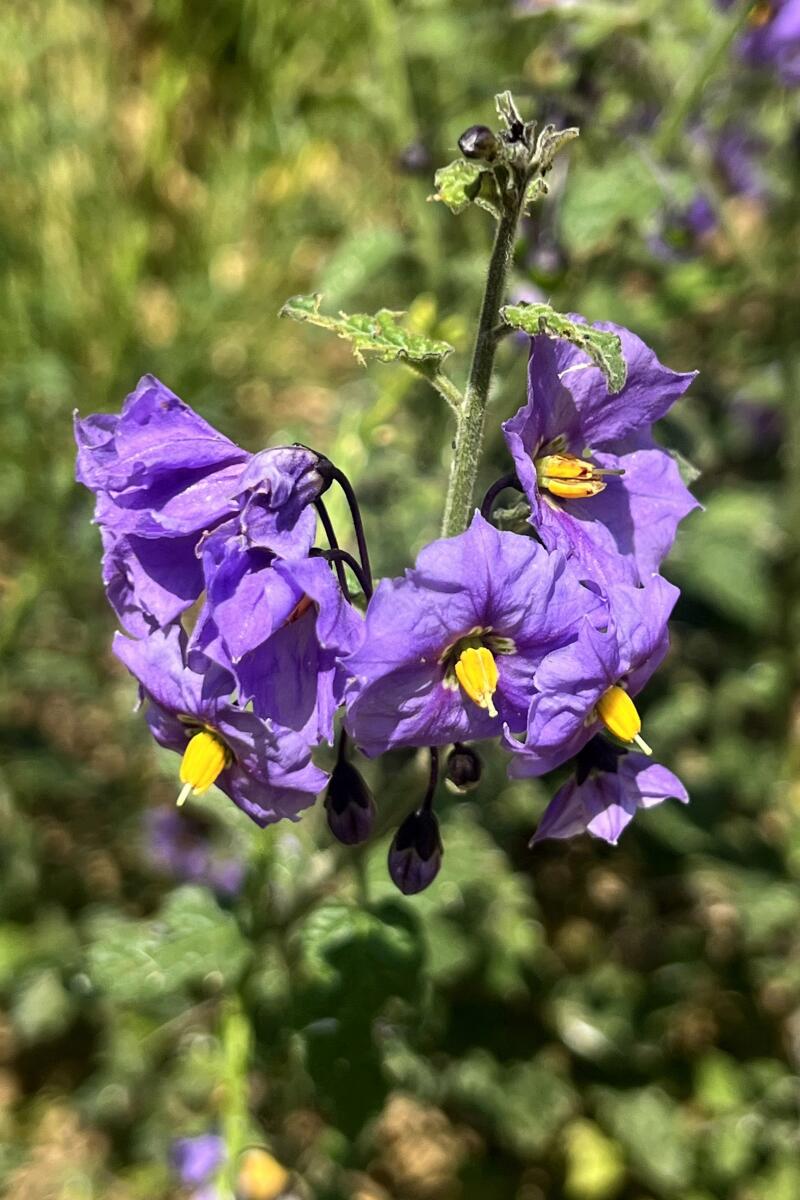
1. Silver lupine (Lupinus albifrons) grows on the hillsides May 8 around Highway 39 in the Angeles National Forest. 2. As does bluewitch nightshade (Solanum umbelliferum), as seen on the same day. (Raul Roa / Los Angeles Times)
On your trip, you may see wildlife such as bald eagles, deer and perhaps bears. Remember to stay on the trails and not pick wildflowers to help the blooms return next year. Keep an eye out for snakes and if you venture farther on some trails, use tick and mosquito repellent, wear comfortable shoes and carry plenty of water.
Other spots worth a road trip to see wildflowers right now include Pinnacles National Park, the California Botanic Garden in Claremont and Los Padres National Forest near Los Olivos, reports the wildflower hotline.


The Kennedy Center, the facade of which remains covered with a tarp, is seen in Washington, DC, on June 28, 2026. A US federal judge asked on June 24 for an explanation for why a tarpaulin continues to cover the facade of the Kennedy Center where President Donald Trump’s name was recently removed. District Judge Christopher Cooper gave the board of trustees of the performing arts venue until the end of July to explain “the purpose for and status of the tarp and scaffolding that Defendants have erected on the front portico of the Center.”
ALEX WROBLEWSKI/AFP via Getty Images
hide caption
toggle caption
ALEX WROBLEWSKI/AFP via Getty Images
More than two weeks ago, President Trump’s name was removed from the Kennedy Center facade though it is still covered by a tarp and the legal battle continues.
On Monday, a U.S. Department of Justice filing on behalf of the Kennedy Center included some surprises. The document was submitted in response to issues raised by lawyers for ex-officio board member Rep. Joyce Beatty of Ohio who is suing to remove President Trump’s name from the center and stop its closure for renovations.
Among the revelations, the Kennedy Center admitted that, during a board meeting on December 18, 2025, Beatty had been “muted and prevented from speaking.” It was at that meeting that the board voted to add President Trump’s name to the center. The filing later acknowledges the congresswoman was “prevented from voicing her opposition.”
The John F. Kennedy Center for the Performing Arts is a living memorial to its namesake. The guidelines for how the theatre complex spends federal dollars are very specific. Among other rules, it states that “no additional memorials or plaques shall be designated or installed.” Beatty argues adding Trump’s name runs afoul of those rules and that any change requires approval from Congress.
According to one of Beatty’s filings, “There was no advance notice in the agenda that the Board would be considering a name change,” a statement the Kennedy Center now does not deny. The center admits that, prior to voting, there was “no discussion about potential risks or downsides of the vote to adopt a secondary name for the Center.” Nor was there a board discussion “about any potential conflict of interest that might result from the vote.”
The center’s lawyers previously contended that if Trump’s name were to be removed, it would “lose money from donors who support” him and “impede the Center’s fundraising efforts.”
Closing for renovations
Earlier this year, Trump announced on social media that the Kennedy Center would close for two years for renovations. He wrote that he made the decision after “a one year review” with “Contractors, Musical Experts, Art Institutions, and other Advisors and Consultants.”
But, according to the center’s lawyers, Trump’s announcement “was made without presenting any plans, analyses, timelines, or funding information to his cotrustees and without any Board vote.”
The Kennedy Center has long denied reporting by The Washington Post that ticket sales plummeted after President Trump became the Center’s board chair. In Monday’s legal filing, the Center admits that, by October 2025, “nearly half of the Center’s tickets were going unsold.”


Paul Tremblay has made a career of pushing the horror genre – and the novel format – in strange and exciting new directions.
In his latest, Dead but Dreaming of Electric Sheep, the author offers an amalgamation of genre elements that can be best described as psychological-dystopian-science-fiction horror. It’s a mouthful, but the narrative does all of that and more in a way that defies categorization.
Julia Flang is a former semiprofessional gamer working two mediocre jobs she dislikes and living in a modest ranch house in a San Fernando Valley suburb with her retired uncle, whom she calls Uncle Fun. Julia likes movies and gaming but there’s little else going on in her life, so when her estranged mother, the CFO of a large tech company, contacts her with a possible job offer – a “once-in-a-lifetime thing” that pays handsomely just for doing the interview – she hesitantly agrees.

The job is relatively simple and perfect for someone with gaming skills: using a controller built into a phone to get a man, who is stuck in a vegetative state, from California to the East Coast. It will require her to learn how to control his body – walking, moving, sitting, standing, using his arms – so she can maneuver him out of the facility where he is located and into cars and planes and through crowded airports. A fan of movies, Julia decides to call the man Bernie – after the movie Weekend at Bernie’s. When the ethics of the job start to bother her, Julia realizes it’s too late and she must go through with it. However, she’s soon contacted by people interested in sabotaging the whole thing, people who, like her, don’t align with the shady interests of conglomerates and those set to make “gobs of money” from this new, somewhat inhuman technology.

As with every Tremblay novel, any synopsis barely scratches the surface. The novel’s chapters alternate between Julia and you (yes, you). Julia’s chapters are “normal” in the sense that they obey a chronological order and have action, basic descriptions of movement and places, and dialogue. The chapters in second person are like fever dreams from a shadow world; the desperate experiences of a man trapped inside his own body with no control of it, no clue what’s happening to him, and only a few fragmented memories of his life. Also, Tremblay uses a similarly fragmented style of storytelling (including words and sentences trapped in boxes and/or “moving” on the page) to keep things interesting but also confusing and creepy.
This novel operates on several different levels and – planes of existence? Bernie has a head full of AI that controls his body, but his consciousness is still there and struggling to regain control, struggling to remember things. There are monsters, leeches, mysterious rabbits, and eerie shadows in his world, but the true horror comes from the lack of control, from being moved around against his will and having no clue what comes next. Bernie is the embodiment of losing control to AI, and when taken together with the commentary of creativity and AI and the meta interludes in which the author takes a wrecking ball to the fourth wall and addresses readers, this is the best anti-Generative AI story horror has produced so far.
Despite the horror of it, this is a very funny novel. Julia is sarcastic and struggles to keep her comebacks in line, but the conversations she has and messages she writes are always entertaining. However, the humor is far from the crown jewel here. That title belongs to a plethora of big ideas Tremblay juggles. The nature of life, death, and consciousness, the evils of conglomerates, inhuman practices in the name of capitalism, and AI, and even what it means to be human are all explored here: “Is Bernie alive? Is he feeling pain? Is he experiencing everything as a prisoner looking through the bars of his body? Has his consciousness been winnowed to a metaphysical keyhole? Where does consciousness begin or end?” There are no definite answers here, but the way Tremblay infuses humanity, love, the importance of relationships, and humor throughout the narrative provides the kind of answers that can’t and don’t need to be spelled out.
A genre-bender full of big ideas that constantly switches between a world full of real or uncomfortably plausible nightmares and a bizarre hellscape in which loss of self, memory, and autonomy are only the tip of the proverbial iceberg, Dead but Dreaming of Electric Sheep is a horrific and terrifyingly disorienting novel that invites readers to consider a future that already started. Tremblay has always been an innovator, but this beautifully written collection of real and imagined grotesqueries cements him not only as one of the most original and exciting voices in horror but also as one of the smartest, most engaging authors in contemporary fiction.
Gabino Iglesias is an author, book reviewer and professor living in Austin, Texas. Find him on X, formerly Twitter, at @Gabino_Iglesias.

-

 Colorado5 minutes ago
Where to watch Miami Marlins vs Colorado Rockies: TV channel, start time, streaming for July 1
-

 Connecticut7 minutes ago
Lamont signs law in Norwich to stop pay to contractors violating wages
-

 Delaware12 minutes ago
Delaware has gotten these 15 verbal commitments from football recruits
-
 Florida19 minutes ago
Kids with autism are prone to drowning. Florida is trying to prevent that
-

 Georgia22 minutes ago
Bradenton man wanted for murder is found hiding in Georgia
-

 Hawaii27 minutes ago
Few state bills this year face potential veto – West Hawaii Today
-

 Illinois38 minutes ago
West Suburban hospital sends permanent layoff notices to about 500 furloughed employees
-

 Indiana43 minutes ago
Extreme heat peaks before holiday weekend storms | July 1, 2026

