Lifestyle
Bucks County, Pa., Is Now a Celebrity Hot Spot


It’s hard to pinpoint when things began to change around here but you might start with the arrival of Yolanda Hadid in 2017.
Ms. Hadid, a onetime regular on “The Real Housewives of Beverly Hills,” bought a farm just outside New Hope, Pa., to be closer to her daughters, the models Gigi and Bella Hadid, who were then living in New York City.
The 32-acre property, with its stone farmhouse, horse barn and formal garden, became a family retreat, and the Hadids’ social media feeds filled with pastoral images: Gigi in a two-piece bathing suit, posing with a bowl of newly picked vegetables beside a patch of basil; Yolanda in black boots, bluejeans and a puffer vest, showing off a heap of fresh-cut lavender.
“We ride horses, we have a vegetable garden,” Yolanda told The Toronto Star in 2018, describing her life in the countryside with her famous daughters, who between them have 140 million followers on Instagram.
The presence of the Hadids attracted other famous people to Bucks County, a woodsy area known for its rolling hills and 12 covered bridges. In 2018, Zayn Malik, the British pop singer who was in a relationship with Gigi, bought a farm there. “It is quiet,” he said in an interview with British Vogue. “There are no human beings.” People magazine shared the news that Gigi gave birth to the couple’s daughter at home in Bucks County in 2020.
Tranquil Bucks County was back in the media spotlight the next year, when TMZ and Billboard reported on an altercation involving Mr. Malik, Gigi and Yolanda that took place at one of their country homes. Facing four charges of harassment, Mr. Malik pleaded no contest and was sentenced to 360 days of probation; he and Gigi broke up after the incident.
In 2023, the actor-writer-director Bradley Cooper, widely reported to have succeeded Mr. Malik as Gigi’s love interest, paid $6.5 million for a 33-acre gentleman’s farm close to Yolanda’s property. Then came local sightings of Leonardo DiCaprio and Justin and Hailey Bieber. Just across the Delaware River from New Hope, in Lambertville, N.J., Julianne Moore and Sydney Sweeney were filming a movie.
Suddenly, New Hope and the quaint neighboring towns were becoming a celebrity enclave. While a census might reveal fewer famous people per acre than in the Hamptons, Malibu, or Aspen, the area’s glamour quotient was on the rise.
Located between Philadelphia and Manhattan, New Hope has long been a haven for wealthy part-time residents. The surrounding countryside has been compared to that of the Cotswolds in England, and the artists and artisans living in the area add a touch of bohemia to the rusticity. But in past decades the weekenders tended to be lawyers and executives from Philadelphia, not supermodels, Hollywood actors and pop stars.
Michael Arenella, a musician and the founder of the annual Jazz Age Lawn Party on Governors Island, bought a weekend house in Bucks County in 2014, when he was living in Brooklyn. He started living there full-time two years later in the belief that he had chosen a place well off the cool map.
“Beacon is like Brooklyn 2.0,” Mr. Arenella, 46, said, referring to the Hudson Valley town that has been nicknamed “Bro No,” an abbreviation of Brooklyn North, because of the many former Brooklynites residing there. “I wanted to get away from New Yorkers. Bucks County is not quite as pretentious.”
Lately, though, Mr. Arenella has been seeing plenty of New York license plates in and around New Hope. Beyond sightings of Gigi Hadid or Jakob Dylan, another famous transplant, there are other signs of change in the area.
Humble inns have been refurbished to attract a new clientele, and several luxury hotels have sprung up, including River House at Odette’s, where the average nightly rate for a Saturday in November was $560 and the private rooftop club charges members $1,250 a year.
Philadelphia magazine cited the hotel and its in-house restaurant as the most glaring example of “the new New Hope.” Opened in 2020 by a group of investors that includes Ed Breen, the executive chairman of DuPont, it was built on the former site of Chez Odette’s, a restaurant and cabaret presided over by an eccentric French actress and poet, Odette Myrtil.
Along with Bucks County Playhouse, which opened in 1939 and drew such stars as Grace Kelly and Robert Redford, Odette’s came to symbolize New Hope’s bohemian culture. It closed in 2007, after three consecutive floods struck the town, and the stone building that housed it was painstakingly relocated to another lot, where it now sits empty.
Just up the Delaware, in Stockton, N.J., population 494, the historic Stockton Inn recently reopened after a two-year renovation. Its owners hired a James Beard Award winner to manage the property and its two restaurants. They also opened Stockton Market, a gourmet café that sells Frankies 457 olive oil and matcha tea made on site. Nearby, another high-end dining establishment, the Northridge Restaurant, opened last month after a three-year transformation of a weathered barn on the property of the Woolverton Inn.
Real estate values have soared in the area as the ultrarich supersize musty, low-ceilinged 19th-century abodes. “The old Bucks County farmhouse is now being blown out and expanded into true estates,” said Michael J. Strickland, a real estate agent with Kurfiss Sotheby’s International Realty who moved from Manhattan to Bucks County full-time in 2000.
Part of the appeal, he added, is that “property values are still accessible here, versus the Hamptons.”
‘Everyone Is From Brooklyn’
Mira Nakashima has seen the changes up close. She moved to New Hope as a child, in 1943. Her father, George Nakashima, was a woodworker and designer whose sculptural tables and chairs were displayed at the Museum of Modern Art and today fetch thousands of dollars at auction.
Mira took over George Nakashima Woodworkers after his death in 1990 and still runs the complex of workshops he built on a tree-lined property above the town. Sitting at a walnut table made by her father, Mira, 82, recalled the old New Hope as low-key and artsy.
“A lot of landscape painters came because the landscape was so beautiful,” she said. “There was fishing on the river. And there were canals running both sides of the river. And it was quiet and peaceful.”
For years, Nakashima Woodworkers held an open house on Saturdays. Recently, Mira said, the grounds became so overcrowded that she now offers guided tours by appointment only.
“Everyone is from Brooklyn. I can smell Brooklyn on them when they arrive here,” added Soomi Hahn Amagasu, Mira’s daughter-in-law and the studio’s sales manager. “So many young people are coming here.”
They won’t find Williamsburg-on-the-Delaware, however. New Hope’s commercial drag still has a hippie vibe distinct from the increasingly refined retail atmosphere of that Brooklyn neighborhood, with its Hermès and Chanel stores.
Mainstays include Witch Shop Gypsy Heaven, MagiKava teahouse and Love Saves the Day, a vintage bric-a-brac emporium formerly located in New York’s East Village. Another store sells tie-dye rock T-shirts. Those places, along with the homey bars and reasonably priced restaurants, bring in the suburban teens, twentysomethings and other day-trippers who clog the streets on weekends.
The lack of luxury stores of the kind you might find in East Hampton is by design, said Larry Keller, New Hope’s mayor for the last 27 years and an antique dealer in town. The town is also not so hot on national chains: After Starbucks and Dunkin’ moved in, the council revised zoning laws to favor local businesses.
“You don’t have the square-footage,” Mr. Keller said, referring to the tiny storefronts. “Where is Ralph Lauren going to have a store and sell enough gear to make sense? These are boutiques.”
One of New Hope’s shops made the grade for Gigi Hadid: Ditto Vintage, on Brick Street. Last winter Ms. Hadid stopped in and bought a Nahui Ollin handbag, a leather jacket and a necklace.
There are some upscale shops in nearby Lambertville: Albucker Gallery sells contemporary art and an assortment of found objects; Ten Church offers vintage clothing; and Rago Arts and Auction Center sells works by Nakashima and other design goods. Lambertville is also on the foodie map: Canal House Station, which serves American fare in a converted 1870s train station, earned a Michelin star.
Back on the Pennsylvania side of the iron bridge, there are signs that New Hope is in the early stages of a makeover. The building that houses Farley’s Bookshop, which opened in 1967, was recently renovated into a bright, modern space. A few doors down, a scruffy indoor mini mall was turned into a Ferry Market, a food hall. A high-end eyeglass store, Kitto Optical, opened on the same block.
“The French fries the restaurants serve are now truffle fries,” joked Katsutoshi Amagasu, 21, a Nakashima family member who grew up in New Hope.
Some of the town’s structures date to the colonial era, like the circa.-1727 Logan Inn. But on the residential north end, beyond the protected historic district, a Victorian house overlooking the river was bulldozed and replaced with a modernist compound befitting Bel Air. On an adjacent empty lot, a builder promises four luxury condominiums, each with a terrace, elevator and private dock. The asking price for one unit is $3.5 million.
Lorraine Eastman, a real estate agent at Berkshire Hathaway, said the riverfront has been built up to the point that portions of the Delaware are no longer visible to passers-by. Ms. Eastman lived in New Hope back in the ’80s, before moving to Los Angeles and eventually returning seven years ago.
“I bartended with Big Sue, who was 6-foot-1, wore size 13 motorcycle boots and smoked a cigar and sang jazz,” she recalled of her time working at John and Peter’s, a bar and rock club on South Main Street that’s still in business. “I lived in a loft on Ferry Street, which is now the Nurture Spa. New Hope was very artsy, gritty, very bohemian. It still has a little bit of all those qualities, but it is changing.”
Eat, Pray, Spend
Like many picturesque small towns, New Hope seems to have been discovered during the pandemic by urbanites who gobbled up property and drove up real estate prices.
“People are always looking for a place to go that’s a hidden little storybook town,” said Ms. Eastman, who recently listed a renovated 1769 farmhouse with a pool and “party” barn on 37 acres for $4.5 million.
Celebrity residents aren’t exactly new, either: Paul Simon had a weekend house in Bucks County in the early ’70s; more recently, the “Eat, Pray, Love” author Elizabeth Gilbert lived in Frenchtown, N.J., 16 miles north.
But the presence of the Hadids and Mr. Cooper, who grew up in suburban Philadelphia, has lent glamour to the area and whetted the appetites of developers and entrepreneurs.
A few miles from Yolanda Hadid’s estate, in the hamlet of Carversville, Pa., another hospitality project is nearly complete.
Milan Lint and his husband, Mitch Berlin, each of whom have had finance careers in New York, are renovating the Carversville Inn, a circa.-1813 stone building that the couple bought in 2020.
Standing amid the construction one morning last month, Mr. Lint, who has owned a weekend home with Mr. Berlin in Bucks County for 20 years, described the plans for the space, which is slated to open soon.
The new Carversville Inn will be a European-style boutique hotel with six rooms priced around $500 a night, Mr. Lint said. Its 65-seat restaurant will have “a French brasserie menu, in the Pastis or Balthazar style,” Mr. Lint added, name-checking a pair of Manhattan stalwarts.
Asked why he and Mr. Berlin had chosen Bucks County as the place for their venture, rather than, say, the Hudson Valley, Mr. Lint shared a memory of a boring, rainy summer spent in the area.
“The Hudson Valley is very pocket, and weather-dependent,” he said. “Here, the towns dot up and down the river. You can have a full weekend four seasons a year.”



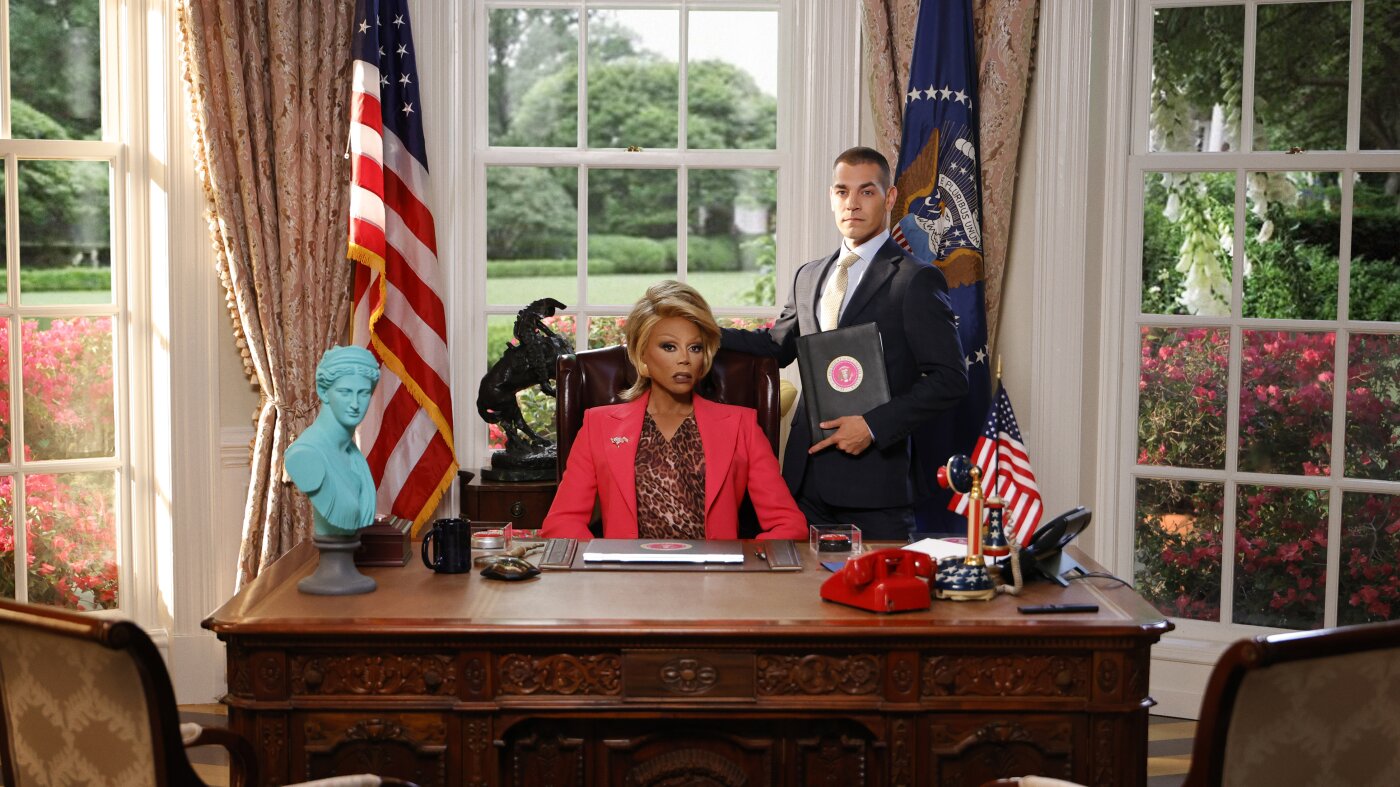
RuPaul and Matt Rogers in Stop! That! Train!
World of Wonder/Bleecker Street
hide caption
toggle caption
World of Wonder/Bleecker Street
When I tell you, reader, that the new film Stop! That! Train! plays exactly like an extended, slightly better-than-average Acting Challenge on a slightly better-than-average season of RuPaul’s Drag Race, some among you will nod sagely, and hie your butts to the theater in boisterous gaggles of girls, gays and theys. (A not-insignificant subset of you may also stop along the way to buy a box of cheap-ass blush wine so you can remove the bag and smuggle it into the theater, and I can’t stop you, that’s your own business.) Some among you will take that same report under advisement, secure in the knowledge that you’ll be fine waiting to stream it in the comfort of your own homes, where you’ve stashed enough champagne … to fill da Nile! Some among you — let’s face it, the younger, hotter, more evolved crowd that prefers your humor to grow organically out of things like characterization, cultural insight and dry wit — will grimace, and resolve to avoid it at all costs.
But the vast majority of you haven’t watched enough Drag Race to internalize its every formulaic tic, and thus won’t be able to glean any useful information from the comparison, so let me break it down for you.
Stop! That! Train! parodies ’70s disaster movies in exactly the way the 1980 film Airplane! did, which is to say: By submitting it to a ceaseless fusillade of broad, sweaty and very dumb jokes, by busting out a parade of game celebrity cameos and by deploying a just-shy-of-legally-actionable number of precisely the same gags.
The only salient difference turns out to be one of sensibility. Where Airplane!‘s humor chiefly arose from encasing its jokes in a thick layer of deadpan solemnity (think Leslie Nielsen’s Dr. “And don’t call me Shirley” Rumack), Stop! That! Train!‘s entire schtick is one of arch, winking camp (think Stephen Stucker’s Johnny, the hilariously queeny control-room worker who served as resident court jester/chaos gremlin).
So think of it as Airplane! with nothing but the Johnny jokes. In a word: drag.
Which only makes sense, as the film’s key roles are filled with queens from RuPaul’s Drag Race and those who love them. There’s Jujubee and Ginger Minj as DeeDee and Tess, two not-so-fresh-faced “train hostesses” whose low-rent rail service folds, causing them to bluff their way into jobs on a Glamazonian Express luxury bullet train.
They receive a frosty reception from the train’s trio of first-class hostesses, Amber (Brooke Lynn Hytes), Allie (Marcia Marcia Marcia, credited here as Marty Lauter) and the ridiculously spelled Ayshleiygh (Symone). Keep an eye out for Latrice Royale, Monét X Change and Angeria Paris VanMicheals while you’re at it.

If you’re finding yourself concerned that you’re eight paragraphs into this review and still don’t know what the movie’s actually about, just know that you, cookie, are not the target demographic for this particular project. But here goes: A high-speed train malfunctions on a cross-country journey and barrels into a series of mishaps involving an escaped scorpion, a haunted tunnel and a climatological event known as a “Stormaganza” while a lot of very funny people stand around making stupid, usually pun-adjacent jokes. Also: RuPaul sports a Deborah Vance wig to play U.S. President Judy Gagwell (see above, in re: pun-adjacency) and does some really stellar face-acting.

Ginger Minj and Jujubee.
World of Wonder/Bleecker Street
hide caption
toggle caption
World of Wonder/Bleecker Street
Also also: the great Rachel Bloom plays Donna, the only government official to understand the peril facing the train’s passengers and crew, whose dire warnings fall on the cartoonishly boorish, misogynist ears of her co-workers. (Her boss, played by Evan Mulrooney, delivers a masterclass in the kind of prideful, bullying willfulness currently stalking the halls of power; it’s the closest thing this defiantly silly little flick comes to a political statement.)
The whole thing’s over and done with in a brisk 90-minute trot, and you’ll have a very good time. Oh sure, you might find yourself squinting at the special effects, such as they are. Not because they evince the now-familiar muddiness of bad CGI, but because they instead bear the disquietingly bright, clean, sharp lines of AI slop. (Director Adam Shankman felt compelled to release a statement attempting to clarify the film’s status, which reads in part: “There are a sum total of ZERO shots conceived by AI in the movie.” [Emphasis mine, because he’d apparently already told Xtra Magazine that some AI was used, in combination with CGI.]) But in the end, the jankiness of the film’s effects only feed into the hey-queens-let’s-put-on-a-show vibe, not distract from it.
You may also find yourself wishing, as you watch drag queens trading barbs, flaring their nostrils and mime-slapping the bejeezus out of one another, that the barbs in question were better, meaner, fiercer. They’re mildly cutting when they could and should be lacerating, and they feel like place-holders. But the script’s downright neutronic joke-density ensures that you won’t be able to linger over such quibbles; so many more jokes are barrelling toward you that by the time the credits roll (do I need to tell you there’s a gag reel? Of course there’s a gag reel) the comedic signal to noise ratio will prove satisfying.
And hey, it’s Pride. You’re already out and about; why not top off your brief interlude with these cinematic queens by taking in a real drag show where IRL performers are waiting, tucked and plucked and working hard, sweating through their foundation to entertain you? Between numbers you can nip off to the bar and debate with your friends which one of the film’s dumb jokes was the absolute dumbest.
Trust me, you’ll be there a while.

I’m doing yoga at Palisades Park in Santa Monica with a friend, when a tall, thin guy with long hair and carrying a guitar approaches. He has that aging rock-star look, which I find … hot.
He says, “Hey, y’all, can anyone join your yoga class?”
Southern drawl? Also, hot. “Oh, it’s not a class,” I say. “Can anyone get a song on your guitar?”
He hoists the guitar and launches into a beautiful ballade. I feel the late afternoon sun on my arms, smell the ocean breeze. I’m reminded why I love Santa Monica, where I moved to from New York after my divorce, looking for a fresh start, and where I’ve remained single ever since.
After the song, the stranger, Clayton, tells us that he moved to L.A. from Georgia in his 20s. He says he got “the biggest signin’ deal of any first-time recording artist.” Now he’s working on the score for a movie with the “biggest producer attached.”
Is this true? I want it to be true. It’s hard to meet a straight guy over the age of 45 who’s successful, single … and has hair. We exchange numbers, but I can’t tell if he’s interested in me romantically. I’ve been single for so long, it’s hard to feel appealing. As a child, I knew I was special, and I knew why: because my mother told me.
But I don’t live with a praiseful parent or a supportive spouse, no. And I work at home; no office mates say, “Cute shoes!” Or “What healthy lunch choices.” I live with a praise deficit, in a vast compliment desert.
The next day Clayton calls and asks me out on a date. Over coffee, he says, “I can write an entire movie script in one week. My agent has never read such good scripts.” Later that week, over drinks, he says, “I got into the Atlanta Boys Choir on my first try.” As if it took everyone else multiple tries.
He picks me up from Los Angeles International Airport — an act of chivalry that deserves knighthood. He has his guitar in the car. Inching home on Lincoln Boulevard, he plays a song he’s composing while steering with one knee. “This song is gonna to be a huge hit,” he says.
Clayton is cool and kind and a big braggart. When I mention that my stomach is bothering me, he says, “I’m gonna cook you the best dinner you’ve ever eaten!”
This brag worries me. I worked as a food critic in New York City. There’s no way Clayton’s very seared salmon with watermelon radish can top a Jean-Georges chocolate mousse.
I finally snap: “Clayton! No one talks this way. You don’t hear me saying, I don’t know, ‘I scored so high on those standardized tests in high school, my score went right off the chart. They couldn’t even keep my score on the chart, that’s how high I scored.’ ”
And then I stop. I had totally forgotten about my excellent test scores. They used to give me a lot of confidence, but I never talk about standardized test scores now because I’m an adult. But since I don’t, they have disappeared from my story of myself. I am more versed in my deficits than my strengths these days.
Clayton is on to something. That night, I call my yoga friend. “We need to start bragging like Clayton,” I say. “But also, keep our friends.”
We hatch a plan: We will start a weekly bragging practice. It will be like a meditation practice but more aggressive. Bragging is not like some tepid self-affirmation; it’s competitive. It’s like my mother.
We decide to begin that Saturday. We have plans to work in the morning, walk to the Korean spa for a scrub, then go to a friend’s improv show where Clayton will join us. As we’re walking to the spa, my bragging buddy is supposed to start. I see her struggling. “Uh. I am really good at … uh, walking down the street?” she says.
“You do have a nice walk,” I say. “And me? I’m really good at, um … It’s so cool how I’m always carrying a cup of coffee around everywhere I go. Like I’m just so comfortable here … in the crosswalk … drinking coffee?”
Bragging is not easy. After a lifetime of being pleasant, polite and self-effacing, trying to brag is like taking a final you haven’t studied for, given in a foreign language.
We arrive at the spa late, but they charge us for the whole hour anyway. After the scrub, I realize I left my phone at home and can’t call Clayton with the improv’s address. I feel bad about all this, but I have made a commitment to brag, so I have to see how these snafus reflect positively on me.
Then I do see it. “You know, I pack a lot in one day,” I say. This is true, but without the bragging practice, I would not have seen it.
My friend and I stick with our bragging practice for six months, longer than the relationship with Clayton lasts. But the experience left a positive impact.
Later, I have plans to travel back to New York City, and my lodging falls through. A friend says, “You have nowhere to stay. You should probably cancel your trip.”
This seems like reasonable advice, but after all that bragging, it sounds off. Is he suggesting that even though I lived in New York for 20 years, I don’t have any friends there I can crash with? I say, “A lot of people want me to stay with them.”
This brag becomes true. I wind up splitting my time between my friend Ben’s on the Lower East Side and Katie’s on the Upper West. As I’m dragging my suitcase down the subway stairs at midnight to switch apartments, I think, “This was a stupid plan.”
But then I hear a Southern drawl in my head. I look around the empty station and say, “I am good at dating, because I learn something valuable from everyone I meet.”
I track down Clayton this spring to make sure he’s OK with being written about. He’s back in Georgia, with “a great new band,” he tells me. About the story, he says, “Go ahead. If you got it, flaunt it.”
“Thanks,” I say. “But my story is about you, um, kind of being a big braggart.”
He pauses and then tells me that when he was young, he had a chance to play guitar with an older, impressive musician. He denigrated his own skills. The older man stopped him, saying that how you talk about yourself becomes your reality. Clayton has been making an effort to speak positively about himself ever since.
It’s easy to think guys in L.A. are egotistical or narcissistic. But this was a reminder that men struggle with these issues too. We’re all out here doing our best, trying to find someone to love.
The author is an author, journalist and budding stand-up comedian in Santa Monica. She shared a version of this essay at the L.A. Affairs Live storytelling event in April. Find her on Instagram at @wendypariscomedy.
L.A. Affairs chronicles the search for romantic love in all its glorious expressions in the L.A. area, and we want to hear your true story. We pay $400 for a published essay. Email LAAffairs@latimes.com. You can find submission guidelines here. You can find past columns here.

Life’s too short for small talk. Rachel gets right to the questions that matter most. Once a week, famous guests pull questions from a deck of cards and open up about the kind of stuff we all think about but rarely say out loud. Actors, authors, and thinkers are prompted to talk about everything from their insecurities and dreams to grief and God. Named one of the 10 best podcasts of 2024 by The New York Times, Wild Card stands out among celebrity interview podcasts. When modern life feels chaotic or overwhelming, listen to Wild Card for a joyful, grounding reminder of our shared humanity.
Want to listen to Wild Card sponsor-free? Support NPR by subscribing to Wild Card+. Learn more at plus.npr.org/wildcard.
- NPR App
- Apple Podcasts
- Spotify
- Amazon Music
- iHeartRadio
- Youtube Music
- RSS link
-

 Louisiana3 minutes ago
10 Louisiana Small Towns With Unmatched Friendliness
-

 Maine10 minutes ago
Tournaments, Ellie the elm, elections and a retirement focus of central Maine week in photos June 5-12, 2026
-

 Maryland13 minutes ago
Month-By-Month Summer Forecast Released For MD
-

 Michigan18 minutes ago
Wisconsin man charged after alleged kidnapping ends in Michigan
-

 Massachusetts25 minutes ago
Authorities recover 35 ‘high-risk missing children’ in Mass. in anti-trafficking initiative amid World Cup – The Boston Globe
-

 Minnesota28 minutes ago
Kyler Murray, J.J. McCarthy to continue Minnesota Vikings QB competition into training camp
-

 Mississippi33 minutes ago
Tennessee football offers 2029 Mississippi wide receiver
-

 Missouri40 minutes ago
Christie Jean Lee Vauter

