Lifestyle
Adult Bonnets Are The Winter Hat of the Moment


Each winter, it’s often the case that a specific cold-weather accessory — a rainbow-check scarf, for example — comes to define the season. This year that item appears to be a knit hat that could be described as a baby bonnet for adults. It also evokes a balaclava, leading some sellers to christen it the “balabonnet.”
The accessory, which has been embraced by a certain set of fashionable women, comes in various interpretations that range from girlie to monastic. Many styles can be tied under the chin to create a streamlined egg shape, and some have longer straps that can be wrapped around the neck like a scarf for a fully snooded look.
There are bonnets embellished with sterling-silver rings, like the version by Gemsun, a brand in New York City. Mimi Wade, a label in Los Angeles, makes a cutesy style with pointed cat ears. The hats are also sold at mall chains like Free People and Hot Topic; the latter offers a bonnet covered in tiny pink bows.
A $210 version by Pien Studios, a four-year-old label in Amsterdam, has emerged as one of the most covetable. The fuzzy hat, which the brand calls a balaclava, is made of a blend of mohair, merino wool and silk and has skinny, scarflike ties. Produced in a handful of colors, it is sold at trendy boutiques across the world, including Amomento in Seoul, Esmeralda Serviced Department in Tokyo and Carmen in Amsterdam.
Grace Hwang, an advertising creative director in Brooklyn, bought a Pien Studios hat last year at Tangerine, a multibrand store in Williamsburg. Ms. Hwang, 33, said she had noticed women in New York City wearing bonnets of various designs, and called her Pien Studios version the most versatile winter accessory that she owns. (She prefers to call it a hat-scarf, not a bonnet.)
The Pien Studios hat has an ovular shape that Pien Barendregt, the label’s founder, said was inspired by those of space-age-style hats from the 1960s. Ms. Barendregt, 30, added that she aimed for a silhouette that looked feminine compared with bulkier winter gear. “It looks really elegant if you have a super big coat; it balances it nicely,” she said.
While the label calls its hat a balaclava, Ms. Barendregt agreed it was more of a bonnet and said she had received requests to make children’s versions. When she introduced the style two and a half years ago, many women described it as nostalgic, she said, adding that bonnets are practical accessories for the cold, damp winters in Amsterdam, where she lives, because they envelop the head like a hood.
Ms. Barendregt used to knit each hat herself, she said, but she recently outsourced their production in order to fulfill the hundreds of orders she has received this winter.
Lau Frías, 30, bought a white Pien Studios hat at Bomi, a boutique in Manhattan’s SoHo neighborhood, in October. “It feels like an elevated version of the many bonnets out there,” said Ms. Frías, who works in music and lives in Brooklyn. She sees the growing interest in the accessory as indicative of women not dressing to be noticed by men, but instead “thinking about looking cute for the female gaze,” she said.
While a wide selection of bonnets is available in stores, people are also knitting their own. Several patternmakers have released D.I.Y. templates, including PetiteKnit, a Danish company popular with younger knitters, which sells the pattern for its Sophie Hood — a bonnet-scarf hybrid — for 35 Danish kroner, or about $5. An Instagram video showing a finished version of the hat has been viewed more than 16 million times since being posted in late December.
The PetiteKnit founder, Mette Okkels, 35, said the hood was designed to be a little slouchy because she thinks tightfitting bonnets look too similar to versions for babies. “I don’t feel ready for that,” she said.
Recently, at the weekly knitting events hosted by Knit Club, a yarn store in Providence, R.I., a majority of the attendees have arrived wearing bonnets of their own creation, said Lindsay Degen, the store’s owner.
“And it’s not always same people every time,” added Ms. Degen, who is also a knitwear designer. “It’s a massive thing.”
The ethics behind our shopping reporting. When Times reporters write about products, they never accept merchandise, money or favors from the brands. We do not earn a commission on purchases made from this article.



Sunday Puzzle
NPR
hide caption
toggle caption
NPR

On air challenge
I’m going to give you some seven-letter words. For each one, change one consonant to a vowel to spell a new word.
Ex. CONCEPT –> CONCEIT
1. REVENGE
2. TRACTOR
3. PLASTIC
4. CAPTION
5. SCUFFLE
6. POMPOMS
7. MOBSTER
8. LINKAGE
9. TEMPERS
Last week’s challenge
Last week’s challenge came from Joseph Young, of St. Cloud, Minn. Name an animal. The first five letters of its name spell a place where you may find it. The last four letters of this animal will name another animal — but one that would ordinarily not be found in this place. What animals are these?
Challenge answer
Stallion —> Stall, Lion
This week’s challenge
This week’s challenge comes from Peter Gordon, of Great Neck, N.Y. Name some tools used by shoemakers. After this word place part of a shoe. The result will be the subject of a famous painting. What is it?
If you know the answer to the challenge, submit it below by Thursday, April 2 at 3 p.m. ET. Listeners whose answers are selected win a chance to play the on-air puzzle.
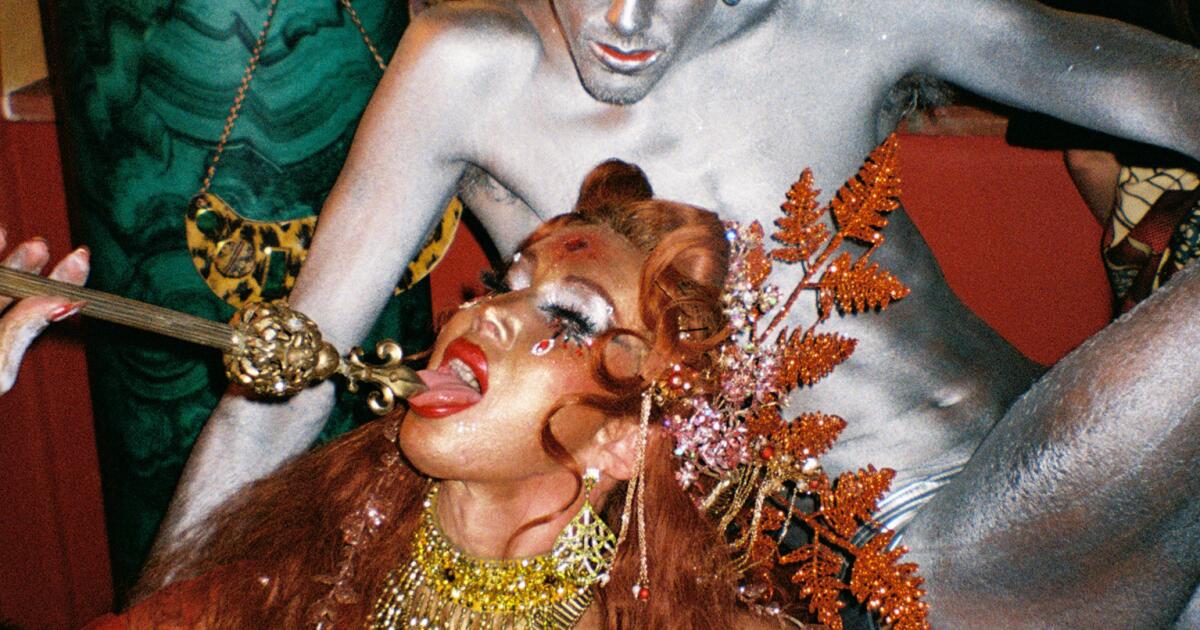
The sun, played by Love Bailey, and the moon, played by Logan Wolfe.

He has been described as a magician and “being of light.” As Salvador Dalí’s kindred spirit and protégé. As the Andy Warhol of the West Coast. The artist Steven Arnold ought to be a household name. The exhibition “Cocktails in Heaven” at Del Vaz Projects in Santa Monica, which opened this week with a party co-hosted by Karen Hillenburg and Christine Messineo of Frieze, is a hopeful step in this direction.
On Monday night, the gallery transformed into a replica of Arnold’s legendary home and studio in Los Angeles, known as Zanzabar, which has been compared to Warhol’s Factory for the luminaries it attracted (Timothy Leary, Debbie Harry, Ellen Burstyn) and the creative synergy it inspired. Throughout the ’80s and into the early ’90s, Zanzabar was host to queer gatherings and parties, as well as surrealist photoshoots with exquisite paper-cut set designs that Arnold entirely made from hand. “My house is a temple for me. It’s a religious space, it’s where the creativity happens,” he says in the 2019 documentary made on him, “Heavenly Bodies.” Arnold died at the age of 51 in 1994, from AIDS-related complications, and left behind a mind-bending body of work that is now housed by ONE Archives at the USC Libraries.


Steven Arnold “Cocktails in Heaven” exhibition at Del Vaz Projects. First row: Jay Ezra Nayssan of Del Vaz Projects, performance director Tyler Matthew Oyer, exhibition design and artistic director Orrin Whalen, Donna Marcus Duke of Del Vaz Projects, Channing Moore of Del Vaz Projects, chef Gerardo Gonzalez; Second row: Bria Purdy, Anna Bane and Sabine Paris of Del Vaz Projects.
At Del Vaz, characters from Arnold’s ethereal photographs and films came to life in performances directed by artist Tyler Matthew Oyer: At the door, two French waiters, dressed in Mozart wigs and original coats hand-painted by Arnold, checked off guest names from an 8-foot scroll. Inside, performers dressed as the sun and moon — their mostly nude bodies spray-painted gold and silver — languorously laid over a banquet table abundant with crudités, conjuring a scene from Arnold’s most famous film, “Luminous Procuress,” which was projected on the wall. In the courtyard, a bodybuilder posed as a live version of Michelangelo’s “David” sculpture. It was an ode to the joyous, maximalist world that Arnold meticulously and affectionately built in both life and art — because for him there was no distinction, art was life.

Steven Arnold, “Angel of Night,” 1982, featuring model Juan Fernandez.
(Courtesy Del Vaz Projects © ONE)

Steven Arnold, “Untitled,” 1974
(Courtesy Del Vaz Projects © ONE)

Steven Arnold, “Intersection of Dreams,” 1985
(Courtesy Del Vaz Projects © ONE)
Every detail of the party came from something found in Arnold’s archive. The artistic director of the exhibition, Orrin Whalen, planted a few of Arnold’s actual belongings in the warm room where his photographs and drawings hung: his ornate metal bracelet rested on a seashell, and replicas of his red leopard print business cards fanned open on the front table. “Cocktails in Heaven” is also the title of Arnold’s unpublished memoir and became the source material for the party’s chef, Gerardo Gonzalez, who scanned for passages where the artist mentioned his favorite foods — mainly hors d’oeuvres and copious glasses of Vermouth.
Guests on Monday included fashion and art world luminaries, including artists Ron Athey and Joey Terrill, designer Zana Bayne, former Hammer Museum director Ann Philbin, and jewelry designer Sophie Buhai, who mingled under the dangling grapevines and in a tent where upside-down paper umbrellas suspended from the ceiling. The dress code was “Complete Fantasy Conglomerata Divina Magnificata,” and the crowd did their part wearing feathered hats, leopard-print tops, golden sequinned dresses and polka-dotted face paint. It was only fitting to pay homage to Arnold this way, a fashion icon in his own right who was once voted the best dressed man of Los Angeles by L.A. Weekly.
The evening signaled that this is not the type of show that will deaden an artist behind glass vitrines. “We can summon artists’ spirits through gatherings,” says Jay Ezra Nayssan, founding director and chief curator of Del Vaz Projects, which is also Nayssan’s home. “This opening is an aspect of a project that should be equally important as the exhibition itself … Queer culture is carried not only through scholarship but through laughter, perfume, embrace and touch, through dinners and concerts — and whatever forms are waiting to be invented.”


Christine Messineo, director of Frieze Americas, and Jay Ezra Nayssan, founding director and chief curator of Del Vaz Projects.


William Escalera and Francisco George


Waseem Salahi, left, and Elisa Wouk Almino, Editor in chief of Image Magazine.

French waiters Stella Felice and Kabo check in the guests, wearing original coats hand-painted by Steve Arnold.


Joey Kuhn, left, and Jessica Simmons.


Miles Greenberg and Vidar Logi.


Actor Charlie Besso, left, and director Luke Gilford.


Roman Smith as the live Michelangelo “David” statue.


Lisa Kudrow as Valerie Cherish in The Comeback.
Erin Simkin/HBO
hide caption
toggle caption
Erin Simkin/HBO
Consider Valerie Cherish, the perennially desperate-to-be-seen, desperate-to-be-loved Hollywood C-lister played by Lisa Kudrow. Valerie, bless her, reenters our collective lives once every decade, like the census.
And like the census, her return always assumes the form of an appraisal, a ruthless and clear-eyed taking of stock. In The Comeback‘s original 2005 season, Valerie donned a cupcake costume and pratfalled her way through the rise of reality television, starring in both a corny sitcom and its making-of documentary. In 2014, a second season found Valerie headlining a prestige HBO series about that sitcom, auguring the fusillade of high-end, self-satisfied streaming dramedies that were about to pummel an unsuspecting populace into submission.
In this third season, she’s still out here hustling. Sure, she’s got an Emmy under her belt, and she’s been booked and busy, but there are signs of trouble — she and her husband (Damian Young) have downsized from their Brentwood mansion to a West Hollywood apartment. Her publicist-turned-manager (Dan Bucatinsky) seems even more checked out than baseline. She’s hired a social media consultant (Ella Stiller) and has even started (ominous chord, shudder) … a podcast.
As we meet her, she’s older, wiser but still essentially Valerie: Blithely optimistic, hungrily opportunistic. She’s still desperate for attention — but the precise nature of the attention she’s craving these days has subtly but significantly shifted. It’s no longer enough for Valerie to be seen; now, she wants — expects, demands, even — to be heard.
She remains ridiculous, thank God. And Kudrow once again imbues her with the physicality that has come to define Valerie’s essential self: She’s still going through life nodding like a bobblehead, still punctuating just about every sentence with a “right?” or a “yeah?” or a “y’know?,” because it’s a learned response. If the world refuses to affirm her in any way — and somehow it continues to find endlessly novel ways to do just that — then she’ll just affirm her own darn self, yeah? Right?
But something happens in the first episode of the new season that efficiently signals how much has changed for Valerie. The setup is classic The Comeback: She’s agreed to star as Roxie in Chicago on Broadway (after receiving assurances that her choreo will be the “dumbed down, Real Housewives version”). Rehearsal isn’t going great — her director and fellow dancers are mean, catty and dismissive (apart from one gay guy, whose words of praise Valerie seeks out like a homing missile — which checks out).
What happens next is quietly remarkable, given the Valerie Cherish we’ve come to love/cringe-in-sympathy-with over The Comeback‘s previous seasons. She doesn’t chirpily ignore their insults and blithely soldier on. She doesn’t try to excuse and minimize their bad behavior so she can take advantage of the opportunity they’re affording her. No, she calls them out, and she quits. (More accurately: She finds a ready, contractually viable excuse to quit — same difference, I’d argue.)
This isn’t the Valerie we used to know. When an opportunity to star in an AI-written sitcom arises, she doesn’t knock over furniture to lunge at the chance, as she would have before. She refuses (at first), she seeks assurances that actual writers will be involved (they will, sort of), and she steps up as the show’s executive producer as soon as it becomes clear she’s the only one involved who cares about the cast, the crew and the quality of the show itself.
There remain plenty of opportunities for Kudrow to make us laugh at Valerie, but as the season progresses, we find ourselves rooting for her more than ever. That’s because Kudrow has altered Valerie’s fuel mixture a bit. She’s always been acutely self-aware, she’s always known when she’s being disrespected, but the Valerie of seasons one and two was perfectly content to swallow other people’s low opinions of her if it meant she got some time in the spotlight.
Now, that self-awareness is matched to something besides her default, pathologically sunny perseverance; it’s married to defiance, and to action.
She stands her ground against a costume designer (Benito Skinner) who sees her as camp and nothing more (yet another of The Comeback‘s knowing digs at its rabid gay fanbase). She agrees to play nice with a network executive (Andrew Scott) until she, very publicly, doesn’t. And when her dour husband starts flailing on his own reality show, Valerie draws on her vast reserves of experience on both sides of the camera to show him how it’s done.
But a self-actualized Valerie affects the show’s comedic chemistry, and there are times when the season can’t quite manage to sustain its satiric bite. On two occasions, the show’s pitched disdain for Hollywood phoniness and hollow ambition falters, and something akin to sincerity peeks out from behind the mask. In one, a beloved real-life Hollywood comedy legend delivers a short monologue to Valerie about why AI can never replace real comedy writers, because comedy needs broken people. In another, a cast member from The Comeback‘s first season returns simply to assure Valerie that she is a good person, a wonderful person, and that she is in no way in the wrong.
On both occasions, seasoned viewers will be patiently but eagerly awaiting the turn, the rug-pull, the reveal that such abject, wet-eyed earnestness will of course get swatted down, because this is The Comeback. But the turn never comes, the rug remains firmly in place and we are left to grapple with the knowledge that we’ve just been exposed to the creators’ true intent, delivered with a gravid plainness, without anything even resembling the gimlet-eyed take we’ve come to, well … cherish.
But you know what? Fine. Who knows if Valerie will return in ten years’ time to once again Cassandra us all about the state of the entertainment industry? Who knows, in point of fact, if there’ll be an entertainment industry for her to return to? I forgave those moments of uncharacteristic ingenuousness because I managed to convince myself they felt valedictory, triumphant — a few discordant bars within Valerie Cherish’s swan song.
Which, as viewers of The Comeback’s definitive, beloved, iconic Season 1 finale will remember, is “I Will Survive.” Because it could never be anything else. Y’know?
This piece also appeared in NPR’s Pop Culture Happy Hour newsletter. Sign up for the newsletter so you don’t miss the next one, plus get weekly recommendations about what’s making us happy.
Listen to Pop Culture Happy Hour on Apple Podcasts and Spotify.

Bay Area residents hold rally in SF as war with Iran enters 2nd month

Dallas Jenkins says he is the ‘evangelical mascot of the LDS church’ and talks Easter celebrations

New video shows aftermath of police shooting in Downtown Miami

Boston Celtics Star Jayson Tatum Made History In Hornets Game

Game Thread: Denver Nuggets vs Golden State Warriors. March 29th, 2026. – Denver Stiffs

Florida High School Football Rankings: Top 25 teams – Oct. 21

How old is Bo Nix? What to know about Oregon quarterback ahead of 2024 NFL Draft

Cleary's 21 help Le Moyne down Central Connecticut State 69-64 in OT

99th annual Pony Swim held in Virginia

Indiana Members Credit Union announced as new anchor tenant at Bottleworks District

Scathing report claims nation’s oldest labor union ‘betrayed’ MAGA members through ‘shocking’ spending

Republican US lawmaker demands Congress vote on any Iran troop deployment

So you went to a No Kings protest. Now what?

JD Vance says he was ‘obsessed’ with UFOs, believes aliens are actually ‘demons’
The EU's recipe for trade deals : easy on beef, tough on wine
-

 Sports1 week ago
IOC addresses execution of 19-year-old Iranian wrestler Saleh Mohammadi
-

 New Mexico1 week ago
Clovis shooting leaves one dead, four injured
-

 Miami, FL4 days ago
Jannik Sinner’s Girlfriend Laila Hasanovic Stuns in Ab-Revealing Post Amid Miami Open
-

 Tennessee6 days ago
Tennessee Police Investigating Alleged Assault Involving ‘Reacher’ Star Alan Ritchson
-

 Minneapolis, MN4 days ago
Boy who shielded classmate during school shooting receives Medal of Honor
-

 Politics1 week ago
Schumer gambit fails as DHS shutdown hits 36 days and airport lines grow
-

 Science1 week ago
Record Heat Meets a Major Snow Drought Across the West
-

 Technology1 week ago
YouTube job scam text: How to spot it fast